Pages

Wednesday, 15 August 2018

Flying Tiger magnetic sheet

As regular blog readers will already know, I'm always on the lookout for things that might be re-purposed for wargaming. On Monday, whilst visiting Maidstone in Kent, I came across something that certainly can be re-purposed ... A4-sized magnetic sheet.

I found this useful stuff in the local branch of 'Tiger'. ('Tiger' is the name used by the Danish 'Flying Tiger Copenhagen' chain of variety store or price point retail shops. They specialise in selling household accessories and toys, and the name 'Tiger' is thought to be derived from the Danish pronunciation of the word tiger, which sounds similar to the Danish word tier, a ten kroner coin. Ten kroner is worth approximately one pound (£1.00) and was the price charged for everything when the chain first started.)

When displayed in the shops, the A4-sized magnetic sheet could easily be mistaken for a very thin pad of pre-punched file paper with a marker pen ...


... but when turned over the magnetic sheet is very obvious.


The magnetic sheet seems to be powerful enough to hold a figure mounted on a steel washer or similar in place, but it is not so powerful as to make removing said figure difficult. At £2.00 per sheet it seemed like a bargain, and I have bought enough to line the bottom of some of my storage boxes.

Tuesday, 14 August 2018

What shtat to use?

The Russian word for staff or establishment when applied to a military organisation (i.e. the Table of Organisation and Equipment or TOE of a military formation) is штат, which when written in English script is shtat.

During the Great Patriotic War the Russian Army went through a number of different штат (or TOEs) for its military formations, with the result that Rifle Divisions could easily vary in size from 14,000 men to 6,000 men depending upon their location, time of formation, and exposure to combat. In some cases the actual (rather than the theoretical) strength of a Rifle Division could be much lower, especially after a period of combat.

So how does this affect my Thistlebarrow concept Rifle Divisions? I gave it some thought, and came up with the following examples:

Full-strength Rifle Division

  • In PORTABLE WARGAME terms, this Rifle Division would have a total of 32 SP
  • In HEXBLITZ terms, this Rifle Division would have a total of 17 SP and a Logistic capacity of 2 LOG
Medium-strength Rifle Division

  • In PORTABLE WARGAME terms, this Rifle Division would have a total of 27 SP
  • In HEXBLITZ terms, this Rifle Division would have a total of 13 SP and a Logistic capacity of 1 LOG
Low-strength Rifle Division

  • In PORTABLE WARGAME terms, this Rifle Division would have a total of 21 SP
  • In HEXBLITZ terms, this Rifle Division would have a total of 9 SP and a Logistic capacity of 1 LOG
These are just examples, but they have given me more options to consider as I develop my own version of the Thistlebarrow concept.

Monday, 13 August 2018

I have been to ... La Valette Underground Military Museum, Guernsey

During our most recent cruise, Sue and I visited La Valette Underground Military Museum on the outskirts of St Peter Port, Guernsey.

The museum is located in what was intended to be an underground fuel storage facility for U-Boats, but although the fuel tanks were installed, the tunnel complex was never completed. The excavation work was carried out by the Organization Todt using slave labour to do the majority of the heavy manual work.

The tunnels and their contents were left untouched for the first couple of years after the end of the Second World War, but in 1947 two of the three fuel storage tanks were removed. The site was then left untouched again until the early 1980s, when it was proposed to convert the tunnels into a museum. Once approval had been given, considerable work had to be done to ensure the tunnels were structurally safe and that the proposed museum met the current health and safety regulations. This work took two years, and the museum finally opened in August 1988.

As the following photographs show, the museum uses all the available space to tell the story of the German occupation of Guernsey as well as the part played by the people of the Island during the First and Second World Wars.


As will be obvious for these photographs, this is a relatively small museum that is crammed full of exhibits. We were only able to spend forty-five minutes there, but could easily have spent three or four time as long.

Sunday, 12 August 2018

Miniature Wargames Issue 425

The latest issue of Miniature Wargames arrived in the post on Friday, and I have spent the time since reading it.


The articles included in this issue are:
  • Welcome (i.e. the editorial) by John Treadaway
  • Forward observer
  • Send three and fourpence: Grappling with computers on the Toy Soldier Frontier: Part 1 of an interview with Arofan Gregory by Conrad Kinch
  • Kadesh 1274 BC: Egyptians vs. Hittites by Jon Sutherland, with photographs by Diane Sutherland
  • What a complete Tanker!: Fighting a historic and a film battle with the Lardy Rulesby Dave Tuck, with photographs by Malc Johnston
  • Siege Train Scenarios by John Treadaway
  • Darker Horizons
    • Fantasy Facts
    • By Crom!: A game for muscular heroes by Chris Swan
  • Getting out alive: A WW2 scenario with options by Jim Webster
  • Recce
  • New Residence: The continuing tales of a wargames widow by Diane Sutherland
  • Show Report: Six Appeal: the Editor attends Joy of Six 2018 by John Treadaway
  • Club Directory
So, what did I particularly enjoy in this issue? Much more than I expected!

Many, many years ago wrote a computer-aided naval wargame, which I demonstrated at Salute. It was written in BASIC using a Sinclair Spectrum 48kb computer, and I actually sold copies of the program to one or two people. Since then the world of computer-aided wargaming has come on leaps and bounds, and it was for this reason that I found the first part of Conrad Kinch's interview with Arofan Gregory interesting.

I also enjoyed reading Dave Tuck's What a complete Tanker! because I have yet to try the latest addition to the Two Fat Lardies stable and it gave me a flavour of how the rules work. John Treadaway's Siege Train Scenarios showed that a good scenario design can be adapted for pretty well any historical period, and Jim Webster's Getting out alive gave a few ideas that I might use in the future.

The biggest surprise was enjoying Chris Swan's By Crom!, which seemed to capture the essence of the Conan stories (of which I am a closet fan!) in a relatively simple game.

As far as I am concerned, this was a good issue ... and not just because Arthur Harman's review of THE MADASAHATTA CAMPAIGN and GRIDDED NAVAL WARGAMES were published in the Recce section!

Saturday, 11 August 2018

An idea that just would not go away

I finally decided to see if I could 'create' a World War II Russian Army along similar lines to Thistlebarrow's Napoleonic armies. The result looked like this:

  • An Army Commander
  • 1st Corps
    • Corps Commander
    • Artillery (one base with a heavy gun plus towing vehicle)
    • Four Rifle Divisions (each of four bases of infantry, some of which might be support weapons)
    • Medium Tank Brigade (one base of tanks)
  • 2nd Corps
    • Corps Commander
    • Artillery (one base with a heavy gun plus towing vehicle)
    • Four Rifle Divisions (each of four bases of infantry, some of which might be support weapons)
    • Medium Tank Brigade (one base of tanks)
  • 3rd Corps
    • Corps Commander
    • Artillery (one base with a heavy gun plus towing vehicle)
    • Two Naval Infantry Brigades (each of four bases of Naval infantry, one of which is a support weapon)
    • Two Rifle Divisions (each of four bases of infantry, some of which might be support weapons)
    • Medium Tank Brigade (one base of tanks)
  • 4th Corps
    • Corps Commander
    • Four Rifle Divisions (each of four bases of infantry, some of which might be support weapons)
    • Light Tank Brigade (one base of light tanks)
  • Cavalry/Mechanised Corps
    • Corps Commander
    • Two Medium Tank Brigades (each of one base of tanks)
    • Two Cavalry Regiments (each of one base of cavalry)
    • Motorised Rifle Division (four bases of infantry with trucks [The latter are not shown in the photograph])
No logistics 'tail' is shown above, but I have plenty of suitable trucks and wagons that I could include.

The above is a rather rough-and-ready attempt to see if the concept works. It will not please everyone, but it works for me although I think that it needs a bit more tinkering before I want to take it fully on board.

Friday, 10 August 2018

It's in The Works

I am an habitue of 'The Works', a chain of discount book, craft, and toy shops, and visit any branch that I come across. Sue and I recently visited the Retail Outlet Centre in the Chatham Maritime area, and as there is a branch of 'The Works' there, I paid it a visit.

Coincidentally I recently had an email from Derek Clark about some model ships he had bought to modify and use with my GRIDDED NAVAL WARGAME rules. Amongst the models he bought was one for a small stern wheel paddle steamer ...


... and during my visit to 'The Works' I found a very similar (if not exactly the same!) model on sale for £1.50 ... and bought two.

The front and back of the box look like this ...


... and the instructions and components look like this:


I probably won't build the models straight from the box but will use the components to build vessels of my own design.

Thursday, 9 August 2018

My latest book sales figures

Just as I finish writing the text of my latest book, my current book sales figures were sent to me by Lulu.com.


There are no major changes since last month, with sales of most of my wargame books continuing to go up slowly but surely. I hope that one or two of my more recent books will be reviewed in a wargame magazine sometime soon, and that this will encourage a few more sales.

Wednesday, 8 August 2018

Addendum to 'A different way of measuring weapon ranges in Gridded Naval Wargames'

As an addition to a comment to a recent blog entry, Philip Dutré sent me the following note and diagram:
Dear Bob,

I've included a quick diagram below, showing a straight line on an offset grid. You can see that the distance between 2 squares is 6, but the straight line passes through 7 squares.

This happens in some particular situations, but I guess that in practice during the game, it doesn't matter.

Phil

I must admit that I had not considered this possibility, but I think that it is worth sharing as it is a very useful addition to the discussion.

An idea that just will not go away

I really like the somewhat abstract way in which my fellow blogger Thistlebarrow has approached organising his Napoleonic armies. Since retiring to Spain he has been using his numerous armies to re-fight whole campaigns, something that I would love to emulate ... but with campaigns set during the Second World War.

He recently used a photograph of his Napoleonic Austrian Army to illustrated his method of organising a tabletop army ...


... and since seeing it I have been thinking (and not for the first time) about whether a similar approach might fit my requirements.

Thistlebarrow's armies are organised as follows:
  • An Army Commander
  • 1st Corps
    • Corps Commander
    • Artillery (one base of artillery)
    • Four Brigades (each of four bases of infantry)
    • Cavalry (two bases of cavalry)
  • 2nd Corps
    • Corps Commander
    • Artillery (one base of artillery)
    • Four Brigades (each of four bases of infantry)
    • Cavalry (two bases of cavalry)
  • 3rd Corps
    • Corps Commander
    • Artillery (one base of artillery)
    • Four Brigades (each of four bases of infantry)
    • Cavalry (two bases of cavalry)
  • 4th Corps
    • Corps Commander
    • Artillery (one base of artillery)
    • Four Brigades (each of four bases of infantry)
    • Cavalry (two bases of cavalry)
Each army therefore contains:
  • Five commanders (and their staff)
  • Four units of artillery
  • Sixteen units of infantry
  • Four units of cavalry
Not counting commanders and their staff, an army therefore has 128 infantry figures, 32 cavalry figures, 16 gunners and 4 guns.

This is something that I want to do some more thinking about ... and this might involve getting some figures out of storage and putting them on the tabletop.

Please note that the photograph featured above is © Thistlebarrow.

Tuesday, 7 August 2018

A different way of measuring weapon ranges in Gridded Naval Wargames

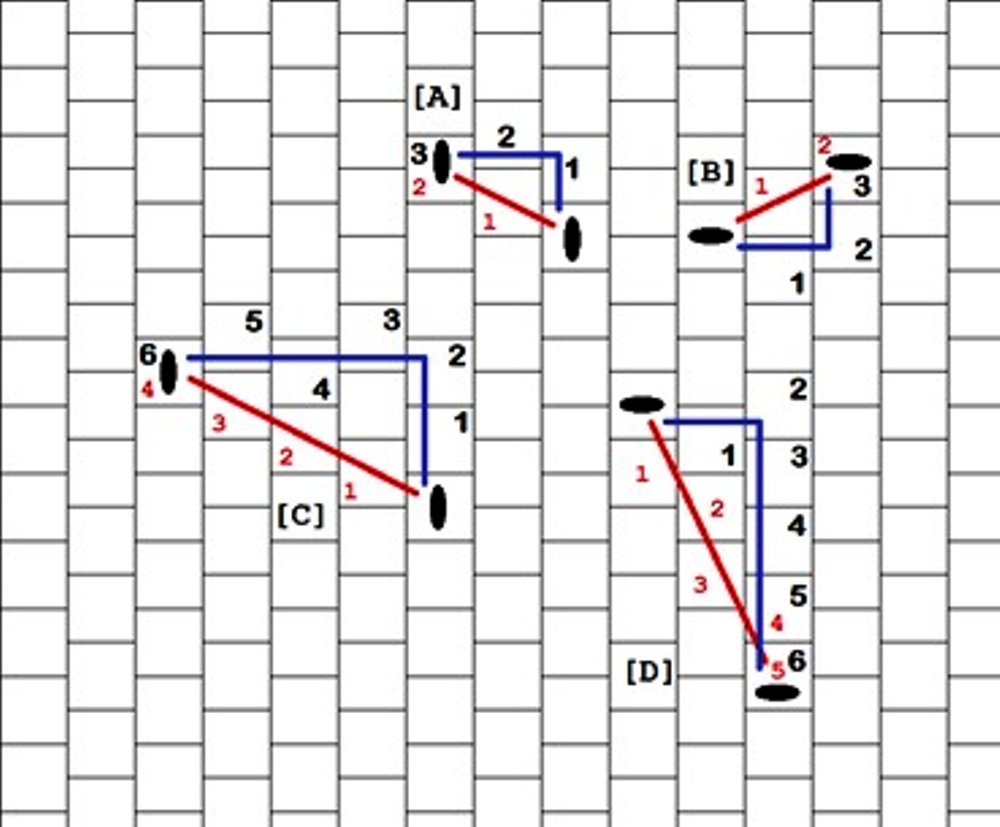
Last Saturday I received a very interesting email from Eric Sprague which was accompanied by an explanation of how he thought that movement and weapon ranges should be measured on a grid of offset squares. I thought that what he proposed was well thought out and with his permission I have reproduced it below.
Movement and Range on an Offset Square Grid

To calculate movement and range on an off-set square grid should be no different than a hex grid. I have recreated the diagrams from your book. (Figures B and D are just rotated 90 degrees.) I have added a blue line to show how you proposed calculating these. The numbers in red are how I would have calculated the same distance.
The same in hexes. These are the same as the off-set squares above to show the similarities.
Notice how I numbered in black exactly as you had above. In Figures A, B and C, in both off-set squares and hexes, the red line follows from one square or hex to the next without going astray. In Figure D the red line does not follow a distinct path but is more closely approximated by the red numbers.
This makes a lot of sense, and I can see why he proposes these changes. In consequence, I thoroughly recommend anyone who wants to to use Eric's method in preference to that laid down in my book. From personal preference I will continue to use hexed and normal squared grids and avoid offset ones whenever I can ... but if I do use them at some time in the future, I will be using Eric's method of measuring weapon ranges.