During the afternoon on our first day in New York I managed to persuade my wife to pay a visit to the Intrepid Sea-Air-Space Museum which was only ten minutes walk from the berth occupied by our ship, MV Aurora.
The Intrepid Sea-Air-Space Museum is based on and around the retired US Navy aircraft carrier USS Intrepid (CV11).
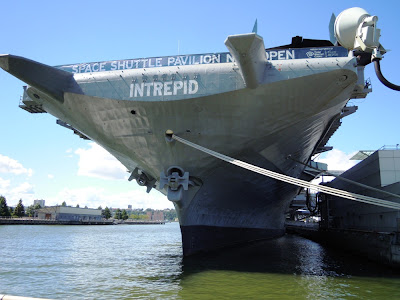
USS Intrepid is one of the twenty four Essex-class aircraft carriers built for the US Navy during the Second World War. She was first commissioned in August 1943 and participated in most of the major naval battles that took place during the last two years of the Pacific campaign, including the Battle of Leyte Gulf.
Like most of the rest of her class USS Intrepid was decommissioned after the war had ended. Because she was relatively new and in good condition she was modernised during the 1950s. From September 1955 until April 1957 USS Intrepid was re-modelled and re-built in the New York Navy Yard to meet the US Navy's SCB-125 specification. She emerged from the modernisation with an enclosed hurricane bow and a steel angled flight deck. The latter modification enable her to handle faster jet aircraft and for a time she operated as an attack carrier (CVA). As the size of aircraft grew the USS Intrepid proved to be too small to handle the newest generation of naval attack aircraft and in 1961 she was re-designated as an anti-submarine carrier (CVS).
USS Intrepid took part in the Vietnam War but she is probably most famous for being the ship that recovered Scott Carpenter's Mercury space capsule Aurora 7 when it splashed down after completing the second NASA manned space flight.
USS Intrepid was finally decommissioned in 1974, and in 1982 – after a campaign led by real estate developer Zachary Fisher – Intrepid became the centrepiece of the Intrepid Sea-Air-Space Museum, New York City.
USS Intrepid's armament
Whilst she was a serving aircraft carrier the USS Intrepid's main armament was her compliment of aircraft, but she also carried guns for self-protection, and some of these are still carried aboard. They include quadruple 40mm Bofors gun mounts, ...

... single 5"/38 dual-purpose guns ...

... which were controlled by radar-equipped fire-control directors, ...

... and single 20mm Oerlikon guns.
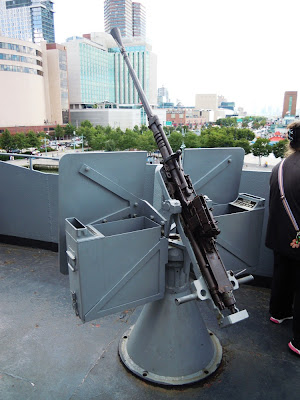
The guns were mounted below the level of the flight deck in gun tubs situated to port and starboard, fore and aft.


USS Intrepid's island
USS Intrepid's island was where the ship's operations were controlled from.

This not only included the Captain's bridge (and Admiral's bridge if one were aboard) but also the control position occupied by the 'CAG' (Commander, Air Group) and his staff.
The Flight Deck
The Intrepid's flight deck is currently the home to a large number of historic aircraft including a Grumman F-9 Cougar, ...

... a Grumman F-11 Tiger, ...

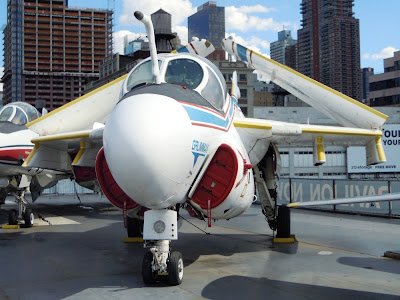
... a Grumman A-6 Intruder, ...
... a Grumman F-14 Tomcat, ...


... a Lockheed A-12, ...

... a Grumman E-1 Tracer, ...


... a General Dynamics F-16 Fighting Falcon, ...

... an IAI Kfir, ...


... a McDonnell Douglas F-4 Phantom II, ...


... a Vought F-8 Crusader, ...

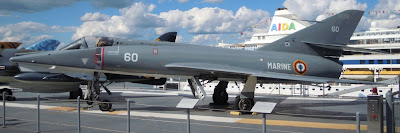
... a Dassault Etendard IV, ...


... a Hawker Siddeley AV-8C Harrier, ...


... a MiG-17, ...


... a MiG-21, ...


... a Sikorsky HH-52A Seaguard, ...


... a Bell UH-1 Iroquois, ...


... a Bell AH-1 Cobra, ...


... a Bell AH-1J Sea Cobra, ...

... and a Sikorsky H-19 Chickasaw.

The Hanger Deck
The Intrepid's hanger deck is currently used to display a large number of different exhibits including a Grumman TBM Avenger, ...


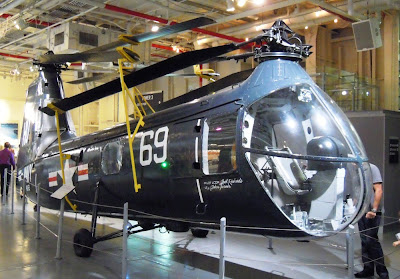
... a Piasecki H-25 Army Mule/HUP Retriever, ...

... a North American FJ-2/3 Fury, ...


... a Douglas A-4 Skyhawk, ...


... a replica of the Mercury Aurora 7 space capsule, ...
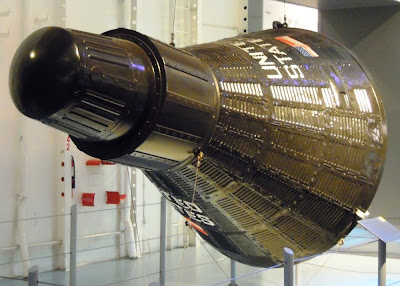

... and a Vostok spacecraft.

The Quayside
The quayside at the Intrepid Sea-Air-Space Museum is home to a former British Airways Concorde (G-BOAD) which set the world's speed record for passenger airliners on 7th February 1996.

This aircraft flew from New York to London in 2 hours, 52 minutes, and 59 seconds!
Moored alongside the quayside was the US Coast Guard 110-foot Island-class Patrol Boat Staten Island (WPB 1345), ...


... and the decommissioned missile submarine USS Growler.


USS Growler (SSG-577) was a early diesel-electric missile-carrying submarine, and was one of the two members of the Grayback-class. She was laid down on 15th February 1955 at the Portsmouth Naval Shipyard, Maine and was launched on 5th April 1958. USS Growler was commissioned on 30th August 1958 and after undergoing launch training with her Regulus nuclear-armed cruise missiles she began active service on 12th March 1960.
USS Growler undertook nine patrols in the Pacific before being decommissioned on 25th May 1964 when the Regulus missiles were withdrawn from service. Unlike her sister ship USS Grayback, USS Growler was not converted into an amphibious transport submarine. USS Grayback was lengthened by 12 feet to accommodate two auxiliary tanks at the forward end of the engine room, the conning tower (or sail) was increased by in height by an additional ten feet, and the former missile storage hangers on the submarine's forecastle were converted to hold sixty seven embarked troops and several SEAL Swimmer Delivery Vehicles (SDVs), including a decompression chamber in the starboard hangar.
USS Growler was given to the Museum by Congress on 8th August 1988 and then became a permanent exhibit alongside USS Intrepid.
The Intrepid Sea-Air-Space Museum is based on and around the retired US Navy aircraft carrier USS Intrepid (CV11).

USS Intrepid is one of the twenty four Essex-class aircraft carriers built for the US Navy during the Second World War. She was first commissioned in August 1943 and participated in most of the major naval battles that took place during the last two years of the Pacific campaign, including the Battle of Leyte Gulf.
Like most of the rest of her class USS Intrepid was decommissioned after the war had ended. Because she was relatively new and in good condition she was modernised during the 1950s. From September 1955 until April 1957 USS Intrepid was re-modelled and re-built in the New York Navy Yard to meet the US Navy's SCB-125 specification. She emerged from the modernisation with an enclosed hurricane bow and a steel angled flight deck. The latter modification enable her to handle faster jet aircraft and for a time she operated as an attack carrier (CVA). As the size of aircraft grew the USS Intrepid proved to be too small to handle the newest generation of naval attack aircraft and in 1961 she was re-designated as an anti-submarine carrier (CVS).
USS Intrepid took part in the Vietnam War but she is probably most famous for being the ship that recovered Scott Carpenter's Mercury space capsule Aurora 7 when it splashed down after completing the second NASA manned space flight.
USS Intrepid was finally decommissioned in 1974, and in 1982 – after a campaign led by real estate developer Zachary Fisher – Intrepid became the centrepiece of the Intrepid Sea-Air-Space Museum, New York City.
USS Intrepid's armament
Whilst she was a serving aircraft carrier the USS Intrepid's main armament was her compliment of aircraft, but she also carried guns for self-protection, and some of these are still carried aboard. They include quadruple 40mm Bofors gun mounts, ...

... single 5"/38 dual-purpose guns ...

... which were controlled by radar-equipped fire-control directors, ...

... and single 20mm Oerlikon guns.
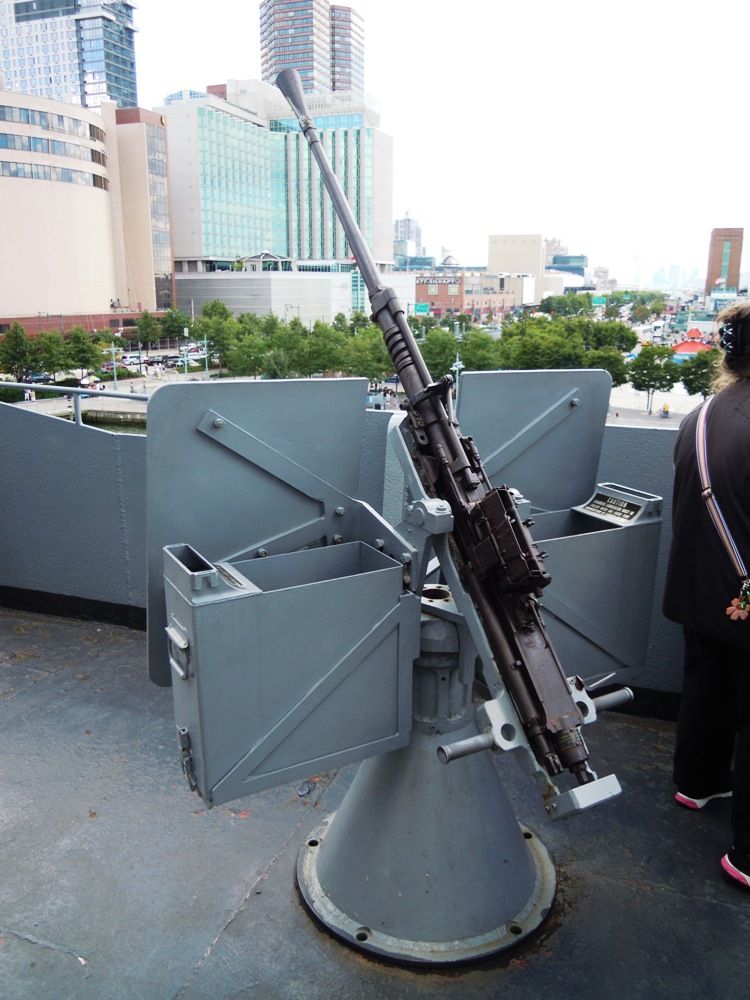
The guns were mounted below the level of the flight deck in gun tubs situated to port and starboard, fore and aft.


USS Intrepid's island
USS Intrepid's island was where the ship's operations were controlled from.

This not only included the Captain's bridge (and Admiral's bridge if one were aboard) but also the control position occupied by the 'CAG' (Commander, Air Group) and his staff.
The Flight Deck
The Intrepid's flight deck is currently the home to a large number of historic aircraft including a Grumman F-9 Cougar, ...

... a Grumman F-11 Tiger, ...

... a Grumman A-6 Intruder, ...

... a Grumman F-14 Tomcat, ...


... a Lockheed A-12, ...

... a Grumman E-1 Tracer, ...


... a General Dynamics F-16 Fighting Falcon, ...

... an IAI Kfir, ...


... a McDonnell Douglas F-4 Phantom II, ...


... a Vought F-8 Crusader, ...

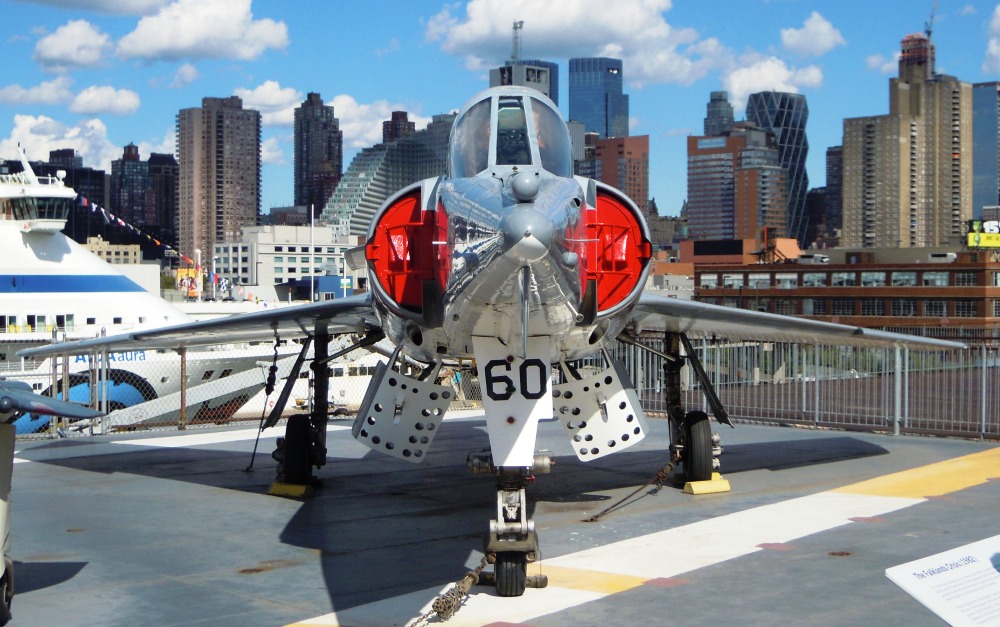
... a Dassault Etendard IV, ...



... a Hawker Siddeley AV-8C Harrier, ...


... a MiG-17, ...


... a MiG-21, ...


... a Sikorsky HH-52A Seaguard, ...


... a Bell UH-1 Iroquois, ...


... a Bell AH-1 Cobra, ...


... a Bell AH-1J Sea Cobra, ...
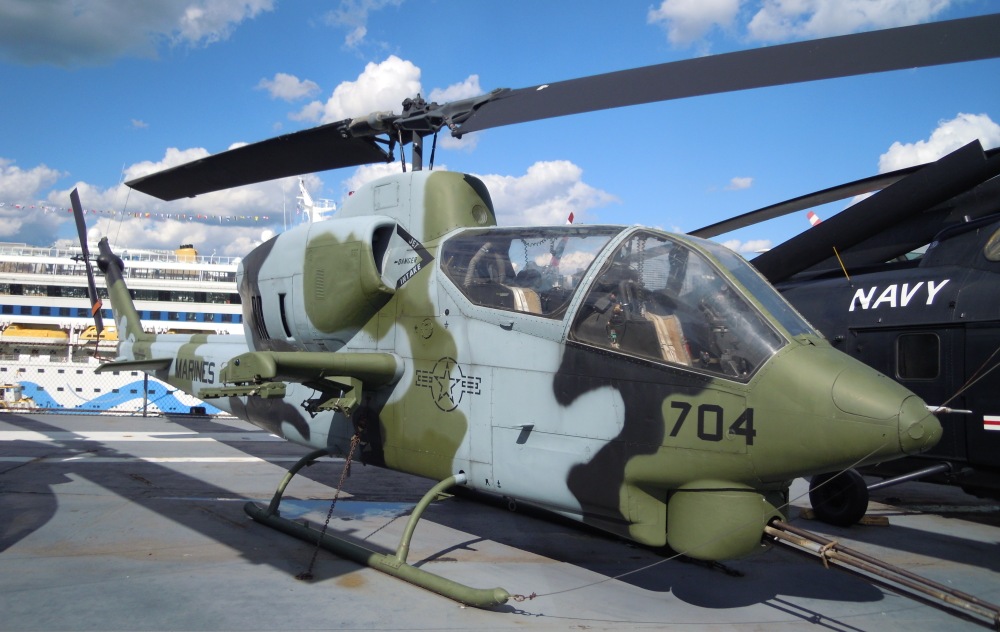
... and a Sikorsky H-19 Chickasaw.

The Hanger Deck
The Intrepid's hanger deck is currently used to display a large number of different exhibits including a Grumman TBM Avenger, ...


... a Piasecki H-25 Army Mule/HUP Retriever, ...
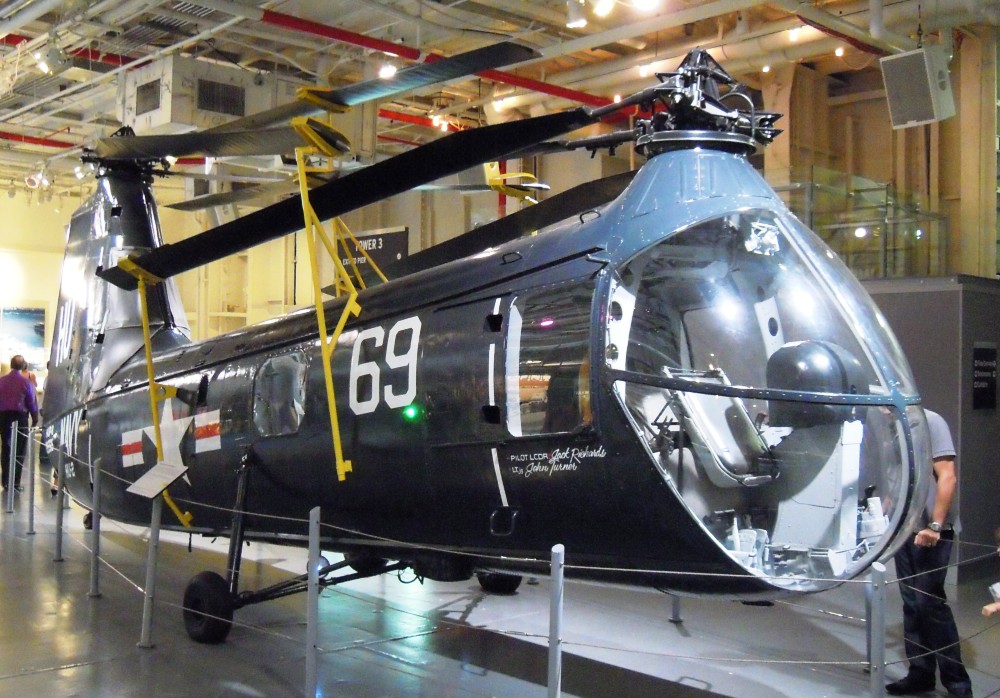

... a North American FJ-2/3 Fury, ...


... a Douglas A-4 Skyhawk, ...


... a replica of the Mercury Aurora 7 space capsule, ...
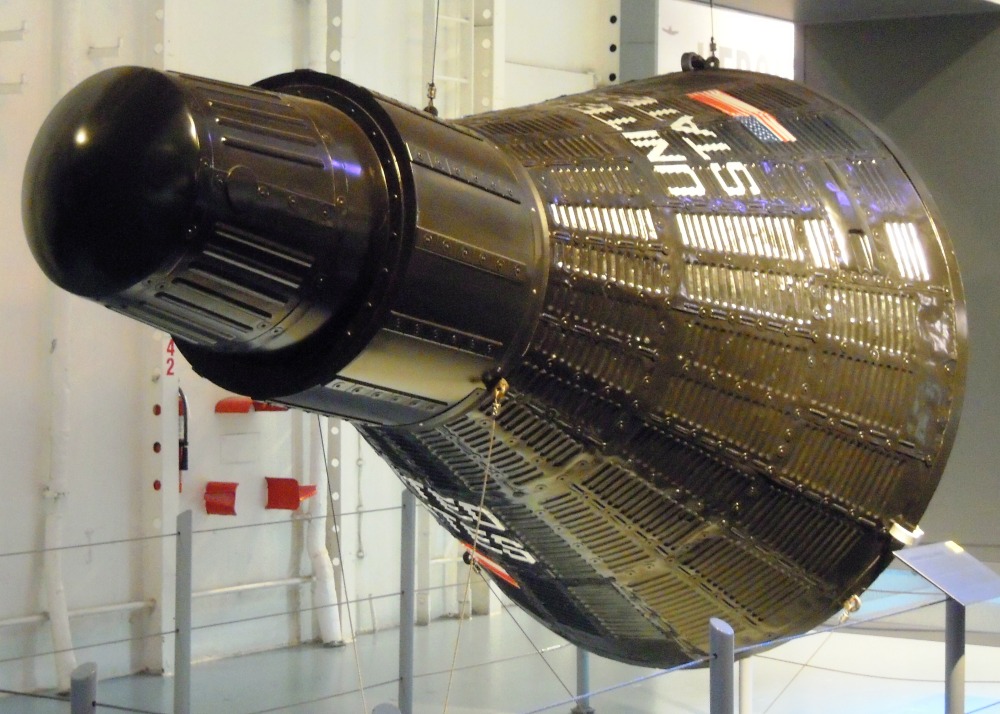

... and a Vostok spacecraft.

The Quayside
The quayside at the Intrepid Sea-Air-Space Museum is home to a former British Airways Concorde (G-BOAD) which set the world's speed record for passenger airliners on 7th February 1996.

This aircraft flew from New York to London in 2 hours, 52 minutes, and 59 seconds!
Moored alongside the quayside was the US Coast Guard 110-foot Island-class Patrol Boat Staten Island (WPB 1345), ...


... and the decommissioned missile submarine USS Growler.


USS Growler (SSG-577) was a early diesel-electric missile-carrying submarine, and was one of the two members of the Grayback-class. She was laid down on 15th February 1955 at the Portsmouth Naval Shipyard, Maine and was launched on 5th April 1958. USS Growler was commissioned on 30th August 1958 and after undergoing launch training with her Regulus nuclear-armed cruise missiles she began active service on 12th March 1960.
USS Growler undertook nine patrols in the Pacific before being decommissioned on 25th May 1964 when the Regulus missiles were withdrawn from service. Unlike her sister ship USS Grayback, USS Growler was not converted into an amphibious transport submarine. USS Grayback was lengthened by 12 feet to accommodate two auxiliary tanks at the forward end of the engine room, the conning tower (or sail) was increased by in height by an additional ten feet, and the former missile storage hangers on the submarine's forecastle were converted to hold sixty seven embarked troops and several SEAL Swimmer Delivery Vehicles (SDVs), including a decompression chamber in the starboard hangar.
USS Growler was given to the Museum by Congress on 8th August 1988 and then became a permanent exhibit alongside USS Intrepid.


