Pages

Showing posts with label Napoleonic Wars. Show all posts

Friday, 18 July 2025

Dominion of Napoleon Bonaparte has been published

The latest in the 'Dominion of ...' series of rules has been published ... the much-awaited DOMINION OF NAPOLEON BONAPARTE.

The rules have the same structure and game mechanisms as the previous ones in the series, but includes certain period-specific rules to make them suitable for solo wargamers who want to refight Napoleonic period battles.

Armies 'cost' 12 points and most units 'cost' 2 points each.

Units fall into one of the following categories:

  • Line Infantry: These are infantry that fight in line and rely on firepower. Typically, these are British, Austrian, later Prussian, later Portuguese and some Spanish infantry units. Frequently used in a defensive role.
  • Column Infantry: These are infantry that fight in columns and rely on overwhelming numbers. Typically, these are French, Russian, early Prussian, early Portuguese and Spanish infantry units. Frequently used in an attacking role.
  • Light Infantry: These are infantry that are used for skirmishing. Examples include British Riflemen, Austrian Grenzers, and French Voltigeurs.
  • Heavy Cavalry: These are heavy and medium cavalry that rely of shock to defeat their opponents. Typically, these include Horse Grenadiers, Cuirassiers, Carabineers, and Dragoons.
  • Light Cavalry: Typically, these include Hussars, Uhlans, Chasseurs, Light Dragoons, and Cossacks.
  • Artillery: These include field and siege artillery.

Units can be given attributes that reflect particular tactical advantages and/or unit quality. These are:

  • Defence advantage (D): Troops in fortifications, behind a river, or uphill of their opponents have a defensive advantage. Likewise, certain disciplined units (e.g. Elite or veteran Column Infantry) may also have a defensive advantage. This advantage adds 1 point to the 'cost' of a unit.
  • Attack advantage (E): Elite or veteran units may have an attack advantage (e.g. Elite Line Infantry and Elite Heavy Cavalry). This advantage adds 1 point to the 'cost' of a unit.
  • Unreliable disadvantage (UR): Troops who are poorly trained, inexperienced, or understrength, may be regarded as unreliable. This disadvantage reduces the 'cost' of a unit by 1 point.

Examples of typical units include:

  • British Hussars: Light Cavalry (cost 2 points)
  • French Imperial Guard Infantry: Disciplined Column Infantry (cost 3 points)
  • British infantry in a village: Elite Line Infantry in fortifications (cost 4 points)

A typical pair of armies (in this case for the Battle of Salamanca, which is the battle used in the rules as an exemplar) are:

  • British:
    • 1 Unit of Dragoons (2 points)
    • 1 Unit of Hussars (in surprise flank attack) (2 points)
    • 1 Unit of elite Line Infantry (3 points)_
    • 2 Units of Line Infantry (2 points each = 4 points)
    • 1 Unit of unreliable Artillery (1 point)
    • Total = 12 points
  • French:
    • 1 Unit of Dragoons (2 points)
    • 2 Units of disciplined Column Infantry (3 points each = 6 points)
    • 1 Unit of unreliable Column Infantry (surprised) (1 point)
    • 1 Unit of unreliable Column Infantry (Sarrut with reinforcements) (1 point)
    • 1 Unit of Artillery (2 points)
    • Total = 12 points

The combat rules include specific sections that cover pre-battle artillery fire, unreliable units, infantry vs. infantry, cavalry vs. cavalry, cavalry vs. infantry, fighting artillery, and rallying.

The rules also include army lists and dispositions for twenty-five battles:

  • Montenotte (11th to 12th April 1796)
  • Lodi (10th May 1796)
  • Rivoli (14th to 15th January 1797)
  • Pyramids (Embabeh) (21st July 1798)
  • Marengo (14th June 1800)
  • Austerlitz (Battle of the Three Emperors) (2nd December 1805)
  • Jena (14th October1806)
  • Auerstedt (14th October 1806)
  • Eylau (7th to 8th February1807)
  • Friedland (14th June 1807)
  • Bailén (16th to 19th July 1808)
  • Roliça (17th August 1808)
  • Vimeiro (21st August 1808)
  • Corunna (16th January 1809)
  • Wagram (5th to 6th July 1809)
  • Talavera (27th to 28th July 1809)
  • Salamanca (22nd July 1812)
  • Borodino 1812 (7th September)
  • Berezina (26th to 29th November 1812)
  • Vitoria (21st June 1813)
  • Leipzig (Battle of the Nations) (16th to 19th October 1813)
  • Hanau (30th to 31st October) 1813
  • Quatre Bras (16th June 1815)
  • Ligny (16th June 1815)
  • Waterloo (18th June 1815)

My collection of Napoleonic figures is currently in storage, but as soon as I can gain access to them, I hope to refight some of the battles featured on this list.


The DOMINION OF NAPOLEON BONAPARTE rules were written by Steve Parker and published in 2025 by Orc Publishing. They can be bought in PDF format from Wargame Vault for $5.90/£4.40.


Whilst researching her genealogy, my wife came across an interesting story that was originally published in The Advertiser (South Australia) on Tuesday, February 23, 1999. It tells of research carried out by Robert Torrens (who is described as a local historian) into a story that Bonaparte's grandfather was actually William Bayne, who fled abroad from Balloch (a village near Crieff in Perthshire, Scotland) in the aftermath of the failed Jacobite Rebellion of 1745. The ship the family were sailing in was wrecked off Corsica, and they were treated so well by the local population that they settled on the island, where they were known as Bayne (or Buon) and his party. Subsequently, his sons were called the Buon-de-party or Bonapartes.

This is a wonderful piece of genealogical whimsy, as it is generally accepted that Napoleon's paternal ancestors were minor nobility (the Cadolingi di Borgonuovo) from Tuscany, who had emigrated to Corsica at some point during the late 15th century. His maternal ancestors (the Ramolinos) were also a minor noble family, but that they originally came from Lombardy. Napoleon's grandfather was Sebastiano Nicola Buonaparte (not William Bayne!) and his parents were Carlo Maria Buonaparte and Maria Letizia Ramolino. They were living in Maison Bonaparte in Ajaccio, Corsica, when Napoleon (whose baptismal name was Napoleone di Buonaparte) was born there on 15th August 1769.

Friday, 21 March 2025

Ancients at Shrewsbury House

On Wednesday I carefully rested for most of the day in order to conserve my energy so that I could set up and take part in a battle using the Portable Ancient Wargame rules from DEVELOPING THE PORTABLE WARGAME. My strategy worked, and I had a very enjoyable evening introducing my opponent (Richard) and an interested bystander (Ian) to the joys of THE PORTABLE WARGAME system.

I provided the terrain and Richard provided the figures ... and it turned out that although he had been assembling his collection for some years, he had not had the opportunity to fight a wargame with them. The terrain looked like this:

I chose to field a Spartan army ...

The right of the Spartan army. It comprised a unit of slingers and two units of Helot spearmen.
The center of the Spartan army. It comprised eight units of Hoplites.
The left of the Spartan army. It comprised a unit of slingers and two units of Helot spearmen.

... and my opponent chose the Athenians. (He even provided a suitably ruined temple for Athena to occupy and oversee her city-state's army.)

The Athenian army.
Two units of Athenian Hoplites.
Two more units of Athenian Hoplites.

The Athenians took the offensive ...

... and after both sides used their light troops to try to disrupt their opponent's Hoplites ...

... the battle soon became a trial of strength between the rival bodies of Hoplites.

It was a hard fought battle ... but the Athenians eventually prevailed and the Spartans withdrew after losing their slingers and Helot spearmen in order to preserve their elite Hoplites.

The battle took just under an hour to fight, and once it was over we reset the forces and re-fought the battle twice more, firstly using the 'two hits = unit destroyed' rule and 'two hits plus hit effect' rule. The Athenians won both battles, and they even managed to kill the Spartan commander during the last battle.

By the end of the evening Richard and Ian were both enthusiastic converts to the whole PORTABLE WARGAME concept ... and I hope to be able to give them a chance to try the PORTABLE NAPOLEONIC WARGAME rules soon.

Saturday, 11 January 2025

Broadside and Boarding: Small scale action in the Age of Fighting Sail 1740 - 1815

I have been a fan of Antoine Vanner's writings since his first book about the fictional British naval officer Nicholas Dawlish was published. Recently he has published his first non-fiction book entitled BROADSIDE AND BOARDING: SMALL SCALE ACTION IN THE AGE OF FIGHTING SALE 1740-1815, and I reaad it whilst I was on our recent cruise.

The book is a collection of short articles that take five to fifteen minutes to read, some of which originally appeared on Antoine's blog. Most of the actions feature frigates and small vessels acting alone or in the company of other small ships. A number of cutting out operations are included as are a few attacks on coastal fortifications.

I would highly recommend this book to anyone with an interest in naval warfare during the latter part of the eighteenth and the early years of the nineteenth centuries. It describes the different tactics used by the participants and also covers the sort of technical details that will appeal to those who want to understand how small warships fought each other. For example, the French tended to fire at masts and sails to reduce their opponent's ability to manoeuver whilst the British tended to fire at the hull to punch holes in the side of their opponent's ship and disable their armament. For the naval wargamer, this book contains a wealth of potential scenarios that they could easily reproduce on a tabletop.


BROADSIDE AND BOARDING: SMALL SCALE ACTION IN THE AGE OF FIGHTING SALE 1740-1815 was written by Antoine Vanner and published in Kindle and paperback formats in 2024 by Old Salt Press (ASIN B0DNBDFZDR/ISBN 978 1 9434 0455 1)

Friday, 25 October 2024

Other people’s wargames: Gary Sheffield’s refight of the Battle of Wavre

Recently, my old friend Professor Gary Sheffield refought the Battle of Wavre using Martin Rapier’s hex version of Neil Thomas’s ONE HOUR WARGAMES.

The following is based on Gary’s description of the battle:

The French started aggressively by attacking at all the crossing points, Limale in the west, Bierges in centre right, and Wavre in the east. The French got into action quite quickly and made good use of light infantry at Bierges and Wavre to attrit the defenders. The Prussians defended well and held off the French at all three crossing points while relieving battered units from the front line and sending off units to Waterloo.

Wavre became a meat grinder, with both sides taking heavy losses and having to rally off them off. But on turn 8 the Prussian garrison at Limale routed, and since the other infantry unit had departed for Waterloo, it was down to a heavy cavalry division to guard the crossing.

It got worse for the Prussians on turn 9, as the division defending Bierges was routed and the French finally crossed the River Dyle and threatened to outflank Wavre.

Turn 10 threatened to be a complete disaster for the Prussians. The Landwehr unit holding the Bridge of Christ at Wavre was attacked, failed a morale test and bolted, and so French infantry at last forced their way into Wavre. Then General Thielmann was killed while rallying a Prussian Regular unit. The only bright spot for the Prussians was that the Swiss unit finally routed because of the pummelling it had received.

On turn 11 French light cavalry crossed the Dyle at Bierges, and threatened to cut the Wavre-Brussels road, while the French heavy cavalry fought an inconclusive melee with Prussian heavies on the north bank of the River Dyle. At that point darkness came and the fighting ended.

The result was an honourable draw. The French had captured Wavre but failed to exit two units along the Brussels road (they had no chance of doing this by end of turn 12) while the Prussians had sent off 5 units to Waterloo at the appropriate times as per their victory conditions, but had lost Wavre. Had the French managed to force the crossing of the Dyle at Bierges only one or two turns earlier, things might have been very different.


Please note that the photographs featured above are © Gary Sheffield.

Thursday, 12 September 2024

Thinking about maps

The recent problems that I have had creating the maps for my Belle Époque project have encouraged me to look at alternative methods that I might use.

I have looked at several drawing programs including Paint 3D and Affinity Designer 2, but none of them seemed to be suitable. I also looked at Hex Kit (a desktop application for building hex maps for use with table top role playing games), Hexographer 2 (which comes in a free basic and paid for expanded versions), and Hexfriend. All of them are very suitable for drawing D&D and RPG maps, but none of them quite met my requirements.

On the advice of two regular blog readers (Mike Lewis and Mike Hall) I then looked at two drawing programs, Inkscape and Paint.net.

I then looked at the one blog where I know the creator has spent a lot of time designing maps for his ongoing Napoleonic campaigns ... Thistlebarrow's Napoleonic Wargaming blog. He recently revised his maps and explained the process on his blog. His finished maps looked like this:

Map of Europe.
Map of Germany.
Map of the Brunswick area.
Campaign map

These stylised maps are closer to the sort of end result that I am looking for, and having read his explanation of the way in which he created his maps, I am seriously thinking about following Thistlebarrow's methodology.

I also looked for inspiration on YouTube ... and discovered that just two weeks ago Henry Hyde had produced a video about the way in which he creates his maps.

It was very interesting to see Henry's methodology in operation, and it certainly gave me lots of ideas ... and reminded me that I really ought to re-read the relevant section in his book WARGAMING CAMPAIGNS.

This research has left me with plenty to think about. It has also left me feeling far more positive and my enthusiasm to re-start my map drawing project has been reinvigorated.


Please note that photographs featured above are © Napoleonic Wargaming blog.

Saturday, 6 July 2024

The Third Portable Wargame Compendium: An update

Work has been continuing on the next Portable Wargame Compendium. I am awaiting two more articles (another about the Napoleonic Wars and one about re-fighting the Battle of Gettysburg), and once those have arrived, been added to the existing draft, and proofread, I will be beginning the publication process.

The Third Compendium currently includes the following articles:

  • Modifications to the Ancients rules in Developing the Portable Wargame for fighting medieval battles
  • Constantinople Beleaguered ... a PW3x3RW campaign idea
  • A simple English Civil War campaign system for Portable Pike and Shot
  • Simple English Civil War 8 x 8 Campaign Rules
  • Some suggested improvements to the Brigade-level Portable Napoleonic Wargame Rules
  • Ideas for developing the Portable Napoleonic Big Battle or FP3x3PW Rules
  • Wargaming the Flagstaff War – New Zealand 1845 – 1846
  • Sham-Battle and the Portable Wargame: Melding two concepts to produce a set of mini-campaign rules
  • Some well-known scenarios revisited
  • Big Battles, Small Armies
  • A simple framework for narrative campaigns
  • 6 x 6 Portable Wargames

This looks as if it is going to be the biggest compendium to date ... and I hope to publish it by the end of August.

Thursday, 20 June 2024

The Third Portable Wargame Compendium: Another progress report

The current draft has been proofread by the incomparable Arthur Harman, and it is already ninety-three pages long. It is worth noting that the First Compendium had 108 pages and the Second Compendium had 132 pages.

At present, the Contents looks like this:

I know that there are at least two more contributions in the pipeline, and I hope that the Compendium will be ready for publication somewhat earlier than I expected.

Sunday, 16 June 2024

Another video has been uploaded to the YouTube channel

I have just uploaded the final video about the Franco-Prussian War of 1810 to the Wargaming Miscellany channel. It tells the story of the pursuit and destruction of the 3rd Prussian Infantry Division Gap, which is the fifth and final battle of the war.


The video can be seen using this link.

Sunday, 9 June 2024

The latest YouTube video has been uploaded

I have just uploaded the latest video about the Franco-Prussian War of 1810 to the Wargaming Miscellany channel. It tells the story of the Battle of the Leipzig Gap, which is the fourth battle of the war.


The video can be seen using this link.

Thursday, 30 May 2024

My third YouTube video has been uploaded

I must admit that I've rather caught the YouTube 'bug', and I am really enjoying putting together videos to upload to the Wargaming Miscellany channel!

The latest is the next instalment in the story of the Franco-Prussian War of 1810, and covers the twin Battles of the Northern Frontier. Because it covers two battles, it lasts just over twelve minutes, but I hope that it isn't too long. (I have been told that five minutes is the average time viewers will spend watching a YouTube video.)

I have scheduled the latest video to upload at 10.00am this morning ... and it should be available to watch by the time you read this blog post.


The video can be seen using this link.

Saturday, 25 May 2024

My second YouTube video has been uploaded

I found myself with a couple of hours on my hands this afternoon, so I decide to see if I could create a video of a 3 x 3 Portable Wargame battle report.

I chose the first battle of the Franco-Prussian War of 1810, and despite a few mistakes that I made along the way, I learned a lot and this will hopefully help me to make more and better videos in the future.


The video can be seen using this link.

Thursday, 23 May 2024

Charles Esdaile’s Wargaming Waterloo

I suspect that amongst most wargamers in the United Kingdom – and possibly beyond its shores – the Battle of Waterloo is a battle that they may have hankered to refight at some time. Like Hastings, Agincourt, and Trafalgar, the battle marks one of those points in our country’s history which somehow seem to define us as a nation. (There are other more recent ones that I could have added but I did not want this to be a list of battles lost and won.)

There are so many different wargames out there that seek to recreate the Waterloo campaign or the final climatic battle that by studying them, one is inevitably going to examine the almost endless variety of methods and mechanisms that wargame designers have used to create their wargames of the battle. Professor Charles Esdaile has done this in his recent book WARGAMING WATERLOO … and it is – in my humble opinion – a tour de force that should be essential reading for anyone who likes to think of themselves as a wargame designer. Its analysis may be based on the way wargame designers have designed their wargames about this one specific battle but it applies an analytical approach that could – and possible should – be applied to other wargame designs.

If wargaming wants to be treated as a serious academic pursuit, this book points the way in which this can be achieved. It is therefore of no great surprise that Professor Esdaile’s book has been published by the US Marine Corps, an organisation that takes its wargaming very seriously. (The publisher is actually the Marine Corps University Press.)

The book is divided into the following parts:

  • Foreword (by Tony Pollard, Professor of Conflict History and Archaeology, University of Glasgow, field director of Waterloo Uncovered, and prime organiser of the huge refight of the battle in Glasgow in June 2019.)
  • Preface
  • Chronology of Events, February – July 1815
  • Chapter 1: The History and Development of Wargames
  • Chapter 2: The Waterloo Campaign and the Battle
  • Chapter 3: The March of the Miniatures: Fighting Waterloo with Model Soldiers
  • Chapter 4: How Many Hexes to Hougoumont? Waterloo by Board Game
  • Chapter 5: Historical Hexagons (1): Grand Tactics
  • Chapter 6: Historical Hexagons (2): Operations
  • Chapter 7: Historical Hexagons (3): Strategy
  • Chapter 8: Historical Hexagons:(4): Fantasy
  • Conclusion: Some Thoughts on the Wargame as a Research Tool
  • Appendix A: Suggested Amendments for Napoleon at Waterloo
  • Appendix B: A Ludography of Waterloo
  • Bibliography
  • Index
  • About the Author

The first chapter contains an excellent summary and is – in my humble opinion – in itself worth the cost of the book. It does have a bias towards the ways in which this particular battle has been wargamed over the years, but this in no way detracts from its excellent examination of the history of wargaming.

The following chapter gives a first-rate description of the battlefield and includes short history of the events leading up to the battle as well as a blow-by-blow account of the fighting, and the third chapter examines the pitfalls inherent in the use of miniatures for such a refight and is reminiscent in places of the case against toy soldiers propounded by the late, great Dr Paddy Griffith.

The remaining five chapters look at the ways in which the battle – and the campaign leading up to it – have been modelled using gridded board wargames.

The concluding chapter puts forward a very convincing argument as to why properly designed wargames can be a valuable research tool. Towards the end of the chapter Professor Esdaile quotes from Robert M Citino's contribution to ZONES OF CONTROL: PERSPECTIVES ON WARGAMING, which was published in 2016 by MIT Press. In it, Citino suggests that a military historian who seeks to better understand a war, a campaign, or a battle should fight a wargame about it. To this I would add that getting them to design the wargame would be an even better route to achieving that understanding!

As I stated above, in my opinion this book is a tour de force and I thoroughly recommend it to anyone who considers themselves to be a wargame designer.


WARGAMING WATERLOO was written by Professor Charles J Esdaile and published by the Marine Corps University Press (ISBN 979 8 9865 2944 4). It is available as a free download via www.usmcu.edu/mcupress.

Tuesday, 26 March 2024

Gary Sheffield's suggested changes to the musketry rules in the Portable Napoleonic Wargame

Further to the recent blog post about his suggested changes to the PORTABLE NAPOLEONIC WARGAME rules, Professor Gary Sheffield sent me the following suggested change to the musketry rules:

  • Musket-armed units can only fire into an adjacent grid area to better reflect actual effect range of Napoleonic muskets.
  • When a unit enters a grid area that is adjacent to a grid area that is already occupied by an enemy unit, it has the option either to fire at the enemy unit or to engage it in Close Combat.
  • Rifle-armed troops can fire 3 grid areas, but they suffer a penalty to reflect the fact that rifles were slower to reload than smoothbore muskets.

He also wrote the following about his home-made grid squares:

'The terrain squares are homemade. I bought a job lot of wooden squares off the internet, painted them green using cheap acrylic paint, then sprinkled flock onto them. If the paint had dried, I used a coat of PVA glue before using the flock. I then varnished the flocked squares. I used different shades of green flock to get some variation, and sometimes splashed various colours of brown on the flock. I used green felts of various types on a few squares, again with brown splodges. I have some largish green felt squares (from sets of children's roulette that I bought from a department store in the Canaries!), and I put them plain side up under the terrain squares, so no white bits show through from my wargames table.'

Here are some examples of Gary's home-made grid squares:


Please note that the photographs featured above are © Professor Gary Sheffield.

Sunday, 24 March 2024

Other people's Portable Wargames: Proposed Napoleonic rules changes

My old friend and occasional online wargame opponent Professor Gary Sheffield has been playing around with the rules in THE PORTABLE NAPOLEONIC WARGAME and come up with some very interesting rule modifications.

The battle was set in 1806 and saw the French fighting the Prussians. According to Gary, it was a very tough fight, with the French advantage in manoeuvrability being effectively cancelled out by superior Prussian musketry. In fact, both sides reached their respective Exhaustion Points during the same turn!

The French attacked the Prussians and captured some of the high ground being defended by the Prussians, but having done so, they were unable to exploit their advantage as they were exhausted. At this point Gary diced to determine what would happen next and adjudicated that the Prussian commander would withdraw his forces in good order, leaving the battlefield in French hands.

The amendments that Gary made to the basic rules included units becoming Disordered after Close Combat, and having to fight at a disadvantage until they were able to reform … which costs them one activation points. He also added some specific pluses and minuses for the French and Prussians to reflect their differences. Gary also shortened the range of musketry to better reflect actual effect range of Napoleonic muskets.


Please note that the photographs featured above are © Professor Gary Sheffield.

Friday, 15 December 2023

Phil Sabin’s version of Napoleon at Waterloo

I have known Professor Phil Sabin for many years, and even though he is now living in South America, we still keep in touch.

Our most recent contact came as I was coming down with COVID and it was over a week before I was able to watch his most recent YouTube video. This outlines the interesting changes that he has made to James Dunnigan's classic NAPOLEON AT WATERLOO game. His modifications are outlined in some detail, and coming at a time when Ridley Scott’s film about Napoleon has been released and Professor Charles Esdaile has published his excellent book about wargaming Waterloo, I can foresee them being used by a large number of wargamers.

Phil’s video includes a complete visual record of a recreation of the Battle of Waterloo he fought using his tweaked version of the rules and collection of painted Airfix 20mm Napoleonic figures. The latter are mounted on hexagonal bases that fit very nicely onto Phil’s hexed 2m x 2m tabletop.

The blow-by-blow account of Phil’s wargame helps to explain how the rules work and the decisions made by both commanders. This is very helpful to someone like me who has never used Dunnigan’s original game or Phil’s earlier tweaks.

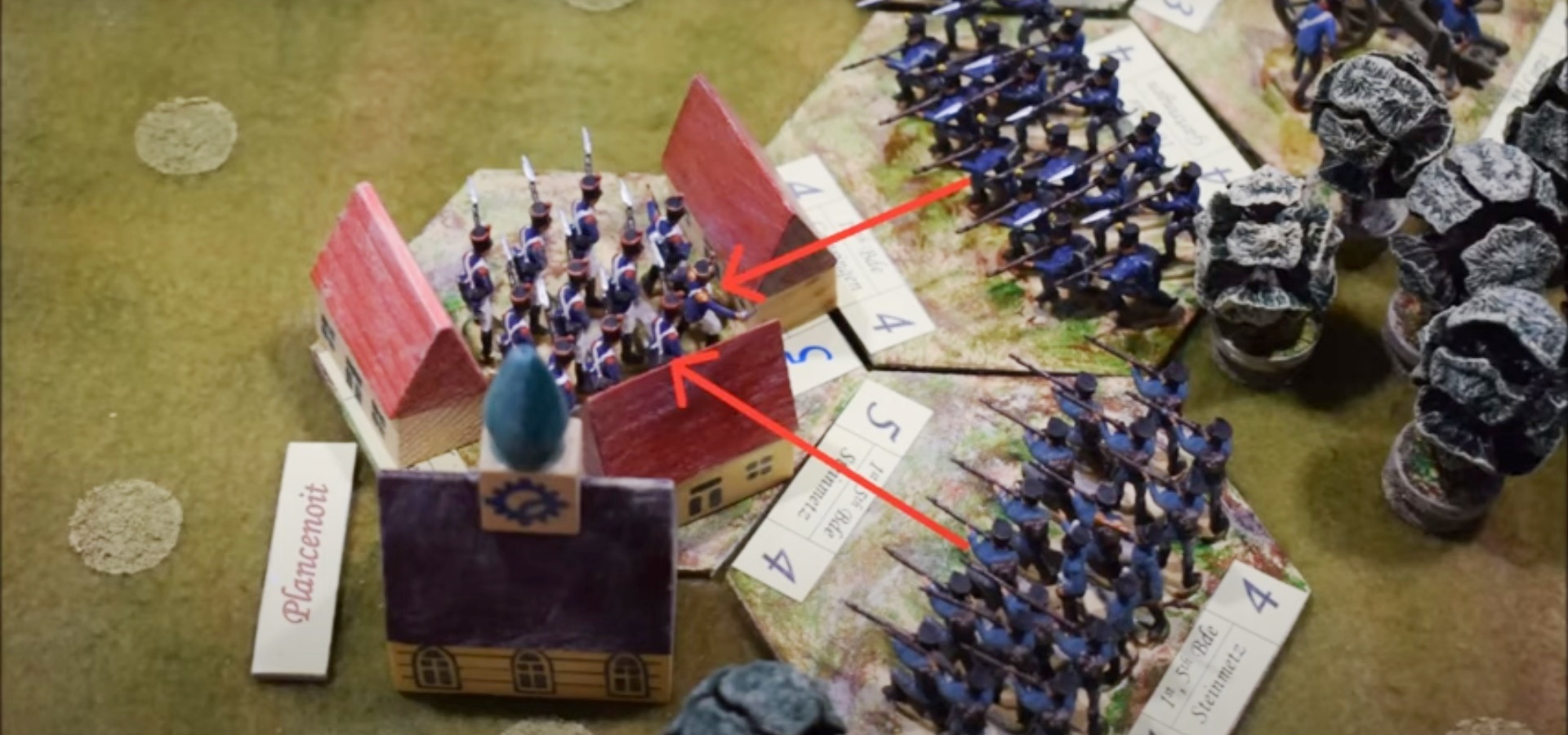
The following stills from Phil's video give a flavour of its contents.


Phil's blog is a cornucopia of useful game designs and is well worth adding to one's list of favourite blogs/websites.