Pages

Monday, 15 December 2014

Britannia's Wolf: The Dawlish Chronicles: September 1877 - February 1878

One of my areas of interest are the wars of the latter half of the nineteenth century, and whenever I find a novel set during that era, I will usually buy it. BRITANNIA'S WOLF: THE DAWLISH CHRONICLES: SEPTEMBER 1877 – FEBRUARY 1878 (written and published by Antoine Vanner [ISBN 978 1 4802 7527 0]) is one such book ... and I have just finished reading it on my Kindle.


The book is the first of what is – so far – a trilogy about the adventures of Nicholas Dawlish, and this story is set during the Russo-Turkish War of 1877 – 1878. Dawlish is a Commander in the Royal Navy who has 'resigned' so that he can serve Britain's interests as an officer in the Ottoman Navy.

The book is well researched, and certainly has a 'feel' for the naval warfare of the period. It is also an interesting source of potential scenarios for naval wargamers, particularly those who want to organise a small-scale campaign that features ironclads, gunboats, and torpedo boats.

The other books in the trilogy are:
  • BRITANNIA'S REACH: THE DAWLISH CHRONICLES: NOVEMBER 1879 – APRIL 1880
  • BRITANNIA'S SHARK: THE DAWLISH CHRONICLES: APRIL 1881 – SEPTEMBER 1881
I have already bought these books for my Kindle and I am looking forward to reading them over Christmas.

Saturday, 13 December 2014

The trench and the football match

Due to a last-minute change of plans, Sue and I were able to pay a visit this morning to an event that had been organised by the Firepower, the Royal Artillery Museum.

As part of their World War 1 commemorations, Firepower hosted a football match that was played of the Royal Artillery Barrack Field in Woolwich by pupils from Eglinton School, Plumstead. The match took place at 11.45am next to the Museum's trench reconstruction on the Barrack Field, and members of the Museum's Living History Team were present to lend authenticity to the event. Besides showing visitors around the trench, the Team cooked (and gave away) some 1914-style food.

On our way to the Barrack Field we passed a Boer War memorial.


The trench was laid out in front of one end of the Royal Artillery Barracks.


It was designed to represent the sort of third-line trenches found on the Western Front.


The two teams were drawn from a local school, Eglinton School, Plumstead.


The Firepower Living History Team watched the first part of the match ...


... before returning to their trench to prepare the food.


The location of the trench and the football match gave a wonderful view of the Georgian facade of the Royal Artillery Barracks ...


... and the very imposing Royal Artillery Crimean War Memorial.


Friday, 12 December 2014

Another 'Works' outing

Yesterday Sue and I paid another visit to the retail outlet centre at Chatham Maritime ... and I managed to acquire several more cheap train sets from 'The Works'.


We also managed to visit Regal Models, which is located near to the retail outlet centre and on the approach road to the Historic Dockyard, Chatham.


Regal Models is located next to the Ramada Encore Hotel near the Mast Pond. There is free parking on site and the shop has extensive stock that covers everything from tins of paint to Hornby Trains. Brands stocked include Corgi, Hornby, Airfix, Revell, Scalextric and Hobby Master.


The shop operates a world-wide mail order service and is open as follows:
  • Monday to Friday: 9.00am to 5.00pm
  • Saturdays: 10.00am to 4.00pm
  • Sundays: 10.00am to 2.00pm
  • Closed on Bank Holidays
Nigel Drury – one of my regular blog readers and a fellow member of Wargame Developments – recommended that I visit Regal Models ... and it was amazing. It seems to have a very extensive stock that covers all aspects of modelling ... and I could (and probably will) spend hours there just examining what they have on sale.

Thursday, 11 December 2014

Keeping on OO/HO track

A visit yesterday to the nearest branch of Hobbycraft enabled me to buy four short lengths of straight Hornby OO/HO-gauge model railway track ... and when I got home I discovered that my cheap toy train loco and rolling stock will just about run on it. (The axles and wheels are wide enough for the wheels to sit on top of the rails even though the flanges on the wheels are about 1mm inside the inner edge of the rails.)


I have begun re-modelling the locomotive ... but the results are not quite as good as I hoped. (The model doesn't look quite right, and needs another pair of wheels.)


With luck I hope to be able to buy another toy train set (or several) later today, and this should enable me to re-model the locomotive with an additional pair of wheels ... or even to build more than one.

Wednesday, 10 December 2014

4-3-2 becomes 3-2-1

During the two recent play-test battles that I have fought, I used what has become my standard Strength Values for Infantry, Cavalry, and Artillery units ... 4, 3, and 2 respectively. This is also the number of figures I used to represent each type of Unit in earlier battles.

On these two occasions I used Units that had three Infantry, two Cavalry, or two Artillery figures, and each 'hit' was marked on a Unit using small, transparent Roman Blind rings. I soon realised that I did not need as many figures in a Unit as it had Strength Value (which is what I had previously done); what I needed was one less figure than the Unit's Strength Value.

This can best be illustrated thus:

An Infantry Unit (Strength Value = 4).
An Infantry Unit after one 'hit' (Strength Value = 3).
An Infantry Unit after two 'hits' (Strength Value = 2).
An Infantry Unit after three 'hits' (Strength Value = 1).
The next hit will not need to be marked as the Unit's Strength Value will be reduced to 0 and the Unit will be removed.
The upshot of this is the fact that I can reduce the number of figures I need to represent Units from the former 4-3-2 ratios I previously used to 3-2-1. (I must admit that for aesthetic reasons the sight of a single figure crewing a piece of artillery does jar somewhat ... but I suppose that there is no reason why I could not increase the Strength Value of Artillery Units to 3, thus ensuring that Artillery Units will always have two figures.)

This is certainly something that I need to think about and – if possible – to play-test further.

Tuesday, 9 December 2014

Keeping on track

I have discovered one small but significant problem with my newly acquired toy train set ... the track doesn't have much in the way of straight sections ... just four pieces, each three inches long.


The rest of the track is made up of a number of curved sections that can only be laid so as to form a circle or part of an oval.


The only other model railway track that I currently own is N-gauge, which is too narrow. I need to try to find some OO/HO-gauge track to see if that is compatible with my toy loco and rolling stock, otherwise I will have to buy several more toy train sets in order to have enough straight track to go from one end of my tabletop to the other.

Monday, 8 December 2014

I have the inspiration; all I need now is the perspiration!

Sue and I have been away for the weekend to visit Bristol. I am sure that it is a lovely city ... but it has one of the most confusing road systems I have ever had to drive around. Even the locals I spoke to find it difficult to navigate, and in our case the lack of road signage that makes sense made it doubly so.

Whilst we were away I had an idea. (I do have some good ones occasionally!). Somewhere in the collection of Chaco War photographs that I have stored on my computer I remembered seeing an image of a Paraguayan troop train that looked rather like the toy train that I bought last Thursday. I did not have the opportunity to look through the photographs until this morning, but eventually I found it ... and here it is!


As you can see, it is not that dissimilar to the toy train I have bought.


I now have the necessary inspiration; all I need to add is the perspiration (and time) to do something about it!

Saturday, 6 December 2014

A 'Works' outing

Last Thursday Sue and I went to the retail outlet centre at Chatham Maritime. Whilst we were there I paid a visit to a branch of 'The Works' (this is a chain of discount book, stationery, craft, and toy shops) where I bought a cheap train set (it cost £3.00) ...


... and a boxed set of games.


The train set needs a bit of work to make it suitable for wargaming, but it was so cheap that I can afford to risk remodelling the locomotive and rolling stock ... and making a hash of it. The boxed set of games contains a number of very useful items, including a small chessboard, chessmen, draughts pieces (chequers pieces), playing cards, D6 dice, Poker dice, and dominoes ... most of which I will be able to use.

Thursday, 4 December 2014

Men with pointy sticks

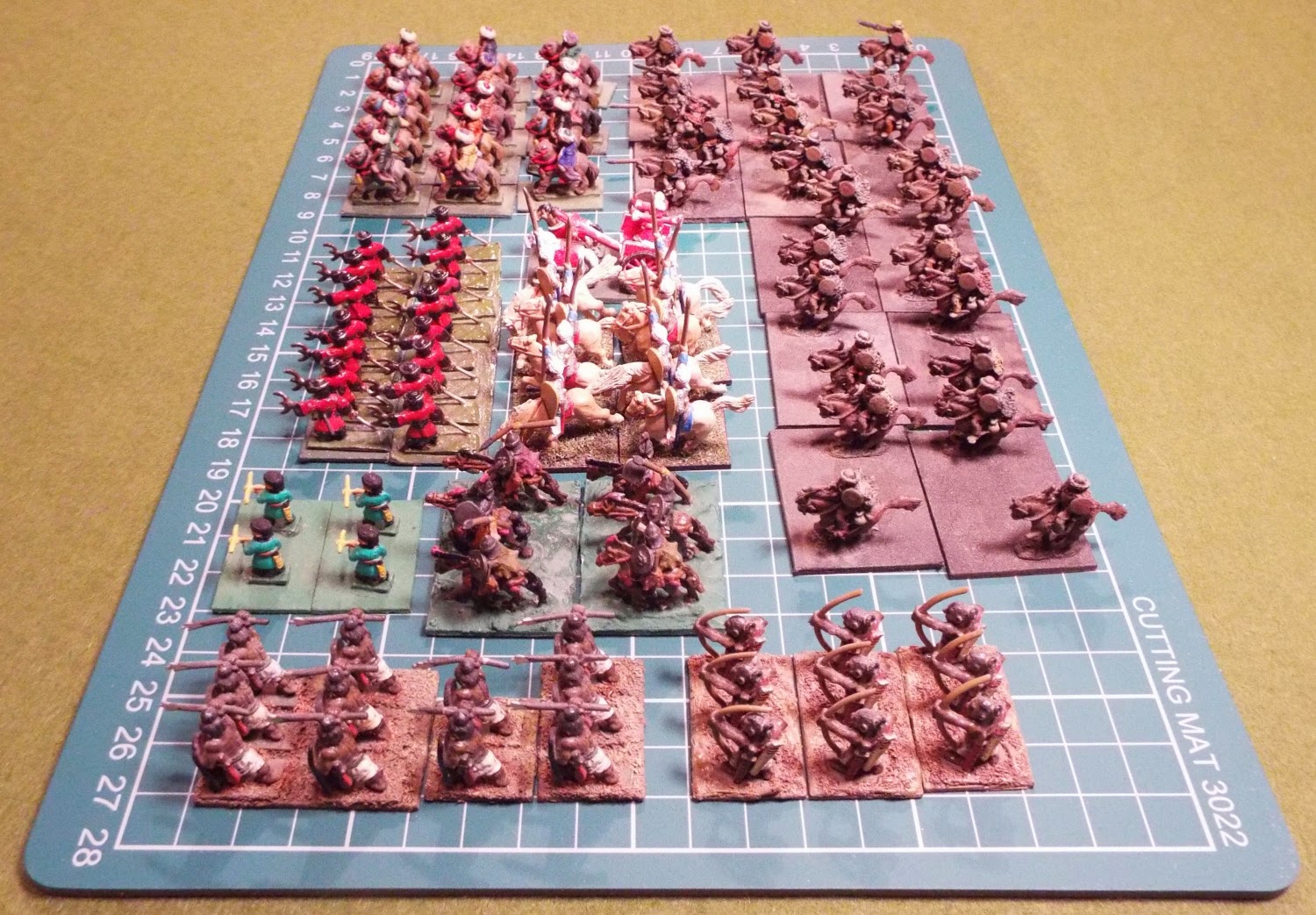
On Tuesday Tim Gow very kindly gave me a small collection of 15mm-scale Ancient Chinese and Indian wargames figures.


Despite having been a wargamer for over fifty years, these are the first Ancient figures that I have ever owned. In fact I have very rarely fought a wargame set during the Ancient period and have been know to refer to them as being fights between men with pointy sticks ... hence the title of this blog entry.

As Tim pointed out to me, I can easily use these figures as opposition for my imagi-nation Colonial wargames armies ... and that is exactly what I intend to do.

So what is in my new collection?

Chinese (or possibly Chinese)
  • 25 Light Cavalry (Tartar?)
  • 6 Cavalry (Chinese/Mongol?)
  • 15 Halberdiers (Chinese)
  • 4 Crossbowmen (Chinese)
Indian (or possibly Indian)
  • 15 Mounted Archers (Indian?)
  • 8 Lancers (Indian?)
  • 11 Spearmen (Indian?)
  • 9 Archers (Indian?)
  • 1 Chariot (Indian?)
There are enough figures for me to put together two small armies – a Chinese one and an Indian one – to use with my PORTABLE WARGAME rules ... and enough for a sizeable Chindian army for my imagi-nation Colonial wargames.

This is not going to be a high priority project for me ... but it certainly gives me something to work with in the future.

Tuesday, 2 December 2014

Brothers in Arms and Brothers in the Lodge

Yesterday saw the publication of my latest book, BROTHERS IN ARMS AND BROTHERS IN THE LODGE: THE STORY OF THE MEMBERS OF THE GROVE PARK LODGE (No. 2732) WHO SERVED DURING THE FIRST WORLD WAR (ISBN 978 1 291 98955 7).


I wrote this book to mark two major events. The first was the centenary of the outbreak of the First World War, and the second was the 50th anniversary of the Initiation into Freemasonry of the most senior Brother in my Mother Lodge. He has never missed a meeting of the Lodge in all his years as a member, a record that is – to my knowledge – unique.

The book was written with the help of the members of the Lodge of Instruction, my wife – Sue – who is a very gifted amateur genealogist, and the staff of the Library of Freemasonry at Freemasons’ Hall, London. It is split into two parts. The first part covers the history of the Lodge from 1914 until 1919, and the second part deals with the individual histories of the ten members of the Lodge who served in the armed forces during the First World War. They were:
  • Edwin Arthur Norman
  • Henry King Nicholls
  • George Woodfall Bourne
  • William John Graham
  • Frederick Charles Rosendale
  • Hugh Bourne
  • Hugh Probyn Malet Lord
  • Henry Charles Bradshaw Good
  • Sidney Herbert Crapp
  • Charles Ernest Stacey
Two of them – Henry King Nicholls and Sidney Herbert Crapp – paid the ultimate price for serving their King and Country.

The book also contains three appendices that explain some of the Masonic terminology used in the book as well as the Medals, Stars, and Commendations mentioned in the text.

The book costs £5.00 and is currently available for sale from Lulu, and will be available from Amazon in the very near future. The profits from all sales of the book will be donated to the Royal Masonic Trust for Girls and Boys, a charity funded by Freemasons 'to relieve poverty and advance education for children and young people'.