Pages

Tuesday, 17 February 2015

Barbarossa Mini-campaign: Battle No.2: Late arrivals

Once the Germans had broken through the Russian front-line they advanced as rapidly as they could into Soviet territory. The Russian response was to send all available units forward to meet the invaders, to defeat them, and then to throw them back across the border.

This was the second battle of my Barbarossa Mini-campaign.

Late Arrivals
This battle used Scenario 10 from Neil Thomas's ONE-HOUR WARGAMES. Both sides had six units available to take part in the battle.

The Germans had:
  • Three Infantry Units (= 12 Strength Points)
  • One Machine Gun Unit (= 4 Strength Points)
  • Two Tank Units (= 6 Strength Points)
Note: The German will become exhausted when they have lost 11 Strength Points.

The Russians had:
  • Four Infantry Units (one of which was Militia) (= 15 Strength Points)
  • One Anti-tank Gun Unit (= 2 Strength Points)
  • One Tank Unit (= 3 Strength Points)
Note: The Russians will become exhausted when they have lost 10 Strength Points.

The terrain looked like this:


The leading German troops had outstripped their supporting units and had halted in order for them to catch up. The Russians were already rushing reinforcements forward to stem the German advance, and a clash was inevitable. It was know that the German support units were moving up the road that ran through the built-up area in the corner of the wargaming board nearest the camera, and that the Russian troops would be arriving via the same road but from the opposite corner. The hill was deemed to be unclimbable and was regarded as impassable terrain.

The battle began when the first Russian units (led by their Tank Unit) entered the battlefield. The Russian Tank Unit immediately engaged the German Tank Unit ...


... and missed!

The Germans responded by moving their Machine Gun Unit out onto their right-hand flank whilst their Tank Unit fired at the Russian Tank Unit and forced it to withdraw.


Further Russian units arrived on the battlefield ...


... and this enabled the Russians to move forward.


The Russian Tank Unit's fire forced the German Tank Unit to withdraw down the road towards the built-up area ...


... whilst the Russian Anti-tank Unit was able to open fire on the German Machine Gun Unit and inflict 50% casualties on it.


At this point the first of the German support troops arrived, and this enabled the Germans to begin counter-attacking.


The German Tank Unit fired at the Russian Tank Unit and reduced its effectiveness by 33% ...


... and the German Machine Gun Unit was able to return fire upon the Russian Anti-tank Gun Unit and kill half of its gunners.


The duel between the two Tank Units continued ...


... but no further damage was caused.

A Russian Infantry Unit had moved forward and engaged the German Machine Gun Unit, but it was equally unsuccessful.


Events then began to favour the Germans when their Tank Unit was able to hit the Russian Tank Unit twice ... knocking it out.


The German Machine Gun Unit switched target and fired at the Russian Infantry Unit, but was unable to hit it.


The German Tank Unit now moved forward and forced the foremost Russian Infantry Unit to fall back.


This success was followed up by the two German Infantry Units, which advanced on either flank of the Tank Unit.


The Russians responded by moving their Anti-tank Gun Unit into the woods (thus giving it some protection) and forming a road block with their Infantry Units.


The left-hand German Infantry Unit fired at the Russian Infantry Unit in the centre of the roadblock, inflicting 50% casualties upon it.


The German Machine Gun Unit also engaged this Russian Infantry Unit, and reduced to 25% of its original strength.


The German Tank Unit chose to fire at another of the Russian Infantry Units ... with devastating effect.


At this point the Russians had reached their Exhaustion Level (they had lost 10 Strength Points) but were still in a position to defend ... which they chose to do.

(Once a side reaches its Exhaustion Level it cannot take any offensive actions such as advance, but may either retreat or fight on in the hope that they will exhaust their opponent. In this case Stalin's 'Not one step back!' order seems to have been obeyed.)

The Russians quickly proved that they were unwilling to give up their positions. The Anti-tank Unit fired at and hit the German Tank Unit ...


... and the Russian Militia Infantry Unit moved forward to support the Russian front-line.


At the same time the right-hand Russian Infantry Unit engaged the nearby German Infantry Unit and caused it to suffer 25% casualties.
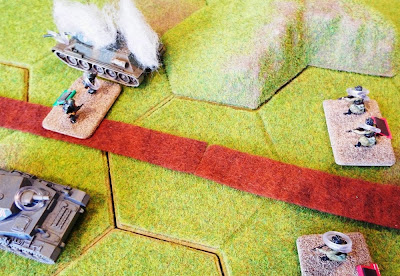

The Germans reacted by moving their right-hand Infantry Unit forward, ...


... bringing further troops onto the battlefield, ...


... and wiping out the Infantry Unit in the centre of the Russian front-line.


In the hope that they could stem the German advance, the Russian Anti-tank Unit fired at the leading German Tank Unit and forced it to fall back.


The left-hand Russian Infantry Unit engaged the German Machine Gun Unit at long range, but their fire was ineffective.


The German response was vigorous and effective. The leading German Tank Unit moved forward and engaged the Russian Anti-tank Gun Unit ... and destroyed it!


The second German Tank Unit also advanced and engaged the right-hand Russian Infantry Unit. The latter was already reduced to 25% of it original strength, and this attack wiped it out.


The left-hand German Infantry Unit also moved forward and fired at the Russian Militia Infantry Unit, but the range was long and the German Unit's fire was ineffective.


The left-hand German Infantry Unit moved forward again, and this time its fire reduced the strength of the Russian Militia Infantry Unit by 33%.


The undamaged German Tank Unit advance and engaged the remaining Russian Infantry Unit, which it forced to retreat.


Both the Russian Infantry Units then fired at the nearest German Infantry Unit. The Russian Militia Infantry Unit's fire had no effect ...


... but the Russian Infantry Unit's fire did inflict a 25% loss upon the German Infantry Unit.


It was now only a matter of time before the Germans prevailed ... and when the end did come, it came very swiftly.

The right-hand German Tank Unit moved forward and fired at the remaining Russian Infantry Unit, inflicting 25% casualties on it


The left-hand German Tank Unit followed suit, and forced the Russian Infantry Unit to retreat.


Soon afterwards the leading German Infantry Unit engaged the Russian Militia Infantry ... and wiped it out!


The sole remaining Russian Infantry Unit was destroyed moments later when the left-hand German Tank Unit advanced yet again and fired at the Russian Unit.


The Germans had won the battle ... but at a cost. Its units were spread out all over the battlefield, and if the Russians were able to mount a counter-attack, the Germans could easily be pushed back. The Russians had also suffered casualties that might be difficult to replace if the campaign was to be a prolonged one.

At the end of the fighting the battlefield looked like this:


This battle was set up on Sunday night and fought in several short sessions on Monday and Tuesday. One of the joys of using the card-driven unit activation system is that it is possible to leave a battle in situ and return to it without having to worry as to which side had the initiative or whose turn it was to move their units next.

It was a real 'ding-dong' battle, and although the Russians ultimately lost, they had held up the German advance and inflicted a significant number of casualties.

Sunday, 15 February 2015

Barbarossa Mini-campaign: Battle No.1 : Control the river

Finally – and slightly over a week later than expected – I began fighting the Barbarossa Mini-campaign I planned to fight to celebrate my sixty fifth birthday.

The organisation of the campaign was 'stolen' from the NUMBERS, WARGAMES AND ARSING ABOUT blog that is written by Old Trousers, and used a number of scenarios from Neil Thomas's ONE-HOUR WARGAMES. All the battles were fought on Hexon II terrain set up on my new wargaming board, and the rules were a concoction of my own that use the combat system from Richard Borg's MEMOIR '44 rules and my playing card-driven unit activation system.

Control the river
This battle used Scenario 3 from Neil Thomas's ONE-HOUR WARGAMES. Both sides had six units available to take part in the battle.

The invading Germans had:
  • Four Infantry Units (= 16 Strength Points)
  • One Artillery Unit (= 2 Strength Points)
  • One Machine Gun Unit (= 4 Strength Points)
Note: The German will become exhausted when they have lost 11 Strength Points.

The defending Russians had:
  • Three Infantry Units (= 12 Strength Points)
  • One Artillery Unit (= 2 Strength Points)
  • One Anti-tank Gun Unit (= 2 Strength Points)
  • One Machine Gun Unit (= 4 Strength Points)
Note: The Russians will become exhausted when they have lost 10 Strength Points.

The terrain looked like this:


The Germans were advancing from the side of the wargaming board nearest the camera and the Russians entered the battlefield from the edge furthest away.

The battle began with both sides sending troops forward to seize the bridges.


Supporting troops were then brought forward ...


... and fighting broke out for control of one of the bridges.

One Russian Infantry Unit raced across the bridge, forcing one of the German Infantry Units to fall back ...


... but at the cost of 75% casualties!

The Germans fought back with considerable ferocity, destroying the Russian Infantry Unit and forcing the Russian Machine Gun Unit to fall back.


Luck seemed to favour the Germans, who were able to bring their fire to bear on the foremost Russian Units, destroying a further Infantry Unit and forcing the Russian Machine Gun Unit to withdraw.


The Russians fought back ...


... but to little avail, and the tide of battle seemed to be moving inexorably against them.

The fighting continued for some time, but eventually the Russians became exhausted and withdrew ...


... leaving the Germans in control of the river!

This was a really fun little battle that took longer to write up that it did to fight. The size of the board and the number of units per side produced a fast but balanced game, and throughly vindicated my decision to follow the example set by 'Norm' of BATTLEFIELDS & WARRIORS blog and to convert the whiteboard into a wargaming board for use with my Hexon II terrain.

Roll on the next battle in this mini-campaign!

Saturday, 14 February 2015

No plan survives first contact ...

Sue and I have been feeling under the weather for the past week, and today was the first day when neither of us felt like staying in bed all day. As a result I had hoped to begin fighting my mini-campaign this morning ... and then Sue remembered that we had booked tickets for the a Daily Mail Cruise Show at Olympia, London.

We set off for Central London just after breakfast, and arrived at the Olympia Exhibition Centre at 11.15am. We stayed at the show for just under two hours, after which we made our way to Welling in Kent to have lunch and to do some essential shopping. The journey to Welling took much longer that expected due to a number of hold ups (road works, broken-down vehicles, diversions) and we did not finish lunch until 3.30pm. The shopping took up a further forty five minutes, and we did not get home until 4.30pm ... by which time we were both feeling rather tired.

After a rest (and a short doze) I did not feel much like starting the first battle of my mini-campaign, so I did some work on basing my Del Prado 25/28mm-scale pre-painted Napoleonic wargames figures. I have decided that the figures will be mounted as follows:
  • Line and Light Infantry: Three figures per 50mm x 25mm base, with two bases = one unit
  • Rifles: Two figures per 50mm x 25mm base, with two bases = one unit
  • Cavalry: Two figures per 50mm x 50mm base, with two bases = one unit
  • Artillery: Two figures (plus space for one cannon) per 50mm x 75mm base, with a base = one unit
  • Commanders: One figure per 25mm x 50mm base (mounted) or 25mm x 25mm base (on foot)
By adopting this method of organising my troops, a unit plus a Commander can easily fit within a Hexon II hex, and the way in which a unit's bases are positioned can show what tactical formation it is in.
  • Infantry can be in
    • Column (both bases facing in the same direction, one behind the other)
    • Line (both bases facing in the same direction, next to one another)
    • Square (both bases facing in opposite directions, one behind the other)
  • Cavalry can be in
    • Column (both bases facing in the same direction, one behind the other)
    • Line (both bases facing in the same direction, next to one another)
  • Artillery can be deployed
    • Ready to fire (cannon facing forwards)
    • On the march (cannon facing backwards).
So far I have concentrated on my Prussian Army figures, and have managed to base eight units of Infantry and two mounted Prussian Commanders, and I have three Artillery units ready to base once the requisite bases arrive in the post. The only Prussians that will then remain to be based are three Cavalry units, two more mounted Commanders, and two foot Commanders.

Wednesday, 11 February 2015

New wargaming board is ready to go!

Despite suffering from a heavy cold, I have managed to get my new wargaming board ready to use.

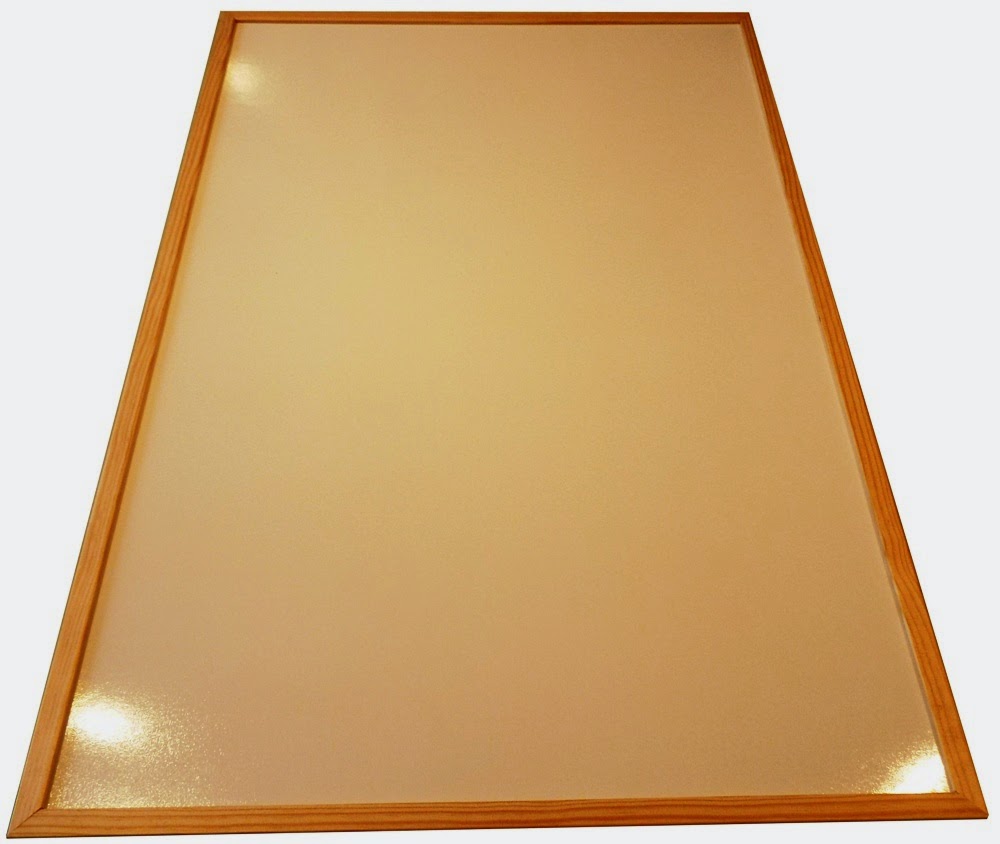
It began life as a whiteboard ...


... which I turned over so that I could use the MDF side of the board as the basis of my wargaming board. (The surface does not look very white due to the lighting in my toy/wargames room.)

As the frame of the whiteboard was not glued to the board (the board was slotted into groves in the frame) the whole thing was a bit too flexible for my liking. I therefore glued thin wooden beading to the edge of the MDF and the inside edge of the frame.


This had the effect of strengthening the board, making it more rigid, and ensuring a tight fit between the Hexon II terrain tiles and the edge of the wargaming board.


With luck I will feel well enough by the weekend to begin using my new wargaming board. In the meantime I can continue sorting out my 28/28mm-scale pre-painted Del Prado Napoleonic figures into units that I can begin basing.

Tuesday, 10 February 2015

Laid low by a cold

Having had a great time celebrating my birthday on Friday, Saturday, and Sunday, the vagaries of normal life reasserted themselves as Sunday night became Monday morning. The irritating cold that I had already had for over a week suddenly got a lot worse, and by the time I got out of bed on Monday morning my eyes itched, my sinuses hurt, and my head felt as if it was stuffed with cotton wool. Unfortunately my wife was also suffering from a cold, and as a result neither of us felt like doing much all day.

I had planned to begin fighting my mini-campaign on Monday, but in the end all I did was a bit of work preparing my new wargaming board. This is a 90cm x 60cm whiteboard that I bought in a branch of a large stationers on Sunday morning. (This idea was 'borrowed' from the BATTLEFIELDS & WARRIORS blog that is written by 'Norm'. Over the past year or so he has been developing a number of sets of hex-based wargame rules, including TIGERS AT MINSK. These use an eight x six grid of Hexon II terrain that just fits within the frame of a 90cm x 60cm pin board or whiteboard.)

It might seem odd that I have decided to try this idea out, especially as I have a table in my toy/wargames room that can be extended to give me a 6 foot x 4 foot playing surface, but as regular blog readers will already know, I have been designing wargames that can be fought in relatively small areas for some time ... and this looked like a really good concept to experiment with. One of the big advantages of the board is that I can set up the terrain for a battle on it and then move it without risking the whole lot coming apart.

With luck I will be feeling better later this week ... and when I am, I will begin fighting my mini-campaign.

Sunday, 8 February 2015

My birthday celebrations

First of all I would like to thank everyone who sent me birthday greetings ... including Google!


The first thing that I do most mornings after getting up, feeding the cat, and making my wife a cup of tea is to read my emails ... and the long list of them from friends and regular blog readers who wanted to wish me a happy birthday was a great way to start the day. (The cat joined in the celebrations by bolting down its breakfast and then 'revisiting' it all over the carpet outside our home office. It certainly brought me back down to earth with a bit of a bang.)

My personal celebrations began on Friday when Sue and I went out for lunch in the Mark Masons' Hall Carvery Restaurant, St James's, with some friends. We sat by the window in the beautifully decorated restaurant, overlooking St James's Street and the entrance to St James's Palace. The food was excellent (an hors d’oeuvres trolley, followed by a selection of roast meats with all the trimmings, a dessert trolley or cheese selection, and tea or coffee to finish up with) and including wine it cost just over £33.00 each. The quality of the food was more than matched by the company, and the three hours we spent over lunch seemed to zip past and was a great way to begin my celebrations.

After reading my emails on Saturday morning, Sue and I went to Café Rouge in Bluewater for a full English breakfast, followed by a bit of light retail therapy. We got home just after 1.00pm, had a drink, and then I opened my birthday cards and presents. The latter included INLAND WATER TRANSPORT IN MESOPOTAMIA by Lieutenant Colonel L J Hall (Originally published in 1919; re-published by The Naval & Military Press Limited in association with FIREPOWER, The Royal Artillery Museum, Woolwich (ISBN 1 84342 952 7]). This was sent to me by my old friends and fellow wargamer, Tony Hawkins.


After lunch I sorted out some of my Prussian 25/28mm-scale Napoleonic wargames figures so that I will be able to begin basing them later this week, after which I began preparing for my birthday celebration mini-campaign. The idea for this was stolen wholesale from the campaign section of the PLAN B: RUSSIA 1941 wargame rules on the NUMBERS, WARGAMES AND ARSING ABOUT blog that is written by Old Trousers. The campaign works very simply, and uses a linear system that links together scenarios from Neil Thomas's ONE-HOUR WARGAMES.

For the sake of simplicity – and because Old Trousers has done all the preliminary work for me – I am also setting my mini-campaign in Russia in 1941. I will be using my own draft modern (i.e. World War II) rules to fight the battles, although they are currently just a mishmash of my PORTABLE WARGAME: MODERN rules and my MEMOIR OF MODERN BATTLE (MOMBAT) rules ... with a few bits added.

Just after 8.00pm Sue and I went to the Saray Restaurant in Welling for my birthday dinner. The restaurant describes itself as being 'Mediterranean', but the food has a very strong Turkish element to it ... which is something that I like. The food and service was excellent ... and the experience was made all the better by the discovery that the restaurant was owned by the family of a young man that used to teach. The young man – whose name is Metin – even organised for my dessert to be delivered to our table with a lit candle in my baklava whilst 'Happy Birthday' was played over the restaurant's sound system.

The perfect end to a perfect day.

Saturday, 7 February 2015

Happy birthday to me!

Today is my birthday ... and I have reached the ripe old age of sixty five!

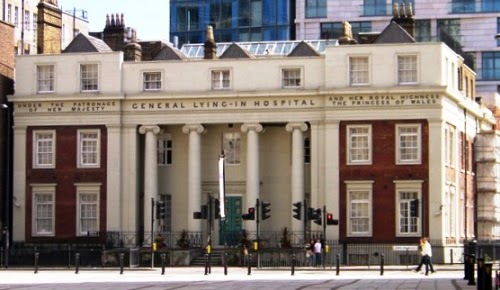
The hospital where I was born on Tuesday 7th February, 1950 ... the General Lying-In Hospital, Lambeth.
This means that I am now an Old Age Pensioner although I understand that I should really call myself a 'Recipient of State Retirement Pension' and not an OAP. This opens all sorts of doors for me – or so I am led to believe – including:
  • Cheap haircuts on slacks days at the barbers
  • Cheap seats to watch films during the afternoon
  • Free prescriptions and eye-tests
  • Free bus travel anywhere in England
  • Access to cheap train and coach travel
Not a bad deal just for being a year older than I was yesterday.

I am not sure what I am going to do today, although I do know that Sue and I are going out for a meal in a local restaurant this evening. I will certainly think about staging a wargame at some point during the day ... but I might just spend the day chilling out watching the DVD of a favourite film ... or two.

And here for the historically mined amongst my regular blog readers are some 'interesting' facts:

Some of the famous events that took place on 7th February include:
  • Edward of Caernarvon (later King Edward II of England) became the first English Prince of Wales in 1301.
  • The French and Spanish forces lifted the Great Siege of Gibraltar in 1793.
  • The Battle of Eylau was fought in 1807
  • In 1898 Émile Zola was brought to trial for libel for publishing J'Accuse.
  • The board game Monopoly was published in 1935.
Some of the famous people who share the 7th February as a birthday are:
  • 1478: Sir Thomas More. lawyer, politician, and writer
  • 1812: Charles Dickens, novelist
  • 1873: Thomas Andrews, designer of RMS Titanic
  • 1962: Eddie Izzard, comedian, actor, and producer

Thursday, 5 February 2015

My Waterloo

I have been wargaming for as long as I can remember, but in all that time I have never developed a great enthusiasm for wargaming the Napoleonic era. That is not to say that I have not owned Napoleonic wargame figures ... but I have never made much of a commitment to fighting battles with them.

Some years ago I bought the entire RELIVE WATERLOO series of 25/28mm figures and magazines from Del Prado, and more recently I have bought more of these figures via eBay. These are currently sitting in storage boxes in my toy/wargames room, and as a result of a conversation that I had on Tuesday morning with a old wargaming friend who – like me – has not fought many Napoleonic wargames, I have decided that I want to get these figures based by the bicentenary of the Battle of Waterloo on 18th June this year.

This is going to be a slow-burn, non-priority project over the next few months, and will no doubt progress in fits and starts ... but progress it will!

Monday, 2 February 2015

A busy week ahead

I have quite a busy week ahead, and don't expect to be doing much in the way of wargaming, modelling, or even blogging for the next six days.

This morning I have to visit the Post Office to send out the latest issue of THE NUGGET, and after lunch I will be picking up two other members of my Masonic Lodge (The Grove Park Lodge No.2732) in order to drive them to a meeting in Cheshunt, Hertfordshire.


The meeting starts at 4.30pm, but we like to get there at least an hour beforehand to make sure that we are properly prepared. The meeting will last until just after 7.00pm, and will be followed by a quick drink in the bar before we all go into eat. The dinner should end sometime between 9.00pm and 9.30pm, after which I will drive home with at least one of the people I drove to the meeting. (Sue and I are providing bed and breakfast for the Worshipful Master as he lives in Bristol.)

Hopefully Tuesday will be a relatively easy day. Our overnight guest will probably leave at some point during the morning, after which Sue and I have to do some shopping. On Wednesday we plan to visit Maidstone and/or Bluewater (our local shopping mall), although this might have to be postponed until Thursday if the weather takes a turn for the worst. (At present the weather forecasters don't seem to be able to predict the weather with any great deal of accuracy other than to say it will be very cold. There is a possibility that we will have some snow ... or it might miss us or turn into rain. Who knows? They certainly don't appear to!)

On Friday Sue and I are going for lunch with some friends in St James's, London. We have booked a table in the restaurant of Mark Masons' Hall, where they have an excellent and relatively inexpensive carvery lunch menu.


The lunch is part of my birthday celebrations, and I had hoped that a few more people might have been able to attend. That said, entertaining those who aren't able to get to the lunch will give us lots of excuses to go out to lunch or dinner with them later in the month.

Saturday is the big day ... and I am hoping that the weather will be fine enough for us to go out somewhere during the day. As this birthday is a 'special' one, (I finally become a State Pensioner as I will have reached the ripe old age of sixty five years!) Sue and I have booked a table at a local restaurant for dinner on Saturday evening. We have eaten there before, and the food – which is Eastern Mediterranean – is excellent in both terms of quality and price.

If the chance arises, I will try to fight a tabletop battle or two ... but with the sort of week that I have in front of me I am not sure whether I will have the time to do so.

Sunday, 1 February 2015

The Portable Naval Wargame revisited

Before looking at the possible introduction of some of the elements of my existing PORTABLE NAVAL WARGAME rules into my 'new' Ironclad vs. Ironclad rules, I decided to stage a re-fight of one of my recent play-tests using my PORTABLE NAVAL WARGAME: PRE-DREADNOUGHT rules.

I rated each of my Rams as Ironclad/Coastal Defence Battleships and gave them temporary names. The model with the pronounced ram bow was named Rambeau (as per Archduke Piccolo's suggestion) and the other was named Furious (well it did get sunk twice during the first play-tests!).

Rambeau vs. Furious
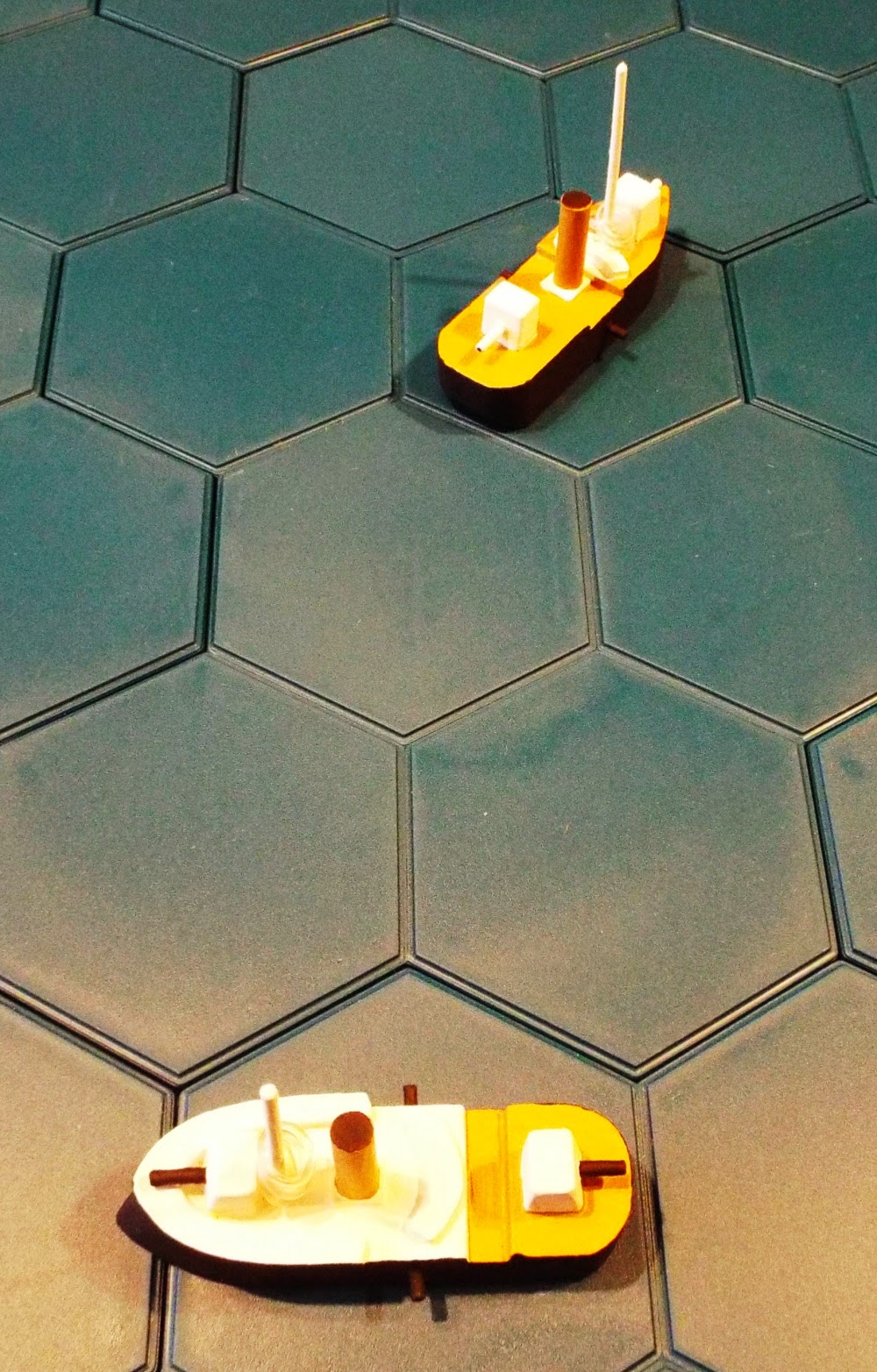
As before I set up an unencumbered 12 deep by 10 wide grid of blue Hexon II hexes. The opposing warships were placed on the rows of hexes furthest from each other and 5 hexes in from their respective left-hand column of hexes, with Rambeau being closest to the camera in the following image.


The battle began with the Furious trying to close the range as quickly as possible whereas the Rambeau turned to port in order to be able to fire broadsides at her enemy when the range closed.


Both ships maintained their courses ...


... until their guns came into range. The Furious managed to hit the Rambeau twice, but the Rambeau was only able to do half that amount of damage to the Furious when she returned fire.


Events then began to favour the Rambeau, whose subsequent broadside did sufficient damage to the Furious that the latter was forced to turn away. The Furious was not out of the fight by any means, and her return fire inflicted further damage upon the Rambeau, forcing her to break off from the battle as well.


As neither ship prevailed, the battle was drawn.

Conclusions
I was somewhat surprised by the fact that this battle was so short and felt less satisfactory than the two Ironclad vs. Ironclad play-tests I had previously staged.

After some thought I came to the conclusion that the individual Ship's Flotation Points and Critical Point (i.e. the point at which a ship is forced to break off action due to damage) in my PORTABLE NAVAL WARGAME: PRE-DREADNOUGHT rules is too low for a single ship vs. single ship action. I also felt that the movement rates and turning rules in my PORTABLE NAVAL WARGAME: PRE-DREADNOUGHT rules were not right for the size of the playing surface, and preferred the shorter and simpler movement rate and turning rules in the Ironclad vs. Ironclad rules.

I do feel that the gunnery rules in my PORTABLE NAVAL WARGAME: PRE-DREADNOUGHT rules work better than those in the Ironclad vs. Ironclad rules, but that the option to disable an enemy ship which is included in the latter rules is something that I would like to think about including in any future pre-dreadnought era naval wargame rules.

The Ironclad vs. Ironclad rules do place great emphasis on ramming whereas my PORTABLE NAVAL WARGAME: PRE-DREADNOUGHT rules do not. (My original PORTABLE NAVAL WARGAME: 1860 to 1870 rules do included ramming rules, but I removed them when I wrote the pre-dreadnought version.) In the Ironclad vs. Ironclad rules a rammed ship is deemed to be automatically sunk, which I think is too drastic a result. My personal opinion is that ramming should be used to administer the coup de grace to an already damaged enemy ship and not as a ship's primary weapon.

My PORTABLE NAVAL WARGAME: PRE-DREADNOUGHT include rules for locomotive torpedoes whereas the Ironclad vs. Ironclad rules do not. Any rules that I do end up writing as a result of melding these two sets of rules together will have to include rules for torpedoes, but like ramming they should be seen as a coup de grace weapon rather than as a major warship's primary weapon.

This was an interesting play-test, and it raised quite a few matters that require further thinking. I hope that as a result of this I will end up with a set of very simple, fast-play naval wargame rules for the ironclad era ... and if I don't, I will have had fun trying!