Pages

Saturday, 25 June 2016

Ship models in the Monaco Naval Museum: Battleships (Part 1)

The museum's collection of battleships includes the following:

Pre-dreadnought Battleship Danton (France, 1909)
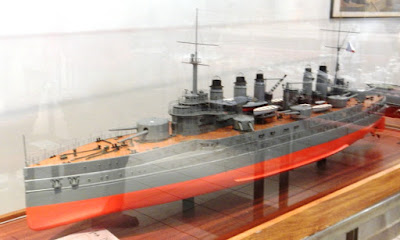


Danton was the lead ship of a class of pre-dreadnought battleships that were laid down and completed for the French Navy after the completion of HMS Dreadnought. Despite the fact that she was already obsolete when she entered service, she had an active career in the Mediterranean until 19th March 1917 when she was torpedoed and sunk by U-64, a German U-Boat commanded by Kapitänleutnant Robert Moraht.

Dreadnought Battleship HMS Dreadnought (Britain, 1906)


When HMS Dreadnought entered service with the Royal Navy in 1906, she revolutionised naval power and represented such a paradigm shift in naval technology. At a stroke she rendered all other battleships obsolete, and although by the time the First World War started in 1914 she was herself obsolete, her name came to be that by which all subsequent battleships would be described.

Battlecruiser HMS Hood (Britain, 1918)


HMS Hood was the last battlecruiser to be built for the Royal Navy, and during the 1920s and 1930s she came to symbolise British seapower. Long, low, fast, and well-armed, she looked both menacing and graceful. She was originally intended to be the first of a class of four battlecruisers, but after the Battle of Jutland the design was revised and this slowed down progress on her construction. Hood was eventually launched on 22nd August 1918 and commissioned on 15th May 1920.

She was scheduled to undergo a major rebuild in 1941 to correct her growing obsolescence and lack of modern armour protection, but the outbreak of World War II prevented this from happening. As a result she was essentially un-modernised when she engaged (and was sunk by) the German battleship Bismarck and the heavy cruiser Prinz Eugen on 24th May 1941.

Battleship USS Arizona (BB-39) (United States of America, 1915)


USS Arizona was one of the two Pennsylvania-class battleships that were built for the US Navy during the early years of the First World War. She served with the Pacific Fleet for most of her life, and was extensively modernised form 1929 until 1931. She was sunk during the Japanese attack on Pearl Harbour of 7th December 1941. After being repeatedly hit by bombs, she exploded and sank, with the result that 1,177 officers and crew were killed. Her wreck still remains in situ, and forms the underwater part of the USS Arizona Memorial, which was dedicated on 30th May 1962 to the memory of all those who died during the attack.

Battleship Bismarck (Germany, 1939)


The design of the Bismarck was based on plans developed from those of the German World War I-era Bayern-class battleships. Bismarck and her sister ship Tirpitz were heavily armoured and had twenty two watertight compartments. This made them very tough opponents and both survived incredible amounts of punishment before they sank.

The Bismarck was sunk during her maiden raiding cruise in the North Atlantic after she had managed to sink HMS Hood and severely damage the new battleship HMS Prince of Wales. An attack by a group of Fairey Swordfish torpedo bombers during the night of 24th May 1941 from the aircraft carrier HMS Victorious did sufficient damage to cause the Birmarck to turn for home.

When fifteen of HMS Ark Royal's Swordfish torpedo bombers launched an attack on Bismarck on 25th May, three of their torpedoes are thought to have struck the ship. Two of them did very little damage but the third hit and jammed Bismarck's rudders hard to starboard. This damage could not be repaired, and the battleship began turning in a large circle. This turned her into the path of her pursuers, and early on the morning of 26th May 1941 the British battleships HMS King George V and HMS Rodney began firing at the Bismarck. Within a short time Bismarck's main armament was silenced, and at a little after 10.15am the cruiser HMS Dorsetshire was sent in to finish her off with torpedoes. Only 110 of Bismarck's crew were picked up after the battle, the rest having been killed, drowned, or died from exposure.

Friday, 24 June 2016

Brexit

I've now had time to think about the result of the referendum, and although I voted to stay, I can understand why a majority of the voters did not share my vision for the future.

I think that we can look forward to what the Chinese call 'interesting times', but whatever happens, it will have been because the majority willed it ... and I'd rather live in a democracy where my opinion and vote counts than live under another form of government.

Ship models in the Monaco Naval Museum: Aircraft and Helicopter Carriers

The museum's collection of aircraft and helicopter carriers includes the following:

Aircraft Carrier HMS Illustrious (Britain, 1940)


HMS Illustrious was the first of the Illustrious-class armoured aircraft carriers built for the Royal Navy. She was designed in the late 1930s and was first commissioned in 1940. After working up she joined the Mediterranean Fleet, and her aircraft were involved in the attack on the Italian naval base in Taranto. This resulted in one enemy battleship being sunk and two other being and seriously damaged. Two months later she was attacked by aircraft from the German Kliegerkorps X. She was badly damaged, and had she not been armoured it is very likely she would have been sunk.

After being repaired in North America, she was sent to the Indian Ocean, where she supported the Allied landings on Madagascar. She then returned home, and after a lengthy refit she joined the Home Fleet. She then transferred to the Mediterranean, where she supported the Salerno landings. In mid-1943 Illustrious again went east, and remained part of the Eastern Fleet until she was transferred to the newly-formed British Pacific Fleet. After taking part in the early stages of the Battle of Okinawa she returned to the UK to have a number of serious mechanical defect remedied.

Illustrious was in dock when the war ended, and it was decided that she would become the Home Fleet's trials and training aircraft carrier. As a result she took part in the deck-landing trials of most of the post-war British naval aircraft designed and manufactured the early 1950s. She was finally paid off in 1955, and sold for scrapping the year afterwards.

Escort Carrier USS Bouge (CVE-9) (United States of America, 1942)


The USS Bogue was the lead ship of one of the first classes of escort carriers built in the United States for service with the US Navy and (under lend-lease) the Royal Navy. The design of the hull of the Bogue-class escort carriers were based on the Maritime Commission's Type C3 cargo ship hull, and it was originally planned that after the war they would be converted into cargo ships. Some were so converted, but ten were retained by the US Navy (including Bouge) and were used during the mid 1950s they were re-designated as helicopter escort carriers (CVHE).

During World War II USS Bouge sank eleven German and two Japanese submarines. This made her the most successful anti-submarine escort carrier of the war.

Aircraft Carrier USS Nimitz (CVN-68) (United States of America, 1972)


USS Nimitz (CVN-68) is the lead ship of her class of ten nuclear-powered aircraft carriers that are currently in service with the US Navy. She was laid down on 22nd June 1968, launched on 13th May 1972, and commissioned on 3rd May 1975. She is expected to remain in service until 2025.

Amphibious Assault Ship USS Nassau (LHA-4) United States of America, 1978)


USS Nassau was the fourth of the Tarawa-class of amphibious assault ships (LHA) to enter service with the US Navy. She was aid down on 13th August 1973, launched on 21st January 1978, and commissioned on 28th July 1979. She was capable of carrying a Marine Expeditionary Unit (MEU) of 1900 US Marines and their equipment. Her air wing (6 × AV-8B Harrier VSTOL attack planes, 4 × AH-1W Super Cobra attack helicopters, 12 × CH-46 Sea Knight helicopters, 9 × CH-53 Sea Stallion helicopters, and 4 × UH-1N Huey helicopters) was tasked to support any landings undertaken by the MEU.

USS Nassau was decommissioned on 31st March 2011, and now forms part of the U.S. Department of Transportation's Maritime Administration (MARAD) National Defense Reserve Fleet.

Helicopter Cruiser/Training Ship Jeanne D'Arc (R97) (France, 1964)


Jeanne d'Arc was originally named La Résolue, as her 1930s-built predecessor was still in service when she was first commissioned. She was subsequently renamed Jeanne d'Arc in 1964. She had two main roles; in peacetime she was a training ship, but in wartime she was expected to be a fully-operational helicopter cruiser.

The ship was retired on 7th June 2010 and decommissioned on 1st September 2010. She was sold for scrapping in 2014.

Thursday, 23 June 2016

Ship models in the Monaco Naval Museum: Liners and Research Ships

The museum's collection of model liners and research ships includes the following:

Liner RMS Titanic (Britain, 1912)


Probably the most famous liner ever launched, she sank after hitting an iceberg in the North Atlantic during her maiden voyage.

Liner SS France (France, 1962)


She was sold in 1979 to Norwegian Cruise Line (NCL) and renamed SS Norway. She was sold for scrapping in 2006, and was finally demolished in 2008.

Research Ship RV Calypso (USA, 1941/France, 1950)


Originally built as the BYMS (British Yard Minesweeper) HMS J-826 in Seattle, Washington, USA. In 1949, after the end of the Second World War, she was sold, and for four months she operated as a ferry between two of the Maltese islands. She was then re-sold to a (then) unknown buyer, who leased her to the underwater explorer Jacques Cousteau. He had the ship modified and rebuilt into an expedition vessel that could support diving, underwater film-making and oceanographic research.

Wednesday, 22 June 2016

Ship models in the Monaco Naval Museum: Sailing Ships and Early Steamships

The museum's collection of model sailing ships and early steamships includes the following:

Turtle Ship (also known as Geobukseon) (Korea, 1415)


The Geobukseon was a type of large armoured warship that was used by the Royal Korean Navy from the early 15th century up until the 19th century. Its main purpose was to defend Korea from invading Japanese ships.

Galley


Galleon (Spain, 1545)


Galleons were large, multi-decked sailing ships that were primarily used by European states during the 16th, 17th, and 18th centuries.

Galleon San'yago (or Santiago) (Spain, 1588)


This is possibly a model of either the Santiago el Mayor (24 guns) or the San Felipe y Santiago (24 guns), both of which took part in the Spanish Armada

Galleon Vasa (Sweden. 1628)


Vasa is a Swedish warship built between 1626 and 1628. She sank during her maiden voyage on 10th August 1628. The largely intact remains of the ship were salvaged in 1961, and after prolonged conservation she is currently on display in the Vasa Museum in Stockholm, Sweden.

Frigate Olifant (Russia, 1704)


The Olifant had a short life, being launched in 1704 and broken up in 1712.

Galley Reale de France (France, 1694)


She was designed by Jean-Baptiste Chabert, and became the flagship of the French galley fleet during the reign of Louis XIV. She was decommissioned in 1720.

East Indiaman Boullongne (France, 1758)


Frigate USS Constitution (United States of America, 1797)


USS Constitution was one of six original frigates constructed as a result of the Naval Act of 1794. She and her sisters were designed by Joshua Humphreys and she was built in Edmund Hartt's shipyard in Boston, Massachusetts. She remained in service until she was decommissioned on 14th June 1855 at Portsmouth Navy Yard. USS Constitution was then converted to serve as a training ship, and remained in that role until 1871. She was subsequently overhauled so that she could participate in the centennial celebrations of the United States of America, but after sailing to France and back in 1878 she reverted to being a training ship.

In 1881 she was moved to the Portsmouth Navy Yard, where she was used as a receiving ship until 1897, at which point she was moved yet again, this time to Boston. After being used as a barracks she was partially restored and in 1907 she became a museum. She was renamed USS Old Constitution so that her original name could be used for one of the new Lexington-class battle cruisers. When this new ship was not built, Old Constitution reverted to her original name.

Since then she has been restored several times, and between 1931 and 1934 she visited ninety port cities along the Atlantic, Gulf, and Pacific coasts before returning to Boston. She has been restored and reconstructed several times since then, and today she is a visitor attraction that is used to promote a greater understanding of the United States Navy's role in war and peace. USS Constitution is the oldest commissioned warship afloat in the world.

Sloop Mirny (Russia, 1818)


Whilst building Mirny was originally named Ladoga, but when it was decided that she should be used as an expedition ship, her incomplete hull was remodelled and she was renamed.

Mirny took part in the First Russian Antarctic Expedition in 1819—1821, during which the Vostok and the Mirny circumnavigated the globe, visited and twice circumnavigated Antarctica, and discovered a number of islands and archipelagos in the Southern Ocean and the Pacific.

Steam Frigate Svietlana (Russia, 1858)


Svietlana was built in Bordeaux, France. She served in the Mediterranean Sea during 1859–1860 and then in the Northern Pacific from 1860 until 1862. She visited Brazil in 1867–1868 and the USA and Japan in 1871–1873. She returned to the Mediterranean Sea from 1875 to 1877 before becoming a training ship in 1878. She was decommissioned and scrapped in 1892.

Steam Frigate HMS Warrior (Britain, 1861)


HMS Warrior and her sister ship, HMS Black Prince, were the world's first ocean-going iron armoured ships. HMS Warrior was completed in October 1861 and re-armed between 1864 and 1867. In 1881 she became a training ship on the Clyde, and 1884 she was re-rated as an reserve armoured cruiser. She remained in reserve until 1902, when she became a torpedo depot ship in Portsmouth. In 1904 she was re-named Vernon III, but reverted to her original name in 1923. She was hulked six years later, and re-named C77 in 1945. She was restored in 1979 and is now preserved at Portsmouth, Hampshire.

Barque Belem (France, 1898)


Built in Nantes, France, Belem was originally a cargo ship. She was used to transport sugar from the West Indies as well as cocoa, and coffee from Brazil and French Guiana to Nantes, France. In 1914 to she was bought by the Duke of Westminster, who had converted her into luxurious pleasure yacht with auxiliary diesel engines.

She was sold again in 1922 to Sir Arthur Ernest Guinness, who renamed her Fantôme II. After Sir Arthur died in 1949 she passed through the hands of several owners. (1951: New owner Vittorio Cini renamed her the Giorgio Cini in memory of his dead son; 1972: The Italian Carabinieri attempted to restore her to the original barque rig but this proved too expensive.)

She reverted to her original name Belem in 1979 and was converted into a sail training ship in Nantes, which remains her home port.)

Tuesday, 21 June 2016

I have been to ... The Naval Museum, Monaco

During our cruise last April, Sue and I spent a day in Monaco. During our time there we visited the principality's Naval Museum (Musée Naval), which is located in the Fontveille district.


The entrance is 'guarded' by an Italian human torpedo.


This was called Maiale (or 'Pig') by the Italians, and it was used to great effect by the famous Italian Navy's Special Forces Unit, the Decima MAS.

The museum is quite small, but it is packed with models of all sorts of ships, ...


... a Venetian gondola, and numerous model aircraft.


Due to the sheer number of items that are on display in the museum, I have decided to write a number of themed blog entries about its contents, and these will appear over the next few days.

Monday, 20 June 2016

Downfall 1945

I recently bought a copy DOWNFALL 1945: THE FALL OF HITLER'S THIRD REICH, and have been reading it on and off over the past few days.


It is one of Osprey's CAMPAIGN series (No.293) (ISBN 978 1 4728 1143 1), and was written by Steven J Zaloga and illustrated by Steve Noon. The book covers the final few weeks of the Second World War in Europe, a time when the Allies made tremendous advances into the Reich in the face of desperate German resistance, particularly in the east. As my father took part in this (his division – 6th Airborne – reached Wismar on the Baltic just ahead of the Russians in May 1945) the subject is of specific interest to me.

Sunday, 19 June 2016

Zones of Control: Yet another progress report

I was determined to finish reading this book, even though I did find some of the content really challenging now that my intellectual powers are on the wane thanks to my increasing age!

PART VII: IRREGULARITIES
  • Gaming the Nonkinetic by Rex Brynen
  • Inhabited Models and Irregular Warfare Games: An Approach to Educational and Analytical Gaming at the US Department of Defense by Elizabeth M. Bartels
  • Chess, Go, and Vietnam: Gaming Modern Insurgency by Brian Train and Volko Ruhnke
  • Irregular Warfare: The Kobayashi Maru of the Wargaming World by Yuna Huh Wong
  • A Mighty Fortress is Our God: When Military Action Meets Religious Strife by Ed Beach
  • Cultural Wargaming: Understanding Cross-Cultural Communications Using Wargames by Jim Wallman
The work of Rex Brynen is well-known, and his opening article explores the relationship between kinetic wargaming (i.e. the actions required to destroy the enemy) and nonkinetic wargaming (i.e. the political, economic, and social measures that can be used to achieve objectives), and the growth of the latter's importance in recent years ... in no small part due to the work done by Professor Bynen at McGill University!

Elizabeth M. Bartels' contribution makes great use of the term 'instantiate', which I understand to mean a model (i.e. wargame) that represents something or is an example of it. Once I had grasped that, what she wrote made a lot more sense to me than it had the first time a read this section of the book.

Having taken part in a number of counter insurgency wargames over the years, I was very interested to read Brian Train and Volko Ruhnke's article. It certainly emphasised the need for game designers to fully understand 'the interplay of overlapping but not identical incentives' when framing victory conditions and the 'dissimilar capabilities to pursue those incentives' when framing the conflict resolution mechanisms. As an added bonus, the rules for Brian Train's Guerrilla Checkers are included in the article.

I used to enjoy watching STAR TREK, and immediately recognised the name Kobayashi Maru when I read it in the title of Yuna Huh Wong's contribution. (The Kobayashi Maru scenario is a no-win test which students at Starfleet Academy are subjected to.) Her conclusions are that winning an irregular warfare wargame is impossible, but that by trying to win (and losing), players can learn valuable lessons by asking themselves how and why they went wrong ... just as long as they realise that they could never have won.

Although in his article he cites the impact of religious strife in three wargames he has designed (Here I stand, Virgin Queen, and Gods and Kings, Ed Beach is really using religious strife as an example of a non-military layer within a game that interacts and changes the military layer. This is something that I have come across in some of the matrix games and campaigns that I have taken part in, and have always found that it added complexity and a degree of realism that would otherwise have been missing.

I remember attending Andy Callan's session at the first ever COW where he put forward the concept of 'Cultural Wargaming'. Jim Wallman also attended that session, and his contribution shows how far the concept has developed since 1980. He explains that in cultural wargames the designer uses the scenario to expose the player's assumptions (these are spoken assumptions, implicit assumptions, unspoken assumptions, and hidden assumptions) and these are reflected in the way in which the game is structured and players are briefed. Furthermore, as an example, he has included an outline of Barwick Green: An Everyday tale of Country Folk within his contribution, and it makes it very clear what a cultural wargame is.

PART VIII: OTHER THEATERS
  • Wargaming (as) Literature by Esther MacCallum-Stewart
  • Tristram Shandy: Toby and Trim’s Wargames and the Bowling Green by Bill McDonald
  • Third Reich and The Third Reich by John Prados
  • How Star Fleet Battles Happened by Stephen V. Cole
  • Total Global Domination: Games Workshop and Warhammer 40,000 by Ian Sturrock and James Wallis
  • When the Drums Begin to Roll by Larry Brom
  • War Re-created: Twentieth-Century War Reenactors and the Private Event by Jenny Thompson
Esther MacCallum-Stewart's opening article looks at wargames - in their broadest sense - and how they have been depicted in and/or influenced certain types of literature, whilst at the same time being influenced by that literature. She also compares the often negative and/or simplistic depiction of wargames with the often positive and/or complex way in which chess is depicted in literature. Her conclusion is of particular interest, as it confronts some of the reasons why wargaming as a pursuit is still regards by many as being something negative, whereas chess – and some other games – is not. Her last sentence sums up the main thrust of her article: 'It would be heartening to think that as games in general become more culturally accepted, their representation in popular texts will increase in complexity.'

I must admit to never having read TRISTRAM SHANDY. I've tried on at least two occasions, but I never seemed to penetrate very far into the text. Having read Bill McDonald's article about it, I might try again, but somehow I think that the text will still remain impenetrable to me! Mind you, having read this section of the book, I probably no longer need to read it as his explanation of the plot and the reasoning behind the recreation of the sieges that take place therein is very extensive.

I actually do have the novel THE THIRD REICH on my 'to read' list, having recently read a brief online synopsis of this novel about the playing of a wargame. Now that I have seen John Prados' contribution to this book, the novel has moved up my list. Stephen V. Cole's description of how the STAR TREK stories generated a desire to create Star Fleet Battles, and how the latter grew into such a large venture, is an interesting expose of the way in which one form of literature can spark creativeness in the field of game design.

Ian Sturrock and James Wallis's contribution is a history of Games Workshop and probably its most famous creation, Warhammer 40,000. I had always considered the latter to be very derivative, and having read this article I can see that its development has been highly influenced by a large number of science fiction and other sources. The authors also include two descriptions of the same scenario fought using the first edition of the rules and the seventh edition. This seems to prove that the latest iteration of the rules better matches Games Workshop's desire to create 'a shared experience' and a game narrative in which all the players are involved.

The late Larry Brom's contribution was – in fact – the first thing that I read when I opened this book. His description of the origins and development of his rules, The Sword and The Flame (know universally as TSATF) is not only easy to read but also a testament to the reason why the rules have been so highly regarded for such a long period ... and will continue to be so as long as there are wargamers who want (in his words) to 'get the same thrill and visual spectacle that I got from a movie screen when gaming with my toy soldiers on a tabletop.'

Reenactment is an area of military history with which my only contact has been to watch reenactors at various history events (e.g. the annual War and Peace Show). These have ranged from Anglo-Saxon warriors, through the era of Napoleon and the two World Wars, and up to the Balkan Wars that resulted from the breakup of former Yugoslavia. Jenny Thompson's article examines in some depth the types of reenactment they take part in, the reasoning behind what they do, and their constant quest to 'get things right'.

PART IX: FIGHT THE FUTURE
  • War, Mathematics, and Simulation: Drones and (Losing) Control of Battlespace by Patrick Crogan
  • How to Sell Wargames to the Non-Wargamer by Michael Peck
  • Wargaming the Cyber Frontier by Joseph Miranda
  • The Unfulfilled Promise of Digital Wargames by Greg Costikyan
  • Civilian Casualties: Shifting Perspective in This War of Mine by Kacper Kwiatkowski
  • Practicing a New Wargame by Mary Flanagan
By the end of Patrick Crogan's opening article I had begun to have serious concerns about the picture he was creating of the future. It makes for disturbing reading ... but it serves as a warning that we should heed.

Michael Peck's short but interesting contribution makes a number of very valid points about why historical wargaming needs to be 'sold' to a wider group of people. As he says in his final paragraph, 'Historical wargaming will never appeal to everybody. But it will appeal to some, and that's enough. It is a window on the past. Now is the time to open the curtains.'

In his contribution, Joseph Miranda begins by outlining the impact of new technologies in an era when asymmetric warfare was on the increase and at a time when he was attempting to design wargames that reflected the changes that were occurring. He cites numerous examples of wargames that were designed to incorporate elements of cyberwarfare, ending with New World Order Battle: Kiev which is about the recent conflict in the Ukraine. Interestingly he mentions that in that game the players have the ability to mount cyber attacks on the enemy, and that these can reduce the superiority enjoyed by that enemy. The result could be that a unit equipped with and highly reliant upon twenty-first-century electronic systems would suddenly find itself having to improvise some sort of replacements for the now-lost systems, and that their lower-tech opponent might be able to use the ensuing hiatus to gain the upper hand.

Greg Costikyan makes some very cogent arguments for why computer-based wargames are better that board wargames ... and then explains why they have not achieved the sort of game design breakthroughs that were hoped of them. He argues that although there have been some developments in game design thanks to the advent of computers, most computer-based wargames have yet to exploit their potential in wholly novel styles of game.

I must admit that I had not heard of Kacper Kwiatkowski's work before reading the article that he wrote, but I was immediately struck by the way that the videogame he has designed (This War of Mine) turns the normal understanding of what a wargame is on its head by creating a game that concentrates on how civilians are affected by and try to survive a war.

Mary Flanagan's contribution begins by developing the argument that wargaming is currently too engaged in trying to simulate conflict, whether it is platoon vs. platoon, division vs. division, or country vs. country. She proposes that alternative wargames should be examined that 'express the different ways we might begin to see contemporary global challenges, incorporating different modes of problem solving, aesthetics, and nonviolent conflict resolution'.

That concludes my review of ZONES OF CONTROL. As I wrote some time ago, it is not a book that one could describe as 'not put downable', but now that I have finished reading it, I firmly believe that it is going to be a work to which wargamers and wargame designers will refer for many years to come.

Saturday, 18 June 2016

The Colonial Wargaming Website: The end of an era ... and possibly the beginning of another

One of my first forays into putting something online was my Colonial Wargaming website. I began it back in the early noughties, and until 2010 I regularly updated and added to it. Since then, however, it has been very much on my wargaming back-burner, and I have now decided that I can no longer afford to pay for it to be hosted by its current website hosting service. (The cost is approximately £150.00 per year; not a lot on money in the great scheme of things, but it is money wasted if I am not continuing to use and update the website.)


At some point next month the website will no longer be available to view online. Once that has happened I will give some thought to finding another way for the data contained therein to be made available to anyone who wants to use it ... but it will not in the form of a website. One possibility is to turn some of the website's pages into PDFs that can be stored and downloaded, and that is one direction in which my thinking is taking me.

So it is the end of an era ... but possibly the beginning of another.

Friday, 17 June 2016

Another tragedy

The Soviet dictator Joseph Stalin is alleged to have said to Averill Harriman, the then U.S. Ambassador to Russia, that 'The death of one man is a tragedy; the death of millions is a statistic.' From one point-of-view the death of many may just be a statistic, but from the point-of-view of the individuals and families that are affected by the violent killing of a friend and loved one, every death is a tragedy.

Earlier this week forty nine people who were just enjoying themselves were slain by someone who thought that they had a cause or a reason to justify taking the lives of others. Yesterday Jo Cox MP was killed by someone who may have thought that they also had good reason to use violence to make their point. All their deaths were tragedies.

Jo Cox's death was a tragedy for her husband and young children, but it was also a tragedy for the rest of her family, her friends, her constituents, and those who knew her. A brief look at her biography shows that she was someone who cared deeply about others, and for whom becoming a Member of Parliament was a way of taking that caring attitude into a forum where it could do good for an even larger number of people. Her death diminishes us all.

It appears from the news coverage that I have seen that the man who is alleged to have shot and stabbed Ms Cox may have been motivated in some way by the increasingly rancorous arguments both sides have been presenting in the current pre-referendum debate. Those campaigns have been put on hold for the moment as a result of Ms Cox's murder ... and one hopes that when they resume, everyone involved will try to tone down the level and style of rhetoric that was being expressed prior her death.

Yet again, I am sure that I am expressing the thoughts and feelings of all my regular blog readers when I state that our condolences and sympathy go out to Jo Cox's family and all those who have been affected by her murder.