Pages

Saturday, 21 August 2010

I am a bit odd ... but at least I know that I am!

In the film MAGNUM FORCE, Inspector Harry Callahan (played by Clint Eastwood) utters the immortal line:
'A man's got to know his limitations!'

I think that I know some of mine ... and one of them is keeping a printed record of my blog.

I know that this sounds a bit odd, but despite all the wonders of electronic media, I still like paper. I like to read books, newspapers, and magazines. I own (and use) a Filofax. I enjoy being able to sit in a comfortable chair or in bed and read ... and despite the advances that have been made with things like electronic organisers, PDAs, iPhones, iPads, and EBooks, in my opinion they are just not as easy or enjoyable to use as good old paper-based media. Hence my reason for keeping a printed version of my blog.

Pretty well ever since I started keeping this blog I have copied and pasted the text and images into a document every couple of days. Once the document – which I call my Blog Diary – reaches forty pages long, I print it off in colour, store it in a display folder, and start a new document. To date I have printed twenty volumes (I printed the twentieth off today) and in total I have written almost 195,000 words.

You might think that I am a bit odd ... but at least I know that I am!

Game stopped play

Be warned ... if you do not understand cricket, the rest of this blog entry will not make much sense.

When I got up this morning I had every intention of play-testing my latest version of Joseph Morschauser's 'Frontier' wargames rules after lunch ... and then I sat down to watch the fourth day of the Test Match between England and Pakistan.

Now in our house cricket is a bit of an obsession. Both my wife and I played cricket at school, and it is an interest that we continue to share. We love to watch the game in all its formats: Five-day Test Matches, One Day Internationals, County matches, and T20.

Both my wife and I watched almost every ball of the morning session, and after lunch we were transfixed by the game. It looked as if Pakistan should get the required runs without too much trouble ... and then England started to get wickets. It reached a point where the Pakistanis only had to get 16 runs to win, but had already lost 6 wickets, and then they seemed to lose the ability to score. England's bowlers closed the game right down, and the Pakistani batsmen just could not seem to find any gaps. For what seemed like an age (about thirty minutes, in fact!) the Pakistanis could not score runs and England could not take wickets. Everything seemed to hang in the balance ... and then the Pakistanis found a couple of gaps in the field and scored two boundaries.

In the end Pakistan won by 4 wickets; this means that if they win the next game in the series, the series will end as a draw.

Roll on Thursday 26th August, when the next Test Match starts at Lord's!

Back to the 'Frontier'!

Now that I have finished transcribing Joseph Morschauser's HOW TO PLAY WAR GAMES IN MINIATURE and have sent off the draft to the publisher, I have been able to return to developing Morschauser's 'Frontier' rules so that Units other than Artillery Units can fire at each other.

I had already sketched out some ideas on paper, and I am in the process of amending my copy of the 'Frontier' rules to incorporate the following:
  • 'Battle' has been replaced by the term 'Close Combat'
  • 'Firing' has been added to the Turn Sequence (It comes after 'Movement' and before 'Close Combat' [formerly 'Battle'].)
  • 'Firing' rules have been added (These are based on the existing 'Artillery' rules as I saw no reason to have two different systems for resolving fire combat in the same set of rules. This is very much in line with my desire to always keep things simple! The only major differences are that non-artillery fire is either 'hit' or 'miss' [it cannot land in the 'wrong' hex] and that units that are behind cover are regarded as being fired at 'indirectly'; this removes the need to include additional rules for the effect of cover or to have 'saving throws'.)
  • The firing range of Artillery has been increased
Once these draft rules are ready, I hope to try them out in a play-test.

Friday, 20 August 2010

Scanning images: Update

I used the scanning method I outlined yesterday (i.e. a slightly higher resolution and as colour (rather than monochrome) images) .. and it worked a treat! So much so, that I was able to add the scanned images to the draft text of Joseph Morschauser's book that I have been transcribing, and I have sent it off to the publisher for them to give it the 'once over'. I still have more to add to the draft, but the bulk of it is now done.

The problem I had with the scanner settings can be illustrated by the following two images. The first was done as a monochrome image ...

... and the second was scanned as a colour image.

As you can see, the second image is of a somewhat better quality than the first. And before anyone makes a comment ... I know that the second image is not of an outstanding quality, but the original photograph that I scanned was not of a very high quality in the first place.

Thursday, 19 August 2010

Scanning images

I spent part of this morning trying to scan the photographs from Joseph Morschauser's book so that I can add them to the transcribed manuscript. I had done about half by lunchtime, but then my wife and I had to go to visit my father-in-law in Herne Bay, Kent ... and then take him to and from the hospital in Canterbury where he wanted to visit a friend.

When I got back I decided to print copies of the images I had scanned ... and I am very pleased that I did ... because they have not turned out too well. Although they look all right on screen, when they are printed they seem to lose some of their definition.

As a result, I am going to go back to the beginning and will scan them in again, this time on a slightly higher resolution and as colour (rather than monochrome) images. I have experimented with the scanner settings, and this should result in much better images ... I hope!

Wednesday, 18 August 2010

The task of transcription is now over!

The task of transcribing Joseph Morschauser's book is now over. I managed to complete the last of the appendices last night, and now that all I have to do is to add scans of the pictures featured in the book (along with their captions) and some additional items (including the text of at least one article he wrote about his wargames, a copy of his 'Frontier' wargames rules, and the text of a set of wargames rules that I have developed from Joseph Morschauser's ideas).

This may not sound like a particularly arduous set of tasks to complete, but they are time-consuming, and I have not set myself a deadline for achieving them. That said, I hope to complete them by the forthcoming Sunday. Once that is done I will send the whole thing to John Curry in the hope that it will be published as part of his HISTORY OR WARGAMING project in the near future.

Tuesday, 17 August 2010

Joseph Morschauser's 'How to play war games in miniature'

I am still transcribing Joseph Morschauser's HOW TO PLAY WAR GAMES IN MINIATURE, but the end is now well and truly in sight. I have finished everything as far as the end of the first of the appendices, and the remaining appendices should only take me another day or two.

Reading this book in detail has made me realise that there were a lot more ideas and concepts in it than I remembered, and the process of transcription has made me think about how I intend to develop my version of Morschauser's 'Frontier' wargames rules. As they exist at present, they work ... and do exactly what I want from a set of wargames rules. However, I would like to change them slightly so that Infantry Units can take part in combat at a distance, and not only when they are in the square or hex adjacent to their target. This will require some more thought and experimentation.

In addition I would like Units to suffer some sort of step-down in firepower as a result of combat rather than total annihilation at a single stroke. The most obvious thing to do would be to utilise Morschauser's 'Roster System' ... but I prefer systems that do not require paper-based recordkeeping. My experience of the latter is that in the heat of battle people unintentionally forget to record losses. A simpler, on-table solution is to use the magnetic strength marker system developed by Tim Gow for his MEGABLITZ wargames rules; an alternative is to use Units made up of a number of single figures rather than a multi-figure stand or 'tray' representing a Unit. I have used both before, and both work, so the choice might well come down to my personal preference.

Monday, 16 August 2010

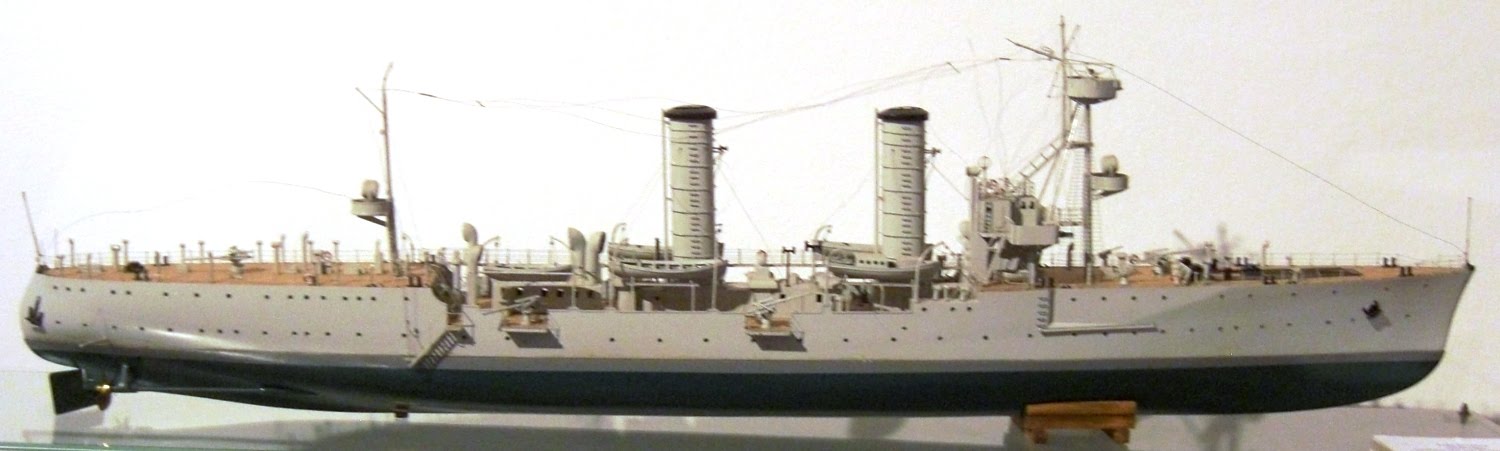
The Yugoslav/Croatian Cruiser Dalmacija

The one model I saw during my visit to the Croatian Maritime Museum (Hrvatski Pomorski Musej) in Split that really interested me was that of the cruiser Dalmacija.

She began life as SMS Niobe, one of the ten Gazelle class cruisers built for the Imperial German Navy at the turn of the twentieth century. Her general characteristics at the time she was launched were:
  • Displacement: 2,916 tons, 3,033 tons full load
  • Length (overall): 344 ft/105.1 metres
  • Beam: 40 ft/12.2 metres
  • Draught: 18 ft/5.4 metres
  • Propulsion: 2-shaft triple expansion engines (8,000 ihp)
  • Speed: 21.5 knots
  • Complement: 249
  • Armament: 10 × 4.1-inch/105mm QF Guns; 10 x MGs; 3 x 17.7-inch/450mm torpedo tubes
SMS Niobe was already obsolete by the time that the First World War broke out, and she saw limited service during the War. As a result of her obsolescence, the Navy of the new German Republic was allowed to retain her as part of the post-War fleet.

In 1925 she was sold to Yugoslavia, renamed Dalmacija, and she was refitted at Kiel to prepare her for her new role as flagship (and training ship) of the Royal Yugoslav Navy. Her former 'ram' bow was replaced by one with a more modern shape and the armament was changed. She now carried 6 x 3.5-inch/83.5mm QF Guns, 4 x 47mm QF Guns, 2 x 15mm AA MGs, and 2 x 17.7-inch/450mm torpedo tubes.

After the invasion of Yugoslavia in 1941, she was captured by the Italians at Kotor. They promptly renamed her Cattaro (the Italian name for Kotor) and commissioned her as a training cruiser. The only changes they made to her armament was to replace the 15mm AA MGs with 20mm Breda AA Guns.

After the Italian capitulation in 1943 she was incorporated into the German navy (again!) and recommissioned with her original name, Niobe. They enhanced her armament by adding 2 x 20mm Flakvierling (i.e. 2 x 4 x 20mm AA Guns). The Germans used her offensively against the Yugoslav partisans, but eventually they handed her over to the newly formed Croatian Navy (most of her crew whilst she had been part of the German Navy had been Croat), and she may have been renamed Dalmacija yet again.

She was lost on 22nd December 1943 as a result of running aground whilst returning from an aborted mission and subsequently being torpedoed by two British Motor Torpedo Boats.

Battle Reports: Progress has been made!

I have now added a 'Battle Report' label to all the relevant blog entries I have written since September 2009 ... and it made me realise just how many there were!

In fact the numbers for each year are as follows:
  • 2008: 11
  • 2009: 11
  • 2010: 4

It strikes me that I was playing a lot more wargames when I started this blog than I do now ... and this is something that I must seriously address!

The most obvious reason is that I am working longer hours now than I used to, but I also suspect that I am now doing much more wargame designing that I did back then, and that this has tended to reduce the number of wargames that I have fought.

That said, I feel that I am almost at a stage where I have a set of simple but effective wargames rules that will satisfy my needs for the foreseeable future. They are based on Joseph Morschauser's wargame rules (which is not very surprising!) but with elements (and inspiration) drawn from the work of Donald Featherstone, Ian Drury, Richard Brooks, and Tim Gow.

With a bit of luck In hope to write quite a few 'battle reports' by the end of December this year; just keep reading this blog to find out how many!

Battle Reports

Whilst I have been away I received an email asking if – in the light of the blog entries I wrote last month about the 'Incident on the border' – I intended to write any more 'battle reports'. I then realised that this was a 'label' that I had not set up, and that the casual blog reader would not be able to find them.

It is my intention to add such a 'label' as soon as possible, and to go back through my blog entries and identify any relevant entries that it should apply to.