Pages

Sunday, 22 September 2013

The irresistible itch still needs scratching

Despite my best intentions, I have yet to begin drafting a set of rules that will utilise Archduke Piccolo's innovative D6 dice combat resolution system. Other things – such as the need to continue work on the major gardening project my wife and I have in hand – have rather occupied my time ... and I know that I will not have much free time next week. (I am attending a long meeting – followed by a formal dinner – at Great Queen Street on Wednesday and a wedding on the following Saturday.)

I still intend to write these rules ... but it looks as if it might have to wait until early October before I can.

Saturday, 21 September 2013

A meeting in London

A few weeks ago I received an email from one of my regular blog readers who is also an occasional blogger in his own right. (He blogs under the name Desto Fante.) He was coming to London on business and wondered if we could meet up for chat. This sounded like an excellent idea ... and so we did!

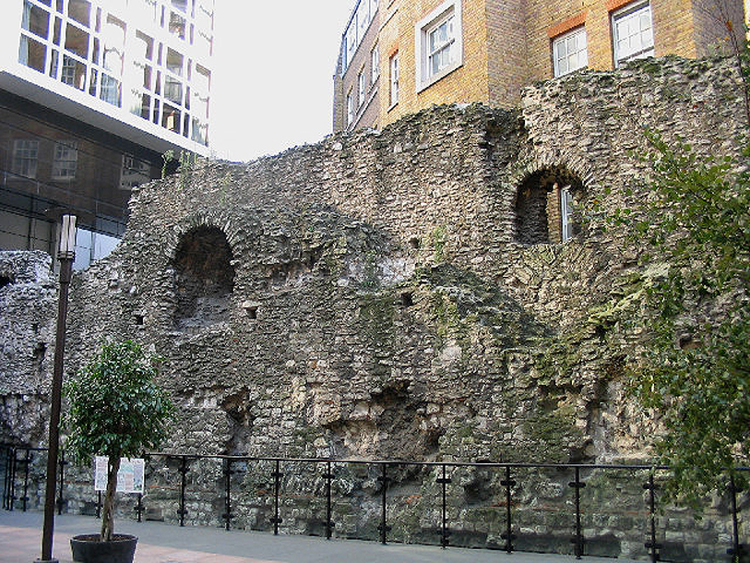
As Desto Fante was staying in a hotel near to the Tower of London, I suggested that the best place to meet was outside Tower Hill underground station. Not only does this overlook the Tower of London and Tower Bridge, it was also the site of one of the places where public executions used to be held. Furthermore it is just around the corner from Cooper's Row, where a stretch of the Roman wall around Londinium is still extant.

We arranged to meet at 12.30pm, and after brief introductions we set off to find somewhere to sit and have a refreshing drink. This took slightly longer than expected as most of the pubs in that part of the City of London were shut, but eventually we found somewhere, and we spent a very pleasant hour chatting. It was then time for lunch, which we ate outside a cheese shop in Leadenhall Market. We finally made our way back to Tower Hill, where we parted company just after 3.30pm.

It was a very pleasant way to spend the early afternoon on a Saturday in September, and we hope to meet again the next time Desto Fante is in London.

Miniature Wargames with Battlegames Issue 366

The latest issue of MINIATURE WARGAMES WITH BATTLEGAMES magazine arrived in the post yesterday, but I only managed to look through it this morning.


The articles included in this issue are:
  • Briefing (i.e. the editorial) by Henry Hyde
  • Forward observer by Neil Shuck
  • Are these huts just crepe?: The continuing tales of a wargames widow by Diane Sutherland
  • Fantasy Facts: Lifting the lid on scenery by John Treadaway
  • Stop thief!: An exercise in pursuit by Daniel Mersey
  • The Wild West (According to Hollywood …) by Leslie Tipping
  • Command challenge: Encounter at Plattdorf by Henry Hyde
  • Tealight ironclads: Simple ships for naval games by Rob Young
  • Send three and fourpence by Conrad Kinch
  • Suleiman’s ‘Stalingrad’: The Great Siege of Malta 1565 by Gary Mitchell
  • Last post for the toy soldier general: A tribute to Donald Featherstone, 1918 – 2013 by Chris Scott and Charles Grant
  • Wiener Planspielregeln: Combined Arms Wargaming 1940 – 1970: Part 1 by Franz Ehart
  • At play with Crooked Dice: Bonding with the SpyFi masterminds by John Treadaway
  • Recce
  • The Battlegames Combat Stress Appeal report by Henry Hyde
The tribute to Donald Featherstone is an excellent summary of his life and work, and is the best obituary about him that I have read to date.

From a personal point-of-view the article about the Wiener Planspielregeln is particularly interesting, especially as the original rules were written back in 1957 and in total isolation from what was happening in the English-speaking world of wargaming.

Friday, 20 September 2013

Wellington's veterans in South America

Whilst I was at the National Archives on Thursday I paid a visit to the in-house bookshop ... and found a very interesting book entitled CONQUER OR DIE!: WELLINGTON'S VETERANS AND THE LIBERATION OF THE NEW WORLD.


The book was written by Ben Hughes and published (in 2010) by Osprey Publishing (ISBN 978 1 84908 183 2). It tells the story of the 6,000 British veterans who enlisted in the army raised by Simon Bolivar to liberate Gran Colombia from the Spanish. Besides a Preface, a Prologue, and a wonderful Dramatis Personae (see below), the book is split into four parts:
  • Part One: RAMBLING BROTHERS O' THE BLADE 1815 – 1818
  • Part Two: INTO THE HEART OF DARKNESS 1818 – 1819
  • Part Three: THE TIPPING POINT 1819 – 1820
  • Part Four: VICTORY: 1820
The book also has maps of the areas in which the main fighting took place and the battles of Calabozo, Semen, Vargas, Boyacá, and Carabobo.

Although the Napoleonic Wars have never been of great interest to me, the South American Wars of Liberation have been, and I am looking forward to reading this book in the near future.

Who could resist a book that states the following about some of the main characters?
Anzoátegui, Lieutenant-Colonel José (b. 1789): Foul-tempered Venezuelan patriot.
Brion, Admiral Luis (b. 1782): ‘A creole … rather advanced in years, of a commanding and stern deportment, dark penetrating eyes, and remarkably long black mustachios’, Brion was the Curaçao-born mercenary admiral of the patriot fleet.
Grant, Captain Peter Alexander (b. 1794): British Army deserter. After working as a slave-driver on Demerara became an early independent volunteer. A ‘specimen of eccentricity’.
Manby, Captain Thomas (b. 1798): Napoleonic veteran. Later became officer in Captain Elsom’s Rifles. 'Dearly love[d] women ... and wine'.
Vowell, Lieutenant Richard Longeville (b. 1795): Oxford undergraduate of 'amiable but thoughtless disposition'. Joined Colonel MacDonald’s 1st Venezuelan Lancers.
It also has the irresistible strap-line 'A tale of defiance, courage, disasters and man-eating crocodiles'.

What is there not to like?

In search of William Richardson

Yesterday my wife and I took a break from gardening (and the prospect of investigating the contents of the shed!) and took a trip to the National Archives, Kew. We spent several hours pouring through British Army records from the late eighteenth and early nineteenth centuries trying to find information out about William Richardson (one of my wife's forebears) ... and for once we had some success.

William Richardson was born in 1772 in Chatham, Kent, and at the age of twelve he enlisted in the Royal Artillery at Woolwich as a drummer. I actually managed to find the list that was drawn up by the recruiting officer that showed that William signed up on 1st August 1785, and that he then joined Captain Reid's Company. This was a detachment of the 4th Battalion (which was then in the Americas and West Indies) and was used for recruit training and to provide drafts to be sent out to join the 4th Battalion. I further discovered that William was transferred to Captain Keith's Company of the 4th Battalion in June 1786, but remained in Woolwich until the Company returned to England later in the year.

Whilst I was doing this research my wife was looking at the end of William's career. She discovered that he was promoted to become the Sergeant Major of 1st Battalion, Royal Artillery in 1810, and that he remained in that position until he retired in 1824. He was awarded a pension, and the records relating to his pension state that he served in the West Indies for part of his service.

What we now have to do is to fill in the missing years of his service ... but that may have to wait for a few weeks, or possibly even months. Although the National Archives are in Kew in South West London, getting there from where we live (in South East London) takes nearly two hours. We have tried driving and going by public transport, but it makes no difference to how long it takes us to get there. So going to the National Archives is a whole-day event ... and we do not have many completely free days in our diaries until after Christmas.

Thursday, 19 September 2013

Playing around with Cyberboard

In the odd free hour or two I have had away from the gardening I have been doing, I have been playing around with Cyberboard. I decided to produce some more terrain tiles for my Cyberboard maps, and after some considerable thought I decided that I wanted to produce map icons that were more pictorial and less topographical in style.

So far I have created:
  • Fortresses (three types: Medieval-style, Vauban-style, and Desert-style)
  • Hills
  • Hills with Trees
  • Mountains
  • Towns and villages: Mediterranean (two alternatives)
  • Towns and villages: North European (two alternatives)
  • Trees (deciduous, pine, and palm)
The results are shown below:


I know that they will not be to everyone's taste, but they do show what can be achieved with a little time and patience.

Wednesday, 18 September 2013

Excavating my shed

When my wife and I moved into our current house in 1985, the garden was a mess. The previous owners had bought the house when it was built in 1936, and as they got older they did less and less gardening. By 1985 it was an overgrown jungle of weeds, and one of the first thing that we did was to have it cleared and a lawn laid down that covered most of the plot. The main exceptions to this were a number of young laurel bushes that were planted along the bottom boundary of the garden and a garden shed that was situated in one corner of the garden next to the laurel bushes.

When we had some building work done ten years ago I 'temporarily' moved some of my wargaming stuff into the shed, and other than the occasional sortie inside to find something, the shed has remained unopened ever since. Over the years the laurel bushes have grown ... and grown ... and grown! In fact they had grown so much that the shed had eventually disappeared from view ... until today.

Over the past week my wife and I have been doing some much needed gardening, including some drastic pruning of the laurel bushes. Thanks to the loan of heavy-duty garden shredder from my brother, we have managed to chop the pruned branches into a lot of very tiny pieces, which are currently awaiting disposal. I finally managed to open the shed door this morning ... and discovered that what I thought was a few crates full of stuff was actually twenty crates full.

A cursory glance inside the crates that were closest to door seemed to indicate that most of the contents were intact, if a little dirty. A proper sort out will have to wait until the rest of the garden is tidied up, a job that will probably take another week, weather permitting. As I have only the vaguest memories of what I put into the crates, investigating their contents could be a very interesting exercise.

My 2,000th blog entry

Back on 18th September 2008 (exactly five years ago!) I wrote my first blog entry. It was entitled SMALL BEGINNINGS and stated the following:
After much prompting ... and not a little reluctance on my part ... I have decided to take the plunge.

I have now joined the world of the self-publicising, self-centred, self-indulgent blogger.

I intend to share my thoughts on wargaming (and other related matters that crop up) with a wider audience ... probably much to the relief of my wife and wargaming colleagues. So watch this space ... and come prepared to be bored!
This is my 2,000th blog entry ... and I think that I have managed to do what I set out to achieve just five years ago.

The last five years have seen quite a few up and downs. My father and father-in-law have both died, and my wife and I are now retired from full-time work ... and hope to remain so. We have cruised around the countries of Europe – visiting almost every one that has a coastline – and even managed to travel across the Atlantic Ocean to visit the United States and Canada.

The most important things that blogging has done for me are:
  • I have done much more wargaming in the last five years than I had done in the previous ten years (it is difficult to write a blog if you don't actually have anything to write about ... so I fought lots of wargames so that I did!).
  • I have made a huge number of new friends and acquaintances around the world, and have even had the opportunity to meet some of them.
  • I have learnt a lot about wargaming – and people – from the feedback regular readers have written in reply to my blog entries.
Thank you to everyone who has read my blog. My only hope was that it was not too boring!

Tuesday, 17 September 2013

Scratching that irresistible itch

Have you ever had a mental itch that just HAD to be 'scratched'? You know what I mean; an irresistible idea that just won't go away and that you have just GOT to use? I have ... and it is a result of Archduke Piccolo's very simple and very effective method for using normal D6 dice to determine the outcomes of combat.

Ever since I read his original blog entry I had wanted to incorporate his dice system into a simple set of wargames rules for the late 19th century ... and today I decided that I just had to 'scratch' that 'itch'. At present my progress can best be described as 'slow but steady', and I doubt if the first draft will be ready much before the weekend, but when I do I would hope to play-test the rules fairly soon afterwards.

Even more ROCO/Roscopf stuff!

Yesterday's post brought with it several boxes of newly-acquired ROCO and Roscopf stuff which will considerably enhance my inventory.

For the Germans there were four Pzkpfw IVs (one of which was a Roskopf model and therefore much smaller than the rest) and two Pzkpfw IIIs, ...


... eight sWS armoured vehicles (two with quadruple 20mm anti-aircraft guns, two with single 37mm anti-aircraft guns, two with infra-red searchlights, and two with multi-barrelled Nebelwerfer launchers), ...


... and seven trucks (four small 4 rad. trucks, one large 4 rad. truck with van body, a Unimog truck with van body, and a tracked RSO truck).


For the Allies there were two 2.5 ton trucks, a 6 ton truck, a high-speed artillery tractor, four cast-hull Shermans, ...


... a trailer, four 155mm howitzers, and five 105mm howitzers (three of which were slightly smaller than the other two).


I am fast reaching the stage where I think that I almost have enough vehicles for my Eastern Front/Great Patriotic War campaign ... but there are still some bits and pieces on sale on eBay that are worth acquiring, so I have not stopped buying ... yet!