Pages

Saturday, 27 July 2013

The Battle of Arora Junction: The loss of Deutsches Sudan

Chapter 1 – The founding of Deutsches Sudan
During the latter part of the 19th century the German Empire set out to acquire its own colonies in Africa. Most of these colonies flourished, but one – Deutsches Sudan (German Sudan) – was only short-lived.


This colony was founded in 1885, and was situated on the Red Sea coast where the borders of Mahdist Sudan and Abyssinia were unclear. The main settlement – Neu Stettin – was a small coastal port whose main function was to act as a coaling station for the Imperial German Navy. Inland from Neu Stettin, and connected to it by a narrow gauge railway, was the settlement of Arora Junction. Arora Junction was garrisoned by an under-strength battalion of native troops, and they were quartered in a small fort in the centre of the settlement.

Chapter 2 – The Khalifa orders Emir Baggar-Tel to attack
The presence of these infidels on what he regarded as his land was a great irritation to the Khalifa, and he ordered his trusted lieutenant Emir Baggar-Tel to drive the "Turks" into the sea.

Knowing that the German troops would be armed with the latest weapons, Baggar-Tel gathered together a large force of riflemen and cavalry with which he planned to make a surprise attack on Arora Junction. His troops managed to avoid contact with the German patrols, and overnight they surrounded the settlement.

Chapter 3 – The Battle of Arora Junction
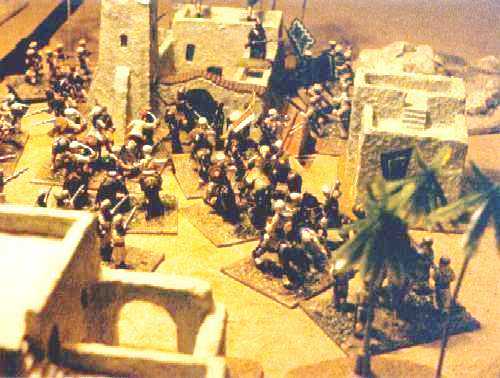
As the sun rose Baggar-Tel was amazed to see most of the German garrison forming up on the parade ground outside the fort.
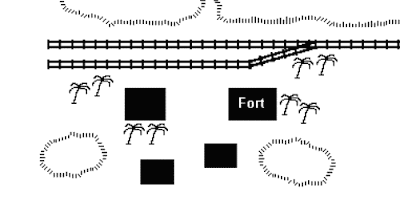

Unbeknown to Baggar-Tel, the garrison commander had received orders from Oberstleutnant Ritter von Stümper – the Colonial Governor's military adviser – to move two of his three infantry companies to Neu Stettin because it was believed that a large Mahdist force was on its way there.


As soon as the German troops began to march towards the train, Baggar-Tel ordered his forces to attack. Surprise was total, and before the lookouts on the fort walls could call out a warning, hordes of Mahdist riflemen and cavalry began their attack.


The main body of German troops were caught outside the fort's walls, and were forced back on them by the sheer weight of the attack. They gallantly fought on despite the odds, but were eventually overcome and slaughtered to a man.


The remains of the garrison continued to defend the fort until nightfall, when they attempted to break-out. They managed to reach the train, but by then the locomotive's boiler was cold and the train was unable to move. They fought on as best they could in the area around the railway, but only one man managed to escape the slaughter.


Chapter 4 – The end of Deutsches Sudan
He reached Neu Stettin next day, and on hearing the news of the massacre the Governor - Doctor Konrad Klutz - contacted Berlin for urgent reinforcements. In reply he was told that a light cruiser of the Imperial German Navy would arrive the next day with orders for him.

At sunrise on the next morning the light cruiser SMS Kaiserberg steamed into Neu Stettin, and the Governor of Deutsches Sudan was summoned aboard. Much to his surprise Doctor Klutz was told to gather all the German citizens and their belongings together at once because the Imperial Government had decided to abandon the colony. The Governor was aghast at the news, but obeyed his orders, and by nightfall Deutsches Sudan had ceased to exist.

Modelling Notes
The troops featured in the photographs are mainly 20mm-scale Jacklex and Les Higgins figures. They were originally owned and painted by Richard Madder. The buildings are from the Hovels 15mm-scale Middle East Buildings range, the narrow gauge locomotive and rolling stock are made by Liliput™, the trees are Small Palm Trees supplied by Essex Miniatures, the terrain cloth was bought in the Maidstone branch of Games Workshop, and the hills are home-made from plywood, expanded polystyrene, white glue, Dulux matt emulsion paint, and various scenic scatter materials.

Friday, 26 July 2013

Rationalising my Colonial Wargames website

Before I revamp my Colonial Wargames website, I have been going through it in some detail ... and I have come to the conclusion that some of the battle reports are no longer needed.

That said, I don't want to see them disappear completely, and I have therefore decided to turn them into blog entries that I will publish over the forthcoming weeks. To regular blog readers who have read them previously, I am sure that you will enjoy reading them again ... and for those who have not read them before, I hope that you will enjoy reading them for the first time.

Thursday, 25 July 2013

The proof of the pudding … or rather, the proof of armour and guns

I have lived in the Woolwich area for nearly forty years, and during that time I have had access to the Royal Artillery’s Museum, both in its old location at the Rotunda and its present site within the old Royal Arsenal. Some of the more unusual exhibits on show are large pieces of armour plate that have acted targets for heavy guns. This was done to see how proof the armour was against guns of different types and calibres.

The following are examples of such armoured targets.

5-inch iron armour


11-inch iron armour


13-inch iron armour


As a result of such experiments, it was possible to draw up a table that compared the resistance to penetration of different types of armour.


Guns were also proofed at Woolwich and the largest ever tested there was the 16-25-inch Breech Loading Mk.I that was manufactured by at Elswick by Armstrongs.


Its specifications were:
  • Total Weight: 111 tons
  • Calibre: 16.25 inches
  • Barrel length: 487.5 inches
  • Shells: 1,800 pound Armoured-piercing, Common, and Shrapnel shells
  • Elevation: -5° to + 13°
  • Muzzle velocity: 2,087 feet/second
  • Maximum range: 12,000 yards
The gun was introduced into service in 1885, and was used aboard HMS Benbow, HMS Victoria, and HMS Sans Pareil.

The proof mounting used still exists, and was on display in Woolwich until recently. The barrel is NOT a 16.25-inch but an 18-inch howitzer that was developed towards the end of the First World War.


Wednesday, 24 July 2013

The Battle of Abu Klea … in poetry

One of my heroes is Colonel Frederick Gustavus Burnaby, whose death at the Battle of Abu Klea was the inspiration – in part – for two poems, one by Sir Henry Newbolt and the other by William McGonagall.

“Vitai Lampada”
By Sir Henry Newbolt

There's a breathless hush in the Close to-night –
Ten to make and the match to win –
A bumping pitch and a blinding light,
An hour to play and the last man in.
And it's not for the sake of a ribboned coat,
Or the selfish hope of a season's fame,
But his Captain's hand on his shoulder smote
"Play up! play up! and play the game!"

The sand of the desert is sodden red, –
Red with the wreck of a square that broke; –
The Gatling's jammed and the colonel dead,
And the regiment blind with dust and smoke.
The river of death has brimmed his banks,
And England's far, and Honour a name,
But the voice of schoolboy rallies the ranks,
"Play up! play up! and play the game!"

This is the word that year by year
While in her place the School is set
Every one of her sons must hear,
And none that hears it dare forget.
This they all with a joyful mind
Bear through life like a torch in flame,
And falling fling to the host behind –
"Play up! play up! and play the game!"

Published in Admirals All (1897)


“The Battle of Abu Klea”
By William McGonagall

Ye sons of Mars, come join with me,
And sing in praise of Sir Herbert Stewart's little army,
That made ten thousand Arabs flee
At the charge of the bayonet at Abu Klea.

General Stewart's force was about fifteen hundred all told,
A brave little band, but, like lions bold,
They fought under their brave and heroic commander,
As gallant and as skilful as the great Alexander.

And the nation has every reason to be proud,
And in praise of his little band we cannot speak too loud,
Because that gallant fifteen hundred soon put to flight
Ten thousand Arabs, which was a most beautiful sight.

The enemy kept up a harmless fire all night,
And threw up works on General Stewart's right;
Therefore he tried to draw the enemy on to attack,
But they hesitated, and through fear drew back.

But General Stewart ordered his men forward in square,
All of them on foot, ready to die and to dare;
And he forced the enemy to engage in the fray,
But in a short time they were glad to run away.

But not before they penetrated through the British square,
Which was a critical Moment to the British, I declare,
Owing to the great number of the Arabs,
Who rushed against their bayonets and received fearful stabs.

Then all was quiet again until after breakfast,
And when the brave little band had finished their repast,
Then the firing began from the heights on the right,
From the breastworks they had constructed during the night.

By eight o'clock the enemy was of considerable strength,
With their banners waving beautifully and of great length,
And creeping steadily up the grassy road direct to the wells,
But the British soon checked their advance by shot and shells.

At ten o'clock brave General Stewart made a counter-attack,
Resolved to turn the enemy on a different track;
And he ordered his men to form a hollow square,
Placing the Guards in the front, and telling them to prepare.

And on the left was the Mounted Infantry,
Which truly was a magnificent sight to see;
Then the Sussex Regiment was on the right,
And the Heavy Cavalry and Naval Brigade all ready to fight.

Then General Stewart took up a good position on a slope,
Where he guessed the enemy could not with him cope,
Where he knew the rebels must advance,
All up hill and upon open ground, which was his only chance,

Then Captain Norton's battery planted shells amongst the densest mass,
Determined with shot and shell the enemy to harass;
Then came the shock of the rebels against the British square,
While the fiendish shouts of the Arabs did rend the air.

But the steadiness of the Guards, Marines, and Infantry prevailed,
And for the loss of their brother officers they sadly bewailed,
Who fell mortally wounded in the bloody fray,
Which they will remember for many a long day.

For ten minutes a desperate struggle raged from left to rear,
While Gunner Smith saved Lieutenant Guthrie's life without dread or fear,
When all the other gunners had been borne back,
He took up a handspike, and the Arabs he did whack.

The noble hero hard blows did strike,
As he swung round his head the handspike;
He seemed like a destroying angel in the midst of the fight,
The way he scattered the Arabs left and right.

Oh! it was an exciting and terrible sight,
To see Colonel Burnaby engaged in the fight:
With sword in hand, fighting with might and main,
Until killed by a spear-thrust in the jugular vein.

A braver soldier ne'er fought on a battle-field,
Death or glory was his motto, rather than yield;
A man of noble stature and manly to behold,
And an honour to his country be it told,

It was not long before every Arab in the square was killed,
And with a dense smoke and dust the air was filled;
General Stewart's horse was shot, and he fell to the ground,
In the midst of shot and shell on every side around.

And when the victory was won they gave three British cheers,
While adown their cheeks flowed many tears
For their fallen comrades that lay weltering in their gore;
Then the square was re-formed and the battle was o'er.

Published in Poetic gems selected from the works of William McGonagall, poet and tragedian with biographical sketch by the author and portrait (1890)

Two somewhat different poetic approaches to the same subject material!

Tuesday, 23 July 2013

A useful little gun

Looking through my Colonial Wargames website, I came across some photographs and information about the Ordnance Quick Firing 2.95" Mk.1 Gun.


The gun was designed and built by Vickers and was introduced into limited service with the British Army in 1901. Its specifications were:
  • Total Weight: 830 pounds
  • Calibre: 75mm (2.953 inches)
  • Barrel length: 31.6 inches
  • Width: 32 inches
  • Height: 26 inches (barrel axis)/36 inches (wheel)
  • Shells: 12.5 pound Common and Shrapnel shells and 18 pound Double common shell (all fixed rounds)
  • Elevation: -10° to + 27°
  • Rate of fire: 14 rounds per minute
  • Muzzle velocity: 920 feet/second
  • Maximum range: 4,825 yards
The guns were not adopted by the British Army although 24 guns were bought and operated by the Royal West African Frontier Force (WAFF). The biggest user of the Ordnance Quick Firing 2.95" Mk.1 Gun was the United States Army, who bought 132. These were used during the Philippine Insurrection, and sufficient of them were still in service in 1941 for approximately 50 of them to be issued to the Filipino Army artillery regiments, who used them against the Japanese invasion.

One of these guns was used during the filming of CARRY ON, UP THE KHYBER …


… and several of them featured in the Battle of Omdurman scenes in the film YOUNG WINSTON.

Monday, 22 July 2013

Poetic views of the Charge of the Light Brigade

A recent comment by Bluebear Jeff made me look at two different poems about the Charge of the Light Brigade, the first being Tennyson’s famous poem and the second Kipling’s poem about the treatment of the survivors.

They make very interesting reading.


“The Charge of the Light Brigade”
By Alfred, Lord Tennyson

Half a league, half a league,
Half a league onward,
All in the valley of Death
Rode the six hundred.
“Forward, the Light Brigade!
Charge for the guns!” he said.
Into the valley of Death
Rode the six hundred.

“Forward, the Light Brigade!”
Was there a man dismayed?
Not though the soldier knew
Someone had blundered.
Theirs not to make reply,
Theirs not to reason why,
Theirs but to do and die.
Into the valley of Death
Rode the six hundred.

Cannon to right of them,
Cannon to left of them,
Cannon in front of them
Volleyed and thundered;
Stormed at with shot and shell,
Boldly they rode and well,
Into the jaws of Death,
Into the mouth of hell
Rode the six hundred.

Flashed all their sabres bare,
Flashed as they turned in air
Sabring the gunners there,
Charging an army, while
All the world wondered.
Plunged in the battery-smoke
Right through the line they broke;
Cossack and Russian
Reeled from the sabre stroke
Shattered and sundered.
Then they rode back, but not
Not the six hundred.

Cannon to right of them,
Cannon to left of them,
Cannon behind them
Volleyed and thundered;
Stormed at with shot and shell,
While horse and hero fell.
They that had fought so well
Came through the jaws of Death,
Back from the mouth of hell,
All that was left of them,
Left of six hundred.

When can their glory fade?
O the wild charge they made!
All the world wondered.
Honour the charge they made!
Honour the Light Brigade,
Noble six hundred!

Published in The Examiner (9th December, 1854)


“The Last of the Light Brigade”
By Rudyard Kipling

There were thirty million English who talked of England's might,
There were twenty broken troopers who lacked a bed for the night.
They had neither food nor money, they had neither service nor trade;
They were only shiftless soldiers, the last of the Light Brigade.

They felt that life was fleeting; they knew not that art was long,
That though they were dying of famine, they lived in deathless song.
They asked for a little money to keep the wolf from the door;
And the thirty million English sent twenty pounds and four!

They laid their heads together that were scarred and lined and grey;
Keen were the Russian sabres, but want was keener than they;
And an old Troop-Sergeant muttered, "Let us go to the man who writes
The things on Balaclava the kiddies at school recites."

They went without bands or colours, a regiment ten-file strong,
To look for the Master-singer who had crowned them all in his song;
And, waiting his servant's order, by the garden gate they stayed,
A desolate little cluster, the last of the Light Brigade.

They strove to stand to attention, to straighten the toil-bowed back;
They drilled on an empty stomach, the loose-knit files fell slack;
With stooping of weary shoulders, in garments tattered and frayed,
They shambled into his presence, the last of the Light Brigade.

The old Troop-Sergeant was spokesman, and "Beggin' your pardon," he said,
"You wrote o' the Light Brigade, sir. Here's all that isn't dead.
An' it's all come true what you wrote, sir, regardin' the mouth of hell;
For we're all of us nigh to the workhouse, an' we thought we'd call an' tell.

"No, thank you, we don't want food, sir; but couldn't you take an' write
A sort of 'to be continued' and 'see next page' o' the fight?
We think that someone has blundered, an' couldn't you tell 'em how?
You wrote we were heroes once, sir. Please, write we are starving now."

The poor little army departed, limping and lean and forlorn.
And the heart of the Master-singer grew hot with "the scorn of scorn."
And he wrote for them wonderful verses that swept the land like flame,
Till the fatted souls of the English were scourged with the thing called Shame.

They sent a cheque to the felon that sprang from an Irish bog;
They healed the spavined cab-horse; they housed the homeless dog;
And they sent (you may call me a liar), when felon and beast were paid,
A cheque, for enough to live on, to the last of the Light Brigade.

O thirty million English that babble of England's might,
Behold there are twenty heroes who lack their food to-night;
Our children's children are lisping to "honour the charge they made – "
And we leave to the streets and the workhouse the charge of the Light Brigade!

Published in the St James’ Gazette (28th April, 1890)
The penultimate verse was included in the first publication in the St James' Gazette, but was omitted from the collected versions

Sunday, 21 July 2013

I have been to ... the Home House Club

Yesterday my wife and I attended a luncheon held at the Home House Club in Portman Square, London W1. The lunch was a special 'Ladies Lunch' and was organised by the head of one of the branches of an international fraternal organisation of which I am a member. It is our way of saying 'thank you' to our wives and partners for putting up with us disappearing every so often to attend meetings.


The Club occupies Nos. 19, 20, and 21 Portman Square and was opened as a private members club in 1998.

No. 20 was originally designed in 1773 by James Wyatt for Elizabeth, Countess of Home, but Wyatt was sacked in 1775 before the building was completed, and replaced by Robert Adam. After the death of the Countess the building passed to her young nephew and it was subsequently let to a number of people including the French Ambassador, the Dukes of Atholl and Newcastle, as well as Earl Grey. From 1932 until 1989 it was leased by the Courtauld Institute of Art, but then remained empty until it was bought by Berkley Adam Ltd in 1996. They restored to its former glory and it was opened as a private members club in 1998.

No. 21 was also designed by James Wyatt in 1772, but it was not leased and occupied until William Lock leased it in 1778. He vacated the building in 1781, and subsequently it was occupied by numerous people, including Lord Maynard, Colonel George Clerk, Hamilton Nisbet, Spencer Percival, and George Hanbury. The building ceased being a private residence in 1932, and since then it has served as the home of the Dutch Legation (1930-1952), the headquarters of Rotary International of Great Britain (1953-1958), the Senegalese Embassy (1964-1970), and the drawings collection archive of the Royal Institute of British Architects (1970-2005). The building became part of the Home House Club.

Saturday, 20 July 2013

Muckleburgh ships

I usually manage to visit the Muckleburgh Collection in Norfolk every three or four years. I have not been recently, but I understand that the collection of 1:96th-scale model ships build by Wyndham Williams is still on show.

Here are a selection of the models in that collection:

HMS Magnificent
HMS Magnificent was one of the nine Majestic-class battleships built for the Royal Navy built during the last decade of the nineteenth century.

Her specifications were:
  • Displacement: 16,060 tons
  • Length: 421 feet
  • Beam: 75 feet
  • Draught: 27 feet
  • Propulsion: 2 × 3-cylinder triple expansion steam engines powering twin screws
  • Speed: 16 knots
  • Complement: 672
  • Armament:
    • 4 x BL 12-inch 35-calibre Mk VIII guns (2 x 2)
    • 12 x QF 6-inch 40-calibre guns (12 x 1)
    • 16 x QF 12-pounder (3-inch) (16 x 1)
    • 12 x QF 3-pounder (12 x 1)
    • 5 x 18-inch torpedo tubes (four submerged, one above water)
  • Armour:
    • Belt armour: 9 inches
    • Deck: 2.5 to 4.5 inches
    • Barbettes: 14 inches
    • Conning Tower: 14 inches


HMS Hornet
HMS Hornet was one of the Acheron-class destroyers built for the Royal Navy just before the First World War.

Her specifications were:
  • Displacement: 910 tons
  • Length: 246 feet
  • Beam: 26 feet
  • Draught: 8.9 feet
  • Propulsion: 2 × steam turbine engines powering twin screws
  • Speed: 28 knots
  • Complement: 72
  • Armament:
    • 2 x BL 4-inch L/40 Mark VIII guns (2 x 1)
    • 2 x QF 12-pounder (3-inch) (2 x 1)
    • 2 x 21-inch torpedo tubes

HMS Warrior
HMS Warrior (and her sister-ship HMS Black Prince) were the first armour-plated, iron-hulled warships built anywhere in the world. She has been preserved as a museum in Portsmouth as part of the National Historic Fleet.

Her specifications were:
  • Displacement: 9,137 tons
  • Length: 420 feet
  • Beam: 58 feet 4 inches
  • Draught: 26 feet 10 inches
  • Propulsion: 1 x steam trunk engine powering a single screw
  • Speed: 14 knots
  • Complement: 706
  • Armament:
    • 26 x Smoothbore muzzle-loading 68-pounder guns
    • 10 x Rifled breechloading 110-pounder guns
    • 4 x Rifled breechloading 40-pounder guns
  • Armour:
    • Belt armour: 4.5 inches
    • Bulkheads: 4.5 inches

HMS Warspite
HMS Warspite was a Queen Elizabeth-class battleship that was built during the First World War for the Royal Navy and continued in service (after a major reconstruction) throughout the Second World War.

Her specifications were:
  • Displacement (as built): 33,410 tons
  • Length: 639 feet 5 inches
  • Beam: 90 feet 6 inches
  • Draught: 30 feet 6 inches
  • Propulsion: 4 × direct drive steam turbines powering four screws
  • Speed: 24 knots
  • Complement: 925 to 1,220
  • Armament (after reconstruction):
    • 8 x BL 15-inch L/42 guns Mk I guns (4 x 2)
    • 8 x QF 6-inch 40-calibre guns (8 x 1)
    • 8 x QF 4-inch Mk XVI anti-aircraft guns (4 x 2)
    • 32 x 2-pounder anti-aircraft guns (4 x 8)
    • 16 x 0.5-inch anti-aircraft machine guns (4 x 4)
  • Armour:
    • Belt armour: 14 inches
    • Barbettes and Turrets: 13 inches
    • Conning Tower: 12 inches

Friday, 19 July 2013

Disney's 'Planes'

As a follow-up to the successful cartoon series CARS, Walt Disney Studios will be releasing a new cartoon series entitled PLANES on 9th August 2013 ... and some of the merchandise is already in the shops. I saw some of the diecast model aircraft in the Disney store at Bluewater, and whereas some of them may not be of a great deal of use to wargamers, some might.

Amongst the aircraft 'characters' in the film are:
  • A crop-duster (whose design is very like that of an Air Tractor AT-502 and PZL-Mielec M-18 Dromader)
  • A Chance Vought F4U Corsair
  • A generic biplane
  • A de Havilland DH.88 Comet
  • A Gee Bee Model R
  • Two Boeing F/A-18E Super Hornets
These are the ones that will probably be of most interest to wargamers, and it is interesting to note that most are produced in a number of different scale/sizes.

My own favourite is the Gee Bee Model R, which is little more that a very large radial engine with wings! It looks like an aircraft that SHOULD have been militarised and turned into a fighter.


My second favourite is the de Havilland DH.88 Comet. My paternal grandfather helped built them (he worked for the de Havilland company at the time) and they are often cited as being the forerunner of the de Havilland Mosquito.


Both aircraft would be very suitable for 'conversion' into military aircraft for wars (imaginary or otherwise) that might have taken place during the late 1930s.

Thursday, 18 July 2013

Miniature Wargames with Battlegames Issue 364

I received the latest issue of MINIATURE WARGAMES WITH BATTLEGAMES magazine in the post today.


The articles included in this issue are:
  • Briefing (i.e. the editorial) by Henry Hyde
  • Forward observer by Neil Shuck
  • Up the creek: The continuing tales of a wargames widow by Diane Sutherland
  • Fantasy Facts: Dredding the future by John Treadaway
  • Can I be your condottiere?: Wargaming the Italian Wars by Gerard Miller
  • Command challenge: Doing it by the book by Richard Clarke
  • Send three and fourpence by Conrad Kinch
  • Tommies in hot places: A visual guide to british troops in the tropic by Mark Hargreaves
  • The tide is turning: Terror in the Mersey tunnels by Martin Penneck
  • Wilson's Creek 1861: Adapting Black Powder for the ACW by Paul Stevenson
  • Meet Kevin Dallimore: Brushmeister extraordinaire by John Treadaway
  • Salamanca's siren call: Part 1: laying the groundwork by Henry Hyde
  • Thoughts from an armchair by Mike Siggins
  • Recce
  • The Battlegames Combat Stress Appeal report by Henry Hyde
  • The Secret Eye Candy Page: Broadside 2013 Photo Gallery by Henry Hyde
This looks like being yet another top-notch issue ... and well worth the cost of the subscription that I took out.