Pages

Showing posts with label Battle Cry. Show all posts

Sunday, 24 January 2021

'The history of a wargame design ...'

'... is not unlike the history of a ball. Some designers may recollect all the little events of which the great result is the rules that are written, but no individual can recollect the order in which, or the exact moment at which, they occurred, which makes all the difference as to their value or importance.'

I do hope that the Duke of Wellington will excuse me mangling his quote* about the Battle of Waterloo, but it is rather appropriate at the moment.

This quote came to mind when I began work on the PowerPoint presentation that I am preparing for the forthcoming VCOW2021. I wanted to start with a short explanation about how the whole PORTABLE WARGAME concept came about ... and then realised that it was not as straightforward as I had thought that its was.

Looking back through my past blog posts, I began to realise that the rules evolved as a result of the coming together of several separate strands. The first of these was my desire to emulate the gridded wargames illustrated in both Donald Featherstone's and Joseph Morschauser's books.

In the latter's case, he was strongly influenced by Professor Gerard de Gre, who ran the wargame club at the college that Joseph attended as a student.

The second was Ian Drury's RETURN TO NEW STANHALL game at COW1998(!). This led directly to the development of SCWaRes (Simple Colonial Wargame Rules), which in turn was developed into WHEN EMPIRES CLASH!

At about the same time, I 'rediscovered' Joseph Morschauser's book and bought a copy of Richard Borg's MEMOIR '44 ...

... which eventually led me to buy both the first ...

... and second edition version of his American Civil War game, BATTLE CRY.

I did develop my own take on MEMOIR '44, which I entitled MEMOIR OF BATTLE, which in turn led to MEMOIR OF BATTLE AT SEA and MEMOIR OF MODERN BATTLE.

All the strands were now in place, and all it needed was a catalyst to start the process that led to the final development of the PORTABLE WARGAME.

The catalyst was an old, boxed chess set that was then stored in our conservatory. The heat and sun in the conservatory had not treated it kindly, and the wooden chessmen were warped and cracked. The edge of the board had become detached as the glue had dried out, and my wife gave me an ultimatum to either find a use for the chessboard or to throw it away.

I was loath to throw it away, and decided that it might make the basis of a simple, portable wargame. I began experimenting with ideas that I had garnered from my previous wargame designs ... and this eventually led to the creation of the PORTABLE WARGAME.


* The original quote is:

'The history of a battle, is not unlike the history of a ball. Some individuals may recollect all the little events of which the great result is the battle won or lost, but no individual can recollect the order in which, or the exact moment at which, they occurred, which makes all the difference as to their value or importance.'

It was written by the Duke of Wellington in a letter to John Croker, dated 8th August 1815. Croker was an Irish Member of Parliament and a longtime friend of the Duke.

Tuesday, 13 August 2019

Memoir '44 New Flight Plan expansion set

I like Richard Borg's wargames, and own quite a few of them, including both the early and later versions of BATTLE CRY and COMMANDS & COLORS: NAPOLEONICS. My largest collection of his games consists of MEMOIR '44 and most of the expansion sets ... and I have just added the latest of the latter to my collection.


The MEMOIR '44 NEW FLIGHT PLAN expansion set is a more streamlined and simplified version of the earlier AIRPACK (which I have used but never owned) and includes
  • 16 unpainted aircraft models that look approximately 1:300th-scale
    • US North American P-51 Mustang fighter
    • US Chance Vought F4U Corsair fighter
    • US Republic P-47 Thunderbolt fighter-bomber
    • US Boeing B-17 Flying Fortress heavy bomber
    • UK Submarine Spitfire fighter
    • UK Hawker Typhoon fighter-bomber
    • UK Avro Lancaster heavy bomber
    • German Messerschmidt Bf 109 fight
    • German Junkers Ju 87 Stuka dive bomber
    • Heinkel He 111 medium bomber
    • Japanese Mitsubishi A6M Zero fighter
    • Japanese Aichi D3A Val dive bomber
    • Japanese Mitsubishi G4M Betty medium bomber
    • Soviet Yakovlev Yak-9 fighter
    • Soviet Ilyushin IL-2 Sturmovik ground attack aircraft
    • Soviet Ilyushin DB-3/IL-4 medium bomber
  • 3 aircraft stands for the models to use when 'flying' over the terrain boards from the original MEMOIR '44 games
  • 30 Air Combat Cards
  • 8 Summary Cards
  • 15 Nation Markers
  • 18 Machine Gun and 12 Bomb Markers
  • A Rules Booklet
  • A Scenario Booklet with scenarios for 21 new battles most of which that can be used with or without the MEMOIR '44 NEW FLIGHT PLAN expansion set
    • Western Front
      • Isneauville Junction
      • Battle of Pico
      • Battle of La Heunière
      • Groesbeek Heights
      • North of Oosterbeek
      • Reinforce Arnhem
      • Elst
      • Koevering Corridor Raid
    • Mediterranean Theatre
      • Kalamata Waterfront
      • Fort Capuzzo
      • Attack of the Sabratha Division
      • Gambut
    • Eastern Front
      • Luftwaffe Air Attack
      • Soviet KV-2 tanks at Lutsk
      • The Grain Elevator
      • Battle of Maciejow
      • Cherkasskoye
    • Pacific Theatre
      • Battle of Wau
      • Main line of resistance
      • Hill 107
      • Capture of Meiktila

Although I have yet to use the rules, I have read through them, and they are not unlike my own air combat rules as featured in DEVELOPING THE PORTABLE WARGAME ... which isn't all that surprising considering they both use individual aircraft models on a hexed board!

For more information about this expansion set (including links to downloads of the rules in four languages and ten of the scenarios), go to the relevant page on the DAYS OF WONDER website.

Please note that the photographs featured above are © DAYS OF WONDER.

Sunday, 17 May 2015

Working towards a set of 'universal' wargames rules

Whilst I was on my recent cruise I had time to give quite a lot of thought to the rules I have been using in the Zubia-based mini-campaigns I have fought since Christmas ... and have come to the conclusion that I am on the verge of putting together a set of simple, fast-play wargames rules that will be adaptable to a variety of different historical periods.

The 'universal' wargames rules that are evolving are based upon the work I had previously done when I wrote the following:
  • THE PORTABLE WARGAME
  • MEMOIR OF BATTLE (MOB)
  • MEMOIR OF MODERN BATTLE (MOBAT)
  • ITCHY & SCRATCHY
They also draw heavily upon the work of Joseph Morschauser and Richard Borg.

In a nutshell the rules can be summarised as follows:
  • Units have initial strength values of 4 (infantry), 3 (cavalry), and 2 (artillery);
  • Units retain an undiminished ability to fight (i.e. they throw the same number of combat dice) until they are destroyed (i.e. their strength value is reduced to 0);
  • When one side's remaining strength value is reduced to 50% of the combined strength value they began the battle with, they cannot continue to advance from their existing positions, although they may withdraw and continue to defend themselves; when both sides are reduced to 50% of the combined strength value they began the battle with, the battle ends;
  • A card-driven unit activation system is used;
  • Unit movement is restricted by the terrain the unit is moving through and whether or not it is engaging in combat during its current activation;
  • One combat resolution system for both fire and close combat;
  • The combat resolution system uses standard D6 dice, with the number of dice thrown depending upon the range at which the combat is taking place;
  • The combat resolution system uses pairs of dice to determine 'hits' on enemy units (i.e. 1 + 1 = 'hit' on an enemy artillery unit; 2 + 2 or 3 + 3 = 'hit' on an enemy cavalry unit; 4 + 4 or 5 + 5 or 6 + 6 = 'hit' on an enemy infantry unit; enemy units in cover require these scores plus an additional pair to be 'hit')
I had initially decided to use special D6 dice similar to those used in Richard Borg's BATTLE CRY and MEMOIR '44 rules, but I found that my attempts to do so were flawed (i.e. the dice seemed to end up unbalanced) so I reverted to a simpler system based on the one used in my ITCHY & SCRATCHY rules. (The original idea for this combat resolution system came from Archduke Piccolo [see my blog entry of 14th September 2013 and his blog entry of 13th September 2013].)

These rules have now been set down on paper, but require some more play-testing before I make them more widely available. In the meantime I want to complete varnishing and basing my collection of Del Prado pre-painted 25/28mm-scale Napoleonic figures before the bicentenary of the Battle of Waterloo in June.

Friday, 7 March 2014

It's three o'clock in the morning ... and I'm thinking about wargaming

As I have mentioned before on my blog, I suffer from periodic bouts of insomnia. Over recent days my inability to sleep has been increased by chronic indigestion ... which I suspect may well have been brought on by my poor sleeping pattern.

A couple of nights ago I gave up the uneven struggle of lying in bed trying to sleep, and at just before three o'clock in the morning I got up, went downstairs to the living room, and sat in my chair ... and hoped that the change of location and position might just help me to doze off. It didn't ... so I began to idly list on a notepad all the things I want the next set of wargame rules I write to include ... and the reasons why.

Here is that list:
  • The tabletop will be gridded. (This is now a prerequisite of my figure wargame designs.)
  • The minimum size of grid should be 8 x 8 (if a squared grid) and 9 x 8 (if a hexed grid). (This is based on the experience I gained whilst designing the PORTABLE WAR GAME.)
  • The basic units will have four infantry figures or three cavalry figures or two artillery crew plus a gun. (This will make them compatible with my existing wargame rules as well as Richard Borg's BATTLE CRY, MEMOIR '44, and COMMANDS & COLORS rules. It will also enable me to store an individual unit in a single compartment in one of the hobby trays manufactured by REALLY USEFUL BOXES.)
  • The rules should be able to be used solo and for face-to-face wargames. (Although most of my wargaming is done solo, I am not completely friendless and do like to fight against other wargamers occasionally!)
  • The combat system should be applicable to both fire combat and close combat. (A single system for resolving all types of combat keeps the design simple, easy to remember, and quick to use.)
  • The dice I use should be either standard D6 dice or D6 dice with symbols on each face. (The former are easy to use but the latter usually don't require users to have to remember the outcomes of particular number or dice score combinations.)
  • There should be some form of limit placed on how many units a commander can activate each turn, and that the limit should reflect the commander's underlying ability to command. (This should work for both solo and face-to-face wargames, and bring an element of 'no commander can do everything' into the rules.)
  • A battle fought using these rules should be quick to set up, fast to fight through, and easy to pack away afterwards ... and should require a small (i.e. 4' x 3' or smaller) tabletop area. (I have to accept that in the modern age time – and space – are at a premium, and that I may have to choose between taking part in large but very infrequent wargames and smaller, more regular ones.)
So now that I have my design parameters – none of which are particularly new or revolutionary, and all of which have featured in one way or another in my earlier designs – all I need to do is to design my next set of wargame rules around them.

As Alexandr Orlov would say ... 'Simples!'

Friday, 31 January 2014

Itchy and Scratchy meets OP14 ... the story continues

Although I have not mentioned it on my blog for the past few days, I have been thinking about bringing elements of OP14 and my ITCHY AND SCRATCHY wargame rules (and possibly BATTLE CRY, MEMOIR '44, and MEMOIR OF BATTLE) together. In fact I sat down one day with the intention of writing this 'new' set of rules ... and promptly hit a mental brick wall.

Modern thinking about work practices seems to be that what I should have done at that stage is just ploughed on regardless ... and hope that something useful would result. (I always think of this as the monkeys and typewriters approach!) It is almost as if being seen to do unproductive work is better than producing no obvious work at all, and that spending time thinking about solving a problem is wasted time.


I have never believed in this sort of approach ... which is probably why I never reached any higher on my career ladder than I did. I always preferred to mentally 'walk away' from a problem that I could not immediately solve in order to let my subconscious mind do the thinking for me ... and I usually found that it worked.

When I woke up this morning I felt as if I was almost ready to begin putting my ideas down on paper ... but not quite. Hopefully this will change as the day goes on and I do everything except sit at my computer thinking about how to start!

Saturday, 25 January 2014

Itchy and Scratchy meets OP14

One of the things that struck me as I was taking part in the recent Ivangorod 1914 re-fight was the similarity between the sizes of units used in OP14 and my ITCHY AND SCRATCHY wargame rules ... and in several other sets of rules (e.g. BATTLE CRY, MEMOIR '44, MEMOIR OF BATTLE). All the rules seem to have gravitated towards unit that have the following number of figures:
  • Infantry: 4 figures
  • Cavalry: 3 or 4 figures
  • Artillery: 2 (or more) figures + 1 gun
With this in mind I began decided to see what sort of OP14 'armies' I could field from my existing 15mm and 20mm-scale collections. The results were – to say the least – interesting.

15mm-scale OP14-style 'armies'
A Fezian Army of three Corps and a reserve Division. Each Corps has two Divisions – each having two Brigades/Regiments – and an Artillery Brigade equipped with 96 Field Guns.


A Britannic Home Service Corps. It has three Divisions – each with two Brigades – and an Artillery Brigade equipped with 48 Field Guns.


A Britannic Foreign Service Army of two Corps and a reserve/lines-of-communication Division. Each Corps has two Divisions – each having two Brigades – and an Artillery Brigade equipped with 72 Field Guns.


20mm-scale OP14-style 'armies'
A German 1944 Infantry Division. It has two Infantry Regiments and an Artillery Regiment with 48 Field Guns.


A Russian Rifle Division. It has three Infantry Regiments and an Artillery Regiment with 48 Field Guns.


It would appear that I could certainly field sizeable OP14-style 'armies' in 15mm-scale ... and that 20mm-scale OP14-style 'armies' might make it possible to re-fight quite large battles in a small space.

If the opportunity arises, I may well take this 'experiment' further. The problem is that when I set out the figures to see what OP14-style 'armies' would look like. I was reminded that my ITCHY AND SCRATCHY wargame rules still need further play-testing and that their origins lie in an idea that Archduke Piccolo had to fight grand tactical/strategic-level wargames. That said, by adopting OP14-style 'armies' and reducing the weapon ranges used in my ITCHY AND SCRATCHY wargame rules I might just be on the verge of developing a set of rules that could be used for fighting grand tactical/strategic-level battles.

This 'experiment' has certainly given me plenty to think about over the next few days.

Friday, 25 January 2013

Visiting Fireman

Last night Tim Gow – a fellow member of Wargame Developments who co-organises the Conference of Wargamers [COW] with me every year – paid his (almost) annual visit to my wife and I. As happened on previous occasions, he was in London for a conference and made time to come over for a chat, something to eat, and a wargame!

We spent a very pleasant evening together, and managed to fight the Battle of Bull Run using BATTLE CRY ... which he won! (The end positions for both sides can be seen in the following photograph.)


We also spent time talking about wargaming in general and the Conference of Wargamers [COW] in particular. Quite a few ideas were discussed (including a possible Plenary Game for the next Conference), as were several potential scenarios for large-scale MEGABLITZ wargames we might fight in the future.

As usual my wife and I enjoyed seeing Tim, and hopefully he will be visiting us again in the very near future.

Thursday, 10 January 2013

Getting ready for Sunday

Next Sunday will be the first meeting of the Jockeys Field Irregulars since Christmas. It was originally intended to be devoted to wargames that were designed by Richard Borg (i.e. BATTLE CRY, MEMOIR '44, and COMMANDS & COLORS) but the recent death of one of the regular members – Roger Barnes – has brought about a change in the programme.

I have been asked to take along my PORTABLE WARGAME, and this afternoon I have begun assembling everything that I need. I am planning to put on three games; two using the 19th century version of the rules and one using the 20th century one. The former will be fought out on two of my vinyl chessboards and the latter will use a green baize cloth ... on which I have yet to mark a suitable square grid. The figures and the rest of the playing equipment (other than copies of the rules) have been boxed up, ready for Sunday … which gives me Friday and Saturday to make sure that I have not forgotten anything.

I am looking forward to Sunday as it will be one of the first opportunities I will have had to try the latest versions of my PORTABLE WARGAME rules out against real opponents. It will also ensure that I am well on the way to fulfilling my objective to fight at least two wargames per month during 2013.

Saturday, 22 December 2012

Portable Wargame news

Whilst I have been away on my latest cruise, the PORTABLE WARGAME has continued to go from strength to strength.

Steven Page (who writes the blog 'Adventures in Portable Wargaming') has been using a slightly tweaked version of the 'Modern' rules to refight several actions in North Africa, including:
At the same time Kaptain Kobold has not only produced a specific American Civil War version of the '19th Century' rules entitled MIGHTY MEAN-FOWT FIGHTS but has also used these rules to fight several battles including:
David Crook (of 'A Wargaming Odyssey' fame) has also been busy and refought The Charge of the Australian Light Horse at Beersheba, October 1917 as well as an after D-Day action in Northern France that he has entitled Breaking the Panzers, France 1944.

So what have I been doing whilst all this 'action' was taking place? The answer is simple; no wargaming BUT I have 'converted' my version of my existing MEMOIR OF BATTLE AT SEA rules that cover the late nineteenth century into a similar format to that used in the PORTABLE WARGAME and renamed them the PORTABLE NAVAL WARGAME rules.

With a bit of luck I should be able to make these 'new' rules available online later today.

Monday, 26 November 2012

An idea worth sharing

One of my regular blog readers – Littlejohn – has come up with a very simple and effective method to draw a hexed grid, and his most recent blog entry explains how he used it to create a hexed playing surface for a naval wargame.

His idea was to create a template that used the redundant part of the cardboard terrain from a copy of Richard Borg's BATTLE CRY game. After the terrain hexes were punched out, the cardboard he was left with was a matrix of hexagonal cut-outs, and he converted it to become a template.

The idea is so simple and effective that it deserves recognition, and in my opinion is one of the best ideas I have read about or seen this year ... and for some time before that as well!

Hats off to Littlejohn for coming up with it!

Tuesday, 16 October 2012

Warbases

One of the things that I bought at the recent SELWG show was a number of pre-cut MDF bases from Warbases. The company produces a wide range of different bases, and I was particularly interested in the ones that took figures mounted on one pence pieces.

This morning I had the opportunity to see what the two, three, and four figure bases looked like with some 20mm-scale figures on them ... and I think that look very good indeed!


I can envisage using the four-figure bases for COMMANDS & COLORS-style games (including BATTLE CRY, MEMOIR '44, MEMOIR OF BATTLE, and MEMOIR OF MODERN BATTLE), a slightly larger version of the three and two-figure bases for MEGABLITZ, and any or all three of the base sizes for the PORTABLE WARGAME, depending upon the size of the grid squares/hexes.

I think that by going down this route I will be able to both have my cake and to eat it. In other words I will be able to have single figure bases and multi-figure bases available to me as and when I need then and will no longer need to have several different collections of figures for the same period mounted on single and multi-figure bases.

Wednesday, 12 September 2012

My own wargames rules on my Kindle!

Emboldened by the recent success of downloading a published set of wargames rules to my Kindle, I tried to do the same with a draft set of rules that I have recently been working on.

The rules are heavily based on Richard Borg's BATTLE CRY/MEMOIR '44 rules, but with a few minor changes of my own. What I actually downloaded was a copy of the playsheet that I have been using ... and the process was very simple.

First I created an A5 version of my rules. I did this so that when it appeared on the Kindle's screen the text would be large enough to read. I then converted it into PDF format, checked that the conversion had worked, and then emailed it to my Kindle. As soon as I checked my Kindle for new items using the 'Sync & Check for Items' option in 'Shop in Kindle Store', the rules appeared onscreen!

This is what they look like on my Kindle, ...


... my iPad, and ...


... my iPhone.


Not bad, even though I say it myself!

Thursday, 30 August 2012

Really Useful Boxes

Over the past year or so I have been acquiring quite a number of storage boxes from the massive range manufactured by REALLY USEFUL BOXES. My particular favourite is the 4 litre-sized box, mainly because it will take A4-sized paper and card but also because two fifteen-compartment Hobby Trays will fit into it.


Each compartment in the Hobby Tray has enough space to accommodate at least one BATTLE CRY, MEMOIR '44, MEMOIR OF BATTLE, or MEMOIR OF MODERN BATTLE unit of 15mm or 20mm-scale infantry figures, and it is my plan to reorganise my collection so that I can get an 'army' into one or two 4 litre-sized boxes.


This is not as daft as it may sound. I understand that Stuart Asquith has been doing something along these lines for quite a few years ... and as I get older I feel the need to consolidate rather than expand my wargames collection, and this is one way in which I can do that.

Sunday, 29 July 2012

The attack on the Hill People: A battle report

One film that made a lasting impression on me when I was young was Alexander Korda’s THINGS TO COME. The screenplay was written by H G Wells and is based upon his novel THE SHAPE OF THINGS TO COME (1933) and his book THE WORK, WEALTH AND HAPPINESS OF MANKIND.

One particular aspect of the film that intrigued me was the way it dealt with the aftermath of a war that went on for nearly thirty years. In the end the war spluttered to an end when a pandemic wiped out a large part of the population and left those that remained living an almost medieval lifestyle. Through a combination of ruthlessness and guile one man rose to become leader in the south of England, and he mounted an attack on the Hill People (I assume that this is a euphemism for the Welsh) to take control of their very important natural resources … coal and oil-bearing shale.

The battle scenes in the film were short but very evocative, and reminded me of the sort of fighting that was seen during the Russian Revolution, the Russian Civil War, and the Spanish Civil War.


I always hankered to try my hand at recreating the battle between the Army of Everytown and the Hill People … and I decided that the figures I had recently finished basing would be ideal for the task.

All the figures are Russian World War II miniatures from a variety of different manufacturers. Some of them depict members of the Workers’ Militia, and I decided that they would make excellent Hill People. The more regular-looking troops formed the basis of the Army of Everytown. Neither side had any artillery, but the Army of Everytown did have a couple of Light Machine Guns.

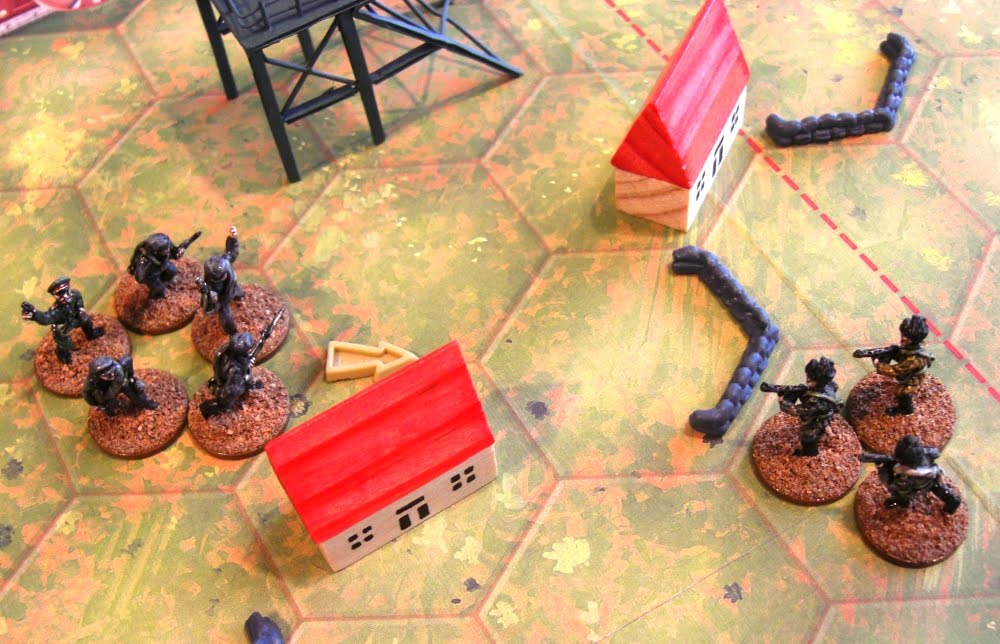
As I had my recently acquired MEMOIR ’44 boards to hand I used one of them to fight my battle on, although I did also use some suitable buildings that I had in my collection. The rules were my own hybrid variant of BATTLE CRY/MEMOIR ’44, and I used the Command Cards from the latter game to generate each side’s tactical choices.

Scenario
The Second Great War started in 1940. After a period of growing tension, a sneak bombing raid wrecked the centre of Everytown. General Mobilisation followed and both sides attempted to break through the other side’s trenches … but to no avail. Despite the use of gas and ever more sophisticated weaponry, neither side could prevail.

The fighting continued until 1966, when a pandemic of the ‘wandering sickness’ (which was probably the result of a biological weapon used by one side or the other) decimated what remained of the world’s population. The vestiges of modern civilisation no longer existed, and people lived much as they had done during the Middle Ages. In southern England one man – known as ‘The Boss’ – eradicated the ‘wandering sickness’ by having any sufferers shot on sight. As a result he rose to be the ruler of a petty fiefdom whose capital was located in what remained of Everytown.

'The Boss' ... and his consort.

However not all technology had been lost. The ability to produce firearms and ammunition remained, and a small number of aircraft – grounded for want of petrol – were kept serviceable by a young technician who worked for ‘The Boss’. Realising that the ability to use aircraft would give his army an advantage over his rivals, ‘The Boss’ decided to invade the land of the Hill People who had abundant supplies of coal and shale that could be turned into fuel for his nascent air force.

The Opposing Forces
The Army of Everytown:
  • ’The Boss’
  • Two Regular Infantry Units armed with Rifles and a Light Machine Gun
  • Three Regular Infantry Units armed with Rifles
The Army of the Hill People:
  • ’The Leader’
  • One Regular Infantry Unit armed with Rifles
  • Three Militia Infantry Units armed with Rifles
Neither side has any artillery or cavalry.

Starting Positions
Hearing that the Army of Everytown is approaching, the Hill People have used their mining skills to throw up a number of fortifications behind which they intend to fight to protect their town and its access to coal and shale.


The Army of Everytown, led by 'The Boss', advanced on a broad front with their two Regular Infantry Units armed with Rifles and a Light Machine Gun on either flank.

Turn 1
The Army of Everytown advanced its two central Units.


The Army of the Hill People refused to be drawn out of their defences.

Turn 2
'The Boss' then ordered the Units on the left and right-hand flanks of the Army of Everytown to advance.


Again the Army of the Hill People remained behind their defences.

Turn 3
The Army of Everytown moved forward a Unit on each flank and in the centre.


As before, the Army of the Hill People refused to react, knowing that in the open the Light Machine Guns of the Army of Everytown could cause them serious casualties.

Turn 4
Frustrated by the lack of response from the defenders, 'The Boss' ordered a General Advance ...


... and for all Units to open fire on the Hill People's defences.


The Units at the centre of the Army of the Hill People's defences suffered significant casualties.


In response, 'The Leader' of the Army of the Hill People ordered his central Units to return fire on the nearest attackers ...


... and inflicted casualties on them!


Turn 5
'The Boss' realised that the Units of the Army of the Hill People opposing his attack in the centre were on the point of collapse and ordered the central Units of his army to attack the enemy front line.


The right-hand Unit managed to wipe out their opponents, but the left-hand Unit failed to inflict any casualties.


'The Leader' of the Army of the Hill People responded by leading his only Regular Infantry Unit forward ...


... and inflicting serious casualties on the attacking Army of Everytown Unit.


Turn 6
His hopes of a quick victory now dashed, 'The Boss' ordered the his two right-hand Units to advance. This gave the Unit armed with Rifles and a Light Machine Gun the opportunity to fire at extreme range ...


... and inflict a casualty.


At this point the Army of the Hill People had suffered over one third casualties and should have surrendered, but 'The Leader' thought that his men still had some fight left in them and decided to fight on.

He moved his Regular Infantry Unit forward and opened fire on the very weak enemy Unit to his front ...


... and wiped it out.


Turn 7
Despite the complete loss of an Infantry Unit, 'The Boss' three of his remaining Units forward to engage the enemy.


This had little effect on the right flank ...


... but on the left flank ...


... and in the middle the Army of the Hill People looked about to collapse!


The Army of the Hill People had been reduced to half of its original strength and its front line had been breached. 'The Leader' realised that his army was about to collapse and he decided to withdraw into the mountains, for where he could wage a guerrilla war on the occupying Army of Everytown.

'The Boss' of Everytown was more than pleased to have successfully secured a supply of coal and shale, even if he had lost an Infantry Unit in the process. Its numbers could easily be replaced as news of this victory spread and more people decided that life under the banner of Everytown (and the benevolent rule of 'the Boss') was better than the alternative.

'The Boss' looks skyward ... possibly in anticipation of the airforce he hopes to have under his command in the very near future.

Conclusions
This was a sharp little action and I really enjoyed fulfilling my long-term ambition to fight it. The newly-based troops looked great, as did the extemporised terrain the battle was fought over. In addition the rules seemed to work quite well as did the system I developed some time ago to use the MEMOIR '44 Command Cards when fighting solo wargames. They did constrain the actions (and reactions) of both sides to events as they unfolded and gave the feeling of unpredictability.