Pages

Monday, 13 January 2014

A 'must have' purchase!

I have been a fan of Boris Akunin's 'Erast Fandorin' stories ever since they were first published in English, and my favourite book is THE TURKISH GAMBIT. This is a spy story set during the Russo-Turkish War of 1877 and revolves around the event of the Siege of Plevna.


Some years ago the book was made into a film by a Russian film company, but it was not – until recently – released as a DVD other than for Region 5 ... which is why I am now the proud owner of a DVD that was made in Russian, dubbed into German and formated for Region 2, and that has English subtitles!


So why was this a 'must have'?

Well besides being a very good story, with lots of action, the film has some wonderful battle scenes ... if what I have seen online is anything to go by!

I am looking forward to watching the DVD at the earliest opportunity ... which will probably be later this week.

The latest Spanish Navy patrol vessels

During my recent visit to Las Palmas in the Canary Islands I saw three Spanish Navy patrol vessels. The were the SNS Meteoro (P41), …


… the SNS Rayo (P42), …


…and the SNS Relámpago (P43).


The fourth ship of the class – the SNS Tornado (P44) – was not present.

These four ships were designed by the Spanish shipbuilder Navantia and are modular in design (i.e. the basic design can be modified to perform a number of functions). They are rated as BAM (Buque de Acción Marítima) and are designed to:
  • Combine high performance with mission versatility.
  • Have high commonality with other ships operated by the Spanish Navy.
  • Have reduced acquisition and life-cycle costs in comparison with similar vessels operated by other navies.
Class Characteristics
  • Displacement: 2,500 tonnes (full load)
  • Length: 93.9m
  • Beam: 14.2m
  • Draft: 4.2m
  • Propulsion: 2 MTU 16-valve 1163 diesel engines powering two variable pitch propellers via a diesel-electric transmission system that uses 2 Siemens electric motors. Each ship is also equipped with 2 x bow thrusters, 4 x MTU 12-valve 2000 diesel generators, and 1 x MTU S60 emergency generator
  • Speed: 20 knots
  • Range: 8700 miles
  • Complement: 46 crew (and 30 additional personnel, as required)
  • Armament: 1 x 76mm OTO Breda or OTO Melara Gun, 2 x 25mm Mk38 MOD 2A Automatic Cannons, 2 × 12.7mm machine guns, 4 x SRBOC Mk36 chaff launchers
  • Aircraft carried: 1 × NH-90 helicopter (as required)
  • Electronic systems and sensors: Dorna 2 fire control system, Scomba combat system, Rigel electronic warfare system, CIT-25D IFF, Tacan MM-6800 navigation set, HC Aries 2 navigation radar, Sperry Vision master FT navigation radar
76mm OTO Melara Gun as fitted to SNS Rayo.
SNS Rayo's bridge and sensors arrays.
The midships section of SNS Rayo showing the hanger doors for the ship's boats.
One of SNS Rayo's 25mm Mk38 MOD 2A Automatic Cannons.
SNS Relámpago's helicopter hanger doors and the helicopter landing deck.
The Spanish plan to build another four or five ships of this class, but that they may well be configured to perform other roles.

Bearing in mind that Navantia's Álvaro de Bazán-class frigate design has been used as the basis for the Norwegian Navy's Fridtjof Nansen-class frigates and the Australian Navy's Hobart-class destroyers, one wonders if developments of the Meteoro-class may be built for other navies.

Sunday, 12 January 2014

Itchy and Scratchy wargames rules: An update

During my recent cruise I did manage to spend some time working on the latest draft on my ITCHY AND SCRATCHY NAVAL wargames rules.

The main changes that I finally introduced (after quite a lot of thought) can be summarised as follows:
  • The Flotation Values of all ship types have been increased.
  • Ships can turn without having to move forward first.
  • Torpedoes now reduce a target ship’s Flotation Value by 2D6.
  • Rules for minefields have been added.
I hope to be able to play-test this new draft of the rules in the near future.

I also produced an amended version of the ITCHY AND SCRATCHY rules so that they can be used to fight early twentieth century battles. The data for smooth-bore artillery has been removed and new data (and rules) for tanks, armoured cars, and motorised transport have been added.

Nugget 267

The editor of THE NUGGET sent the original of the latest issue (N267) to me this morning, and I hope to take it to the printer tomorrow. I intend to collect it from them by the end of the week so that I can post it out to members of Wargame Developments by next weekend.

IMPORTANT: Please note that this is the third issue of THE NUGGET to be published for the 2013-2014 subscription year. Resubscription forms have been sent to all members who have not already resubscribed. Please note that the subscription costs rose with effect from the beginning of the current subscription year.

Saturday, 11 January 2014

¡Arriba España! Spanish Civil War wargames rules

Back in 1985 I wrote a set of Spanish Civil War wargames rules entitled ¡ARRIBA ESPAÑA! They were originally designed to be used with 1:300th-scale figures, but included information so that they could be used with 1:200th and 20mm-scale figures.


Recently I was contacted by someone who wanted to buy a copy of the rules, but who had been unable to find any on sale. (They subsequently did find a copy, but that is another story.) I thought that the easiest thing for me to do would be to send them a copy in PDF format … but when I looked at the .doc file copy of the rules that I had on my computer, I discovered that it was not 100% compatible with the current version of MS WORD that I use.

At this point it dawned on me that unless I did something about this, the electronic copy of rules would end up being ‘lost’, and so I have decided to restore the rules to a format that is compatible with current versions of MS WORD as well as saving the file in PDF format. This will probably take me a few days, but once done the file should then be reasonably safe.

Friday, 10 January 2014

Recent acquisitions

Over the years I have collected all sorts of game-related items, some of which I have managed to use in my wargaming (e.g. small patience cards, leather dice shakers). My wife knows this, and as a surprise present for Christmas she bought me a wooden dice cup and five dice from Marks & Spencer.


I was so impressed with this 'treen' (the title used for objects made from wood [see note below]) that I went and bought three more ... and hope to use them in my future wargames.

Whilst we were on our recent cruise we paid a visit to the branch of El Corte Ingles (a chain of Spanish department stores) in Las Palmas de Gran Canaria. In the gift department my wife spotted something that she thought that I would like and brought it to my attention ... a classic lottery/bingo set made by Juguetes Cayro SL. She was absolutely right ... and I am now the proud owner of a lottery ball, ...


... a set of bingo card markers, a set of wooden balls numbered 1 to 90, a folding wooden board on which to place the numbered balls when they are drawn, ...


... and a set of bingo cards.


I am not sure what I will do with the bingo cards, but the rest of the equipment has potential, especially in the realm of random unit activation in wargames.

(Note: I always thought that 'treen' was the name of the green inhabitants of Mars, as featured in the adventures of Dan Dare in THE EAGLE comic. I stand corrected. They were 'Treens'; 'treen' is something made of wood.)

A classic 'toy' battleship ... now has a name

The builder of the superb 'toy' battleship that I featured in a recent blog entry has now informed me that his ship now has a name ... Lokke.


Lokke is the Danish version of Loki, the Nordic god of mischief, and seems to be a very appropriate name for this ship. I don't know if she has or will be named using the traditional bottle of champagne, but I hope that she will have many safe voyages in the future!


PS. The builder of this magnificent model ship has written a number of entries on the Model Boat Mayhem forum about how this model was built, and I think that it is well worth reading.

Thursday, 9 January 2014

I have been to ... the Regional Military Museum, Santa Cruz de Tenerife

The Regional Military Museum, Santa Cruz de Tenerife is situated in an old D-shaped artillery fort and former barracks near the seafront.

The entrance is in the centre of the flat face of the 'D'.


The main cased exhibits are in the former casemates of the fort, and are situated on the top floor.


Larger exhibits are on show in the small courtyard that forms the centre of the 'D'.


Nelson and Tenerife
In 22nd July 1797 Rear Admiral Horatio Nelson led an amphibious assault on Santa Cruz de Tenerife. This attack was a failure, and the British forces lost 250 dead, 128 wounded, and approximately 300 captured, whilst the Spanish defenders lost 30 dead and 40 wounded. Amongst the British wounded was Nelson, part of whose arm was amputated as a result on injuries caused by Spanish grapeshot.

The people of Santa Cruz de Tenerife are very proud of the way in which their forefathers defended their city, and the story of the British attack and its defeat form part a number of large exhibits in the museum. These include a large painting that is on show at the top of the main staircase, ...


... a large diorama (and recorded Spanish commentary) that shows the course of the battle, ...


... and models of each of the Royal Navy ships that took part.


Ship Models
The museum contains a large number of model ships that cover the period from 1492 to 1940.


Of particular interest is the model of SNS Canarias. This was one of two heavy cruisers built in Spain during the 1930s (the other was the SNS Baleares) to a design based upon that of the Royal navy's County-class. They were originally designed to have two funnels, but they were completed with one large funnel.


SNS Baleares was sunk during the Spanish Civil War, but SNS Canarias served in the Spanish Navy until she was decommisioned in 1975. By then she had been rebuilt and modernised ... and had reverted to her original two-funnel layout.

The Spanish Army in Africa
One section of the museum is made over to a number of exhibits that cover the Spanish Army's campaigns in Africa, especially Ifni.

The exhibits included a uniform from the late nineteenth century made from rayadillo material, ...


... the flag carried by the Punishment Battalion of Morocco, ...


... cloaks worn by locally recruited troops, ...


... uniforms worn by Spanish officers and men in Ifni, ...


... and flags carried by various locally-recruited units.


The flags were displayed in a case that had a mirror in its base. This enabled viewers to see both sides.


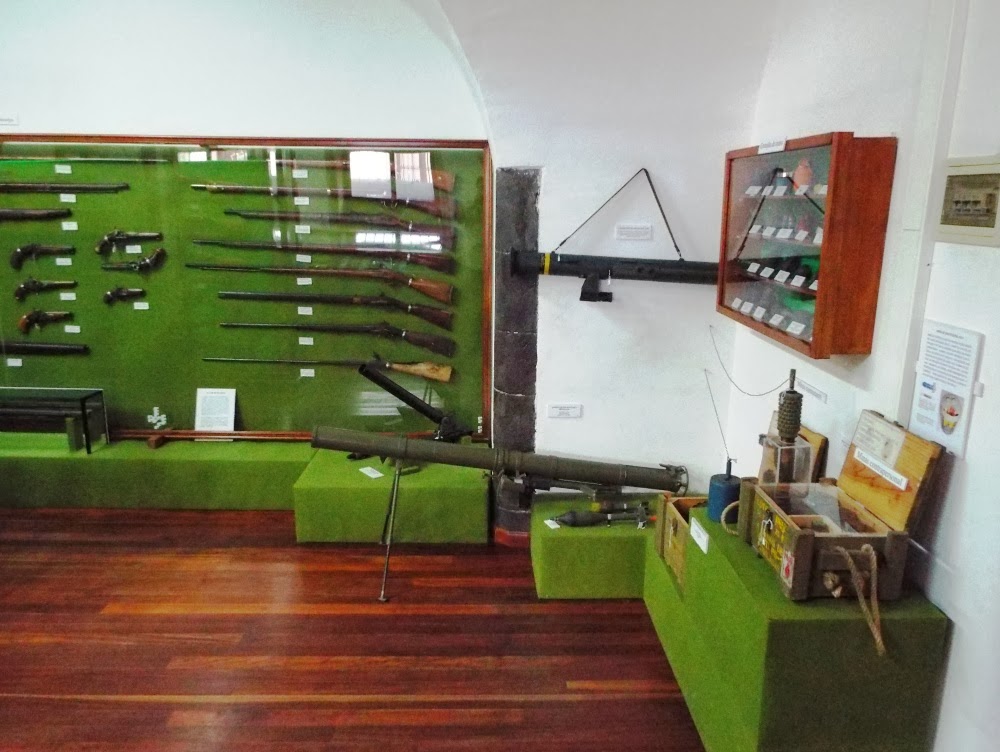
Small Arms
A side gallery is used to display a large range of different small arms.


The Courtyard
The courtyard of the artillery fort contains examples of artillery used by the Spanish Army.

100mm Skoda M1914 Field Howitzer


57mm Maxim-Nordenfelt Quick-Firing Gun


75mm Deport Field Gun


Outside
There are a large number of exhibits outside the artillery fort.

88mm Flak 18 Anti-aircraft Gun


75mm Vickers Anti-aircraft Gun


5.5-inch Vickers Coastal Defence Gun
This was essentially the same gun that was used as the secondary armament aboard HMS Hood.


75mm M1941 Mountain Gun


105mm Vickers Field Gun
The original version of this field gun had a shorter barrel and wooden wheels. This is an example of a modernised version that has a longer barrel and that has been modified for towage by motorised transport.

The original Vickers design influenced the development of the famous British 25-pounder Field Gun/Howitzer.


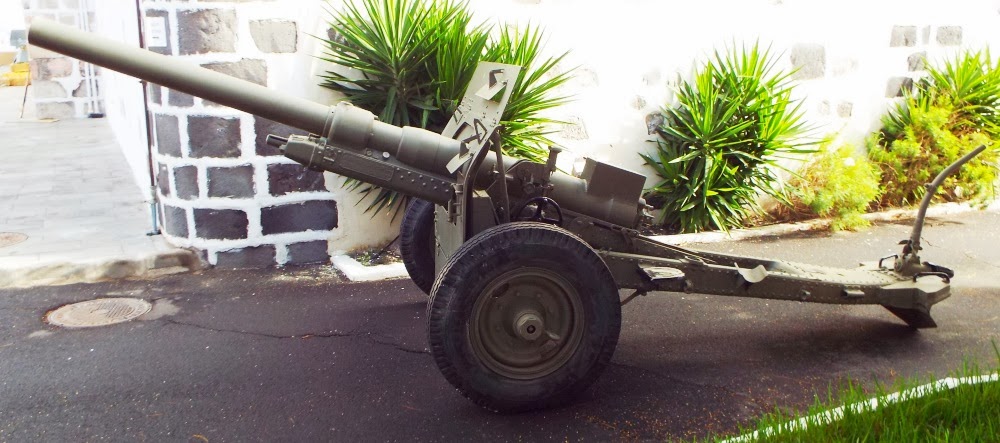
57mm Anti-tank Gun


M41 Walker Bulldog Tank


There are numerous other exhibits in the outside part of the museum, some of which were either not identified or identifiable. These include a pair of smooth-bore cannons (one of which may or may not have been El Tigre, the cannon that fired the grapeshot that wounded Nelson), ...


... a 37mm Hotchkiss Quick-Firing Gun, ...


... a number of vintage and reasonably new military vehicles, ...


... two helicopters (a Bell 47G and a Huey), ...


... a 40mm Bofors Anti-aircraft Gun and its fire control system, ...


... some examples of horse-drawn transport, ...


... and a 20mm Anti-aircraft Gun.


One corner of the former parade ground has been turned into a memorial to all fallen Spanish soldiers.


The Re-enactors
Whilst we were at the museum a number of World War II re-enactors were present, and appeared to be making a film or video.