I returned from COW2023 late yesterday afternoon feeling tired but also reinvigorated, and my wargaming mojo has returned big time! This morning I'm still feeling a bit tired, but what follows is a report about my weekend of wargaming with the best bunch of wargamers I could even hope to meet.
Friday 7th July
My drive to Missenden Abbey in Buckinghamshire took me just over two hours, and had it not been for a broken-down black cab on the approach road to the Blackwall Tunnel, it would have been even quicker. On arrival I parked my car in one of the two car parks and walked over to reception, which was to the right of the entrance to the original abbey building.
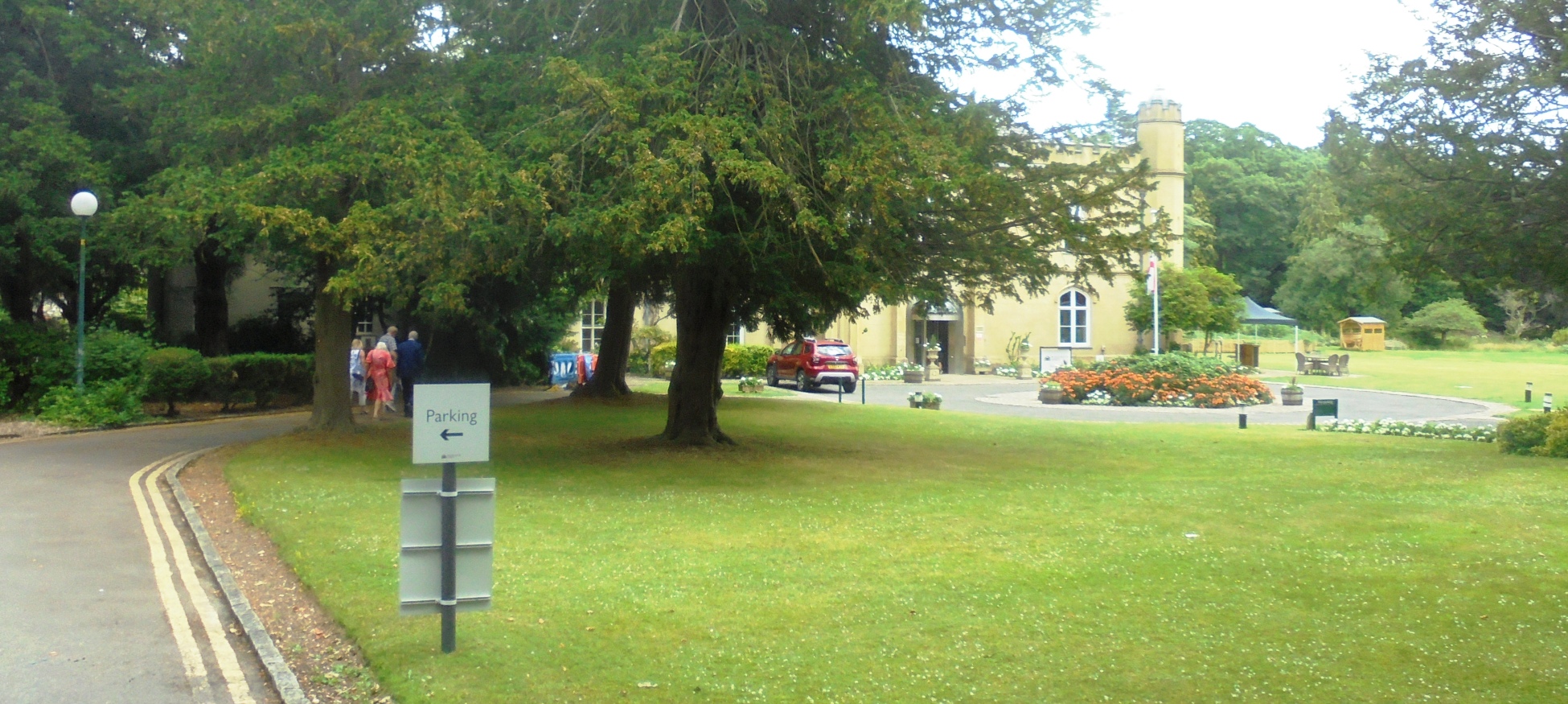
Once I had booked in, I made my way to my room, which was in 'The Coach House'.

This was a well-appointed double room with a large bed, TV, tea and coffee-making facilities, ...

... as well as a shower room ...

... and all the modern amenities one would expect from a reasonably-priced hotel room.
After unpacking and settling in, I went off to the bar area near the 'Arrouaisian Room' (the main meeting room in 'The Coach House' building to meet and chat with the other attendees. (The 'Arrouaisian Room' soon became known as the 'Arousal Room' by those attendees like me who could not get their tongues around its proper name!)

After dinner in the 'Barn Hall' (which also formed part of 'The Coach House' complex), the conference proper began, and after a short introduction by Tim Gow, the Plenary Game started. (It is a tradition at COW to have a plenary game that involves everyone so that new and regular attendees get to mingle and interact with each other.)
This year's plenary game was about the formation of the Wiemar Republic and was entitled Spartacists.
This game began (and ended) with two suitably-attired ladies (one of whom is the wife of one of the long-term members of Wargame Developments) singing songs from the period ...

The more observant blog readers will note that the singers have been paid in suitably large denomination fake German banknotes of the period. No expense was sparedincurred in the running of this game!
... and then the game began.
The game itself was a mixture of committee-style games and a figure-based street fighting game. The teams each represented one of the political factions that were vying for power in post-Armistice Germany, and each member of a team had their own agenda. At the same time, a representative from each team was trying to win a position for their team in the government by suppressing the more militant supporters of any opposition groups in the numerous street fights that took place.

I ended up as Hans Altelt of the People's Naval Division, and my objectives were to:
- Ensure that the Naval Division's overdue pay (3 billion Reich Marks) was paid ... and result that I actually achieved!
- Lead a contingent of the People's Naval Division in battle ... a result I also managed to achieve!
- Ensure that whatever government we ended up with would look after the interests of the people of Germany ... a result that I'm not sure was achieved at all be the end of the game.
- Ensure that a One Nation constitution with a National Leader was achieved. (I suspect that I would have to wait until 1933 for that to happen!)
- Ensure that Die Wacht am Rhein became the new national anthem ... in whci I totally failed!
This was a fun way to start the conference and certainly achieved its object in getting attendees to mingle and interact.
Before going to bed, I took part in a short session run by John Curry (who runs the 'History of Wargaming' project) entitled Ambush.
This was run-through of the game used by the US agency that is charged with moving nuclear materials around the country using lorries escorted by campervans containing armed guards!

The players controlled the convoy guards and ther umpired controlled the ambushers and ther players just about prevailed, although not without casualties. It is somewhat sobering to note that the game we played was based on the actual one that used to be used to train convoy guards.
(The session was observed remotely by a member of Wargame Developments in Australia, who got up early in the morning there to do so.)
Saturday 8th July
After breakfast in the main building, I returned to 'The Coach House' to take part in Little World Wars. This lasted all morning (with a break for mid-morning coffee) and was put on by Tim Gow.
Over recent years Tim has concentrated on building up a very large collection of 54mm figures, and the game I took part in was a tabletop version of his World War II lawn game.
I commanded a German kampfgruppe ... and it was great fun!


I came away with lots of ideas ... and a realisation that as I get older, tabletop wargaming with 54mm figures could increasingly become a most attractive proposition for me.
After lunch in the main building, it was back to 'The Coach House' top take part in Ian Drury's Je Ne Regrette Rien committee game about the plot by the French generals in Algeria to replace De Gaulle after his decision to decolonise Algeria.

It was a committee game, and I took the role of Colonel Yves Godard, a long-time professional soldier who had commanded the notorious DOP (Dispositif Opérationnel de Protection) whilst it conducted a vicious undercover war against the FLN.
By the end of the game I had attempted to assassinate de Gaulle by placing a bomb in his office (he left a few minutes before it went off!) and had fled to Spain to become a member of the OAS (Organisation Armée Secrète).
Once afternoon tea was over, I took part in the Save Gordon! Matrix Game.

Many years ago I took the basic game designed by Chris Engle and turned it into one that I could (and did) take to numerous wargame shows to demonstrate how Matrix Games worked. I've revived it several times since then, and I last took it to COW in the late 2010s. Tim Price has now produced his own version, and when the opportunity to play the game at this COW arose, I seized it with both hands!
I took on the role of General Gordon and actually survived to the end of the game ... a game that saw the destruction of the Mahdist army and the death of its charismatic leader.
This was the very first time I have been able to play this game in what must be thirty years, and I thoroughly enjoyed it. A big thanks goes to Tim for giving me the opportunity to.
Following dinner in the main building I returned to 'The Coach House' to take part in John Bassett's Spike Island Matrix Game about the implementation of the 1941 plans for a British military intervention in Eire to take back control of the Irish Treaty Ports that had handed over to the Irish in 1938.

(The ports might have been of great assistance to the Royal Navy as refuelling bases and refuges during the ongoing Battle of the Atlantic, and there were serious plans developed to do exactly what the game covered. In the end, the force designated to perform the seizure was sent to Iceland ... which was then used as a base for British, Canadian, and United States anti-submarine patrols.)
The game started with a British infantry brigade in possession of each of the three Treaty Ports, and my role was Principal Secretary to the British Minister-Resident for Ireland (Harold MacMillan MP). It was my job to assist him (he was being played by Phil Steele) to achieve his goals of a rapprochement with the Irish Prime Minister Eamon De Valera and the prevent an escalation into a state of hostilities. We also sought to ensure that any IRA Volunteers were interned by the Irish Government and that the latter did not begin to trust or work with the IRA.

The British team (which included Chris Ager as Bernard Law Montgomery, the commander of all the British forces in Ireland) were fairly successful in achieving our goals in the teeth of opposition from both the Ulster government and the IRA. Thanks to Montgomery's plans to withdraw the British troops to very small enclaves around the Treaty Ports and to assist in the training and re-equipment of the Irish Army, we were able to keep De Valera and his government away from the more extreme influences of some of the Catholic clergy (represented by Michael Young as the Catholic Primate of All Ireland) and any reliance of the leadership and guns of the IRA (played by Chris James). We dealt with the turbulent Ulster Government led by John Andrews (who was portrayed by Matthew Hartley) by putting Ulster under direct rule from Westminster ... which seemed a suitable 'punishment' for him instigating a General Strike whilst the United Kingdom was at war!
It was a very interesting exploration of a 'what if?' scenario and showed how a well-designed Matrix Game can be used as a way of looking at possible historical events.
Sunday 9th July
The last day of this all too short COW! By the time I went to breakfast, I had packed my bags and loaded everything that I didn't need for the day in my car as well as return my room key to Reception.
After breakfast I took part in John Armaty's excellent Cold War Wargame Workshop ...


... which he began by describing his attempts to develop a Cold War tabletop wargame. This led to a very wide-ranging discussion about previous sets of rules that had been published, their strengths and weaknesses, and how important (or not) some of the minutiae they often burdened themselves with was to eventual outcomes they achieved. Luckily those taking part were able to bring their own expertise and experience to the table, and I for one came away with a much clearer understanding of what I would want to include and exclude from any Cold War tabletop rules I might write.
After a short break for morning coffee. I returned to the room in which the workshop had taken place to take part in Chris Kemp's Whatever Happened to NQM? session.
NQM (or Not Quite Mechanised) is a set of tabletop rules that Chris has been developing and using for thirty or more years, and having taken a small part in its early stages of development (I took part in the wargame at Moor Park when the first inklings of what would become NQM could be discerned and I have copy number 1 of 20 of the famous pink-covered rules booklet Chris distributed back in the 1980s), this session was an absolute MUST for me!

I was not disappointed. After a brief explanation of the background to the rules and how they worked (including the combat results table that is still known as Table 12!), Chris let us loose on his models.
The scenario featured a Russian Army of two Rifle Corps (each of which had two Rifle Divisions) plus all the sort of Army and Corps-level assets one would expect, attempting to capture a large town and three bridges over a river. They were opposed by a number of German formations, including a Panzer Division.
There was only time for use to play through two full moves, but I think that the participants managed to get a reasonable level of understanding of what Chris's rules are trying to achieve and how the mechanisms work. The following photographs give some idea of how the battle went.


I enjoyed my role as one of the two Russian Corps Commanders, and I am very pleased to say that I am now the owner of copy number 7 of 20 of the latest printed iteration of the rules.
There was just enough time after Chris's session to grab a cup of coffee before the start of the Annual General Meeting ... and then it was time to say our goodbyes and go home. My journey home took just over two hours (it would have been faster if the southbound Blackwall Tunnel had been open, and I had not had to use the Dartford Crossing) and by 5.00pm I was sitting in my armchair boring my wife to death about what a great time I had had at COW2023!


.jpg)


