Pages

Sunday, 15 December 2024

Another long, hard think about my future wargaming

Back in January, before I was afflicted by axonal polyneuropathy, I took a long, hard think about my future wargaming. Towards the end of that blog post, I wrote the following:

I have been mulling what my future wargaming priorities should be for some time. Until very recently I was still very undecided … and then I read an obituary about the late John Ruddle’s garden wargaming, and things began to fall into place.

In the obituary, the wargaming part of John’s garden was described as being L-shaped, with a long left-hand border that was split into Britain, France, Germany, Belgium, and Italy. At right-angles to this and across the bottom of the garden were sections that represented Africa and the Northwest Frontier of India. At the join of the two section was Turkey, and the lawn represented the oceans. My immediate reaction was ‘I’d love to do something like that, but my garden isn’t suitable.’ However, after some thought, I decided that an indoor version of something like it might be possible.

My current thinking is along the lines that I could create a terrain board for each of my Belle Époque imagi-nations using the game board/map from Waddington’s CAMPAIGN game as a guide. These terrain boards could be stored in my future wargame/toy room and be brought out and used as and when required. It would allow me to exercise my terrain modelling skills (something that I have recently rediscovered and that I really do enjoy!) and become the basis of an imaginary wargaming world where nations – both large and small – are constantly vying with each other.

These ideas were predicated on the assumption that Sue and I would be moving house and that the space I would need to pursue this plan would become available in the form of a large garage or garden building ... but now that my mobility has become impaired, our plans to move house have been shelved and our current house is being slowly adapted to meet my needs.

So, how does this affect my plans? Well, I don't think that it is going to be possible to create the terrain boards that I planned to build, but I haven't given up hope that I might be able to do something along those lines in the long run, possibly using lighter-weight materials than I originally planned to use.

I do still intend to make my Belle Époque project my main one for the foreseeable future, and I have plans to add some more imagi-nations to my collection.

Saturday, 14 December 2024

The 1942 Light Fleet Aircraft Carriers: Part 2: The Colossus-class

The first ten Light Fleet Aircraft Carriers formed the Colossus-class, and these were:

HMS Colossus/FS Arromanches

FS Arromanches.

Commissioned too late for active service during the Second World War. Her armament was changed to 21 x 40mm Bofors anti-aircraft guns in 1945. In 1946 she was loaned to the French Navy and renamed Arromanches. She was bought by the French in 1951 and served until she was decommissioned in 1974. She was scrapped four years later.

HMS Glory

HMS Glory.

Commissioned too late for active service during the Second World War. Her armament was increased to 6 × 4-barrelled 2-pounder anti-aircraft guns and 32 x 20mm Oerlikon anti-aircraft guns. She was deployed three times to support operations during the Korean War before being reduced to act as a ferry, troop carrier and helicopter base in 1954. She was placed in reserve in 1956 and sold for scrapping in 1961.

HMS Ocean

HMS Ocean.

Commissioned in August 1945, she was completed with a revised armament of 6 × 4-barrelled 2-pounder anti-aircraft guns and 32 x 20mm Oerlikon anti-aircraft guns. She was modified soon after commissioning to act as a specialist night fighter carrier. She was also used for trials, and on 3rd December 1945 Eric 'Winkle' Brown made the first landing of a pure jet aircraft on an aircraft carrier. After service with the Mediterranean Fleet from the very end of 1945 until October 1954, she was deployed to support UN operations in Korea. By August 1954 she had returned to the UK and was part of the training squadron. She resumed active service in 1956 when she took part in the Suez crisis, where she acted as an interim helicopter assault ship. She went in reserve in 1958 and was scrapped in 1962.

HMS Venerable/HMNLS Karel Doorman/ARA Veinticinco de Mayo

HMNLS Karel Doorman.

Commissioned too late for active service during the Second World War. Her armament was increased to 6 × 4-barrelled 2-pounder anti-aircraft guns and 11 x twin and 10 x single 20mm Oerlikon anti-aircraft guns. After the war ended, she was mainly used to transport former prisoners-of-war and demobilised troops. She was decommissioned in April 1947 and placed on the disposal list. She was purchased by the Netherlands Navy in 1948, and after being refitted she was commissioned as HMNLS Karel Doorman. Between 1955 and 1958 she was extensively reconstructed. As a result, she emerged with an 8-degree angled flight deck, new lifts, a remodelled island superstructure, a new armament of 12 x 40 mm anti-aircraft guns, a steam catapult, and brand-new aviation facilities and electronics, including a Dutch-built new radar. In 1968 she suffered serious damage due to a fire in her boiler room and the damaged boilers were replaced with ones from the incomplete HMS Leviathan. However, due to the increasing cost of operating an aircraft carrier and repairing all the damage she had suffered as a result of the fire, she was withdrawn from service and sold to Argentina in 1969. She was commissioned into the Argentine Navy as the ARA Veinticinco de Mayo later that year. In 1982 she supported the invasion fleet that captured the Falkland Islands, but subsequently she played little part in the conflict. In 1988 she was withdraw from service and it was planned to replace her steam engines with gas turbines, but the cost proved prohibitive and she was never recommissioned. Parts from her were used as spares for her sister-ship, the Brazilian aircraft carrier Minas Gerais. She was sold for scrap in 2000.

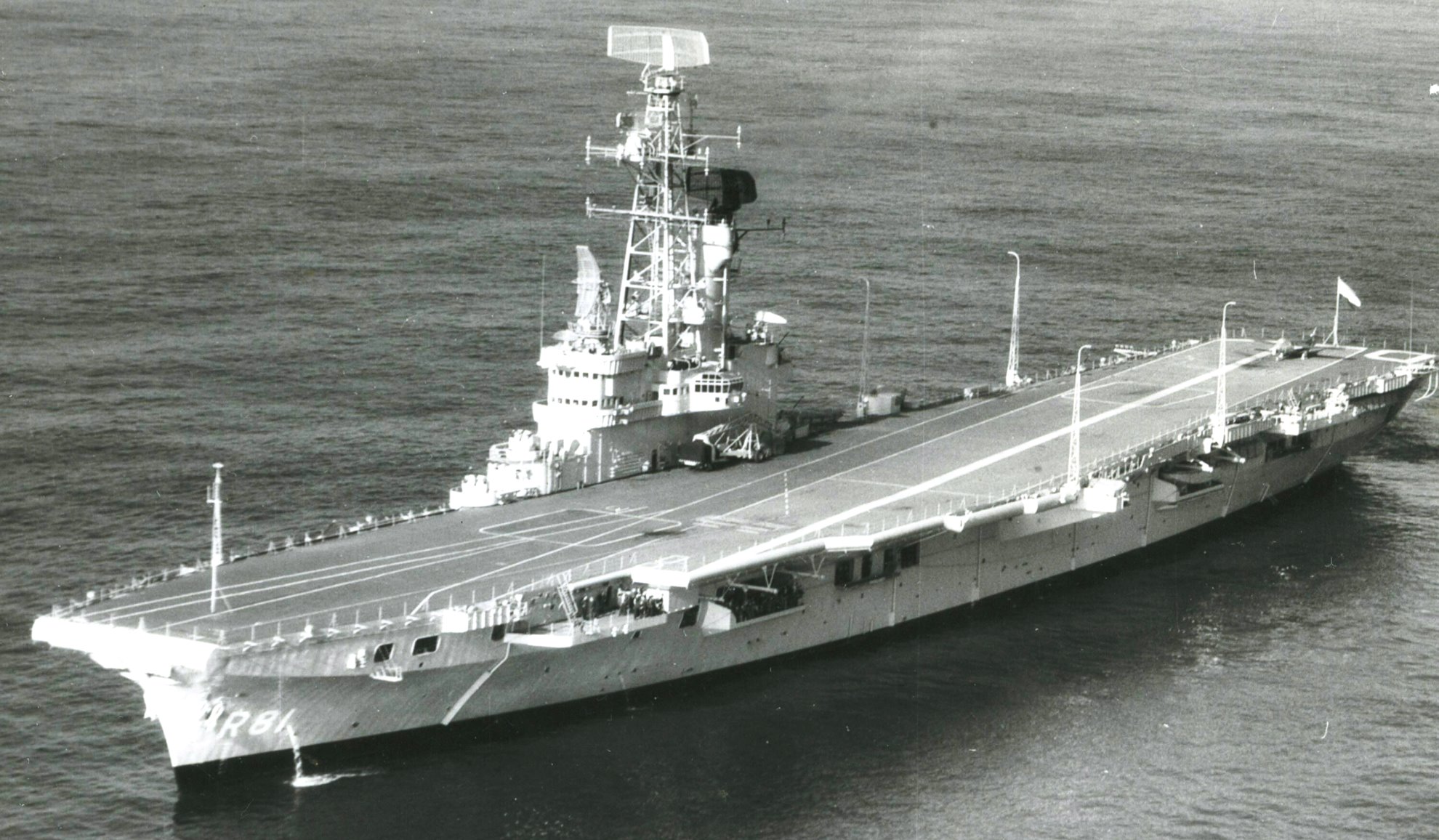
HMS Vengeance/NAeL Minas Gerais

NAeL Minas Gerais.

Commissioned too late for active service during the Second World War. Her armament was increased to 6 × 4-barrelled 2-pounder anti-aircraft guns, 8 x single 40mm Bofors anti-aircraft guns, and 11 x single 20mm Oerlikon anti-aircraft guns. She served in the Far East until th end of 1946, and on her return to the UK she became a training aircraft carrier. In late 1948 she was refitted for Arctic service and took part in several exercises in Arctic waters. In June 1951 it was decided to loan her to the Royal Australian Navy, and after a refit she was transferred to the RAN in November 1952. In 1954 she became a training ship and in 1955 she was returned to the UK, who then placed her on the disposal list before selling her to the Brazilian Navy in 1956. She was renamed NAeL Minas Gerais and after an extensive refit in the Netherlands, she joined the Brazilian Navy in December 1960. Her refit included an 8.5-degree angled flight deck, a more powerful steam catapult, stronger arresting gear, reinforced hangar lift, a mirror landing aid, a new island superstructure, and a completely new radar suite and fire control system. She was refitted twice (1976 to 1981 and 1991 to 1993) and this enabled her to remain in service until 2001. She was finally sold for scrap in 2004.

HMS Pioneer

HMS Pioneer.

She was completed in 1945 as an maintenance aircraft carrier with a modified armament of 6 × 4-barrelled 2-pounder anti-aircraft guns and 19 single 40mm Bofors anti-aircraft guns. She supported fleet operations in the Far East until she returned to the UK in early 1946. She was then placed in reserve and sold for scrapping in September 1954.

HMS Warrior/ARA Independencia

ARA Independencia.

She was completed in April 1945 and loaned to the Royal Canadian Navy from 1946 until 1948. On her return she was used to conduct trials to test the feasibility of using undercarriage-less aircraft and a flexible flight deck that had a rubber surface supported by air bags. The trials used a modified de Havilland Sea Vampire aircraft. Once these trials were concluded, she was deployed to Korea to support United Nations operations. She underwent a refit during 1952 and 1953 that saw her bridge enlarged and a new radar suite and associated lattice mast fitted. Two years later she was refitted for a second time during which she was fitted with a reinforced 5-degree angled flight deck, an improved catapult, strengthened arrester gear, and a mirror landing aid. After a short spell as a training and trials ship she was deployed to the Pacific to support Operation Grapple, the test of the UK's first hydrogen bomb. On her return to the UK, she was decommissioned and put up for sale. She was bought by Argentina in 1958 and renamed ARA Independencia. She served in the Argentinian Navy until placed in reserve in 1970 and sold for scrap in 1971.

HMS Theseus

HMS Theseus.

She was completed and commissioned in 1946. For four years she acted as a training vessel, but after the outbreak of the Korean War she was deployed to support United Nations operations. She remained in Korean waters until 1952, when she returned to the UK. She joined the Home Fleet and took part in numerous NATO naval exercises. In 1956 she was quickly repurposed to become an interim helicopter assault ship so that she could take part in the Suez Crisis. In 1957 she was placed in reserve and sold for scrapping in 1962.

HMS Triumph

HMS Triumph.

Commissioned in 1946, she was completed with a revised armament of 6 × 4-barrelled 2-pounder anti-aircraft guns and 19 x single 40mm Bofors anti-aircraft guns. After representing the UK at the USSR's Navy Day in Kronstadt in July 1946, she joined the Mediterranean Fleet, re she remained until August 1948. In 1950 she was deployed to the Far East and supported UN operations during the first year Korean War. She then returned to the UK and acted as a cadet training ship until 1955. It was during this period that she was used as a trails ship in 1952 for the new angled flight deck concept. Between 1956 and 1965 she was converted into a heavy repair ship and deployed to Singapore. She remained there until she was reduced to reserve status in Chatham in 1975. She was sold for scrapping in 1981.

HMS Perseus

HMS Perseus.

She was completed in 1945 as a maintenance aircraft carrier with a modified armament of 6 × 4-barrelled 2-pounder anti-aircraft guns and 19 single 40mm Bofors anti-aircraft guns. During her career she supported fleet operations in the Far East as well as acting as an aircraft transport. She was also used for experimental trials of the steam catapult between 1950 and 1952 and of the anti-submarine version of the Westland Whirlwind helicopter in 1954. She was then reduced to reserve status and selected for conversion into a submarine depot ship, but this never took place, and she was sold for scrapping in May 1958.


As can be seen, the concept of a light fleet carrier was sound, and even though the first eight ships were of limited capability when compared to a fleet carrier, the majority performed excellent service and - in some cases - had far longer operational lives than their designers could ever have envisaged.

Friday, 13 December 2024

Triskaidekaphobia

Today is Friday 13th December 2024 … and is supposed to be an unlucky day.

Fear of the number thirteen is known as triskaidekaphobia, and the origins of this phobia are shrouded in mystery. Some people claim that it dates back to Norse mythology when Loki was not invited to a feast for twelve gods that was taking place in Valhalla. Loki tricked his way into the feast and pursuaded Höðr - the god of darkness - to shoot Balder - the god of joy and gladness - with an arrow tipped with mistletoe. As a result, great suffering was visited upon the world. Others think that the fear of thirteen dates back to the events leading up to the crucifixion of Jesus. There were supposedly thirteen people at the Last Supper, and that as this meal took place on what is now Maundy Thursday - the day before the crucifixion - this made Friday 13th unlucky.

Another oft quoted reason why Friday 13th is seen as being unlucky is due to the fact that King Philip IV of France ordered the arrest of the Knights Templar on Friday October 13th 1307. The King was heavily in debt to the Templars and used what were false accusations about corruption and immoral conduct in the Order to justify the arrest of the leader of the Templars - Jacques de Molay - and other senior members. De Molay was tortured and eventually executed for heresy by burning at the stake. Many other Templars suffered a similar fate, and by 1312 the Order had collapsed, its wealth had been seized, and its surviving members were dispersed.

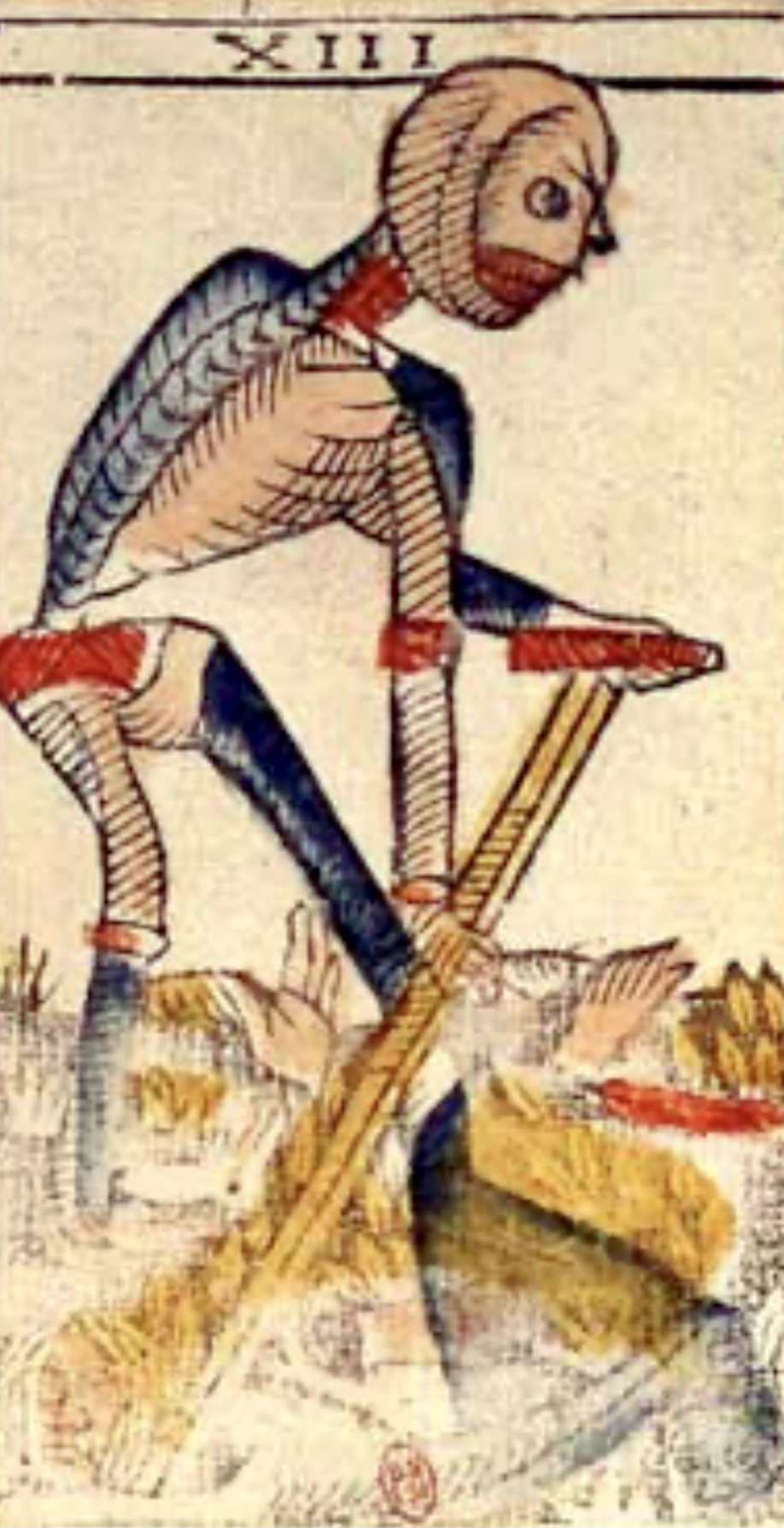
What is certain is that a belief that the number thirteen was an unlucky one was prevalent in Europe by the end of the Middle Ages, and in some packs of tarot cards from the mid fifteenth century the number is associated with the card that depicts the figure of Death.

To date I have no personal experience of Friday 13th being particularly unlucky … but I know plenty of people who do. From what I can gather, many buildings do not have a numbered thirteenth floor and none of the cruise ships I’ve ever travelled on have had a deck that is designated as being the thirteenth. In the case of P&O’s cruise ships, the decks are referred to by numbers (e.g. Deck Seven), letters (e.g. A Deck, G Deck), and names (e.g. C Deck being named Canberra Deck).

Thursday, 12 December 2024

The 1942 Light Fleet Aircraft Carriers: Part 1: The basic design

The design of the Light Fleet Aircraft Carriers was intended to fill the gap between the large and highly capable fleet carriers and the much smaller and less capable escort carriers. Due to pressure of work, the design of these aircraft carriers was developed by Vickers-Armstrong rather than by members of the Royal Corps of Naval Constructors. The shipbuilders chose to make it as simple as possible and to adopt mercantile building standards in order to reduce the construction time to a minimum.

The basic design of the 1942 Light Fleet Aircraft Carrier.

The main characteristics of the original design were as follows:

  • Displacement: 13,190 tons (Standard); 18,040 tons (Full load)
  • Dimensions:
    • Length: 695ft (212m) overall; 690ft (210m) flight deck
    • Beam: 80ft (24m)
    • Draught: 23ft 6in (7.16m)
  • Propulsion: 4 Admiralty three-drum boilers providing steam to 2 sets of Parson’s steam turbines, each driving a propeller
  • Speed: 25 knots
  • Armament: 6 × 4-barrelled 2-pounder anti-aircraft guns; 16 x twin 20mm Oerlikon anti-aircraft guns

It was expected that the sixteen ships that were planned to be built would have an operational life of three years and would be scrapped once the war was over.

Wednesday, 11 December 2024

A new YouTube video: The Naval Museum, Cartagena, Spain

I have just uploaded a new YouTube video to the Wargaming Miscellany YouTube channel.

It is entitled THE NAVAL MUSEUM, CARTAGENA, SPAIN, lasts just under twenty minutes, and is a brief illustrated guide to the contents of the museum.

The video can be found here on the Wargaming Miscellany YouTube channel.

Tuesday, 10 December 2024

Warships for my Belle Époque project: More inspiration

I was checking the links between my blog and my favourite websites when I remembered that the late Rudi Geudens had photos of several model warships that he had built for his Afriboria colonial campaign. They were built along similar lines to those on David Helber's MAJOR GENERAL TREMORDEN REDERRING'S COLONIAL WARGAMES PAGE, and many were based on wooden toy or model ships that could be bought in tourist or ship chandlery shops.

Rudi Geudens's collection included three battleships, the SMS Freidrich de Grosse, …

… FNS Charles Martel, …

… and HMS Empress.

There was also a Belgian gunboat, L'Adrienne ...

… a British colonial torpedo cruiser, HMS Stingray, …

... a small river gunboat, ...

… and a steam and sail-powered, armed trading vessel, La Crise.

These models were built so that they would look right when used alongside 25/28mm figures, and by making some similar ship models that are about half the size of the originals, I should have some ships that will work with my 15mm Belle Époque figures.


Please note that the photographs shown above are © the late Rudi Geudens.

Monday, 9 December 2024

Part of my collection of 1:1200th-scale ships

I recently bought four of the Triang Minic Ships harbour accessories sets and yesterday I decided that it would be a good idea to use elements from the Ocean terminal set to act as a backdrop to some of my collection of 1:1200th-scale ships.

The Imperial Japanese Navy

The battleship IJNS Fuso is moored alongside one of the quays, with the light cruiser IJNS Yubari on the opposite side. The destroyer IJNS Shimakaze is also moored alongside whilst the destroyer IJNS Asagiri is being manoeuvered into place by two harbour tugs.

British ironclads

HMS Victoria is moored alongside whilst HMS Inflexible is being manoeuvered into position by two habour tugs.

German/Turkish Navy battleships

The German battleships SMS Kurfürst Friedrich Wilhelm and SMS Weissenburg moored alongside. These were two of the four Brandenberg-class battleships built for the Imperial German Navy. These two ships were sold to the Ottoman Navy in 1910 and renamed Hayreddin Barbarossa and Turgut Reis respectively.

Sunday, 8 December 2024

My latest Belle Époque army is now completed!

I finally finished renovating, varnishing, and basing my latest Belle Époque army, the Army of the Commonwealth of Britannia.

It comprises:

  • Infantry
    • 1/1st (Grenadier) Infantry Regiment
    • 2/1st (Grenadier) Infantry Regiment
    • 1/2nd (Fusilier) Infantry Regiment
    • 2/2nd (Fusilier) Infantry Regiment
    • 1/3rd (Highland) Infantry Regiment
    • 2/3rd (Highland) Infantry Regiment
    • 1/4th (Rifle) Infantry Regiment
    • 2/4th (Rifle) Infantry Regiment
    • 1/5th (Ranger) Infantry Regiment
    • 2/5th (Ranger) Infantry Regiment
    • 1/6th (Highland) Infantry Regiment
    • 2/6th (Highland) Infantry Regiment
    • 1st Machine Gun Battalion
    • 2nd Machine Gun Battalion
  • Cavalry
    • 1/1st (Dragoon) Cavalry Regiment
    • 2/1st (Dragoon) Cavalry Regiment
  • Artillery
    • 1st Field Artillery Regiment
    • 2nd Field Artillery Regiment
    • 3rd Field Artillery Regiment
  • Train
    • 1st Supply Column
    • 2nd Supply Column
    • 3rd Supply Column
    • 4th Supply Column

Units shown in italics are militia or reserve units.

I have also added the Naval Brigade of the Navy of the Commonwealth of Britannia

  • Naval Brigade
    • 1/1st Marine Infantry Regiment
    • 2/1st Marine Infantry Regiment
    • 1/1st Naval Infantry Regiment
    • 2/1st Naval Infantry Regiment
    • Naval Field Artillery Regiment

Saturday, 7 December 2024

The wargame in a matchbox challenge: There is a report … and yet another genius entry!

Since mentioning Peter of Grid Based Wargaming – but not always blog on my blog, he has uploaded a battle report of a wargame fought using his magnificent ‘wargame in a matchbox’ American Civil War ironclads naval wargame.

I hope that my regular blog readers will follow the links to Peter's blog and read his wonderful battle report.


Maudlin Jack Tar has also designed a ‘wargame in a matchbox’ and has written a very extensive blog entry about it on his blog, Projects and Procrastination.

He took his inspiration from Archduke Piccolo’s recent Fast Play 3 x 3 Portable Wargame Roman Civil War campaign and the results are stunning … as the following photographs show.

This informal competition has produced some wonderful designs … and I have a feeling that there are more to come!


Please note that the photographs shown above are © Peter of the Grid Based Wargaming – but not always blog and Maudlin Jack Tar.

Friday, 6 December 2024

Six million hits!

6,000,000 hits!

Recently my blog has achieved over six million hits!

The blog achieved a million hits by December 2015, three million by December 2018 (I missed when it achieved two million hits), four million hits by November 2021, five million during February this year ... and now it has passed six million hits.


I started this blog sixteen years ago on Thursday 18th September 2008, and since then I have written over 5,600 posts, had approximately 45,500 comments, and attracted 420 followers. I don't think that's bad for something that I described back in 2008 as being 'self-publicising, self-centred, self-indulgent'!