Pages

Monday, 12 May 2025

Two new additions to the 'Dominion of ...' rules

Recently, Steve Parker sent me a copy of his latest additions to the 'Dominion of ...' rules, DOMINION OF THE CLAYMORE, TOMAHAWK AND TALWAR rules ...

and DOMINION OF FREDERICK THE GREAT rules.


The DOMINION OF THE CLAYMORE, TOMAHAWK AND TALWAR rules covers the Jacobite Rebellion of 1745, the French-Indian Wars in North America, the Anglo-Cherokee War, Pontiac's Rebellion, and the battles that were fought in India and in the West Indies.

The rules are very similar to those in the earlier DOMINION OF THE SPEAR AND BAYONET rules but have been modified so that they can be used for the wars that took place outside mainland Europe during the middle third of the eighteenth century.

There are five different types of unit:

  • Line Infantry: These are infantry that fight in close formation and rely on firepower to destroy enemy units. They are normally armed with muskets
  • Ambushers: These are infantry or cavalry that attack enemy units by ambushing them.
  • Skirmishers: These are infantry or cavalry who fight in a dispersed formation and rely on firepower or missile weapons to destroy enemy units at a distance.
  • Melee Units: These are infantry units that are armed with spears (Spearmen), bayonets (Bayonets) heavy swords (Claymores), fighting axes (Tomahawks) or cavalry. It includes all troops that prefer to fight the enemy in hand-to-hand combat.
  • Artillery: It includes all artillery.

Examples of units include:

  • Trained militia armed with muskets and fighting in close formation – Line Infantry (cost 2 points).
  • Militia armed with muskets, fighting in s dispersed formation, and using cover – Skirmishers (cost 2 points).
  • Starving British infantry in a fort – fortified Line Infantry (cost 3 points).
  • Jacobite Highlanders armed with muskets and claymores– elite Claymores (cost 3 points).
  • British Highlander infantry – elite Bayonets (cost 3 points).
  • Best European infantry firing volleys – elite disciplined Line Infantry (cost 4 points).

The book includes Army Lists for twenty-four battles:

  • Prestonpans (1745)
  • Inverurie (1745),
  • Falkirk Muir (1746)
  • Littleferry (1746)
  • Culloden (1746)
  • Arni (1751)
  • Jumonville Glen (1754)
  • Fort Necessity (Great Meadows) (1754)
  • Monongahela (Braddock’s defeat) (1755)
  • Bloody Morning Scout (1755)
  • Lake George (1755)
  • Plassey (1757)
  • Carillon (Fort Ticonderoga) (1758)
  • Condore (1758)
  • Plains of Abraham (1759)
  • Wandiwash (1760)
  • Sainte-Foy (Quebec) (1760)
  • Echoee Pass (1760)
  • Third Panipat (1761)
  • Martinique (1762)
  • Siege of Havana (1762)
  • Bloody Run (1763)
  • Bushy Run (1763)
  • Buxar (1764)


DOMINION OF FREDERICK THE GREAT rules cover the main battles of the War of the Austrian Succession and the Seven Years War that were fought on mainland Europe. It is a development of the DOMINION OF THE SPEAR rules and includes a number of rule changes as well as some period-specific new rules.

There are four different types of unit plus an optional type of unit:

  • Line Infantry: These are infantry that fight in close formation and armed with muskets.
  • Skirmishers: These are light infantry who fight in a dispersed formation and use cover.
  • Cavalry: Includes heavy cavalry (e.g. Cuirassiers and Dragoons). Light cavalry (e.g. Hussars) are assumed to be part of the cavalry units used in these rules.
  • Artillery: It includes all artillery.
  • Optional Light Cavalry: Includes Hussars and Cossacks as separate units in some of the smaller battles.

Examples of units include:

  • Austrian infantry in line and armed with muskets – Line Infantry (cost 2 points).
  • Austrian infantry behind defences – fortified Line Infantry (cost 3 points).
  • Mixed cavalry Cuirassiers and Hussars – Cavalry (cost 2 points).
  • Prussian infantry – elite Line Infantry (cost 3 points).
  • Tenacious Russian infantry – disciplined Line Infantry (cost 3 points).
  • Prussian infantry flank marching before a battle – elite disciplined Line Infantry (cost 4 points).

There are also four Optional Rules. These include:

  • Optional Alternative Activation
  • Optional Unreliable Troops
  • Optional Light Cavalry (see above)
  • Optional Weather

The book includes Army Lists for twenty-four battles:

  • Mollwitz (1741)
  • Chotusitz (1742)
  • Dettingen (1743)
  • Madonna dell’ Olmo (Cuneo) (1744)
  • Fontenoy (1745)
  • Hohenfriedberg (1745)
  • Soor (1745)
  • Kesselsdorf (1745)
  • Lobositz (1756)
  • Prague (1757)
  • Kolin (1757)
  • Hastenbeck (1757)
  • Gross-Jägersdorf (1757)
  • Rossbach (1757)
  • Leuthen (1757)
  • Zorndorf (1758)
  • Hochkirch (1758)
  • Güstow (Tornow) (1758)
  • Minden (1759)
  • Kunersdorf (1759)
  • Liegnitz (1760)
  • Torgau (1760)
  • Burkersdorf (1762)
  • Freiberg (1762)

This period of history is one that appeals to many wargamers who like to create their own imagi-nation armies similar to those used by Brigadier Peter Young, James Lawford, and Charles Grant. To meet this need, the book contains rules that can be used to generate imagi-nation armies.


The DOMINION OF THE CLAYMORE, TOMAHAWK AND TALWAR and DOMINION OF FREDERICK THE GREAT rules were written by Steve Parker and published in 2025 by Orc Publishing. They can be bought in PDF format from Wargame Vault for £4.40.

Sunday, 11 May 2025

Saturday, 10 May 2025

Warship 2025

At about this time of year, I begin to look forward to receiving my annual copy of WARSHIP … and this year's issue was delivered on Thursday.

This issue was edited by John Jordan, and contains the following articles:

  • Editorial
  • The Reconstruction of the Battlefleet of the Imperial Japanese Navy between the wars: Part 1 by Hans Lengerer
  • The 'Black Gang': The development of Torpedo Boats in the Imperial German Navy (Part I)  by Dirk Nottelmann
  • The Twin 6in Mark XXI Turret by Peter Cannon
  • The 'H'-class Coastal Submarines of the Royal Danish Navy 1936-1950 by Tom Wismann
  • Russia's Battlecruiser Design Competition of 1911 by Stephen McLaughlin
  • The IJN Protected Cruisers of the Chikuma class by Kathrin Milanovich
  • The 300-tonnes: The first French Torpedo Boat Destroyer by John Jordan
  • Italian designs for Monitors and Battlecruisers during the interwar years by Michele Cosentino
  • The beginnings of Soviet Naval Power: The 'S'-class Submarines by Przemyslaw Budzbon
  • The German Flak Ships: Part II: The former Dutch and Danish hulls by Aidan Dobson and Dirk Nottelmann
  • Warship Notes
    • The Protection System of the French Battleships of the Second World War by John Jordan
    • HMS Agamemnon as a radio-controlled target ship by Cdr Martin Marks RN (Ret), OBE, BSc (Eng)
    • The Faidherbe and the Marchand Expedition by Ian Sturton
    • Writing on Naval History: Some notes for beginners by Conrad Waters
  • A's and A's
  • Naval Books of the Year
  • Warship Gallery
    • Herbert Charles Sparrow, Royal Marines, 1927-1930

It was great to see that the second part of The German Flak Ships series of articles that was originally going to be included in 2024's volume has been included in this one. I have been looking forward to reading this as this topic is of particular interest for me.

That said, the rest of the articles are all of great interest to me and I know that I will have many enjoyable hours reading them.


WARSHIP 2025 was edited by John Jordan, assisted by Stephen Dent, and published in 2025 by Osprey Publishing (ISBN 978 1 4728 6854 1).

Friday, 9 May 2025

English Heritage’s Risk, the Battle for Medieval England

On Wednesday, Sue and I paid a visit to Eltham Palace. After a very enjoyable walk around the palace grounds, we stopped off in the shop. Sue saw that they were selling copies of RISK, THE BATTLE FOR MEDIEVAL ENGLAND.

This game was exclusively made for English Heritage and is only available from them, and as it was a ‘Member’s Day’ and everything was 20% off, she bought me a copy.

The game contains the following components:

  • A gameboard which is divided up into five regions (North, Midlands, East Anglia, Southeast, and Southwest), each of which is made up on a number of territories that are named after English Heritage properties).
  • Five armies of small plastic figures (red, blue, yellow, black, and green) that are comprised of infantry, cavalry, and siege catapults.
  • Five D6 dice (three black and two red).
  • A pack of forty-two Territory Cards, ten Mission Cards, and nine Power Cards.

It looks as if the game will be an interesting version of RISK to play ... and I can see myself using the figures for a Medieval version of the PORTABLE WARGAME and the gameboard for a campaign.

Thursday, 8 May 2025

Victory in Europe Day (V-E Day): Eighty years on

Today is the eightieth anniversary of Victory in Europe Day (V-E Day) and it is being marked by numerous ceremonies and celebrations across the UK. For many people, their impressions of V-E Day will be shaped by the photographs and newsreels of the celebrations that took place in London and many other cities, towns, and villages ...

... but my thoughts will be of the members of the armed services who were in Germany and the Far East, in the latter case, still fighting the Japanese.

Several members of my family fall into this category:

  • My father, Sergeant George Cordery, who was serving with 6th Airborne Division and who had reached Wismar on the Baltic coast on 2nd May 1945. On 7th May 1945 British Field Marshal Montgomery and Soviet Marshal Konstantin Rokossovsky met in Wismar prior to the handover of the city to the Russians as it was going to be in the Russian Occupied Zone of Germany. Along with other members of his unit, my father celebrated V-E Day with a warm bottle of beer.
  • My maternal grandfather, Regimental Sergeant-Major Arthur Jackson, who was serving aboard a troopship transporting Allied troops in the Indian Ocean.
  • My father-in-law, Sergeant James Bayne, who was working as a cook in HQ South East Asia Command, New Delhi, having retrained after been seriously wounded whilst serving as a signaller during the Imphal and Kohima Campaign.
  • My maternal uncle, Steward Peter Oram, who was aboard the aircraft carrier HMS Indefatigable, which formed part of the British Pacific Fleet.

I will be remembering them today, and celebrating their contributions to the eventual victories in Europe and the Far East.

Wednesday, 7 May 2025

More ChatGPT images

I have been continuing to experiment with ChatGPT's image creation tools. Having used it to create individual images of myself as a Russian World War II general, three different German World War II officers, and as a Viking chieftain, I decided to see if I could use them to create battles scenes based on a photograph of a wargame. I chose a photograph that was taken during a wargame I fought during a session at my local game group.

I asked ChatGPT to turn this photograph into an image of a battle scene, and it created the following image.

I them asked it to remove the helmets from the Russian troops and replace them with fur hats.

I them decided to try something a bit off-the-wall and I asked ChatGPT to produce a version of the image in the style of a Hergé Tintin cartoon ... and the result looked like this:

I rather like the latter and can see myself using this sort of image in appropriate blog posts.

Monday, 5 May 2025

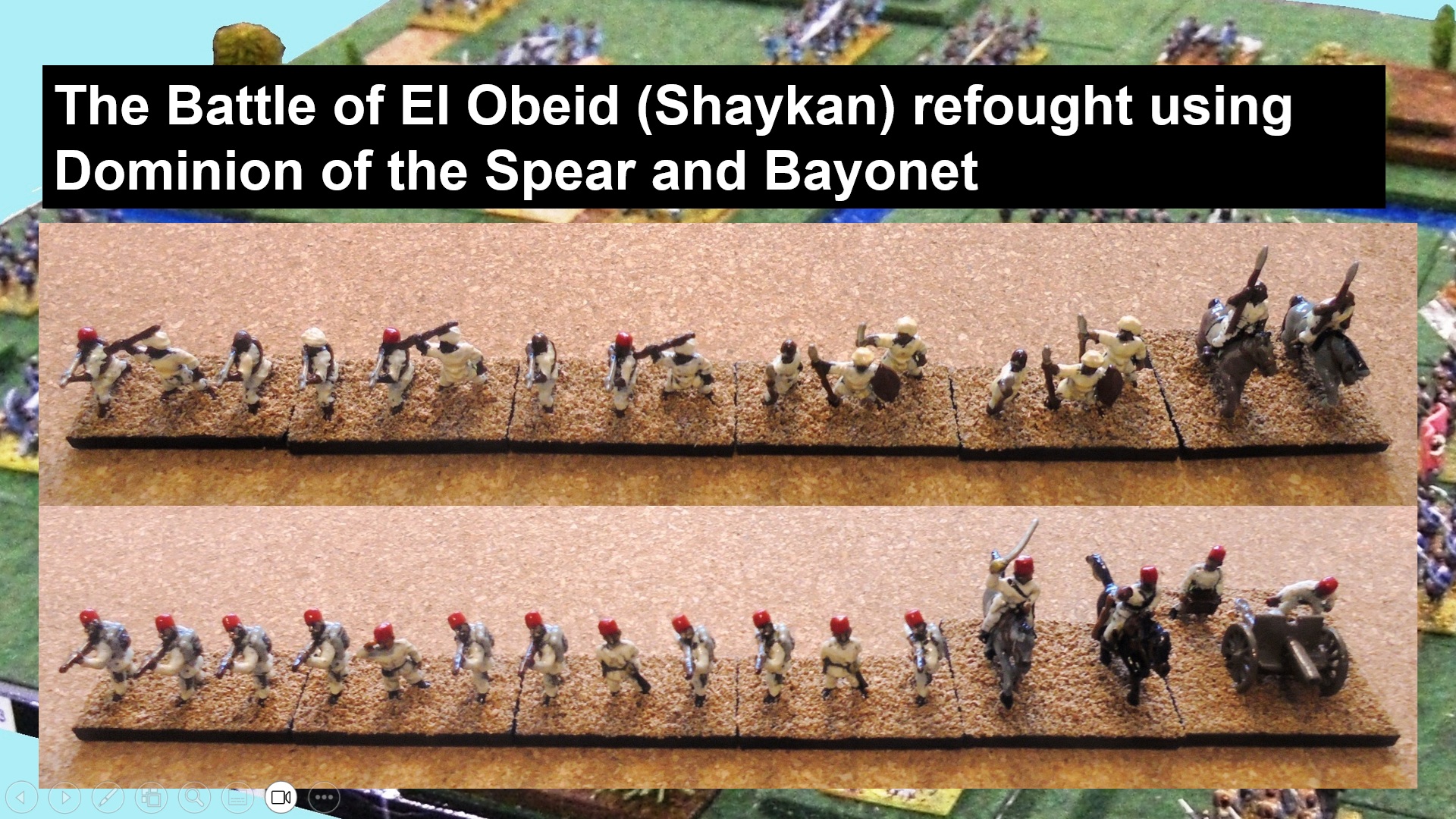
The Battle of El Obeid (Shaykan) refought using Dominion of the Spear and Bayonet

I have been interested in this battle ever since I watched the opening scenes of the film KHARTOUM back in the 1960s. After a spoken introduction, the film depicts an Egyptian force, led by retired British Colonel William (Billy) Hicks, marching through the desert to find and confront the army led by the Mahdi. His army comprised about 8,000 Egyptian regulars, 1,000 bashi-bazouk cavalry, 100 tribal irregulars and 2,000 camp followers, accompanied by a baggage train with approximately 5,000 camels. They are ambushed at El Obeid/Shaykan and pretty well annihilated.

The film takes quite a few liberties when it comes to depicting the battle. For one thing, it didn't take place in a desert valley, but in an area of dense scrub and trees. For another, I have seen no evidence that the Mahdists were equipped with rifles, spears with bombs attached to them, or primitive hand grenades that were thrown by being whirled around the thrower's head on a piece of rope! That said, it was stirring stuff for a teenage me to watch, and left with an abiding interest in the battle.

Colonel Hicks (and his Chief-of-Staff, Colonel Farquhar) leading the Egyptian force to its inevitable doom.
The film depicted the Egyptian infantry as tired, thirsty, and on the point of collapse before the fighting started.
The film showed the Egyptians being overwhelmed very quickly ...
... but the reality is that they formed a defensive square as soon as the attack started, and the square did not collapse until it had been fighting off attacks for two days. In the end, about a one-third of the Egyptians surrendered and were later freed, although all the officers were killed. Only about 500 Egyptian troops eventually managed to escape and make it back to Khartoum.

In the DOMINION OF THE SWORD AND BAYONET SUPPLEMENT, the opposing armies are as follows:

Mahdists

  • 1 x Cavalry
  • 3 x Ambushers (armed mainly with spears and swords)
  • 2 x Spearmen (armed with spears and swords)

Egyptians

  • 1 x Cavalry
  • 4 x Line Infantry
  • 1 x Artillery

The starting positions were as follows:

Turn 1

The Mahdist Ambushers attacked the Egyptian Line Infantry in the centre sector. The Ambushers threw a 5 and destroyed the Line Infantry.

The Egyptians replaced the lost unit with one of the Line Infantry units from their reserve.

In reply, the Egyptian Line Infantry in the right sector attacked the Mahdist Ambushers opposite them. The Ambushers threw first and scored a 2 and the Line Infantry threw a 3. The result was therefore indecisive.

Turn 2

The Mahdist Ambushers in the right sector attacked the Egyptian Line Infantry opposite them. They threw a 3, and in reply, the Line Infantry also threw a 3. As a result, neither side prevailed.

The Egyptian Line Infantry in the right sector attacked the Mahdist Ambushers opposite them. The Ambushers threw first and scored 5, destroying the Line Infantry.

The Egyptians replaced the lost unit with the remaining Line Infantry from their reserve.

Turn 3

The Mahdist Ambushers in the left sector attacked the Egyptian Cavalry opposite them. The Ambushers threw a 2 and in reply, the Cavalry threw a 3. The result was therefore indecisive.

The Egyptian Line Infantry in the right sector attacked the Mahdist Ambushers opposite them. The Ambushers threw first and scored 3. The Egyptian Line Infantry threw a 4. As a result, neither side prevailed.

Turn 4

The Mahdist Ambushers in the centre sector attacked the Egyptian Line Infantry opposite them. The Ambushers threw first and scored a 6, destroying the Line Infantry unit.

The Egyptians replaced the lost unit with the Artillery unit from their reserve.

The Egyptian Cavalry in the left sector attacked the Mahdist Ambushers. The Ambushers threw first and scored a 3. In reply, the Cavalry threw a 5 and destroyed the Ambusher unit.

The Mahdist replaced the lost unit with a Spear-armed unit from their reserve.

Turn 5

The Mahdist Ambushers in the right sector attacked the Egyptian Line Infantry opposite them. The Ambushers threw first and scored a 5, destroying the Line Infantry unit.

The Egyptian Cavalry in the left sector attacked the Mahdist Spear-armed unit opposite them. They threw a 2 and in response, the Spear-armed unit threw a 3. The result was therefore indecisive.

Turn 6

The Mahdist Ambushers in the right sector outflanked the Egyptian Artillery in the centre sector. The Ambushers threw a 6 (+1 for outflanking the Egyptian unit) and the Artillery was destroyed.

The battle was over ... and the result of the refight was the same as the original result.

Comments

This was a very enjoyable battle to refight and took less than fifteen minutes to complete. This has convinced me that I could easily use these rules to fight a quick mini-campaign ... and I am already thinking about a suitable setting.


Postscript

I hope to add a video about this wargame to the Wargaming Miscellany YouTube channel later this week.

Saturday, 3 May 2025

More ChatGPT images

I have been playing around with ChatGPT’s ability to create images based on photographs.

The first was of a Russian World War II general …

… who I have named General Georgi Provgorat. (For some years I was the Masonic Province of Hertfordshire’s Provincial Grand Orator, which was abbreviated to ProvGOrat … which sounded Russian to me!)

The next three were German World War II soldiers. The first is a middle-ranking officer, …

… the second was a general, …

… and the third was an member of the Mountain troops.

Finally, there is a rendition of me as a Viking chieftain.

I was rather pleased with the end results and hope to use this function again soon.

Friday, 2 May 2025

Nugget 371

I will be collecting the latest issue of THE NUGGET from the printer (Macaulay Scott Printing Company of Welling, Kent) later this morning, and I will posted it out to members as soon as I can.

I will also send the PDF copy to the webmaster as soon as I can so that members can read this issue of THE NUGGET online.


IMPORTANT: Please note that this is the eighth issue of THE NUGGET to be published for the 2024-2025 subscription year.

If you wish to subscribe for the 2024-2025 subscription year and have not yet done so, please request a PayPal invoice or the bank transfer information from the Treasurer or follow the instructions on the relevant page of the website.

Wednesday, 30 April 2025

Some of the burials in the East Greenwich Pleasaunce

During our recent visit to the East Greenwich Pleasaunce, Sue and I looked out for the graves of some of the famous people who were buried there. We had a list that we had researched from various sources and managed to find some of their graves.

Lieutenant James Thomas Berry RN (1850 to 12th September 1930): Curator of the Royal Naval Museum for 17 years.

Captain William J Blakey RN (Died 16th September 1893): late commander of HMS Wildfire, the Royal Navy's shore establishment at Sheerness.

John Booth (28th January 1781 to 29th January 1858): Born Northowram, West Yorkshire. Served at the Battle of Trafalgar as a Royal Marine aboard HMS Revenge. In July 1852 he became a Royal Greenwich Hospital in-pensioner. He was one of the first people to be buried in the new Royal Greenwich Hospital cemetery.

Captain Charles Burney RN, CB (9th October 1825 to 19th June 1887): Superintendent of the Royal Hospital School, Greenwich from 1870 until 1887.

Colonel Ernest Henry Burney CB  (17th August 1860 to 16th June 1905): late Colonel of 2nd Battalion, Royal Berkshire Regiment.

John Davidson MD, CB (1813 to 31st January 1881): Surgeon, Inspector-General of the Royal Navy, and Honorary Physician to Queen Victoria.

Albert Escott (Died 1918): Sometime headmaster of the Royal Hospital School, Greenwich.

John Greenwood (1783 to 26th March 1860): Also served as a Royal Marine aboard HMS Revenge during the Battle of Trafalgar.

Sir George Rowland Hill Kt. (21st January 1855 to 25th April 1928): He worked for the Rugby Football Union as an administrator, official, and referee for forty-nine years, eventually becoming the Secretary and later President of the Rugby Football Union (RFU).

Sir John Liddell KCB, FRS, MD (3rd June 1794 to 28th May 1868): Assistant Surgeon, Royal Navy (1812 to 1827), he saw service aboard HMS Asia at the Battle of Navarino; Director, Malta's Bighi Hospital (1827 to 1844); Inspector of Fleets and Hospitals (1844 to 1854); Director-General, Naval Medical Department, Greenwich (1854 to 1864); Honorary Physician to Queen Victoria (1859 to 1864). Retired 1864.

Thomas Joseph Mott (Died 1913): Crimean War veteran. He was Seamanship Instructor to King George V.

George Carter Pulsford FRAS (4th November 1842 to 1st August 1899): Headmaster of the Royal Hospital School, Greenwich.

Edward Robinson (c.1847 to 1926): Metropolitan Police officer who arrested the infamous burglar and murderer Charles (Charlie) Peace in Blackheath. During the arrest, the Constable was shot five times and wounded. He died in poverty at Greenwich Union Hospital, but was granted permission by the Admiralty to be buried in the Royal Hospital Cemetery.

Anthony Francis Oscar Sampayo (22nd February 1818 to 3rd August 1862): French Minister Plenipotentiary to Hesse-Kassel, whose father's sister Maria was married to William Cunningham Dalyell, an inhabitant and employee of the Hospital.

James Shepherd (1825 to 6th August 1907): Veteran of the Crimean War. For eighteen years he was Queen Victoria's boatswain's mate on the Royal Yacht HMY Victoria and Albert.

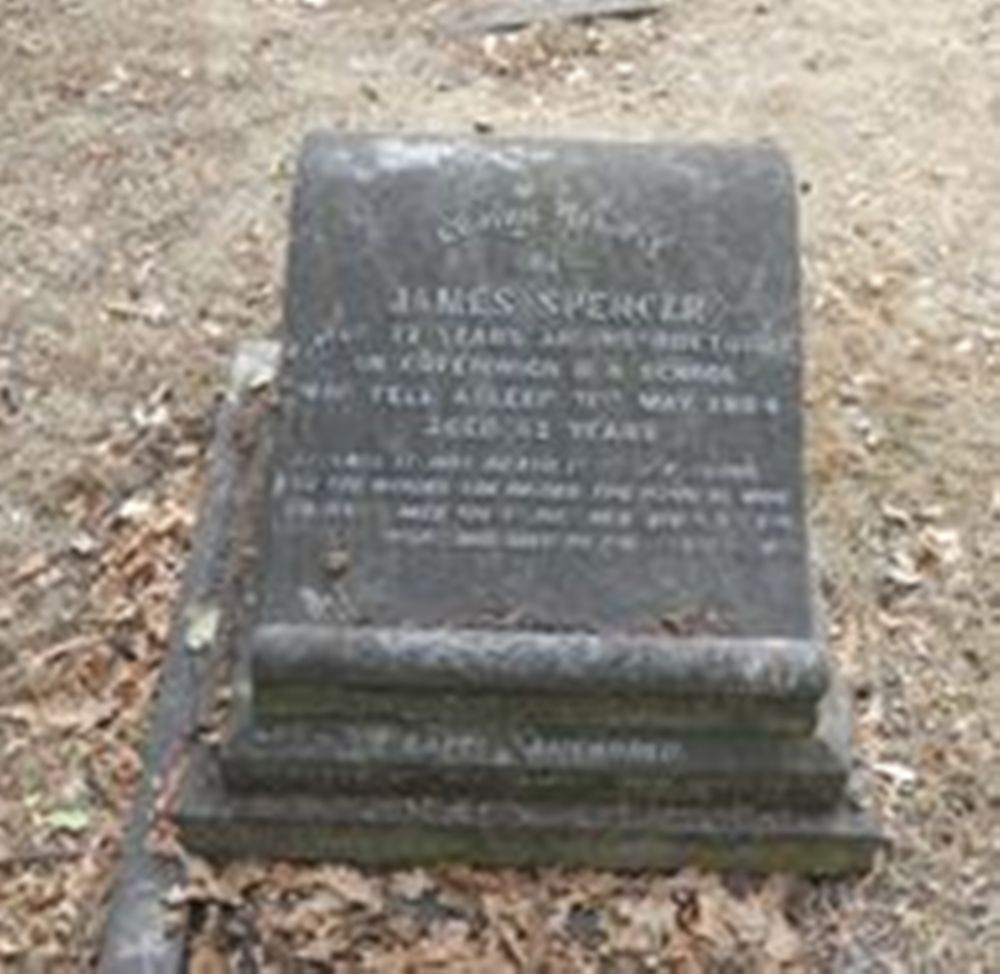
James Spencer (1852 to 1904): For twenty-two years he was an Instructor at the Royal Hospital School, Greenwich.

Captain Mark Halpen Sweny RN (1785 to 1865): Served aboard HMS Colossus as an Acting-Lieutenant at the Battle of Trafalgar.

Reverend Willian Guise Tucker RN, BA (12th May 1812 to 17th January 1885): Vicar of Ramsey, Essex (1872 to 1885), and for thirty-six years he was Chaplain in the Royal Navy, to the Malta, Haslar, and Greenwich Naval Hospitals. He was the first Chaplain of the Fleet, serving in that role from 1865 until 1871.

Reverend George Cleveland Waller MA (? to ?): Chaplain at the Royal Hospital School, Greenwich.

There are also nineteen Commonwealth War Graves of naval personnel who died during the First World War and two from the Second World War.