Pages

Saturday, 17 August 2013

France 1940

I am off to the wilds of the Wiltshire/Oxfordshire border this morning to take part in a multi-player Megablitz battle set in north eastern France in 1940. I am one of the French team ... and I am fully expecting to find myself spending most of the day fighting a number of rearguard actions against the armoured might of the German Army.

It should be a fun and very busy day ... and I know that the company and food will be excellent.

The following are photographs from one of the earliest Megablitz battles ... which was also set in France in 1940!


Friday, 16 August 2013

Cyberboard: It proves a slip ...

I have been trying to get to grips with Cyberboard ... and so far it has been a bit 'one step forward, one step sideways, one step back'.

The problem is that the program comes without a tutorial (the file exists ... but there is nothing in it as yet), and although the description in Philip Sabin's book is helpful, I have found that I need a bit more to go on. This is not to say that I have not made any progress (I have created a very passable hexed version of Eric Knowles's original Madasahatta campaign map) but it now appears that I have painted myself into a bit of a corner and cannot print the completed map as yet.

A section of the original Madasahatta campaign map with the Cyberboard hexed grid placed over it.
The same section of the Madasahatta campaign map after Cyberboard has been used to convert it to a hexed grid map.
So at the moment my grip on Cyberboard is not as firm as it could be ... and my grip might just be slipping ... but I intend to persist, and once I have I will share any results with my regular blog readers.

Thursday, 15 August 2013

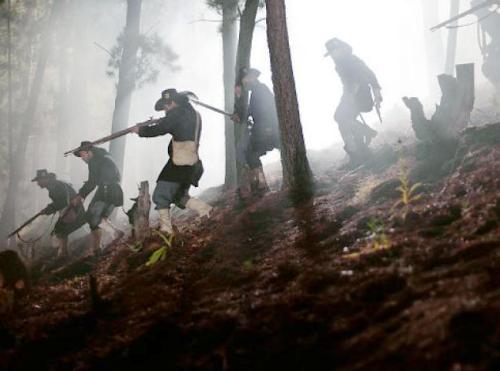
The Scott brothers' film about Gettysburg

During a protracted break in the slow but inexorable process of tidying up my toy/wargames room I took time out to watch a DVD that I bought some weeks ago. It was originally produced as a film for the History Channel by Ridley and the late Tony Scott, and makes use of a combination of CGI and film footage of actors and re-enactors. The result was somewhat different from its somewhat better known namesake film, GETTYSBURG.


The film begins with a warning that some viewers might find some of the scenes disturbing ... and now that I have watched the film I can see why. The Scott brothers have not flinched from showing the brutality of war and its aftermath, and by telling the stories of eight individuals – none of who escape unscathed from the battle in one form or another – it has a very personal edge to it.

The individuals whose roles in the battle are followed are:
  • Lieutenant Colonel Rufus Dawes
  • Sergeant Amos Humiston
  • Colonel James Wallace
  • Brigadier General William Barksdale
  • Brigadier General Joseph R. Davis
  • Assistant Surgeon LeGrand Wilson
  • Private Joseph C. Lloyd
  • Private D. Ridgeley Howard


I would not say that I 'enjoyed' watching this DVD ... but I am glad that I did.

Getting to grips with Cyberboard

If I am going to fight a campaign, I am going to need a campaign map ... and this seemed like an ideal opportunity to try out a computer program – Cyberboard – that I had read about in Professor Philip Sabin's latest book, SIMULATING WAR: STUDYING CONFLICT THROUGH SIMULATION GAMES.

Professor Sabin actually devoted a whole appendix in his book to the uses of Cyberboard, and further stated that he used the program to create all the maps used in his latest book as well as those that are featured in his earlier book, LOST BATTLES: RECONSTRUCTING THE GREAT CASHES OF THE ANCIENT WORLD. Having seen these maps – and having been quite impressed by them – I decided to download Cyberboard and to give it a try.


I visited the Cyberboard website and downloaded both programs – the Game Designer and Game Player programs – and, after a few minor hiccups that were due to me not reading Professor Sabin's notes before I started (nothing new there then!), I soon got to grips with the Game Designer software and produced a very, very basic campaign map based on Eric Knowles's Madasahatta map.


Whilst it is by no means perfect for my needs (it would need far more detail), it enabled me to practice using the software, and I now hope to use it to produce my campaign map.

(Cyberboard was – and continues to be – developed by Dale Larson. He began work on the software in 1994(!) and the current version in 3.10. The package has its own Yahoo Group (link) and the website has links to all sorts of useful stuff. The software is free ... but there is a PayPal button for donations.)

Wednesday, 14 August 2013

On the campaign trail

Over the past week or so several things have conspired to make me give serious thought to setting up and fighting a wargames campaign.

Firstly I have reached the section in Henry Hydes' book THE WARGAMING COMPANION that explained how he had set up his eighteenth century imagi-nation campaign, then I wrote a blog entry about Paul Thistlebarrow's ongoing Napoleonic PBEM campaigns, and finally I have been reading – with considerable interest – about David Crook's planned Aegean Campaign. Added to all this was the fact that I have not actually fought a wargame for quite some time and I have had time to think about this over the past few days whilst I was sorting out our home office.

I am not sure what form the campaign will take, but it is very likely to be a Colonial one set in the late nineteenth/early twentieth century. I already have the troops (mainly 15mm-scale Essex Miniatures), the terrain (my trusty Hexon II terrain), and the rules (the latest draft of my adaptation of Joseph Morschauser's FRONTIER wargames rules). All I need now is a map ... and then I can start my campaign.

There is, however, one fairly important problem that needs to be dealt with first. I need to sort out my toy/wargames room … again! Over the past couple of months – whilst we were away on our recent cruises and whilst the home office was being sorted out – it has been used as a general storage area … and my wargames table is currently covered with stuff that needs to be dealt with (i.e. stored or disposed of). This sort out should only take a day or so to complete, and once that is done – and the map is drawn – the campaign can start!

Tuesday, 13 August 2013

Poetic view of the Charge of the Heavy Brigade

Some time back in July I wrote a blog entry entitled 'Poetic views of the Charge of the Light Brigade'. In response to this one of my regular blog readers – Archduke Piccolo – drew my attention to Alfred, Lord Tennyson's poem entitled "The Charge of the Heavy Brigade at Balaclava". He implied in his comment that it was – in comparison with his "The Charge of the Light Brigade" – not a very good poem. He was right ... and now you can see why for yourselves!


"The Charge of the Heavy Brigade at Balaclava"
by Alfred, Lord Tennyson

The charge of the gallant three hundred, the Heavy Brigade!
Down the hill, down the hill, thousands of Russians,
Thousands of horsemen, drew to the valley – and stay’d;
For Scarlett and Scarlett’s three hundred were riding by
When the points of the Russian lances arose in the sky;
And he call’d, ‘Left wheel into line!’ and they wheel’d and obey’d.
Then he look’d at the host that had halted he knew not why,
And he turn’d half round, and he bade his trumpeter sound
To the charge, and he rode on ahead, as he waved his blade
To the gallant three hundred whose glory will never die –
‘Follow,’ and up the hill, up the hill, up the hill,
Follow’d the Heavy Brigade.

The trumpet, the gallop, the charge, and the might of the fight!
Thousands of horsemen had gather’d there on the height,
With a wing push’d out to the left and a wing to the right,
And who shall escape if they close? but he dash’d up alone
Thro’ the great gray slope of men,
Sway’d his sabre, and held his own
Like an Englishman there and then.
All in a moment follow’d with force
Three that were next in their fiery course,
Wedged themselves in between horse and horse,
Fought for their lives in the narrow gap they had made –
Four amid thousands! and up the hill, up the hill,
Gallopt the gallant three hundred, the Heavy Brigade.

Fell like a cannon-shot,
Burst like a thunderbolt,
Crash’d like a hurricane,
Broke thro’ the mass from below,
Drove thro’ the midst of the foe,
Plunged up and down, to and fro,
Rode flashing blow upon blow,
Brave Inniskillens and Greys
Whirling their sabres in circles of light!
And some of us, all in amaze,
Who were held for a while from the fight,
And were only standing at gaze,
When the dark-muffled Russian crowd
Folded its wings from the left and the right,
And roll’d them around like a cloud, –
O, mad for the charge and the battle were we,
When our own good redcoats sank from sight,
Like drops of blood in a dark-gray sea,
And we turn’d to each other, whispering, all dismay’d,
‘Lost are the gallant three hundred of Scarlett’s Brigade!’

‘Lost one and all’ were the words
Mutter’d in our dismay;
But they rode like victors and lords
Thro’ the forest of lances and swords
In the heart of the Russian hordes,
They rode, or they stood at bay –
Struck with the sword-hand and slew,
Down with the bridle-hand drew
The foe from the saddle and threw
Underfoot there in the fray –
Ranged like a storm or stood like a rock
In the wave of a stormy day;
Till suddenly shock upon shock
Stagger’d the mass from without,
Drove it in wild disarray,
For our men gallopt up with a cheer and a shout,
And the foeman surged, and waver’d, and reel’d
Up the hill, up the hill, up the hill, out of the field,
And over the brow and away.

Glory to each and to all, and the charge that they made!
Glory to all the three hundred, and all the Brigade!


As poems go, it is pretty dire. It is no wonder that it has been forgotten ... and that it also seems to have 'disappeared' from several anthologies of Tennyson's poems.

I have been to ... the Artillery Museum, St Petersburg: Post-war Weaponry

Rockets have formed a major part of the Soviet and Russian arsenals since the end of the Second World War, and the Artillery Museum has an extensive collection of them.

2P26 anti-tank weapon system (AT-1 Snapper anti-tank missile mounted on a modified UAZ-69 light truck)


2P27 anti-tank weapon system (AT-1 Snapper anti-tank missiles mounted on a BRDM-1 chassis)


2P32 anti-tank weapon system (AT-2 Swatter ant-tank missiles mounted on a BRDM-1 chassis)


9K11 Malyutka (AT-3 Sagger) anti-tank missile


3R2 Mars (FROG-2) tactical missile mounted on a tracked chassis based on that of the PT-76 light tank
FROG = Free Rocket Over Ground


3R1 Filin (FROG-1) tactical missile mounted on a tracked chassis based on that of the JS heavy tank
FROG = Free Rocket Over Ground


BM-25 rocket launcher mounted on a KrAZ-214 truck


BM-24 rocket launcher mounted on a truck


BM-14 rocket launcher mounted on a truck


BM-21 Grad rocket launcher mounted on a Ural-375D truck


2A11 Krug (SA-4 Ganef) anti-aircraft missile (background)
2K12 Kub (SA-6 Gainful) anti-aircraft missile (foreground)


9K31 Strela-1 (SA-9 Gaskin) anti-aircraft missile


9K35 Strela-10 (SA-10 Gopher) anti-aircraft missile


Early Russian ballistic missile engines
These were designed by Sergei Pavlovich Korolev, the leading Russian rocket engineer and bear a very close resemblance to the rocket engines fitted to the German V2 rocket.


The Museum also has a very large collection of conventional artillery, much of which is displayed outside the Museum.

2S3 Akatsiya 152mm self-propelled howitzer


2S7 Pion 203mm self-propelled gun


2S1 Gvozdika 122mm self-propelled howitzer


M1955 (D-74) 122mm howitzer


2A36 Giatsint-B 152mm gun