Pages

Saturday, 27 October 2018

Cruising can broaden the mind ... and the waist!

Yesterday Sue and I returned from a cruise to the Mediterranean and back. Along the way we re-visited quite a few places we had been to before and several new ones. I've been making notes and taking hundreds of pictures along the way and have a lot of material to include in future blog entries.

For those of you who have never cruised, I strongly advise you to think about doing so as it can be a great way to visit places. You travel in a luxurious floating hotel, where the food is excellent (hence the comment about cruising having the potential to broaden the waist!) and the people you meet can be both interesting and entertaining. There is time for you to sit and relax as well as to go ashore to visit cities, towns, archaeological sites, museums, art galleries ... and shops. The choice of what you do is yours, and no one will try to dragoon you into doing something that you don't want to do.

Over the next few days we are going to be doing the inevitable chores that always come after a holiday (washing clothes, storing the luggage, catching up on tasks that have not been done whilst we have been away), but with luck I should at some point be able to begin writing a long blog entry about our cruise. In the meantime – however – those chores have got to be done.

Thursday, 25 October 2018

I have been to ... La Spezia Naval Museum: The open-air displays

The final section of the museum we visited were the open-air displays.


These included:

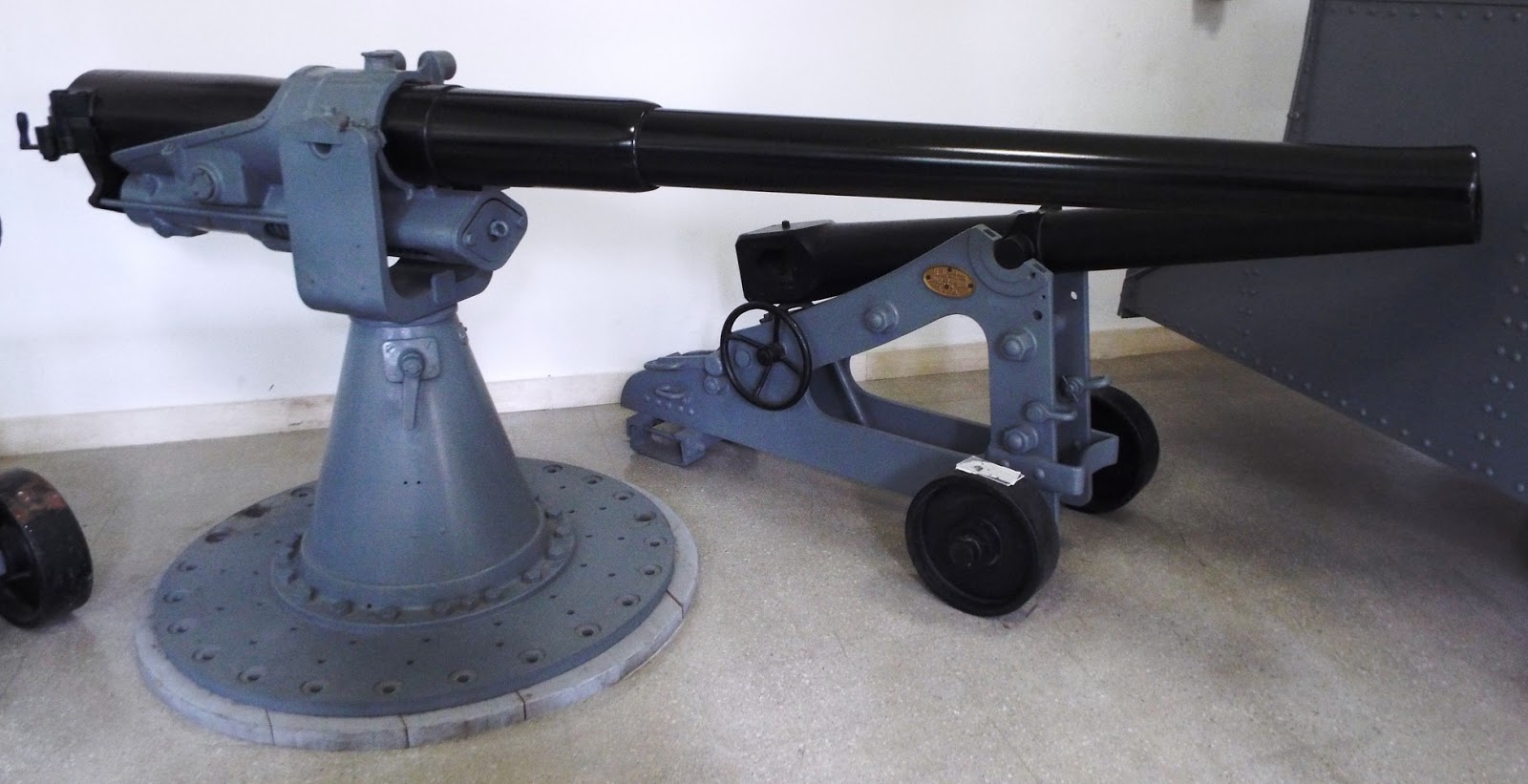
An example of a Cannone da 100/47


A memorial to the crews and submarines of Royal Italian Navy


An example of a 305mm (12-inch) Menon anti-submarine mortar


The Menon anti-submarine mortar was a single barrelled 305mm (12-inch) mortar with automatic loading. It was fitted with a a 7-round magazine and had a range of 400m to 900m (440 yards to 980 yards.

A statue of Constanzo Ciano


Costanzo Ciano commanded a MAS unit during the First World War and won a Gold Medal for Military Valour for leading an attack attack on Austrian shipping in the harbour at Buccari (now Bakar) in Istria, Croatia.

One of the propellers from the Littorio-class battleship Vittorio Veneto

Wednesday, 24 October 2018

I have been to ... the La Spezia Naval Museum: The Artillery Hall (2) - The high-angle guns

The second part of this photo-report covers the high-angle guns in the museum's collection.

Cannone Breda Mitragliera da 37/54 (1939)


This was a light anti-aircraft gun designed and produced by Breda. It was fitted to most of the more modern ships in service with the Royal Italian Navy during the Second World War. It was also produced as a twin-mounted weapon (see below).

Cannone Scudato AA 65/64 (1940)


This Ansaldo-designed anti-aircraft gun was built from 1943 onwards but was never fully adopted into service.

Cannone Mitragliera Breda da 20/65 (1942)


This Breda-designed light anti-aircraft gun was mounted in single and twin-barrelled mountings on many Italian warships.

Cannone Breda Mitragliera Binata da 37/54 (1939)


The twin-barrelled version of the Breda anti-aircraft gun featured above.

Tuesday, 23 October 2018

I have been to ... the La Spezia Naval Museum: The Artillery Hall (1) - The low-angle guns

One part of the museum that I had previously visited was the Artillery Hall.


This contains examples of many of the smaller (i.e. less than 6-inch calibre) weapons carried by Italian warships. The first part of this photo-report will cover the low-angle guns in the collection.

Cannone USN da 76/50 (1942)


This was a United States Navy weapon supplied to the Italian Navy after the Second World War. They were fitted as the armament of three Cannon-class destroyer escorts (Andromeda (F592), ex-USS Weston (DE-184); Aldebaran (F590) ex-USS Thornhill (DE-195); and Altair (F591) ex-USS Gandy (DE-764)) that were transferred to the Italian Navy in 1951.

Cannone Tipo Maxim-Nordenfelt 57/43 (1900)


This gun was supplied by the British Maxim-Nordenfelt Company and was better know as the 6-pounder QF Gun. It was used aboard all types of ship from torpedo boats to battleships.

Cannone da 76/40 (1897 - 1912)


This was an Italian-built version of the Vickers Armstrong 12-pounder 12cwt QF Gun. It was manufactured by Ansaldo and like the Cannone Tipo Maxim-Nordenfelt 57/43 it was used aboard all types of ships.

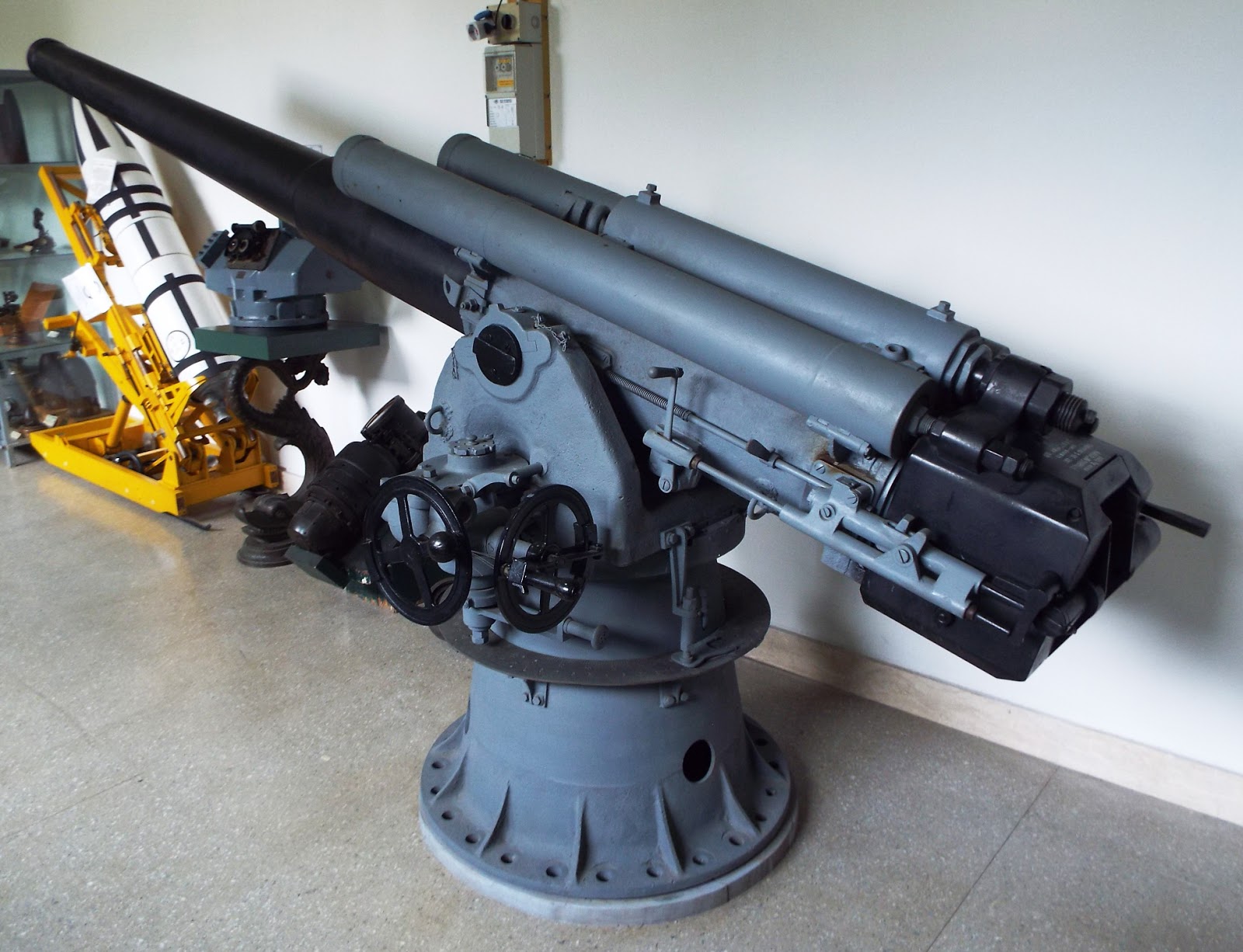
Cannone OTO 100/37 (1937)


This gun was a development of the Škoda 10cm K10 (see below) and was built by OTO. It was used to arm a wide range of smaller ships, including the Gabbiano-class corvettes.

Cannone da 120/40 (1893)


This was the British Elswick-designed 4.7-inch Mark I or III QF Gun, and during the Second World War it was used as star-shell guns aboard the Littorio-class battleships.

Cannone Canadese da 4-inch


This appears to be a Canadian-manufactured, British-designed 4-inch Mk V QF Gun of the type fitted to the Algerine-class minesweepers, one of which (the Alabarda (F560) ex-HMS Larne (J 274)) was transferred to the Italian Navy in 1946.

Cannone Ansaldo da 102/35 (1914)


This was an Italian-built version of a British-designed 4-inch QF Gun. It was used to arm many of the destroyers and submarines built for the Royal Italian Navy during and immediately after the First World War.

Cannone Ansaldo da 102/45 (1917)


This is was an Italian-built version of the British-designed 4-inch Mk V QF Gun and was used to arm many of the destroyers built for the Royal Italian Navy during the inter-war period.

Cannone Škodawerke da 100/47 (1910)


This was the Škoda 10cm K10 Gun, captured examples of which were introduced into Italian service after the First World War. It was copied, and later versions were produced as the Cannone OTO 100/37 (see above).

Monday, 22 October 2018

I have been to ... the La Spezia Naval Museum: The bombing of La Spezia

As it was one of the Royal Italian Navy's main naval bases, La Spezia was heavily bombed during the Second World War, and the museum has a 'before and after' model that shows the damage caused by the bombing and the subsequent re-building.

La Spezia Naval Base in 1945


La Spezia Naval Base in 1960


The naval base was used by major units of the Royal Italian Navy, as can be seen in the following aerial reconnaissance photograph that show three of the Littorio-class battleships moored in the outer part of the naval base.

Sunday, 21 October 2018

The sailing battleship Monarca/steam battleship Re Galantuomo

The first half of the nineteenth century saw major changes to the design of warships, the most important of these being the introduction of steam power. The navies of Great Britain and France were the leaders in this field, but even smaller navies such as the Neapolitan Navy introduced steam-powered warship into service.

When she was built and launched in 1850, the Monarca was the largest and most powerful ship ever built in Italy. She was armed with 84 guns, which rated her as a second-class ship-of-the-line. She was, however, already becoming obsolete because she was solely sail powered, and plans were prepared to convert her to steam power. The conversion (which reduced her armament to 64 guns) took place in 1858, but was not very successful as her first propeller proved incapable to moving her at more than 4 knots. It was later replaced, and the ship's speed under steam increased to 8 knots.

In August 1860 some of Garibaldi's troops (including two companies of the 2nd Battalion of the Sardinan Bersaglieri) attempted to capture the Monarca whilst she was moored in Castellammare harbour. The attempt failed fairly disastrously, and the Monarca remained the most important ship in the Neapolitan Navy for a further month. When the King of the Two Sicilies (Francis II) attempted to flee to the fortress of Gaeta in September 1860, the Monarca, which was now under the command of a new captain, changed sides and was incorporated into the Royal Italian Navy. She was then renamed Re Galantuomo.

The ship was not a great success in service. During a voyage to the United States in 1864 she experienced considerable difficulties with her machinery. During the Seven Weeks War of 1866 the Re Galantuomo patrolled the lower reaches of the Adriatic and did not take part in the Battle of Lissa. She was eventually taken out of service and scrapped in 1875.

In the 1920s the Royal Italian Navy built two sail training ships. They were designed by General Lieutenant Francesco Rotundi, who based the exterior design of the Cristoforo Colombo and Amerigo Vespucci on that of the Re Galantuomo, even down to copying the very thin funnel of the original.

A side view of the Re Galantuomo.
A side view of the Amerigo Vespucci.
The Cristoforo Colombo was handed over to the Russian Navy at the end of the Second World War but the Amerigo Vespucci still remains in service with the Italian Navy.

Saturday, 20 October 2018

I have been to ... the La Spezia Naval Museum: Other large ship models

Besides the large case containing model that show the development of early ships, there are several large model ships on show at various locations throughout the museum.

The steam corvette Vettor Pisani


The ship was named after Vettor Pisani, a Venetian admiral who commanded of the Venetian fleet during the war against the Genoese (1378 to 1381). He defeated the Genoese fleet off Capo d'Anzio in 1378 but was beaten by them at Pula in May 1379. On his return to Venice he was imprisoned. He was later released, returned to command the Venetian fleet, and after the recapture of Chioggia, his victory forced the Genoese republic to agree to peace terms

The training ship Amerigo Vespucci


The Amerigo Vespucci was built in 1930 in Naples by the Castellammare di Stabia naval shipyear. She was launched on February 22, 1931 and commissioned in July of that year. She was the second of two training ships designed by General Lieutenant Francesco Rotundi of the Italian Navy's Engineering Corps (the other was the Cristoforo Colombo). She is styled to look like a large late eighteenth century 74-gun ship-of-the-line such as the Monarca.

She remains in service today.

The galley La Beatrice


La Beatrice and her sister ship Liguria were built in Genoa and were in service in 1815.

The steam battleship Monarca, later Re Galantuomo


The Monarca was a line-of-battle-ship, built in 1850 for the Neapolitan Navy. She was converted to steam power in 1860, handed over to the Royal Italian Navy in 1861, renamed Re Galantuomo, and broken up in 1875.

The sailing corvette San Giovanni


The San Giovanni was built in Genoa in 1849.

Friday, 19 October 2018

Pure self-indulgence

Some time ago, when I was experiencing problems with Blogger, I became concerned that all my blogs would become 'lost' if Blogger every disappeared. I do have a Wordpress backup, but I prefer to use Blogger.

I have always kept copies of my blog entries in MS Word format as ongoing blog diaries. I therefore decided - as a pure piece of self indulgence - to have them printed and bound ... and the latest batch have recently been delivered by Lulu.com.


This is not a cheap way to store my blog diaries, but I now have hardback versions of the early years on my bookshelves, and as and when I can afford it, I will gradually have the rest of them printed.

An example of pure self-indulgence? Yes ... but one that has given me a lot of pleasure!

Thursday, 18 October 2018

I have been to ... the La Spezia Naval Museum: The early ship models

In the centre of the main hall of the museum is a long case containing a large number of models that show the development of early ships.