The journey to Kuston Hall and COW2019
After what seemed to be a somewhat fraught drive to Knuston Hall, I arrived at just after 5.00pm. (I used the quickest route advised by the sat nav; it took me through the Blackwall Tunnel, up the M11 and around the M25 until I reached the northbound M1. I stopped at Toddington Services for a comfort break, and soon afterwards left the motorway to go across country to Knuston Hall
via Olney. Roadworks and sheer volume of traffic added at least 45 minutes to my journey ... and I was feeling somewhat frazzled by the time I walked into the Hall's entrance.)
All my weariness vanished as soon as I booked in and was greeted by the staff and my co-organiser (Tim Gow), and by 5.30pm I had unpacked my bags and was talking wargaming! I had a refreshing cold drink, which I took outside where I was quickly able to renew old acquaintances and really get into the right frame of mind to enjoy COW.
Friday Evening
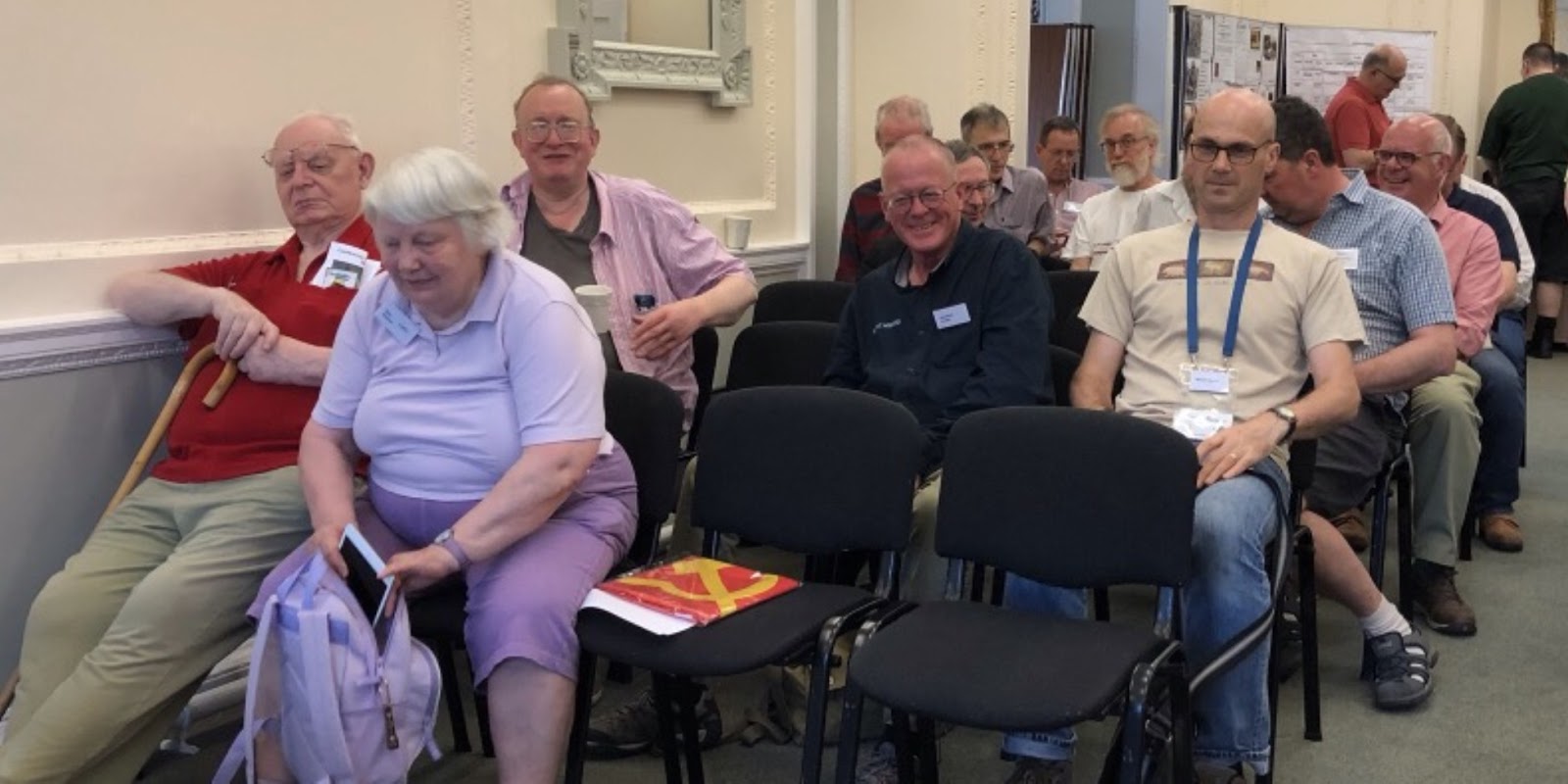
After an excellent dinner (ginger and lime chicken salad to start, followed by three huge lamb chops, potatoes, and vegetables, and topped off with a choice of dessert), we all assembled in the Lounge for a very quick welcome ceremony (during which I was given an award for my services to wargaming) before an introduction to the plenary game.
Above and below: The attendees gather in the Lounge.
The game was based on events leading up to and during the Yom Kippur War in 1973, and involved a mixture of role-play and tabletop action. Use was made of WhatsApp both prior to and during the game to feed news and information to the players, and this proved to be a very effective use of technology. I played Yasser Arafat, ...
Me as Yasser Arafat. (I was told to wear an Arab headdress, combat jacket, and dark glasses ... and the above is the result. The resemblance in uncannily unconvincing!
... and spent most of my time in negotiations with the various Arab players trying to push them into action against Israel and to gain recognition from the Russians. I'm not sure how successful I was ... but I had great fun trying to achieve my objectives!
Once the game was over, I had time to grab a quick drink before going to the Beech Room to take part in John Bassett's HITLER'S CHILDREN. This was not so much a game as a means by which the radicalisation of the members of what was called the Baader Meinhof Gang could be examined and discussed. This was a very though-provoking session, and in my opinion the structure could easily be used to look at the circumstances that might lead a person to become radicalised.
After this session I resolved to go to bed, but as always seems to happen at COW, I ended up talking about wargaming for quite some time, and did not make it back to my room until after 1.00pm on Saturday morning.
Saturday Morning
After a better than expected night's sleep, I was up and dressed by 7.30am, and in time to join everyone else for breakfast at 8.00am.
The cooked breakfast was excellent, and afterwards I had a mug of coffee in the main hall. I then spent the rest of the morning sorting out the booking for COW2020 (which will be the fortieth that the conference has been held at Knuston Hall) as well as visiting almost all of the games that were taking place. These included:
- Graham Evans' VA T'EN ECOSSE, about the Battle of Culloden
Above and below: The early stages of the Battle of Culloden.
- Wayne Thomas, David Brock, and Colin Mosby's OVER THE HILLS (AND FAR AWY), a divisional-level Napoleonic game
Above and below: The British and French are about to come into contact somewhere in Spain.
- Sue Laflin Barker's ASTERIX & REDBEARD'S TREASURE, a cartoon-inspired skirmish set in Gaul
Above and below: The treasure hunt is in full swing.
- Alan Paull's MISSION COMMAND – NORMANDY
Above: The players were fully engrossed in the planning stage of the game when I visited.
Lunch took place not long after midday, and was a very appetising mixture of hot and cold food. I opted for the chicken korma with rice and naan bread, followed by apple crumble and custard. (Yes, I know that it is a bit of an odd selection to choose but ...)
Saturday Afternoon
During lunch the traditional COW weather deserted us, and it began to rain quite heavily. As a result, the Spanish Civil War lawn game – Tim Gow's SPAIN ON THE PLAIN – had to be moved to the Practical Room. The scenario was based on the initial Republican attacks on Gandesa at the beginning of the Battle of the Ebro, and took us about an hour and a half to play though. (Had the we been able to fight the battle outside, both sides would have been able to field larger forces, and the session would have lasted longer.
The Nationalist defenders of Gandesa prepare for the Republican assault.
The Republicans were well equipped with tanks, armoured cars, and artillery.
A close-up of a Republican tank and some of the artillery support.
Two Republican armoured cars.
The bomber will get through ... especially if it is fast!
A Republican Chato fighter.
A Nationalist Fiat fighter being flown by an Italian pilot.
A Republican Mosca fighter.
A pair of Nationalist Fiat fighters, one flown by an Italian and the other by a Spaniard.
The Republican advance begins!
Whilst the Republican infantry assaulted the front of the Nationalist position, their tanks attempted to outflank it.
After afternoon tea, I paid a visit to see Graham Evans' and Phil Steele's EDGCOTE 1469 – THE GAME.
Above and below: The Battle of Edgcote was refought on a magnificent, purpose-built wargame battlefield.
I then watched a session of John Bassett's THE ROOKS, which recreated the service histories of a group of FROGFOOT pilots in Afghanistan and elsewhere. (The aircraft called the FROGFOOT within NATO is known as the ROOK in Russian service.)
The Frogfoot pilots (the Rooks) discover their fate.
My final visit of the afternoon was to see John Curry's CONFRONTATION ANALYSIS: THE CARD GAME, which was being held in the library.
This sort of session is what makes COW so different from almost any other wargame gathering.
Dinner was garlic mushrooms, followed by pork loin with potatoes and vegetables, and rounded off with Lemon Pie and cream. (We eat well at Knuston Hall!)
Saturday Evening
I had just enough time before dinner to set up my CARRY ON UP THE NILE! game in the Library, and at 8.30pm all six players (plus two more who I was able to fit in as additional characters) were seated around the table, ready to start.
Above and below: The terrain for 'Carry On up the Nile! is set up and awaits the arrival of the players.
Running a game is very different from taking part or watching it as an observer, and I managed to take very few photographs during my session. (I am hoping that some of the players did and will share them with me.) I will be writing a detailed battle report in the next few days, but what I can say is that there were quite a few hilarious moments, with the players keeping to their character's role. As a result, everyone – including me – had a great time, and when the game came to an end at just after 10.30pm, I think that everyone who had taken part had enjoyed themselves.
Sunday Morning
I slept soundly, and after a quick shower I was dressed and ready for breakfast well before 8.00am. By 9.00am I was back in the Beech Room to take part in Jonathan Crowe's ZIRKUS game about the D-Day landings.
The D-Day landings are underway ... and Omaha and Juno beaches are proving difficult to take.
Jonathan lives in Normandy, and already guides parties around the landing sites. His game is being developed for use with non-wargamers to give them some idea of the problems faced by both the invaders and defenders, and to allow them to see how the initial fighting unfolded. I commanded 12th SS
Panzer Division, and actually did very little as I had to wait until Hitler woke up before I could be ordered to move towards Caen to engage the invaders. This gave me the opportunity to watch how the game worked, and I came to the conclusion that after a few tweaks, Jonathan will have a game that anyone will be able to play and learn from.
Once the morning coffee break was over, I was off to the Practical Room to take part in John Curry's practical demonstration of the US NAVY WAR COLLEGE'S NAVAL WARGAME.
The Germans entered the Straits of Gibraltar in two parallel columns, whilst the Allies sailed backwards and forwards across it to block their path. A deadly confrontation was therefore unavoidable.
Having taken part in the game played at the National Maritime Museum last year, I was the only 'old hand' besides John. As a result, I was given command of a small German force (three battleships and two battlecruisers) that were attempting to leave the Mediterranean
via the Straits of Gibraltar. The opposing mixed force of British and American ships (four battleships and one battlecruiser) were ahead of us and determined to stop us.
Once the ships reached a position where they could fire at each other, battle commenced with a vengeance. I had split the German force into two parts (a battleship division and a battlecruiser division) with each sailing in line astern towards the line of Allied ships. I was leading the German battleships, who were given the simple orders to 'follow me' and to 'engage the enemy ship in equivalent position in the line-of-battle that is ahead of us'. (I understand that my sub-commander in charge of the battlecruisers did the same.)
My flagship soon began to take hits, and I turned to starboard (right) so that the ships following me could also engage the enemy. We knew that we were doing damage to the enemy, but were suffering damage as well ... and by the end of the game my ship was close to being reduce to about half its effectiveness.
Who won? Well the Allies inflicted more damage, and it was obvious that not all the German ships were going to escape back to Germany, so it was certainly a moral victory for the Allies ... but when you looked at the ships that they were using, almost all of them were a couple of years ahead of the designs fielded by the Germans, and thus had great hitting power and staying power. As such, the rules did reflect that material differences between the ships involved, even though the game itself was never designed to test ships designs but to teach teamwork and tactics. The mechanisms were simple to use, and allowed the game to move along at a reasonable pace ... and this was a big plus for those of use who have used Fred Jane's Naval War Game Rules or the Fletcher Pratt Naval War Game. (The latter uses a similar system of ship degradation to the USNWC game, which is not surprising as he knew many of the people involved in its design and use. However, his gunnery system is very different.)
Lunch was a traditional Sunday roast, and was very well received. (The catering at Knuston Hall is second to none, and I don't remember anyone complaining about the food or the service this year ... or for several previous years.)
Sunday Afternoon
I then attended Jim Roche and John Bassett's MARCHING FROM SPARTA session. This was a discussion led by the session co-presenters, and looked at the history of marching in step and its relationship to drill since Ancient times. The discussion was wide ranging, and looked at various sources that covered the whole spectrum of history from Ancient to modern times.
The discussion - led by Jim Roche and John Bassett - in full swing.
This sort of session is sometimes overlooked in the great scheme of things, but in many ways, it is a sort of masterclass that COW does so well. Getting a group of enthusiastic professional and amateur military historians and wargamers together to share knowledge and understanding means that we can all learn from each other, and has been a core element of COW since it was founded in 1980.
The final event of the conference was the Wargame Developments Annual General Meeting, and although it was somewhat sparsely attended, I was able to announce the dates for next year's conference (10th to 12th July 2020 inclusive) and the cost of attending ... which will be the same as this year.
The journey home from COW2019
I left Knuston Hall almost on the dot of 4.00pm, and my sat nav indicated that I would be home by 6.04pm.
I wasn't. In fact, I didn't drive onto the hard standing outside our house until just after 7.30pm. The delay was due to a number of accidents on the M1 and M25 (at one point the M1 was closed for over twenty minutes whilst they cleared the damaged cars out of the way), and the fact that I had to take a diversion from Barnet and across North London to join the North Circular Road. My troubles did not end there, as there was a further accident on the North Circular Road just ahead of me, and this delayed me by an additional twenty minutes.
I arrived home tired and somewhat frazzled (again!), but once the car had been unloaded, Sue and I set off to have dinner in our local Turkish restaurant. COW2019 was over ... and I already had a list of tasks to perform in preparation for COW2020!