Pages

Friday, 16 September 2011

A day in Herne Bay ... and an interesting 'find' when I got home

My wife and I have spent most of today in Herne Bay, Kent, visiting my father-in-law. On the way there we did his weekly shopping, which we delivered to him before we took him off to look at three apartments in a wardened block of flats.

Herne Bay Pier. It was completed in 1899 and was originally much longer (3,787 feet or 1,154m). It was damaged in by storms in 1978 and 1979, and the central part was demolished in 1980, leaving a landward stub (on which a sports centre was built) and the remains of the landing stage (which was at the far end of the pier) isolated from the shore.

He is now 96 years old and he has, after several false starts, decided that he can no longer cope with living on a bungalow on the outskirts of the town, and that he needs to be much closer to the centre of Herne Bay. We have looked at several apartments in a suitable block of flats that is only about 100 yards from the main shopping street and supermarket in Herne Bay, and today we returned to look at one for a second time because he thought that it might be right for him. As it was, he decided that the apartment was not to his liking, but one of the other two that were on sale was exactly what he wanted.

We took him home, and after a discussion he asked us to sort out the purchase of the apartment for him. This meant that we had to return to the centre of Herne Bay to talk to the estate agent who was selling the apartment. We made an offer on the apartment, but the estate agent was unable to get in contact with the vendor and so we went and had some lunch. We also paid a visit to the bank and began the process of trying to organise the finance for the purchase.

We then paid another visit to the estate agent, but they had still not been able to contact the vendor. They agreed to let use know if the offer we had made was acceptable (or not) to the vendor, and after a bit of 'retail therapy' in the local shops (including a newsagent that sells a small range of different models and modelling materials), we drove home.

We both arrived home feeling absolutely shattered, and it took us several hours to recover. I did, however, manage to spend some time in my toy/wargames room continuing my search through its contents ... and made an important discovery. Behind the storage boxes containing my Hexon II terrain I found two flocked and gridded terrain boards. They are gridded in 5cm x 5cm squares, and each board is 60cm x 90cm (or 12 squares x 18 squares). They very suitable for use with my PORTABLE WARGAME ... and I hope to use one them for my next play-test.

There is only one thing that is bothering me ... I cannot remember making the boards. It must have been some time ago, but I just cannot work out when.

Thursday, 15 September 2011

Some more 'finds'

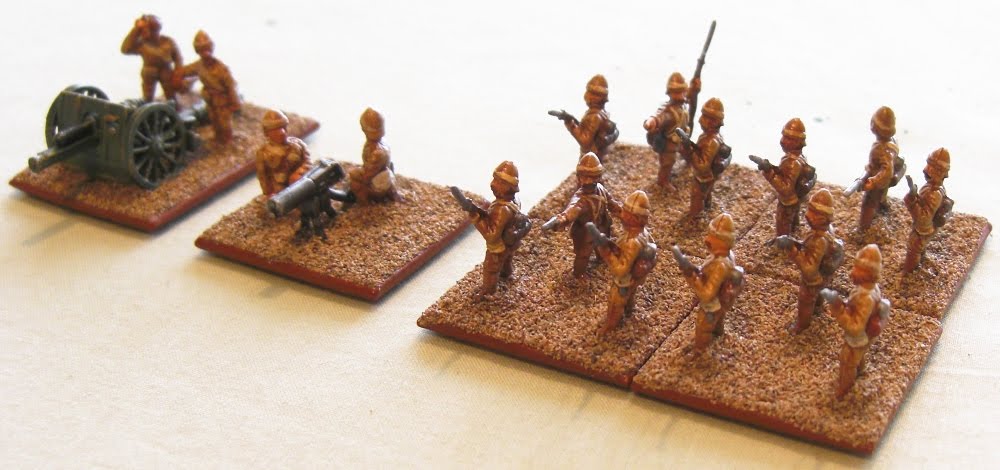
This morning I managed to make some more progress sorting through my toy/wargames room. Amongst the things I found were a small 15mm-scale painted and based Colonial army ....


... and a somewhat larger collection of painted 1870-era Prussian 15mm-scale figures.


The former were acquired for me by Tim Gow, and are based on 40mm wide bases. With the exception of the 18-pounder field gun, the figures are from Essex Miniatures' Colonial range. I think that the Prussian figures were made by Irregular Miniatures, and I must have painted them at least ten or fifteen years ago. There are enough of them to form the basis of two armies that could be used with my PORTABLE WARGAME 2 rules. All that the armies need in order to be completed is a couple of suitable Command figures (and staff), some field guns and crew, and some cavalry.

Finding these figures has made me realise that I probably have enough painted and unpainted 15mm-scale figures in my collection to form quite a few PW2 armies, and that a campaign set during the 1880 to 1910 period would not be too difficult to have ready to start within a matter of months if not weeks. It might mean that I have to do some figure painting (something that I have not done for quite a long time) and quite a lot of basing, but it should not be too arduous a task ... and it will spur me on to finish my PORTABLE WARGAME rules.

Wednesday, 14 September 2011

Looking backwards to go forwards

I spent this morning – and a chunk of this afternoon – at my father’s house helping my brother to remove some items of furniture before the house clearers arrive. This meant that it was not until quite late in the afternoon before I was able to complete the transfer of my blog print-outs to their new storage folders. (Yes … I am that anally retentive … and yes, I do have printed copies of all my blog entries filed in date order!)

This has been a time consuming process … and not just because there are so many pages of A4 paper to file! I keep finding myself stopping quite frequently to read and review what I have been writing about since I started this blog. After a time one begins to notice certain themes that have reoccurred and developments that have taken place.

Most noticeable is the fact that almost from the beginning I was designing and fighting wargames that used some form of gridded playing surface. It is also noticeable that the rules that I have been writing seemed to have been becoming less and less complex, and that with the growth of simplicity has come greater enjoyment.

Another trend has been the increasing use of imagi-nations in my wargames. Over the past four years I have taken part in historically-based battles, but all of these have been organised by other people. Mine have been firmly placed in an imaginary world that is similar to our own … but not an exact replica. To date I have used the following imagi-nations in the wargames I have written about in my blog:
  • Morschauserland (and its colony, New Morschauserland): a quasi-Germanic country located somewhere in Central Europe.
  • Eastland: a country in Eastern Europe that resembles Soviet Russia during the Stalinist era.
  • Fezia: a country that bears a resemblance to Ottoman Turkey.
  • Laurania: Winston Churchill’s invention, it is located on the Mediterranean coast somewhere in Southern Europe.
  • Cordeguay: a South American country that has similarities with Chile and Peru.
In addition I have created several other imagi-nations – some of them a long time ago – that could be used in wargames:
  • Upsland: a Nordic country located somewhere in the Baltic area.
  • Opeland: similar to Upsland – its great rival – and also located in the Baltic region of Europe.
  • Zubia: an Arab country that has similarities with Egypt … and may, therefore, be a former vassal sate of Fezia.
  • Maldacia: Laurania’s neighbour and archrival in Southern Europe.
Finally, there are the imagi-nations that I have used – or been associated with – in my Colonial campaigns, both in the distant and more recent past. These include:
  • Madasahatta: an island in the Indian Ocean, it was the setting for Eric Knowles’ epic and long-running World War I Colonial campaign.
  • Dammallia: a British East African colony.
  • Mankanika: a German East African colony.
  • Marzibar: an island nation that bears a passing resemblance to Zanzibar.
  • Deutsches Sudan: a short-lived German colony on the Red Sea coast.
  • Chindia: a sort of amalgam of British Indian and Indo-China.
  • Gaziristan: China’s north western neighbour and home to a number of warring and very warlike tribes, in has similarities with Afghanistan.
As I wrote this list I realised that the imagi-world that I have been trying to create – on and off – for the past few months is already populated by a series of countries that I need to include. Furthermore, their locations were already roughly fixed, but as yet I had not taken that into account.

So keeping file copies of my blog entries does make sense … as long as I re-read them once in a while!

Tuesday, 13 September 2011

The Portable Wargame ... in the Chaco

Nick Huband – who is also a long-time member of Wargame Developments – has taken a great interest in the development of my PORTABLE WARGAME rules. He has fought several battles using the original 'modern' version of the rules, and I have mentioned them in previous blog entries. He also helped me stage the session I ran at COW2011, and brought along his Spanish Civil War figures and terrain for attendees to use.

This evening he sent me a photograph that he has taken of the latest battle he has fought. What was of particular interest to me was that it was set during the Chaco War between Bolivia and Paraguay.


This has ticked a lot of boxes for me. Nick's modelling skills are second to none, and this is obvious from the quality of the figures and terrain that are featured in his photograph. His wargames always look good, and are therefore always enjoyable to take part in. I also love the inter-war era, and have a special interest in both the Spanish Civil War and the Chaco War.

I do hope that there will be more Chaco War battles to follow ... and if there are, I will definitely write blog entries about them.

Another 'find'

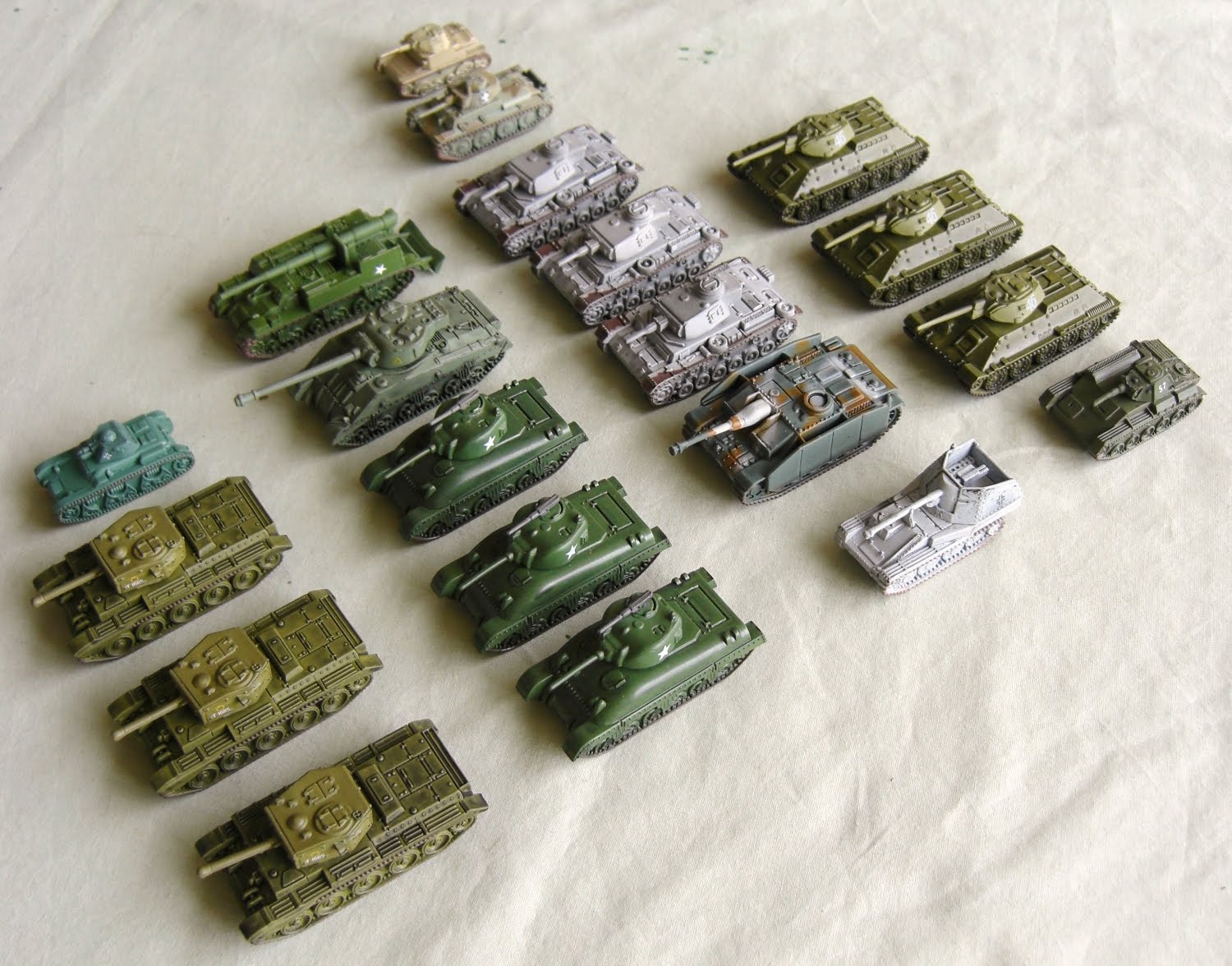
My attempts to sort out my toy/wargames room have been continuing on and off over the past week, and one of the things that I have found is a small collection of AXIS & ALLIES MINIATURES vehicles that I bought some time ago but have not used yet. I bought three basic 'Starter Sets' and some additional 'Booster' ones, and the result can be seen below.


Having taken them out of their storage boxes, it struck me that I could easily use most of the models with my Zvezda 1:100th-scale ART OF TACTIC vehicles ... if and when I get round to constructing and painting them.

I can feel a World War II version of PORTABLE WARGAME 2 gradually forming itself at the back of my mind ... but first I want to get the current version of my PORTABLE WARGAME 2 rules as close to 100% 'right' as I can.

Monday, 12 September 2011

The Portable Wargame 2: New and improved!

The minor change to the PORTABLE WARGAME 2 rules that I suggested in a recent blog entry has generated some interesting comments and ideas. I wanted to introduce a simple method by which it was possible for better quality Units to have a greater chance and for poorer quality Units to have lesser chance of survival on the tabletop battlefield. My suggestion was to introduce a saving throw, and although this was not universally greeted with enthusiasm, it did generate several alternative – and very attractive – suggestions.

The first of these was made in a comment by Steve. This included the following suggestion:
'The morale mechanism from Two Hour Wargames may be of interest. This involves rolling two dice, each will general a "pass" or a "fail" ... perhaps a similar system would work. If "hit" a unit rolls 2 dice. Elite pass on rolls of 4+, Regular on 5+, Poor troops on 6+. Two passes = no effect, one pass = fall back (or disordered?) and two fails = unit destroyed. Having three possible outcomes is sometimes helpful and allows for a more sensitive treatment of outcomes.'
I must admit that this suggestion struck me as having a lot of merit, and I gave considerable thought to using it in the next draft of the rules. However, before I did, Ross Mac sent me a comment that included an even more attractive suggestion:
'Steve's comment mentioning the Two Hour Wargames system (which does work well) got me thinking again.

One of the main things that I don't like about saving throws is that they cancel the result of the original die roll. What if the 2nd roll only modified that result instead of cancelling it? Instead of a "Saving Throw" it could become a "Severity Check" or "Morale Test". This could provide a troop quality differentiation and two levels of hit severity all in one roll, with no markers and without negating a previous roll or affecting the established probability of getting some sort of outcome from a shooting or melee roll.

It might look something like:

Militia:
6: The unit recoils 1 grid.
1-5: The unit routs and is removed

Regulars:
5-6: The unit recoils 1 grid
1-4: The unit routs and is removed.

Elites:
4-6: The unit recoils 1 grid
1-3: The unit routs and is removed.
'
The simplicity of the system Ross Mac proposes means that it has – in my eyes – considerable merit, especially as it only requires one D6 die to be thrown. It also retains the somewhat 'bloody' aspect of the existing combat rules, which is something that some comments have indicated players which to see retained in the rules.

I am now giving considerable thought to incorporating Ross Mac's suggestion into the next draft of the PORTABLE WARGAME 2 rules, with the hope that I can then play-test them later this week.

Table Top Battles: Now available again

One of the major influences on my wargaming in recent years was my purchase – at Warfare 2008 – of a copy of Mike and Joyce Smith’s TABLE TOP BATTLES – TABLE TOP WARGAMING WITH MINIATURES.

This morning I received an email from Leon Smith – who is Mike and Joyce Smith’s nephew – that informed me that there has been another print run of the rules, and that they are available again via Caliver Books. It appears that they are not listed yet on the Caliver Books website, but that they can be ordered from them. The contact details for Caliver Books are:
Caliver Books
100 Baker Road
Newthorpe
NG16 2DP
England
+44 (0)1159 382111

http://www.caliverbooks.com/

Sunday, 11 September 2011

Reflecting unit quality in the Portable Wargame 2 rules

Over the past few days I have been giving some thought as to how to reflect unit quality in the next draft of my PORTABLE WARGAME 2 rules.

My first thought was to use Morschauser's roster system. This has the merit of being simple and it is in keeping with the origins of the rules. The main drawback is that players have to remember to mark 'hits' on the roster .... something that can be easily forgotten during the heat of a tabletop battle.

I then considered the possibility of having magnetic strength markers on the unit bases. These are used in the MEGABLITZ rules and it is a system that I have copied in previous sets of rules that I have written. The main drawback to this system is the need to have a box of strength markers nearby (and this often means that it 'creeps' onto the tabletop) and to ensure that the markers are changed when 'hits' are scored on unit.

Many other sets of rules use 'hit' markers than can be placed on unit bases to show how many 'hits' a unit has suffered. A variety of different 'hit' markers could be used including curtain rings, tile spacers, small stones, tiny dice, specially made plastic caps that fit over a figure's head, and casualty figures. The problems that I have with all of these (and in the past I have tried using most of them) are that they can look unsightly (and thus detract from the aesthetic 'look' of the game), the box of markers can 'creep' onto the tabletop, and they often seem to become detached from the unit that have been placed with. In addition, the sight of a unit dragging its dead about with it just looks plain daft to me!

In the end I have opted for a very 'old school' solution (and one that has been suggested several times by a couple of regular blog readers), namely the good old/bad old saving throw Saving throws are not in keeping with Morschauser's original rules ... but they are contemporary with them. They are a system that I have used before, and I know that it works. Players may not like using saving throws ... but they never seem to forget to use them when their units get 'hit'. Another point in its favour is that the saving throw does not detract from the aesthetic 'look' of the tabletop battle. Finally, it is a mechanism that I can slot into the existing draft of the rules with little problem, it can be removed if it does not work without requiring a complete re-write of the rules, and if it does work but needs fine tuning, any changes can be incorporated into the rules without causing too many problems.

My proposed saving throw rule looks like this:
Any Unit that is destroyed as a result of Artillery Fire, Non-Artillery Fire, or Close Combat throws a D6 die to determine if it will survive the destruction. Elite Units: 4, 5, or 6 = Survive; Average Units: 5 or 6 = Survive; Poor Units: 6 = Survive.

This mechanism gives a Poor Unit a 16.6% chance of surviving, an Average Unit a 33.3% chance of surviving, and an Elite Unit a 50% chance of surviving. In other words, the Average Unit is twice and an Elite Unit is three times as likely as a Poor Unit to survive destruction. These odds may need to be altered as a result of play-testing, but they are the simplest method that I consider will achieve the aim set out in the first sentence of this blog entry.

Saturday, 10 September 2011

Nugget 246

I collected the latest issue of THE NUGGET (No. 246) from the printers on Thursday and posted copies to members yesterday. I intend to post the copies to the non-UK members later this morning. It should, therefore, be with members of Wargame Developments in the very near future.

I have now uploaded the PDF versions of THE NUGGET ...


... and THE NUGGET COLOUR SUPPLEMENT...


... and they are now available for members of Wargame Developments to download and read.

I have also posted out resubscription reminders to all members of Wargame Developments who have not yet renewed their subscriptions for 2011 - 2012. The new password members will need to use to open the PDF versions of THE NUGGET and THE NUGGET COLOUR SUPPLEMENT will be sent out in due course.

Friday, 9 September 2011

New books to read

This morning's postal delivery included a newly published book that I pre-ordered some time ago. It is THE DIAMOND CHARIOT by Boris Akunin (published by Weidenfeld & Nicolson [2011] ISBN 978 0 297 86067 9) and it is the latest in the Erast Fandorin series to be translated into English.


I am looking forward to reading this because it covers Fandorin's visit to Japan in 1878 and his later involvement in the Russo-Japanese War.

During a visit to the bookshop in the local shopping centre I bought a copy of ITALIAN BATTLESHIPS OR WORLD WAR II (written by Mark Stille, illustrated by Paul Wright, and published by Osprey as part of the 'New Vanguard' series [2011] ISBN 978 1 84908 380 5).


I have always had a soft spot for the battleships that the Italians operated during the World War II, and think that the Littorio-class were one of the best looking battleships ever built. They combined elegance with firepower, and have tended to receive what I consider to have been a bad press from many historians.