Pages

Showing posts with label Red Flags and Iron Crosses. Show all posts

Tuesday, 12 May 2026

Going off at a tangent

Until Saturday morning, my wargaming life was bimbling* along quite nicely. I was working – albeit at a leisurely pace – on several projects. These included:

  • The working draft of my Portable Belle Époque Wargame project.
  • Assembling the figures for a couple more armies for my Belle Époque project.
  • Writing an article about the development of warships between 1800 and 1920.
  • My ongoing American Civil War campaign.
  • My weekly role-playing sessions.

So, what happened on Saturday morning?

I opened a cupboard in my toy/wargame room ... and found something that I thought was in storage.

It was the printed copies of first ten years of my blog posts.

Now, many of my regular blog readers might not be aware that way back in 2018 I decided to have the text of my blog posts printed and bound in hardback format. I did this because I was afraid that if Blogger was ever to close down, I would not have a copy of what I had written. I have not had the last eight years of blog posts printed or bound ... but its something that I really need to think about ... just in case.

So, how did this discovery cause me to go off at a tangent?

I made the mistake of opening the first volume of my printed blog posts ... and immediately began to read it. Back then, my blog posts were about the then recently published reprint of Donald Featherstone's WAR GAMES by the History of Wargaming Project and its impact on my RED FLAGS AND IRON CROSSES (TARRED AND FEATHERSTONED) rules. In fact, between 20th September 2008 and 21st October 2008 I wrote eight blog posts about the rules and my play-tests as well as four about the Colonial version, which was entitled REDCOATS AND NATIVES (TARRED AND FEATHERSTONED).

Looking at the rules now (and the former are available online and in the History of Wargaming Project's reprint of Donald Featherstone's WARGAMING AIRBORNE OPERATIONS), I am struck by how much fun they were to wargame with. I was also struck by the fact that they could do with a bit of updating and improving because since I wrote them, I've had a lot more experience in writing wargame rules and developing slicker – and hopefully better – game mechanisms.

So, I now have another project to add to my growing list ... and I can see myself having a bit of fun tinkering with these rules and even pushing a few figures and tanks around on a tabletop!


Here are some images from the play-tests of my RED FLAGS AND IRON CROSSES (TARRED AND FEATHERSTONED) ...

... and REDCOATS AND NATIVES (TARRED AND FEATHERSTONED) rules.

I hope that they convey how much fun I had ... and how few figures etc., I needed to enjoy myself! Sometimes, less is more!


* For those of you who have never come across this verb before, it is defined as being 'to walk or travel at a leisurely pace.'

Saturday, 20 September 2025

Did I get it right seventeen years ago? Or are my Mid-twentieth Century Portable Wargame rules better?

I began blogging on 18th September 2008 ... almost seventeen years ago.

My second blog post on this blog was about the recent republication of Donald Featherstone's WAR GAMES book by John Curry's 'History of Wargaming' Project and it inspired me to incorporate ideas and mechanisms from both Donald Featherstone’s and Lionel Tarr’s rules into my existing World War II rules, RED FLAGS AND IRON CROSSES. The resulting rules were named RED FLAGS AND IRON CROSSES – TARRED AND FEATHERSTONED, and John Curry incorporated them into the 'History of Wargaming' Project reprint of Donald Featherstone's WARGAMING AIRBORNE OPERATIONS. (The rules were slighty renamed TARRED AND FEATHERED at Donald Featherstone's request.

During my recent review of the wargaming rules that have influenced my World War II wargaming, I revisited RED FLAGS AND IRON CROSSES and RED FLAGS AND IRON CROSSES – TARRED AND FEATHERSTONED ... and then the battle reports I wrote about my playtests.

On reflection, this is the sort of wargame that I envisaged fighting using my Eastern Front/Great Patriotic War collection when I began this blog ... so I suppose that I might have got things right seventeen years ago ... and just 'forgotten' that I had!

On the other hand, the battles I fought using my mid-twentieth-century version of the PORTABLE WARGAME were also great fun, and perhaps the rules are better designed. I’m not sure … but I hope to have fun thinking about (and possibly experimenting with) which of these two to choose for my future Eastern Front/Great Patriotic War wargaming.

Friday, 8 September 2023

A flocking progress report: The Germans and Axis troops and equipment

I have now had the opportunity to photograph the German and Axis figures and vehicles that I have renovated, rebased, and flocked with cork granules, and here they are:

Wednesday, 6 September 2023

A flocking progress report: The Russian troops and equipment

I have now had the opportunity to photograph the Russian figures and vehicles that I have renovated, rebased, and flocked with cork granules, and here they are:

Monday, 4 September 2023

A flocking progress report

In the run up to the start of my radiotherapy, I had been continuing to work my way through the figures and vehicles that I renovated during the COVID outbreak, flocking their bases with fine cork granules. I have continued doing this – albeit at a slightly slower pace – since my radiotherapy started, and I have now reached the point where this phase of the project has finished.

To date I have flocked the following:

RUSSIAN

  • Infantry figures: 89
  • Artillery figures: 41 (including 4 x naval gunners)
  • Officer figures: 10
  • Tanks and self-propelled guns: 6 (1 x T-60 light tank and 5 x T-34/76 medium tanks)
  • Armoured cars: 5 (5 x FAI)
  • Artillery pieces: 19 (including 7 x 45mm M1932/M1937 anti-tank guns, 4 x 76.2mm M1927 regimental guns, 1 x 76.2mm M1939 divisional gun, 2 x 122mm M1938 howitzers, 3 x 152mm M1909/30 howitzers)
  • Artillery tractors: 11 (including 2 x STZ-5 light tractors, 3 x T-20 Komsomolets light tractors, and 3 x Komintern heavy tractors)
  • Wheeled vehicles: 15 trucks

GERMAN & AXIS

  • Infantry figures: 114 (including 1 x Policeman, 12 x Hungarian infantry, and 8 x Spanish infantry)
  • Artillery figures: 39 (including 6 x Luftwaffe gunners and 5 x Hungarian gunners)
  • Officer figures: 8 (including 1 x Hungarian officer and 1 x Spanish officer)
  • Tanks and self-propelled guns: 10 (2 x PzKpfw III medium tanks, 2 x PzKpfw IV medium tanks, 2 x Hungarian 38M Toldi light tanks, 2 x Panzerjager I, 2 x 150mm sIG 33 [1 x PzKpfw II chassis and 1 x PzKpfw III chassis) self-propelled guns)
  • Armoured cars: 2 (1 x SdKfz 222 light armoured car and 1 x SdKfz 231 heavy armoured car)
  • Artillery pieces: 17 (including 2 x 37mm PAK 36 anti-tank guns, 4 x 50mm PAK 38 anti-tank guns, 1 x 75mm GK 06 light mountain gun, 3 x 75mm leIG 18 light infantry guns, 1 x 150mm sIG 33 heavy infantry gun, and 3 x leFH 18 light howitzers)
  • Half-tracks: 5 (1 x SdKFZ 11 light half-tracks, 1 x SdKfz 251 armoured half-track, and 3 x SdKfz 7 medium half-tracks)
  • Wheeled vehicles: 15 (including 1 x Citroen staff car, 5 x Kubelwagen light cars, 2 x Steyr 1500A heavy cars, 3 x Opel Blitz light trucks, and 2 x Krupp Protze light trucks)

As I look back at what I have done, it turns out to be a more extensive list than I expected ... and whilst searching for something else on Saturday, I found another couple of boxes of stuff that need to be renovated and rebased. So much – in fact – that I suspect that it will double the size of the collection that I have already done!

Monday, 21 August 2023

Flocking news

Over the weekend I’ve been making progress with the flocking of the bases of my Eastern Front/Great Patriotic War collection, and I should finish all the renovated and rebased figures and vehicles before my radiotherapy starts.

What I have realised is that I still have loads of figures and vehicles that still need to be renovated and/or repainted and/or re-based, and depending upon how I feel during my treatment, I might have a go at dealing with them so that the collection is ready to be used.

Whatever I do, I have a few other wargame-related tasks to perform over the next two months, and they may well have to take precedence. In the meantime, here are some of the photographs of Lionel Tarr’s battles that first inspired me to want to wargame the Eastern Front/Great Patriotic War.

Friday, 28 July 2023

Flocking progress

I’ve been steadily working on flocking my Eastern Front/Great Patriotic War collection, and I am well on the way to finishing the Germans. One thing that this work has thrown up is the need to fill a few holes in the collection, and I am in two minds as to whether to flock the Russian stuff first or to fill the holes.

I think that the answer will be to see how much work the latter will take as I suspect that I will also find holes in the Russian part of the collection.

Friday, 21 July 2023

Flocking the bases of my World War Two collection: A progress report

I began flocking the bases of my 20mm World War Two collection with natural-coloured cork granules a few days ago, and so far I've completed about a third of them. I've not rushed to complete this task as I'm doing a bit of reorganisation as I proceed.

I estimate that it will take me another week or so to finish this, and by then I hope to have the first draft of the latest iteration of RED FLAGS & IRON CROSSES ready for some play-testing using the newly revitalised collection.

In the meantime, here are some more photographs of play-tests of the rules from 2008:

Wednesday, 19 July 2023

Looking back in order to go forward

COW2023 gave me the opportunity to take part in two World War 2 wargames: Tim Gow's LITTLE WORLD WARS and Chris Kemp's NQM: NOT QUITE MECHANISED. As a result, I've been thinking about the rules I want to use for my much-planned Eastern Front/Great Patriotic War project.

Coincidentally, during the conference I spoken to a wargamer who had play-tested the earlier version RED FLAGS & IRON CROSSES ... and that set me thinking about the World War 2 rules that I wrote before I began work on what became the PORTABLE WARGAME, RED FLAGS & IRON CROSSES: TARRED AND FEATHERSTONED. These were published as an appendix to John Curry's 2009 reprint of Donald Featherstone's WARGAMING AIRBORNE OPERATIONS. I still have the MS Word file containing the rules somewhere on my computer, and I hope to print off a copy in due course to see if there is some way that I can meld elements of it with elements of the PORTABLE WARGAME.

The following are some photographs of one of the play-test battles I fought using RED FLAGS & IRON CROSSES: TARRED AND FEATHERSTONED back in 2008.

Wednesday, 12 August 2020

Never, ever reinforce failure!

I had hoped to write a battle report about the first play-test of my redrafted RED FLAGS & IRON CROSSES rules ... but after setting up the table and gaming through the first three moves, I walked away. Basically, the rules worked ... but were so cumbersome and clunky that I was not enjoying the experience. Furthermore, they failed what I term ‘Cordery’s Second Rule of Wargame Design’.

This rule states that:
If you are not enjoying a wargame and you wrote the rules, how do you expect other people to enjoy them?’
Now I try to design rules where the player should have picked up the basics by the end of the third turn, and can pretty well remember the rules by the end of their first game. Once they have reached that stage, they should only need to look at the text of the rules to clarify a point.

The draft of RED FLAGS & IRON CROSSES looked as if they complied with this, but by the end of the third turn I must have spent more time looking at the charts and text, and still I managed to miss things ... and don't forget, I wrote them! I kept reverting to the modern version of THE PORTABLE WARGAME and forgetting the relevant game mechanism from RED FLAGS & IRON CROSSES. Furthermore, the movement distances in RED FLAGS & IRON CROSSES were so short that I knew it was going to be an age before any proper combat was going to take place, and I kept forgetting that unlike in THE PORTABLE WARGAME, artillery does not fire at the beginning of the turn and but during each player's section of the turn.

It is a well-known military maxim that you should never, ever reinforce failure ... and to my mind this 'new' set of rules are going to fail. I am therefore going to leave them as they are, and fight my first mini-campaign battle using the modern version of THE PORTABLE WARGAME as featured in DEVELOPING THE PORTABLE WARGAME.

This setback could have been very disheartening, but I re-learned a valuable lesson. This is that 'if it ain't broke, it doesn't need fixing!'

For those of you who do not know, ‘Cordery’s First Rule of Wargame Design’states that:
If players consistently ignore a rule because it does not make sense or hinders the flow of the wargame, then the rule should be discarded. If players do not notice that it has gone, then it probably should not have been there in the first place.’

Monday, 10 August 2020

A map for my first Red Flags & Iron Crosses play-test battle

It took me less than ten minutes to use my new PowerPoint square grid master map to create a map for my first Red Flags & iron Crosses play-test battle.

I used the terrain generation system outlined in THE PORTABLE COLONIAL WARGAME to create a black and white map of a cultivated are within the coniferous steppe part of Russia. I then pasted it into MS Paint, where I tidied up a few minor errors (i.e. where I had not lined up the terrain squares exactly on the MS PowerPoint grid) and then added some colour. The resultant map looked like this:


The Germans will be advancing from the bottom edge of the map, and the Russian units will be located randomly using the system for locating hills etc., as outlined in THE PORTABLE COLONIAL WARGAME.

Getting to grips with PowerPoint

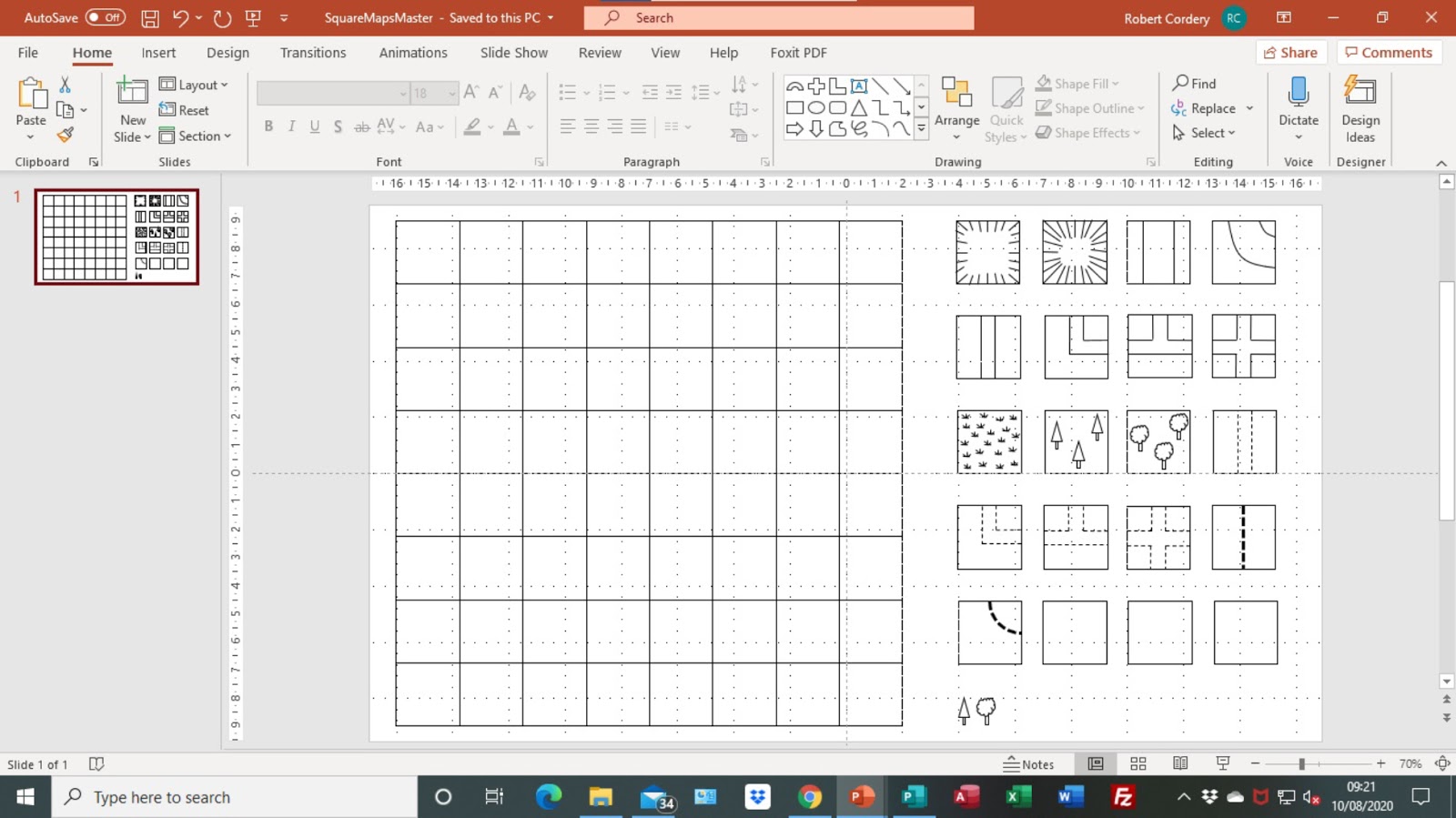
Having experimented with drawing a hex grid 'master' for making maps, I proceeded to do the same for an 8 x 8 square grid. The result looked like this:


This was much easier to create than the hex one, and later today I hope to use it to create the map for the first of my RED FLAGS & IRON CROSSES play-test games.

Tuesday, 28 July 2020

The map and starting positions for my Eastern Front/Great Patriotic War play-test mini-campaign

After playing around with a few ideas, I decided that I will set my play-test mini-campaign in the northern sector of the Russo-German border.


The Germans will use Konigsberg as their supply base, and the attacking force will comprise 1st Panzer Division, supported by 1st and 2nd Infantry Divisions. They will begin the mini-campaign in D9 (1st Infantry Division), D10 (1st Panzer Division), and D11 (2nd Infantry Division).

The Russian defenders (1st and 2nd Rifle Divisions and 1st Tank Corps) will be randomly located in the 6 x 6 grid E to J, 6 to 11 using two D6 dice. The first dice will determine the column and the second dice will determine which row a Russian formation is in. For example, the dice thrown for 1st Rifle Division might be 6 and 5, which would locate the division in J10 ... which happens to be the grid square where the city of Polotsk is located.

Campaign movement will be handled using the system set out in THE PORTABLE COLONIAL WARGAME, with the proviso that the Germans will be allowed two moves before the Russian troops can begin to move in order to represent the element of surprise.

The first draft of the rules I am going to use (RED FLAGS & IRON CROSSES 2020) is almost finished, and the forces have been assembled. All I then have to do is to clear enough space on my wargame table to set up the terrain ... and then the mini-campaign can begin!

Sunday, 19 July 2020

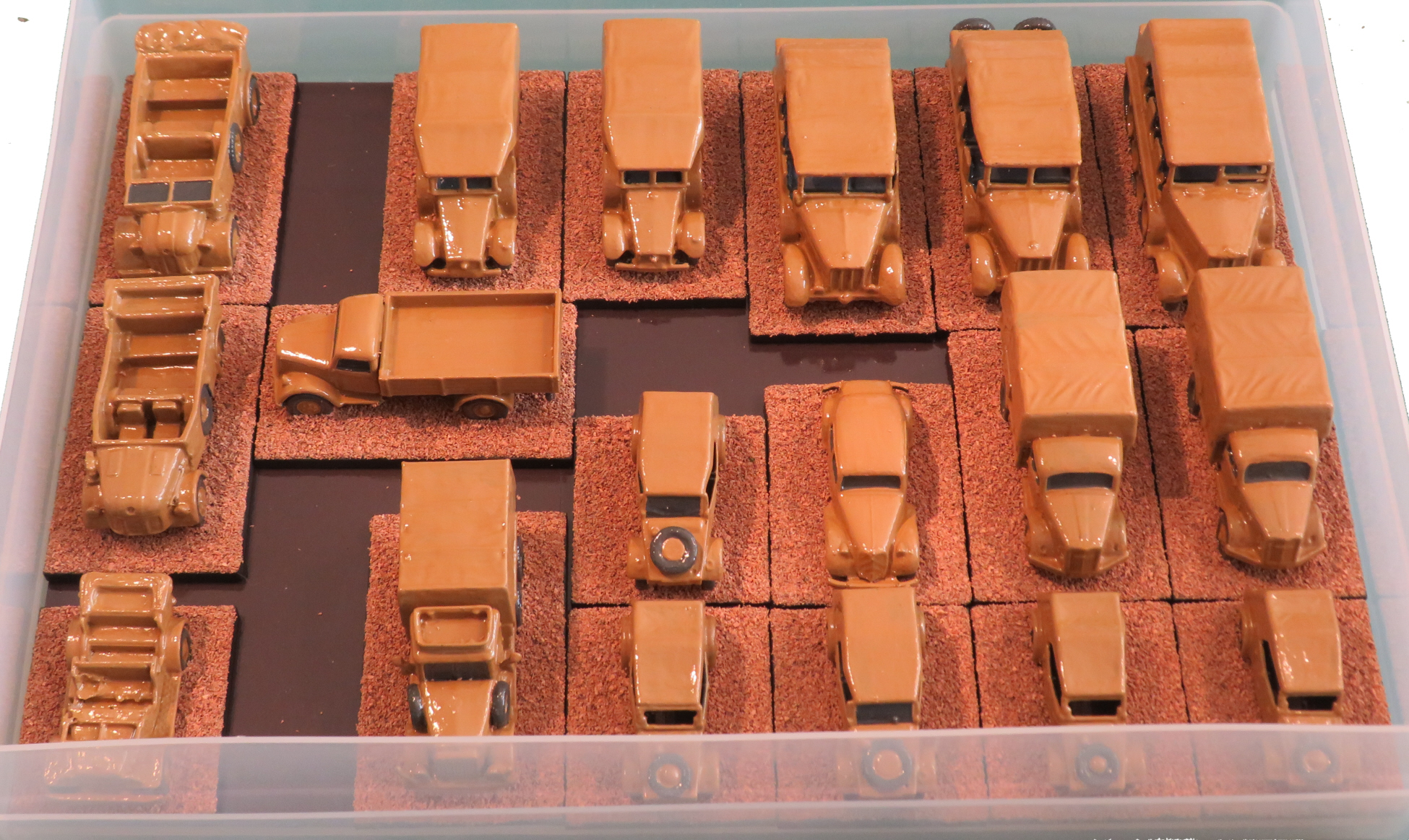
My first Russian 'formations in a box'

Although I have been very busy helping to organise VCOW and trying to do work on my next PORTABLE WARGAME book, I have had time to begin organising part of my renovated 20mm-scale Russian World War Two collection into 'formations in boxes'.

I now have five such formations, and they are shown below.

1st Rifle Division


2nd Rifle Division


3rd Rifle Division


1st Tank Corps


2nd Tank Corps


I have enough renovated infantry figures to organise at least another three Rifle Divisions, but as yet I do not have enough gun crews.

With my previously organised Axis forces, I certainly have enough stuff available to try out my campaign rules ... but first I need to finish re-writing RED FLAGS & IRON CROSSES.

Thursday, 9 July 2020

Looking backward to go forwards

I was quite busy yesterday getting a few things sorted out for VCOW, but I made time to have a look at the original version of RED FLAGS & IRON CROSSES (RF&IC) that I wrote back in 2004, and felt that there were quite a few things that I liked about the design ... and several that I did not!

I actually took RF&IC to SALUTE2004, where I demonstrated it in a number of participation games. I seem to remember that most of the participants were fathers with young children, and that the rules suited them because the games were quick and it gave the father and son teams a chance to play a wargame at together at a wargame show, something that was not generally encouraged at the time. (My more recent experience indicates that this is no longer true, and that many wargame shows encourage the staging of games where a variety of age groups and genders can take part on equal terms.)

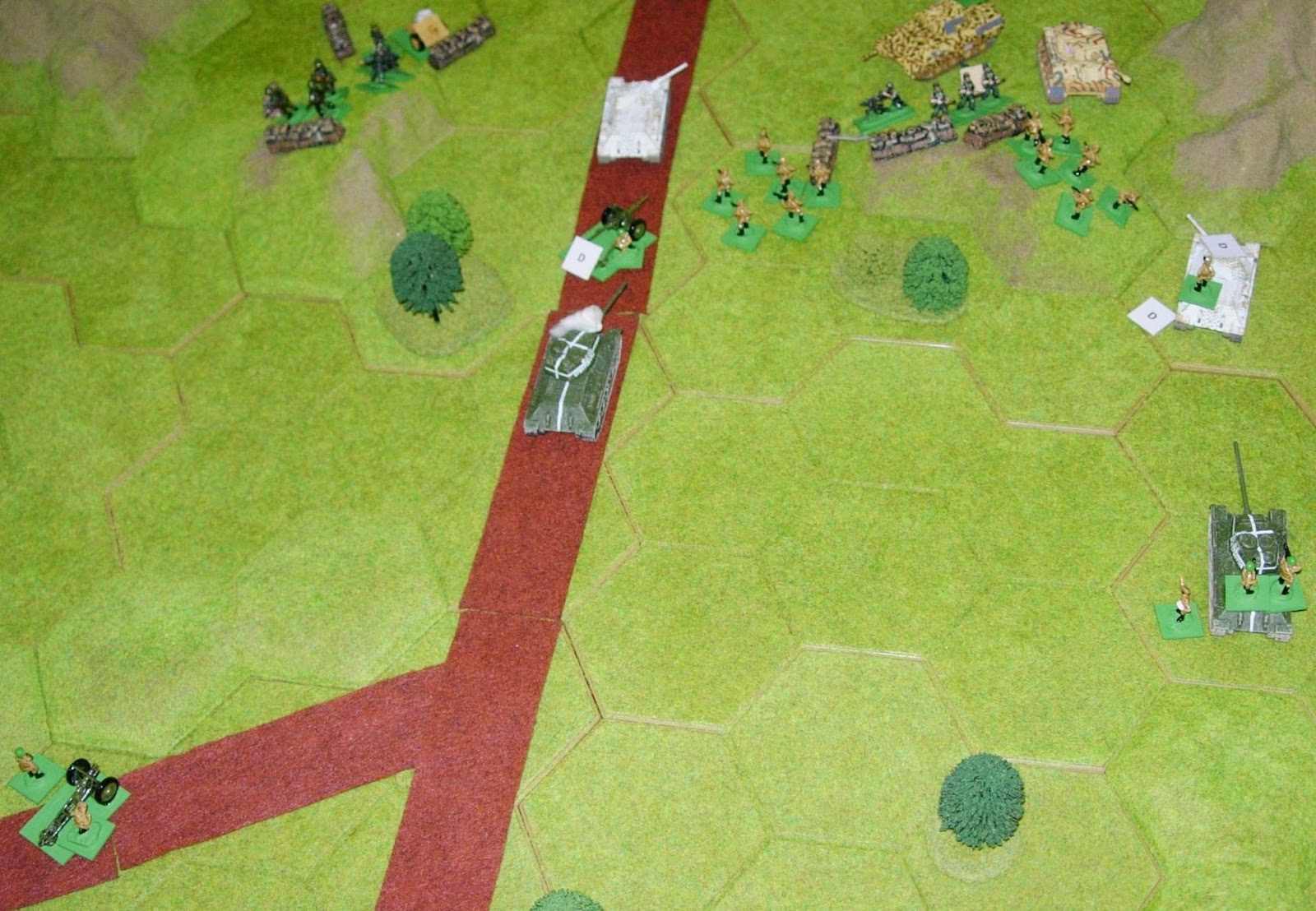
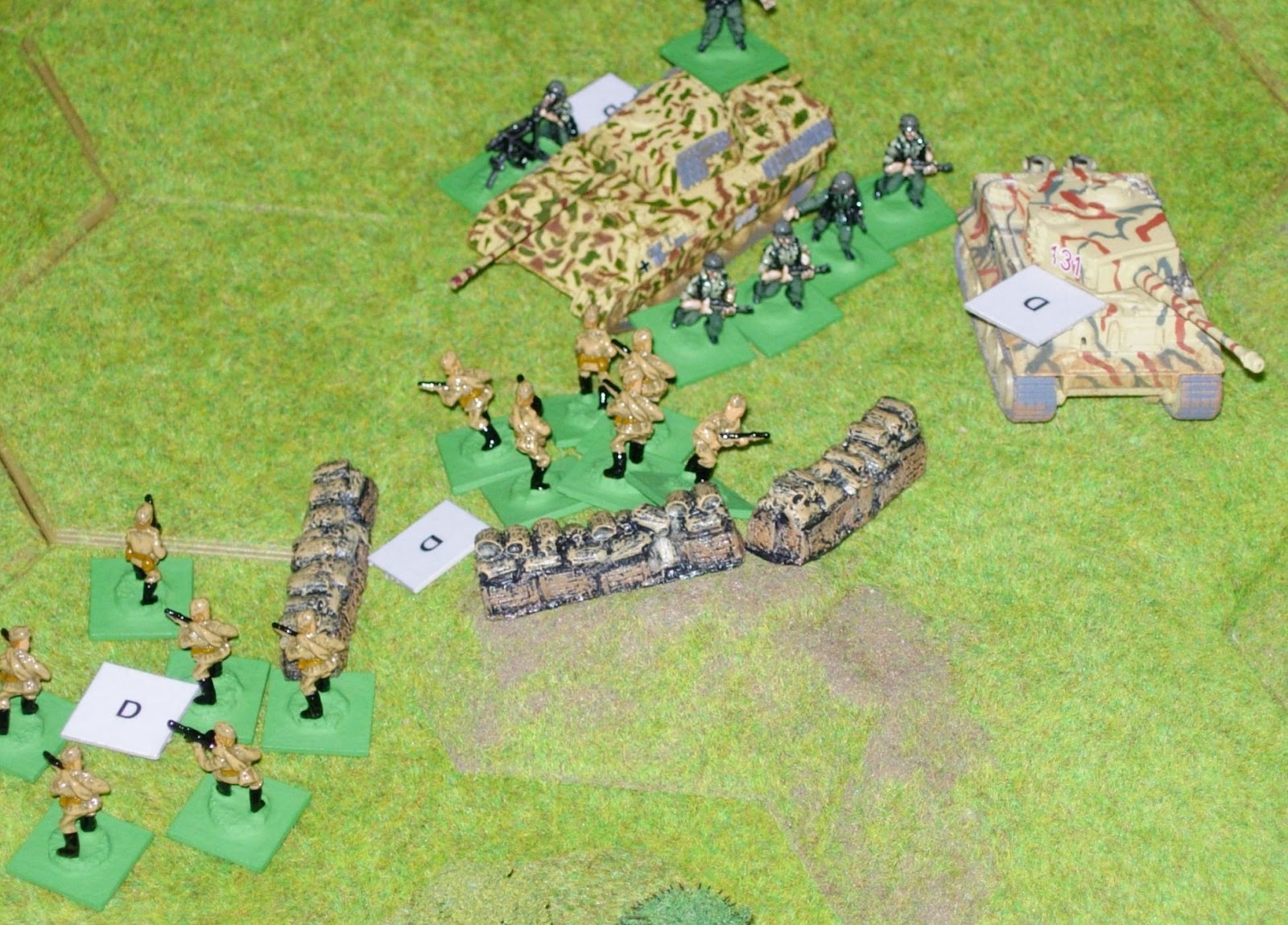
We played through a simple scenario that involved a Russian attack on a couple of fortified positions defended by the Germans. The Russians had infantry, light artillery, and four T-34 tanks (two T-34/76 and two T-34/85) and the Germans had infantry supported by light artillery and two tanks (a Panther tank and a Tiger tank). I managed to take some photographs of one of the battles:


Looking at these photographs again, I realised that this was the sort of wargame that I want to recreate when I redraft RF&IC, but with one major change ... NO MORE FULL-SIZE PLAYING CARDS ON THE TABLETOP!

I have learned a lot about wargame design since 2004, especially what will and will not work. As a result, I will be applying these lessons to the new version of RF&IC, which currently has the working title of RF&IC2020.