The annual Wargame Developments Conference of Wargamers (COW) took place at the Cranfield Management Development Centre over the weekend 10th to 12th July 2026.
The main entrance,
The main hall. The various lecture rooms and break-out rooms all radiated off of this main hall.
The conference proper began after dinner on Friday when the conference organiser, Tim Gow, ...
... welcomed everyone in the venue's main lecture theatre.
This was followed by the plenary game.
THE PLENARY GAME: XERXES’ INVASION OF GREECE
In this game I took the part of Ezra the Scribe, a Jewish functionary in charge of protocol in the Persian court. I had to instruct the lesser members of the court and any military commanders in the correct way to approach and speak to the king, and to act as the eyes of the King's Ear ... his enforcer! I was also tasked with leading the ritual (and regular) praise of the King.
I had a great deal of fun and managed to take photographs of some of the participants which I then asked ChatGPT to turn into historical images.
King Xerxes of Persia ... in a beard that seems to have been borrowed from the film 'Gettysburg',
The serene Queen of Persia,
Two Persian officials. The one of the right was the King's Ear ... and would joyfully stab someone and smile whilst he did it,
The King of Sparta. He seems to be indicating that he's willing to take on anyone who thinks that they are hard enough.
A northern Greek. He seems totally bemused by events.
During the next two days, I took presented or participated in the following sessions.
THE BATTLE OF THE ATLANTIC: SINKING U-BOATS: A REACTION TO THE WATU ‘MYTH’
This lecture has been in preparation for some eighteen months, and I feel that I still have more to add before it will be in anyway complete.
I began by looking at the origins of the WATU (Western Approaches Tactical Unit) ...
... and the way that it has been described and depicted in the media, particularly over the last five years. I did this because I feel that its contribution to the eventual victory of the Battle of the Atlantic is not being assessed in context and is being misused to promote a particular agenda ... and that agenda is harming a proper and just assessment the unit's true impact.
I then described – in approximately chronological order – the weapons, technology, and tactical changes helped the Allies to win the war against the U-boats.
These included:
- Pre-war developments in anti-submarine warfare (e.g. depth charges and their throwers, hydrophones, and ASDIC).
- The design, ordering, and commissioning of the Flower-class & Castle-class corvettes and the River-class & Loch-class frigates.
- The initial failure and later success of wolfpacks.
- The introduction of airborne and seaborne surface search radar.
- The importance of the seizure of the French ports on the Bay of Biscay.
- The roles of the Anti-Submarine Training School and the WATU training courses for escort ship officers.
- The introduction of Convoy Escort Groups and Escort Support Groups.
- The introduction and use of CAM (Catapult Aircraft Merchant) ships, MAC (Merchant Aircraft Carrier) ships, and escort carriers.
- The introduction and use of land-based and seaborne high-frequency direction-finding equipment (HF/DF) and the German counter-measures.
- The development of anti-submarine tactics (e.g. Operation Buttercup and the creeping attack).
- The development of ahead-throwing anti-submarine weapons (i.e. Hedgehog and Squid) and improved ASDIC.
- The role of the Bletchley Park codebreakers.
- Operation Drumbeat.
- The introduction of the Leigh Light on RAF Coastal Command aircraft and its impact on airborne attacks on U-boats.
- The publication of the Atlantic Convoy Instructions.
- The introduction of acoustic torpedoes by the Germans and Allies and their impact.
- The loss of the French ports after D-Day.
- Month-by-month and annual ship and U-boat losses.
I concluded with two graphics that showed the monthly total of U-boats sunk and ...
... and the numbers and tonnage of ship sunk by U-boats compared to the total number of U-boats sunk and destroyed by the Allies.
BATTLESHIP NOVOROSSIYSK
This was a committee game that looked at the events surrounding the sinking of the Russian battleship Novorossiysk (formerly the Italian battleship Giulio Cesare that was awarded to the USSR as a war prize) in Sebastopol on 29th October 1955. It is important to remember that this was less than two years after the death of Stalin on 5th June 1953 and Georgy Malenkov had replaced him.
The players represented the various officials charged with identifying the cause of the explosion that sank the ship and gathering the relevant documentation required to support the committee's conclusion.
My player briefing.
A map of Sebastopol harbour,
My role was a naval engineering Captain from the Baltic Fleet and my main concern – along with the other members of the committee – was to find out what had happened to the ship's engineering log. It had apparently been removed by the ship's engineering officer and I clashed with my opposite number in the Black Sea fleet ... who I regarded as incompetent and obstructive.
I ruled out an accidental explosion and felt that the ship was lost due to the actions of the ship's missing engineering officer coupled with the incompetence of the fleet's head naval engineer and his failure to imposed proper procedures.
It was great fun ... and I'd certain play this game again!
OPERATION JADE EMPEROR
This was a planning game about the re-integration of Taiwan into the People's Republic of China. The players were tasked with mounting an assault on the island that would replace the existing government as quickly as possible and before the United States could intervene.
The map of Taiwan and the forces available to each side. Each of the blocks represented a brigade-sized military unit. The blue ones were the Taiwanese ones, and the red ones were the People's Republic of China's units.,
We were extremely lucky to have a player who had personal experience of an amphibious landing on an enemy-occupied island, and once we had – as a group – decided on a surprise attack of Taipei to decapitate the Taiwanese government, we produced a plan that met the requirements of the supreme leadership.
THE DEVIL TO PAY – BUFORD'S CAVALRY AT GETTYSBURG
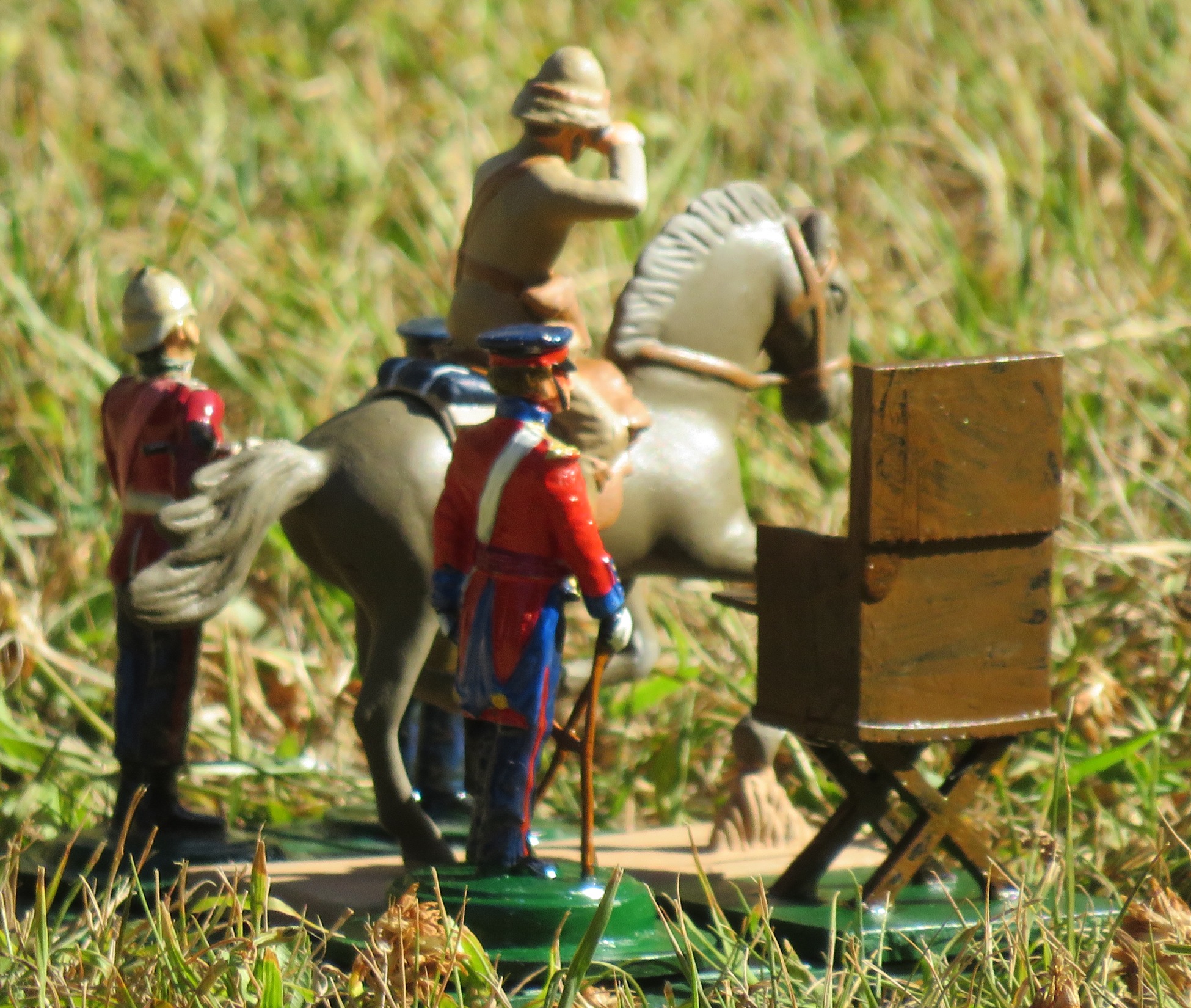
I observed this session rather than participated. It featured an extract from a contemporary map of the ridges that Buford occupied before the Confederate arrived, figures from Warlord Game Epic American Civil War range, and a modification of the DBX rules.
This is still a work in progress, but in my opinion it has lots of potential and I look forward to seeing finished rules. I particularly liked the use of a contemporary map and simply-painted figures. It gave the whole thing an antique look.
THE FIRST FANTASY GAME
This was another session where I was an observer rather than a participant.
Now, until recently I had very little interest in fantasy wargaming, but since joining the Dice of the Hill gaming group my interest has increased by leaps and bounds. The players were using the SEWG Middle Earth Wargame Rules ...
... and some very early fantasy wargame figures.
The session generated a lot of fun and laughter ... and I would have loved to have taken part if I could!
BERLIN NOCTURNE
The mid-1950s saw an increasing level of spying centred around the divided city of Berlin. In this game, the seven players represented the representatives of the KGB (the Russian Committee for State Security) and GRU (the Russian Main Intelligence Directorate) in Berlin and members of the security department of the Democratic People's Republic of Germany, the STASI (Ministry for State Security). This group sat as a committee that met regularly to co-ordinate intelligence operations in Berlin ... and in this game, they had a major leak to deal with.
I played the role of Colonel Kurt Hagens, one of the STASI's counter-intelligence experts. It became very apparent from the start that the KGB and GRU were looking for a scapegoat ... and that scapegoat was not going to be Russian! As a result, my STASI colleague and I attempted to run an operation of our own that would feed information to the KGB to see if it leaked and thus exposed where the leak was.
In order to do this, my colleague (Major Buchardt) fed some false information to the KGB about my personal life. He told one of the KGB officers that it was known that I had a 19-year-old mistress who lived in the Potsdam area and who had links to some dissidents. Furthermore, I also dropped hints to both the KGB and the GRU that I had served as a Communist undercover agent in the Gestapo during the late war. (As I walk with a stick, it was not difficult to persuade them that I had operated under the codename 'Flick' whilst serving in France!)
This turned out to be a big mistake as it made me the obvious candidate to take the blame for the leak ... and that is how the game ended.
(The game was based on Operation Gold/Operation Stopwatch, which was a joint CIA and SIS operation in Berlin using a tunnel into the Soviet-occupied zone of Berlin to tap into landline communication of the Soviet Army headquarters. That was the source of the leak we were trying to find!)
ESSAI DE JEU DE GUERRE
I had hoped to sign up to participate in this session but didn't manage to. However, I did manage to observe ... and that was almost as good as actually playing the game.
The rules were written in France during the early part of the First World War and was intended to validate the French Army's aggressive tactics. The playing surface was a map divided up into squares and the playing pieces represented infantry, cavalry, machine guns, and artillery. Movement was orthogonal and the combat results were deterministic and dependent upon the circumstances the opposing units were in (e.g. the defending unit was in trenches, the attacking unit [or units] had charged and not engaged the enemy in a firefight) and NOT on dice throws. Of particular interest was the fact that artillery engaging a target could not hit it during its first turn as this was regarded as being merely ranging fire.
The tabletop battlefield,
The French attackers,
The German defenders,
During the game, a French force attacked a line of German trenches and after suffering some setbacks and considerable losses, they force the German to retreat. This obviously proved that the aggressive tactics employed by the French should work ... and we all know how true that turned out to be!
This session was of particular interest to me because it showed a French military wargame that was developed during a period when the French Army was not a devotee of wargaming. In many ways it reflected the sorts of designs that were prevent in the UK in the 1880s and 1890s, such as Dr David Charles Ballinger Griffith's POLEMOS.
THE GRIMNESS OF WAR
The Salonika Campaign is probably one of the least well-known operations undertaken during the Great War, and this talk did much to educate the attendees as to why its importance should not be ignored.
My particular interest in this campaign arises from two facts.
Firstly, the 2/20th Battalion, London Regiment (Blackheath and Woolwich) – which was recruited from the part of London where I live – was one of the units that formed part of 60th (2/2nd London) Infantry Division. It participated in the Battle of Doiran (24th to 25th April and 8th to 9th May 1917) before being sent to Palestine later that year.
Secondly, the 8th County of London Brigade, Royal Field Artillery – which had its headquarters at 'Oaklands', St Margaret's Road (later St Margaret's Grove), Plumstead – was also a locally-recruited unit and formed part of 60th (2/2nd London) Infantry Division. (I wrote a blog post about its war memorial on my blog.)
LE KRIEGSPIEL
I had very little idea about the history of wargaming in France before attending this session ... and I left very well informed! This is hardly surprising as the presenter wrote JOUER LA GUERRE: HISTOIRE DE WARGAME (PLAYING WAR: THE HISTORY OF WARGAMING).
It was interesting to note that one early French wargame designer used hexes made up of six equilateral triangles and that after the defeat of the Second Empire in 1870, one German innovation that wasn't emulated by the French Army was wargaming/kriegsspiel.
I enjoyed the aside about the reluctance of some military players to the use of dice ... but they were happy to use six-sided friction generators!
This was a great conference and was the largest staged to date. It has already been agreed that Wargame Developments will be return to Cranfield Management Development Centre for next year's Conference of Wargamers (COW).




.jpg)


