I have just uploaded a new YouTube video to the Wargaming Miscellany YouTube channel.

It lasts approximately twelve and a half minutes.
The video can be found here on the Wargaming Miscellany YouTube channel.
I have just uploaded a new YouTube video to the Wargaming Miscellany YouTube channel.
It lasts approximately twelve and a half minutes.
The video can be found here on the Wargaming Miscellany YouTube channel.
I have just uploaded a new YouTube video to the Wargaming Miscellany YouTube channel. It is about the Funny Little Wars lawn game that took place at COW2025.

It lasts approximately seven and a half minutes.
The video can be found here on the Wargaming Miscellany YouTube channel.
It gave me great pleasure to be able to take on the role of Major-General Backsight-Forethought in Tim Gow's and Nick Huband's excellent FUNNY LITTLE WARS lawn game at COW2025. Despite my apparent inebriation (part of my role-playing as will be apparent from my player briefing!) I was able to take some photographs, which are shown below.
My player briefing:
Major-General Backsight-Forethought
Seasoned campaigner, very well connected socially, utterly inept militarily, prone to long 'inspiring' speeches and always extremely drunk. Think Jack Train as Colonel Chinstrap.
- Be very drunk all of the time.
- Be strongly influenced by whoever has most recently spoken to you.
- Make it clear to all that YOU are in command.
- Avoid damage to your drinks cabinet.

Major-General Backsight-Forethought.

The British Infantry Brigade. The Connaught Rangers are on the right flank, the Queen's Regiment are in the centre (along with the artillery), and the Australian battalion is on the left. The brigade commander is just behind the Queen's and the reserve battalion is behind the artillery.

The Queens and the Connaughts advance on to Boer positions.
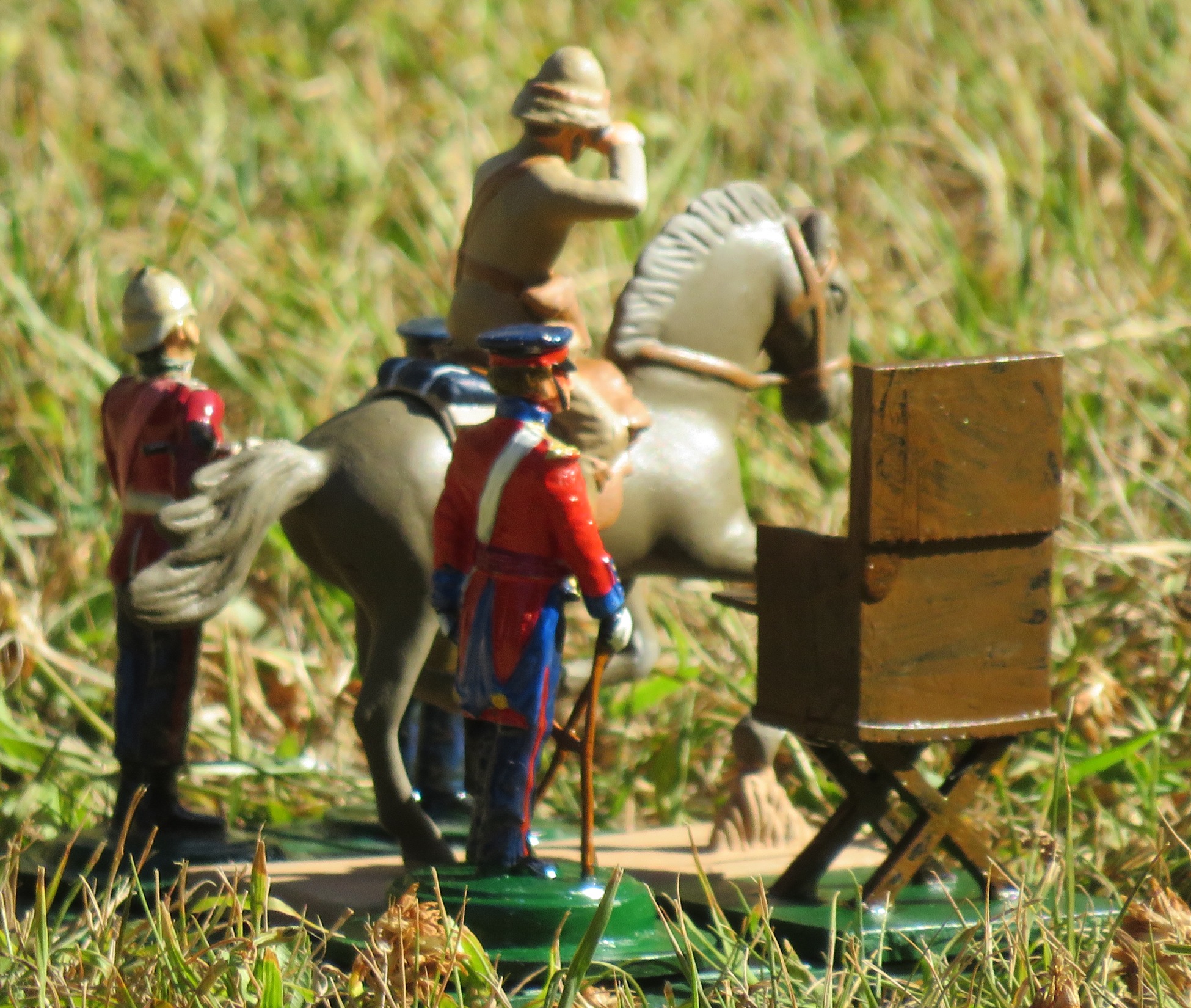
The Major-General's HQ ... with specially-built campaign drinks cabinet!

The Boer entrenchments.

The Queen's Regiment moving forward in column.

The artillery moved forward so as to better engage the enemy.

The reservoir in the centre of the battlefield funnelled the Queens and the Connaughts toward the right side of the Boer positions.

The British artillery maintained a steady barrage on the Boer trenches.

The Boer entrenchments.

A group of Bores hurrying to occupy the left-hand kopje before the Australians get there!

The Boer secret weapon! The Krupp heavy gun known as 'Long Tim'.

A British infantry column advancing in the face of Boer fire.

The Australians are almost at the bottom of the left-hand kopje. The cavalry (which was commanded by Colonel Flashman VC) can be seen in the distance. They did little other than to lend a bit of tone to the occasion!

The Boers won the race to occupy the left-hand kopje.

The Connaughts assault the Boer position on the right-hand kopje.

The reserve infantry advance past the British artillery which had suffered some casualties as a result of Boer fire.
In the end, the result was inconclusive ... sort of! The Connaughts fought bravely (one would expect nothing less of them under their intrepid commander, Colonel Ridley), the Queens never quite got to grips with the Boers (exercising a left wheel in front of the Boer positions was asking for trouble!), and the Australians (who were led by someone who kept telling me that his name was Bruce, but who didn't sound at all Scottish) acquitted themselves well in their assault on the left-hand kopje. The artillery gave as good as the got, but the cavalry failed to turn the Boer flank, having dismounted far to soon.
As to my own performance ... well, I was sniped at and a Boer artillery shell did just miss my campaign drinks cabinet, but luckily no bottles were broken. I have recommended that the infantry battalion commanders and injured Major Flint of the Royal Artillery be awarded DSOs ... and I hope that there may be a chance that I'll get a gong or even a knighthood, just as long as the impertinent journalist that accompanied my brigade doesn't write anything too damning in his terrible newspaper. In retrospect, perhaps my comment that sobriety was a much overrated quality in a general might have been a bit too loose lipped!
This was a fun, FUN, FUN game, with loads of laughs and some wonderful overacting ... including mine! Who could forget Jonathan Crowe's depiction of a Krapp Industries arms salesman? Or Ian Drury's Australian drawl? Or Chris James's impertinent journalist? Or David Burden's incredibly competent Colonel Ridley of the Connaught Rangers? Or Michael Young as Colonel of the Queen's? Or Stuart Davies's depiction of that loveable rogue Colonel Flashman VC? Or Jim Roche's monosyllabic Mayor Flint, Royal Artillery?
This was great way to start the Saturday morning of COW2025 ... and set the tone for the whole weekend!
The image of Major-General Backsight-Forethought was created using ChatGPT.
Before I write my review, I must make the reader aware that I have known the author for many years and have taken part in several wargames that he has organised. These include:
As a result, the reader might think that my review will be in some way biased ... and in all honesty, it probably is, but only because I know how much thought has gone into this author's writing and how much fun his wargames have been to take part in!
Back in 2013, Paul Holcroft Wright published FUNNY LITTLE WARS: A GENTLEMAN'S PREOCCUPATION ...

... and LITTLE CAMPAIGNS: RULES FOR THE CONDUCT OF WAR GAME CAMPAIGNS IN MINIATURE ...

... to commemorate the hundredth anniversary of the publication of H G Wells's LITTLE WARS in 1913.
The latter contained a wonderful campaign map …

… and a history of one of the campaigns that he had fought, The Herring War.

In 2022 he published a new, revised edition of his FUNNY LITTLE WARS book …

... and he is now going to publish a new volume in this series, GARDEN CAMPAIGNS: INCORPORATING THE KRIEGSPIEL SUGGESTIONS OF MR HG WELLS.

The author has taken H G Wells' Kriegspiel rules as his starting point for the rules in this book. Wells' original Kriegspiel rules were written in conjunction with Colonel Sir Mark Sykes and form part of Wells' LITTLE WARS. It was the intention of the authors that these rules would be used by the British Army in place of the existing kriegsspiel-based system that were described as being 'over-umpired' and 'very dull, lacking in realism, in stir and the unexpected ... and of very doubtful value in waking up the imagination'.
The book is split into two parts.
Garden Campaign notes
Although these campaign rules have been written for wargames that are going to be fought on a garden lawn or the floor of a large room, they are eminently suitable for use in any wargame campaign. In particular, the logistics and supply rules can easily be used or modified for any campaign set after the large-scale introduction of firearms.
It is worth noting that the chapter entitled THE CAMPAIGN AS A SIEGE is almost a separate set of wargame rules in itself, and covers the three main stages of siege craft:
The CAMPAIGN SCENARIOS chapter draws heavily upon William Le Quex's book, THE INVASION OF 1910. Le Quex wrote the book as a warning about the growing threat of Imperial Germany and Britain's military unpreparedness to resist an invasion, and it was published in instalments by the national newspaper, the DAILY MAIL. (It is worth noting that this was not the only book that contained such warnings. Others include Sir George Tomkyns Chesney's THE BATTLE OF DORKING, Le Quex's earlier THE GREAT WAR IN ENGLAND IN 1897, Erskine Childers' RIDDLE OF THE SANDS, and Saki's (i.e. Hector Hugh Munro's) WHEN WILLIAM CAME ... the latter being published in the same year as Wells; LITTLE WARS.)
The author uses the Battle of Royston and the Siege of London as featured in Le Quex's book as the basis for two scenarios, respectively for a map campaign and three interlinked games covering the investment of, bombardment of, and assault on London. He provides a set of Army Lists and Victory Conditions for each, and in my opinion, these scenarios alone are worth the price of the book!
In conclusion, I have no hesitation in recommending this book to any wargamer who has ever contemplated fighting a wargame of their lawn or on the floor of a large room, or who enjoys fighting wargames set in the late nineteenth and early twentieth century, or who enjoys reading well-written and thought-provoking wargame books.
GARDEN CAMPAIGNS: INCORPORATING THE KRIEGSPIEL SUGGESTIONS OF MR HG WELLS has been written by Paul Holcroft Wright and will be published in 2025 by Battlefield History Ltd. (ISBN 978 1 4583 7005 1.
Some notes
Peter’s Paper Boys is Peter Dennis' paper soldier company, and it has rightly carved a niche for itself in wargaming. Besides being sold in book form by Helion, they are now available from the Paper Boys webpage.
One of the books is H G WELLS’ LITTLE WARS …

… and Peter has made it possible to download for free his illustration of a Wellsian wargame in progress.

As you can see, it captures the essence of Wells’ floor wargame, and as someone who - when I was more mobile - crawled about on a floor firing matchsticks at 54mm figures, it engenders all sorts of fond memories.
Please note that the illustrations shown above are © Peter Dennis.
Yesterday, thanks to Zoom and the generosity of Tim Gow and the other Sheffield wargamers, I was able to spectate (and make 'useful' comments) whilst they fought a battle on the floor of Tapton Hall, Sheffield.
The battle was based on the Siege of the Alcázar, Toledo, during the opening weeks of the Spanish Civil War, and featured large numbers of 54mm figures and vehicles as well as several 1:72nd-scale aircraft.

In this battle, the Asturian miners managed to undermine the main gates of the fortress, but it was finally overrun after a full-blown assault by Republican militia. History does not record what happened to the defenders ... but the attackers were very aware that a Nationalist relief column was fast approaching and one suspects that they would soon have to retreat from their newly-captured prize.
Everyone seems to have thoroughly enjoyed themselves ... and I hope that I will be able to repeat the experience of being a distant observer when their next battle takes place.
Thanks to The Saint Bookshop, I now own a facsimile copy of SHAMBATTLE.
The book is actually longer than I expected as I had previously relied on extracts from the Thortrains blog, Phil Dutre's webpage, and the Tiny Tin Men blog. The cover is a generic one produced by the publisher, Literary Licensing ...

... and in no way replicates the cover of the original book. However, the text is a replica of the original, including all the wonderful line drawings and maps.
The contents of the book is split up as follows:
CHAPTER I. SHAMBATTLE IS A GAME
A LIEUTENANT'S GAME
CHAPTER II. A LIEUTENANT'S TRAINING

A Lieutenant's Map
CHAPTER III: RULES FOR A LIEUTENANT'S GAME
CHAPTER IV. MINOR TACTICS IN A LIEUTENANT'S GAME

The positions of the troops at the beginning of the Lieutenant's Battle.

The positions and movements of the troops at the turning point of the Lieutenant's Battle.
A CAPTAIN'S GAME
CHAPTER V. A CAPTAIN'S TRAINING

A Captain's Map
CHAPTER VI. RULES FOR A CAPTAIN'S GAME
CHAPTER VII. OFFICERS, MEDALS AND SPIES
CHAPTER VIII. MINOR TACTICS IN A CAPTAIN'S GAME

The positions of the troops at the beginning of the Captain's Battle.

The positions and movements of the troops at the turning point of the Captain's Battle.
A GENERAL'S GAME
CHAPTER IX. A GENERAL'S TRAINING

A General's Map. This is almost identical to the Captain's Map save for the addition of hills.
CHAPTER X. RULES FOR A GENERAL'S GAME
CHAPTER XI. STRATEGY IN A GENERAL'S BATTLE
Having read the book in its entirety rather than an abbreviated version of the General's Game, it becomes immediately apparent that players are expected to start off with the simple Lieutenant's Game, and once the rules and nuances of that game are mastered, they can move onto the Captain's Game and then the General's Game. As such, this made SHAMBATTLE an ideal way to introduce youngsters or novice wargamers to the hobby and is a pattern that we might well adopt nowadays.
There were certain things that did particularly catch my attention:
* The Spinner or Dial is numbered 1 to 6 and could easily be replaced by a standard D6 die of the sort most wargamers are used to using.
SHAMBATTLE: HOW TO PLAY WITH TOY SOLDIERS was written by by Lieutenant Harry G Dowdall (US Army) and Joseph H Gleason and published in 1929 by Alfred A Knoff (New York). My facsimile was published by Literary Licensing (ISBN 978 1254 6818 7).
This is a magazine that I would not normally have bought, but this issue contains two articles that are of interest to me.

The first was written by Paul Wright, and is about the latest, revised edition of his book FUNNY LITTLE WARS. I’ve fought several wargames with Paul (including a refight of the Battle of Waterloo on the lawn of a large house in the centre of London) and played a small part in the process that lead to his book’s publication.
The second was an obituary written by James Opie about John Ruddle. I knew that John had been an avid collector of Britains toy soldiers and had used them to fight his garden wargames, but I wasn’t aware of his importance in the development of the BMSS (British Model Soldier Society) and the creation of a national toy soldier collection.
I first saw this book when it was published in 1980 but did not buy a copy as funds were a little low at the time. (I think that it might have been related to saving up to get married!) This was something that I always regretted, and when Tradgardmastare featured it in a recent blog post, I was determined to buy a copy.
One of my regular blog reader (Elliesdad/Geoff) made me aware that several copies were on sale via eBay, I found one at a very reasonable price, put in an offer ... and I am now the proud owner of my own copy!

Although I am not able to consider myself an avid collector of Britains figures (I do have quite a few of the later ones that were sold in sets), its nice to have such an extensive catalogue to hand. Furthermore, its author has always been something of an inspiration to me ever since I first read about his garden wargames, so hiving a copy of his book on my bookshelves brings me even more pleasure.
COLLECTORS GUIDE TO BRITAINS MODEL SOLDIERS was written by John Ruddle and published in 1980 by Model and Allied Publications 9ISBN 0 85242 568 6).
It seems to be my week for buying glossy wargame magazines! Having bought a copy of WARGAMES ILLUSTRATED earlier this week, yesterday I bought the latest issue of MINIATURE WARGAMES.
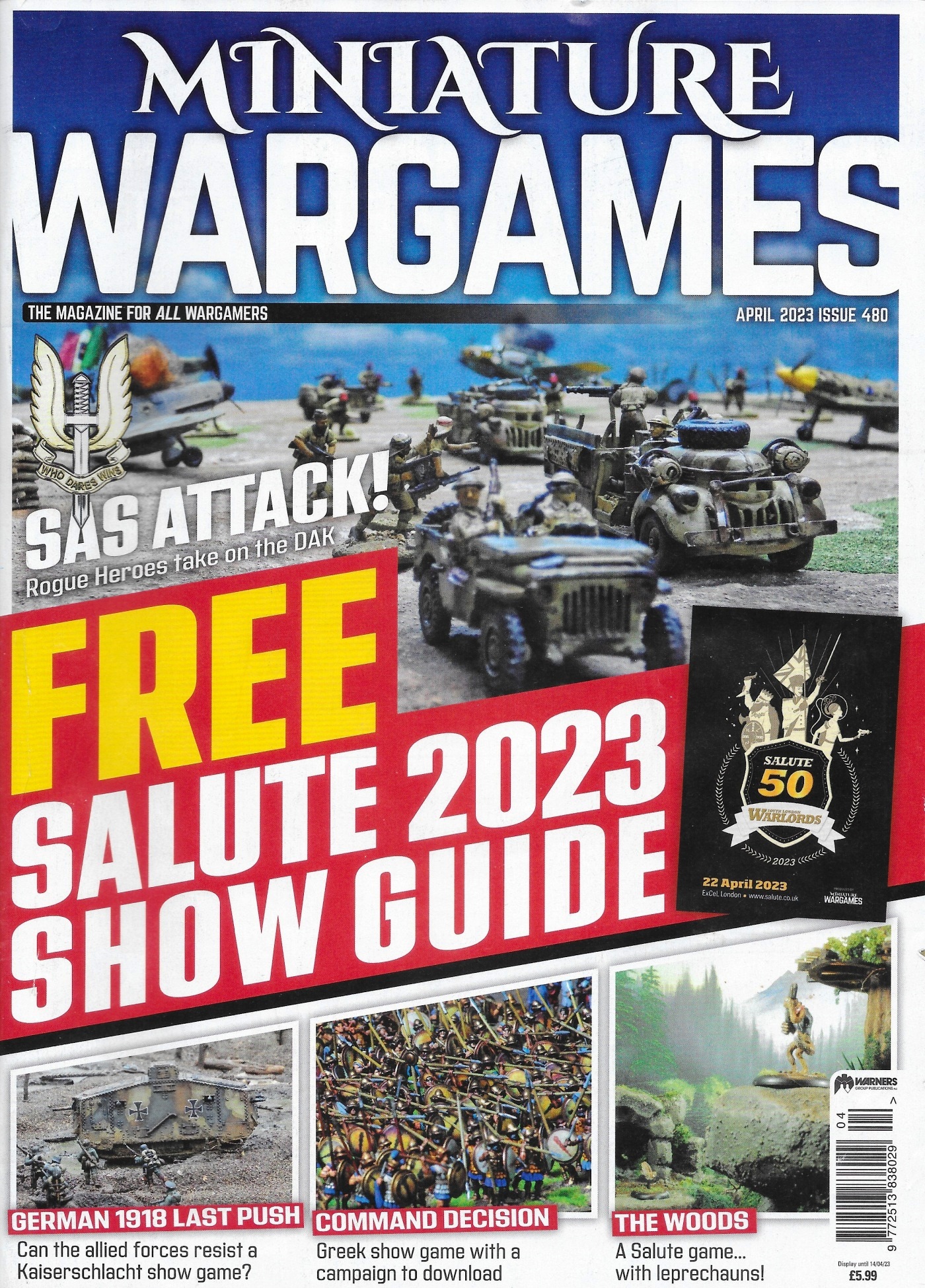
I actually bought it for two things. Firstly, Arthur Harman's article entitled 'Return to the Wells', which included some simple ideas for improving the rules from H G Wells's LITTLE WARS, and secondly for the guide to this year's SALUTE wargame show. I wanted to see what was going to be taking place at the show before deciding whether or not to go.
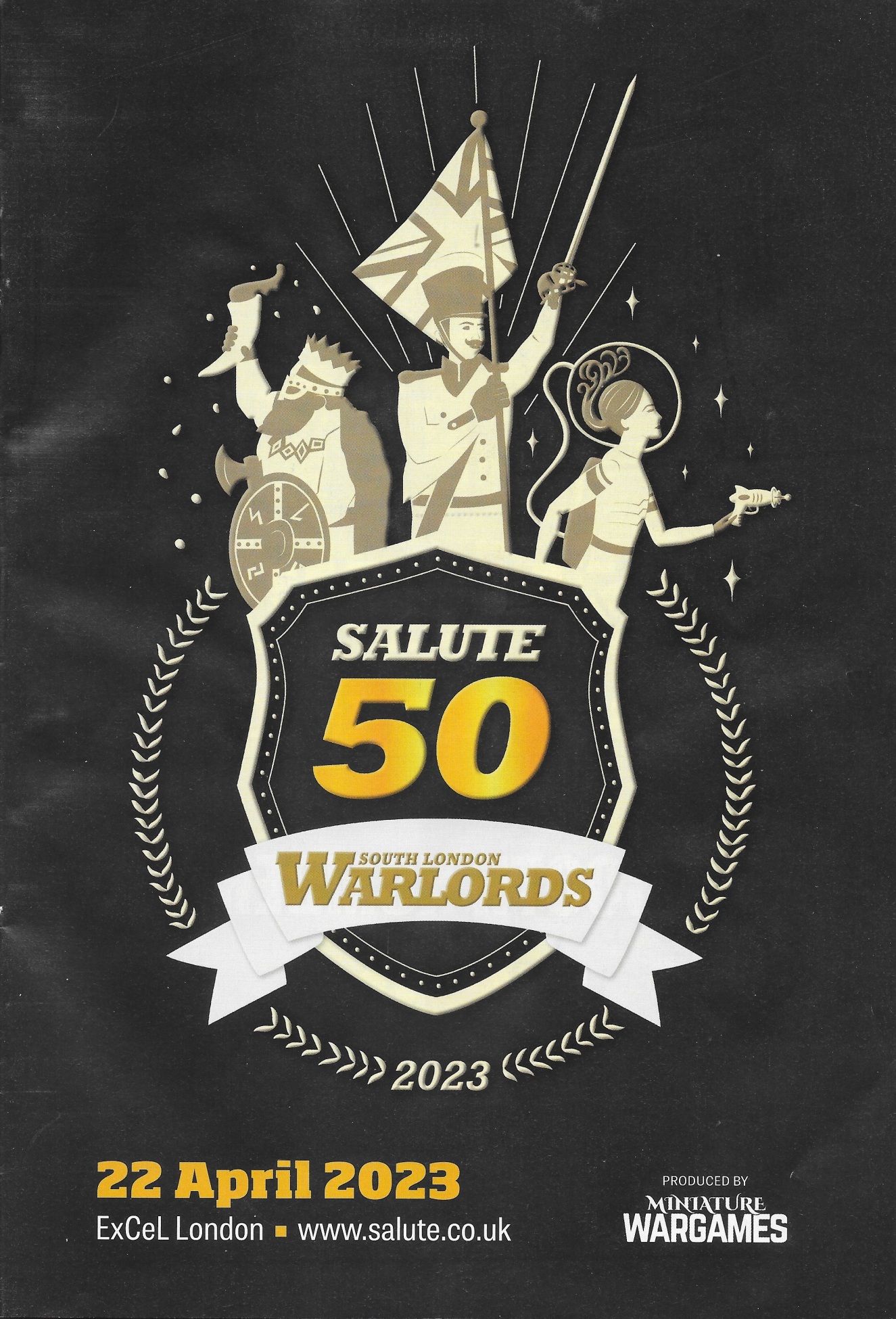
Having read the SALUTE guide, I'm still undecided as to whether or not I will go, but as I can actually see the venue (ExCel, London) from the driveway of my house, it seems silly not to. I'm certainly going to give it a bit more consideration before I make any final decision, but on balance I think that I am more likely to be there than not.
This SALUTE marks the fiftieth year that the show has been running, and over that time I have probably been to at least half of them. South London Warlords had been staging their show for seven years before Wargame Developments was founded and at various times WD has put on games at SALUTE. Looking back through my files I can find photos from several of them, and I have included some of them below. Quite a few of them feature members of WD either taking part and/or running a game at SALUTE.
2003: Restless Natives


2005: Megablitz


2006: Red Flags and Iron Crosses


2009: Solferino in Thirty Minutes


.jpg)


