Pages

Wednesday, 22 February 2012

One step forward ... and two steps back ... but it will be worth it in the end

I began work on laminating Plasticard to create the hulls of my 'Monopoly'-inspired battleships ... but I have run into a bit of a problem.

The problem is not the actual lamination process; it is the fumes given off by the liquid polystyrene cement that I am using. Even with the window open (which is not very nice at this time of year), the smell of the glue has begun to pervade the upper floor of the house (my toy/wargames room is on the top floor of our three-story home) ... and my wife has objected. This leaves me with a dilemma; do I continue the laminating process – which will upset and annoy my wife – or do I use an alternative method.

After giving this matter considerable thought, I have decided that I will try to find an alternative method of gluing the layers of Plasticard together. In the meantime I am going to go back to using basswood and PVA glue to create my prototype model. I know that this is going to be somewhat challenging as it will present me with some construction problems ... but the extra effort will be worth it if it keeps my wife happy!

Tuesday, 21 February 2012

Jim Duncan's Blog

Jim Duncan has now joined the blogosphere by starting a blog entitled ...


I have already signed up as a follower, and I suspect that some of you will do so as well.

His blog can be found at:


Read and enjoy ... I know that I have!

Retail therapy

Once in a while my wife likes to indulge in some serious retail therapy ... and one place that she likes to go is the McArthur Glen designer outlet centre just outside Ashford, Kent. Today was once such occasion, and as a result this morning I found myself driving down the M20 motorway towards Ashford.

She spent an hour or so wandering round the shops whilst I tried not to look too bored (I am not a great lover of designer labels on things ... unless the name is Airfix, Revell, or the like), and then we had a very nice lunch in a pizzeria. She was very pleased with what she had been able to buy, and on the way home I persuaded her that a short diversion to Newnham Court Shopping Village on the outskirts of Maidstone would be a good idea ...


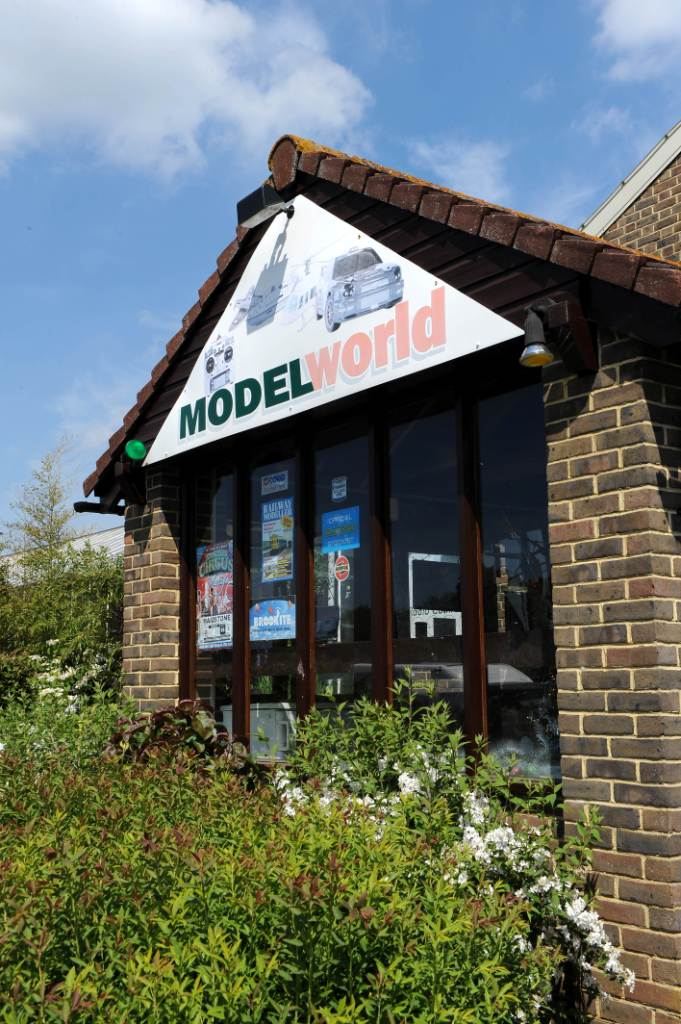
... especially as one of the shops situated there is a model shop called Model World!


I was very pleased with what I managed to buy there. I was able to purchase several sheets of 0.08" Plasticard (which is very useful when one hopes to build quite a few model warships over the next few months!) and another Airfix 'Sink the Bismarck' set (which means that I now have two!).

So in the end it turned out to be quite a good day's retail therapy for both of us.

The Portable Wargame … revisited!

Over the past few months a large part of my wargaming activity has been directed towards the development of MEMOIR OF BATTLE (MOB) and MEMOIR OF MODERN BATTLE (MOMBAT). During that time I have not forgotten about the PORTABLE WARGAME although I have not devoted any time to it … until today!

Because I needed to allow quite some time for the glue to set between the layers of Plasticard I will use to create the hull of my ‘Monopoly’-inspired battleship, I had some ‘spare’ time … and I decided to revisit and review the last draft of my PORTABLE WARGAME rules. What struck me was that – apart from the combat system – there were several similarities between PW2 and MOB. I suspect that these arose because MOB was designed after the latest draft of PW2 was completed, and that the design of the latter informed the design of the former.

One thing that immediately caught my eye as I re-read the PW2 rules was the fact that – as presently drafted – it is impossible for artillery to hit an enemy Unit that is in hard cover unless they are at Short Range. It is also impossible for non-artillery weapons to hit Units that are in hard cover regardless of the range.

I cannot remember why I wrote the rules in this way, and on first sight it does not make sense. I suspect that I chose this to encourage players to get their Units in close and to fight close combats rather than to stand off and engage in artillery duels and firefights. Now that I have spent time away from drafting and using these rules, this strikes me as something that I need to think about again … and that is exactly what I am doing.

Link to MEMOIR OF BATTLE (MOB) at Google Documents
Link to MEMOIR OF MODERN BATTLE (MOMBAT) at Google Documents

Monday, 20 February 2012

The Battle of New Orleans

Yesterday I was able to attend a meeting of the 'Jockey's Fields Irregulars' for the first time in almost a year. Alan Buddles had organised the event, and had chosen to stage his wargame about the Battle of New Orleans.

The players were split into two teams (British and United States), and given a copy of a hexed map of the area around New Orleans ...


... and a small box containing the troops under their command. The map came from Liberty Games Inc's 'Battle for the Bayous: The New Orleans Campaign' that was published in 1998, and Alan used the original map to plot the progress of the various units involved in the campaign. The 6mm figures were all made by Baccus and painted by Alan.


I was part of the United States 'team' and was given command of the Tennessee and Kentucky Militia – along with Hind's Dragoons – that were occupying Slaughterhouse Point. At a council-of-war the American defenders – led by Andrew Jackson (Ian Drury) – decided that the best course of action was to concentrate their forces in and around New Orleans, and to use Hind's Dragoons and the native Indians as scouts who could warn of any British advance. Preparations were also made to fortify the nearest approaches to the city as it was felt that the American troops would fare better if they were in entrenchments. Contact was also made with the pirates led by Jean Lafitte, and after some negotiations (and a promise of a pardon and gold) they agreed to assist in the defence of New Orleans.

As anticipated, the British landed a brigade on the shores of Lake Borgne (to act as a diversion) whilst the bulk of their forces (two brigades) landed on the shores of Lake Pontchartrain. Whilst the British slowly manoeuvred their forces forward – shadowed all the way by the Dragoons and Indians – the Americans prepared.

The British began their attack by advancing their right-hand brigade towards the flank of the incomplete American defences. These troops were faced by a regiment of Tennessee Militiamen armed with long rifles. At that point news reached General Jackson that a second British brigade was moving across the front of the American defences ... and seeing that he had the opportunity to defeat the British attack piecemeal he ordered an all out attack upon the British.

The resulting battle was a rather confused affair. The American advance was met by an advancing British Brigade ... which fell back before battle could be joined. Whilst the Tennessee Militia Regiment harassed the other British brigade, the Americans continued their advance. Unfortunately, just as the third British brigade arrived, the majority of the right-hand British brigade was able to shrug off the Tennessee Militia and crossed the bayou towards the American defences (which were manned by some of Lafitte's pirates), thus threatening the American rear.

The Americans rapidly withdrew, with the intention of defeating the right-hand British brigade before the rest of the British force could come up to support them.


The battle did not go according to plan for the Americans, who found themselves gradually being attacked from both sides and slowly but surely annihilated. When the Kentucky Militia Regiments collapsed and fled the field just as the American Regulars found themselves fighting the British on two fronts at the same time, this marked the end of the battle. The defenders were defeated and New Orleans lay at the mercy of the British.


This was a very enjoyable game, the more so because it was not just a straight re-fight of the Battle of New Orleans. The pre-battle planning and manoeuvring created the narrative for the battle that was actually fought, and although the result differed considerably from what happened during the real Battle of New Orleans, one felt that it worked very well indeed.

Sunday, 19 February 2012

Jim Duncan's Navy

Before I left for central London this morning, I received the following email and photographs from Jim Duncan. He has very kindly allowed me to publish them as a blog entry.

Read and enjoy!
Bob

Here are some slightly better pictures of one of my fleet.


The base is thick card, the hull is three layers of foamboard cut in a ship shape with the top layer recessed to form the maindeck aft of the foredeck. The peaked bow is made from cereal box cardboard and the bridge is another couple of pieces of foamboard. The turrets are carved from balsa wood with guns made from cotton buds. I only used a single barrel on each turret to keep the overall size limited. The mast is a cutdown cocktail stick and the funnels are large drinking straws cut to size. The flags are cut from cereal box cardboard and glued closely to the mast and funnel for resilience. The smoke is made from a pot scourer pad and has been sprayed black. The rest of the paint job is a heavy covering of acrylics including portholes and anchors covered by several coats of gloss varnish. This model is several years old and has fought in several battles without a scratch thanks to the resilience issues covered in its simple construction.

I have two fleets of these, unfortunately lost somewhere between my loft and my garden hut. I hope one day to find them again and put one some more 'cotton wool ball' battles. The main combat system involves throwing a cotton wool ball at a profile target lying flat in a box across the width of the table (usually six feet), the number of balls used is dependent on the number of turrets bearing, the range, the bearing of the target and the speed of the target. Victims of successful shooting usually lost either a turret or a funnel signifing loss of shooting power or loss of speed. Sometimes the bridge would be hit with a subsequent loss of control. A ship would eventually blow up.

Ships suffered accidental and catastrophic magazine hits when the firing captain dipped his cotton wool ball in his beer before firing!!

Great fun was had all round.

Jim
What a lovely model ... and what very simple, fun rules! I hope that Jim can find the rest of his fleet and share more photographs of them with us in the near future.

Leaky pipes can ruin your plans

I spent most of today in central London playing a wargame. For some time I have been a rather inactive member of the ‘Jockey's Fields Irregulars’ (an informal group of wargamers who try to meet once a month in London), but today I had my chance to actually attend and take part in a very interesting wargame ... about which I will write in due course. However, upon my return home I was confronted with a domestic crisis that has rather upset my plans for the next day or so.

I was supposed to be meeting David Crook tomorrow for lunch and a long 'chinwag' ... but I have had to cancel our meeting at short notice because of a leak in the outflow pipe from our first floor bathroom. The pipe developed the leak during the recent spell of cold weather, and the upshot has been that some of the waste water from the bath and sink has been running across the roof of the conservatory ... and then dripping inside the conservatory. I had thought that I had cured this dripping problem, but it returned a couple of days ago, and that is when I realised that the outflow pipe was leaking.

I don't have a long enough ladder to get up onto the roof of the conservatory, but my neighbour – who is a builder – does, and I asked if I could borrow it. Instead he suggested that he should look at the leaking pipe (he has seen my attempts at DIY and knows that I am not very adept at repairing things around the house!), and whilst I was out today, he did so. Unfortunately what he found was that we have a somewhat more serious problem than just one leaking pipe.

It appears that over the passage of time the plastic pipes, joints, and seals on the back of our house have become brittle due to the affect of sun and cold ... and the leaking outflow pipe had developed a split. In addition, the other pipes are showing signs of cracking along their length and some of the joints also needed to be replaced. Our neighbour managed to 'lashed up' a temporary fix so the leak has stopped for the time being, but he thought that the current cold weather was likely to cause it to fail sooner rather than later, and that unless the pipes and joints are changed as soon as possible, we could end up being unable to use the bathroom without flooding the conservatory.

So tomorrow, instead of spending time talking to David Crook about wargaming, I will be sat indoors waiting for the plumbers to arrive and do their work.

Mock-up lessons

Having drawn up a basic design for my 'Monopoly'-inspired battleship, I decided to make a rough mock-up to see what changes might need to be made before I began the build.

It turned out that was a very wise decision to have made.

I made the mock-up from a mixture of basswood and balsa that I had to hand ... and the result looked like this:


The first lesson that I learnt was that balsa wood was too fragile to use for the superstructure. It split along the grain when I drilled the holes for the funnels. I could have avoided this by drilling the holes farther apart, but the design had funnels that were very close together and I wanted to see what they looked like.

The second lesson was that the funnels looked very thin for their height, and might need to be shortened, whilst the third lesson was that the hull sides would have to be deeper if, as on the mock-up, the superstructure was high enough so that 15mm figures could be placed on the model without looking too ridiculous.

When I placed a 15mm figure onto the model it became apparent that the superstructure would have to be slightly higher than it currently is and that, once the turrets were fitted, there would be very little deck space for figures to be placed on it!


I then placed the recently built models of a coastal/river gunboat and a coastal/river passenger steamer alongside the mock-up ...


... and this showed me that the battleship – as currently designed – was far too small to look aesthetically correct if I was going to use all these models together.

This could have been very disheartening but ...

... thanks to some rather badly and hastily used photo-manipulation software I was able to see what the mock-up would look like alongside the models of the coastal/river gunboat and coastal/river passenger steamer if the battleship was built 50% larger than the mock-up ...


... and the results were very encouraging.

It would seem that I am not going to be able to build my 'Monopoly'-inspired battleship so that I can use it alongside my existing 15mm figures and model ships unless I accept that it will have to be closer to 15cm long rather than the 10cm length that I originally planned to use. This is a compromise that I am willing to make ... and as a result building the mock-up has proven to be a very worthwhile and sensible decision.

Saturday, 18 February 2012

... but then I would not have ended up over there

Having decided that the Admiral Ushakov-class battleships/coast defence ships will be the basis of my next attempt to model a 'Monopoly'-inspired battleship, I set about finding a suitable set of working drawings.

After the suggestion that I look at old copies of Jane's Fighting Ships I found a very rough plan and side view of the Admiral Ushakov-class battleships/coast defence ships in one of my reference books. I scanned these into my computer and used them as a basis to create a 'cartooned' version of the design. I distorted the image I used so that it was twice as wide and tall as it should be, and the results looked like this:


This is much more like what I hoped my 'Monopoly'-inspired battleship would look like, and I can now proceed to the next stage, which will be constructing the hull. I will probably use a mixture of balsa and basswood ... although I might try using Plasticard.

Friday, 17 February 2012

If I was going there I wouldn't have started from here ...

After several false starts and dead ends I was on the verge of giving up my idea to build a model battleship inspired by the design of the battleship used as a token in the game of 'Monopoly' when I remembered seeing a 1:1250th-scale model of a Russian battleship many, many years ago. It formed part of the Russian fleet in one of Eric Knowles's naval battles using Fletcher Pratt's Naval War Game rules, but I don't think that it lasted very long and was sunk quite early in the game. From what I could remember, it looked somewhat like the 'Monopoly' battleship ... so I spend some time looking through the relevant section of CONWAY'S ALL THE WORLD'S FIGHTING SHIPS: 1860-1905 and found it ... or – to be more precise – them. The ship I remembered was one of the Admiral Ushakov-class battleships/coast defence ships.

The class consisted of three ships, Admiral Ushakov, General Admiral Graf Apraksin, and Admiral Senyavin, and they were originally designed to counter the armoured ships that had been built for the Swedish Navy during the latter part of the nineteenth century.

As the following photographs show, they look vaguely similar to the ‘Monopoly’ battleship.

Admiral Ushakov


General Admiral Graf Apraksin


Admiral Senyavin


I have even managed to find a plan of the Admiral Ushakov-class battleships ...


... and I am seriously thinking about basing my next attempt at modelling my 'Monopoly'-inspired battleship on a version of this class of ships.