Pages

Friday, 6 September 2013

Tarred and Featherstoned

I wrote the second entry for this blog on 19th September 2008, and its topic was the recent re-publication of Donald Featherstone's WAR GAMES by John Curry. It spurred me to write a set of wargame rules entitled RED FLAGS AND IRON CROSSES – TARRED AND FEATHERSTONED, and most of the blog entries I wrote during that September were about the rules and the play-tests that I ran to test them.

Donald Featherstone's death has made me look back at those rules ... and doing that has helped me to realise how much I enjoyed using them. I know that quite a few wargamers are planning to fight battles using Don's rules as a tribute to him. I have decided that my tribute will be to fight a battle using my RED FLAGS AND IRON CROSSES – TARRED AND FEATHERSTONED wargames rules.

It may be some days before I can set up my battle, so in the meantime here are some of the photographs I used to illustrate the blog entries I wrote about the RED FLAGS AND IRON CROSSES – TARRED AND FEATHERSTONED play-tests.

Play-test 1


Play-test 2


Play-test 3


Play-test 4


Play-test 5


Looking at these photographs has reminded me of how much fun I had play-testing the rules ... and I hope that my tribute wargame will be just as good. If it is, it will serve as a great personal memorial to everything Donald Featherstone did for my development as a wargamer.

Thursday, 5 September 2013

My collection of Donald Featherstone's books

Although CHARGE! was the first wargames book I ever bought, Donald Featherstone's WAR GAMES was the first one I ever read.

My collection of his books includes:
  • WAR GAMES (1968, 1976, and 2008* editions)
  • NAVAL WAR GAMES (1965 and 1975 editions)
  • AIR WAR GAMES (1966 edition)
  • ADVANCED WAR GAMES (1969 edition)
  • WAR GAME CAMPAIGNS (1970 edition)
  • SOLO-WARGAMING (1973 edition)
  • BATTLES WITH TOY SOLDIERS (1984 edition)
  • DONALD FEATHERSTONE'S WARGAMING AIRBORNE OPERATIONS (2009* edition) [My RED FLAGS AND IRON CROSSES – TARRED AND FEATHERSTONED were included in this volume, although at Don's request the were renamed TARRED AND FEATHERED: RULES FOR WWII]
  • DONALD FEATHERSTONE'S LOST TALES (2009* edition)
  • DONALD FEATHERSTONE'S WARGAMING COMMANDO OPERATIONS AND REFLECTIONS ON WARGAMING: LOST TALES VOLUME 2 (2013* edition)
  • KHARTOUM 1885: GENERAL GORDON'S LAST STAND (1993 edition)
  • OMDURMAN 1898: KITCHENER'S VICTORY IN THE SUDAN (1993 edition)
  • TEL EL-KEBIR 1882: WOLSELEY'S CONQUEST OF EGYPT (1993 edition)
  • VICTORIA'S ENEMIES: AN A-Z OF BRITISH COLONIAL WARFARE (1989 edition)
  • WEAPONS & EQUIPMENT OF THE VICTORIAN SOLDIER (1996 edition)
  • KHAKI & RED: SOLDIERS OF THE QUEEN IN INDIA AND AFRICA (1997 edition)
The editions marked with an asterisk (*) are all published under the aegis of History of Wargaming Project.

The titles I own are only a fraction of Don's output. He was a prestigious writer (and not just of military and wargaming books), and I doubt if any modern wargame writers will come close to matching the sheer volume of books and articles he produced during his long life.

Wednesday, 4 September 2013

Connections UK conference: Day 2

Before the second day of the conference started Donald Featherstone's death was announced, and John Curry and Phil Barker gave a short but poignant eulogy about Don, his life, his work, and his legacy.

During the morning the topics of non-kinetic conflict dynamics and the common faults of wargaming in the military were explored, and after lunch there was a discussion about the stigma and scepticism wargaming attracts within the military, academia, and the general public.

The final session of the day was spent discussing what to do next with regard to Connections UK. The general consensus seemed to be:
  • That another conference should be held next year ... and that this would become an annual event.
  • That access to Connections UK should be open to anyone who was willing 'to advance the art, science and application of wargaming' and to participate in the 'exchange (of) information on achievements, best practices and needs.'
  • That once the concept of running an annual conference was embedded, consideration should be given to it being held in other European countries on alternate years.
  • That the Connections UK website would be used as a means through which participants can access the papers, presentations etc., from this and future conferences.
  • That the possibility of creating a dedicated LinkedIn group should be examined.
The most important outcome of the conference was, however, the opportunity it presented for networking, and I suspect that many of the contacts that were made over the past few days will be very fruitful.

Donald Featherstone

I awoke early this morning to get ready to go to the second day of the Connections UK conference when I received an email informing me that Donald Featherstone had died yesterday in hospital following a fall at home.

Don was not a young man, but he was a very active one, and his death was totally unexpected ... and all the more shocking as a result. He can quite rightly be called 'The Father of Modern Wargaming' as far as the recreational side or wargaming is concerned ... and he was certainly an influence of professional wargaming as well.

His passing will be deeply mourned by many people.

DONALD FEATHERSTONE
1918 – 2013
RIP

Tuesday, 3 September 2013

Connections UK conference: Day 1

I have spent the day at King's College London, attending the first ever Connections UK conference. (The conference programme can be downloaded here.)

There have been Connections conferences in the United States since 1993, and their objective has been to 'to advance the art, science and application of wargaming by bringing together all elements of the field (military, commercial and academic) so participants can exchange information on achievements, best practices and needs.'

According to the Connections UK conference website, 'Connections UK will strive to do the same but the primary purpose of the initial event will be to learn what we all do and share best practice. A significant subsidiary purpose will be to discuss future events, their format and feasibility.'

I will be attending the second day of the conference tomorrow, and I hope to write a detailed blog entry about the event as soon as possible thereafter.

Monday, 2 September 2013

The ongoing campaign against Marzibarian slave traders: The sea chase

As soon as he had all his men back aboard HMS Insolent Lieutenant Commander Chamberlain set off in pursuit of the escaping dhows. He had a good idea where they were headed – Marzibar – and knew that his steam-powered gunboat should be able to overtake the dhows within a day. When that happened he was determined to capture the dhows and their crews, and then to return any slaves that he found to their villages in Dammallia.

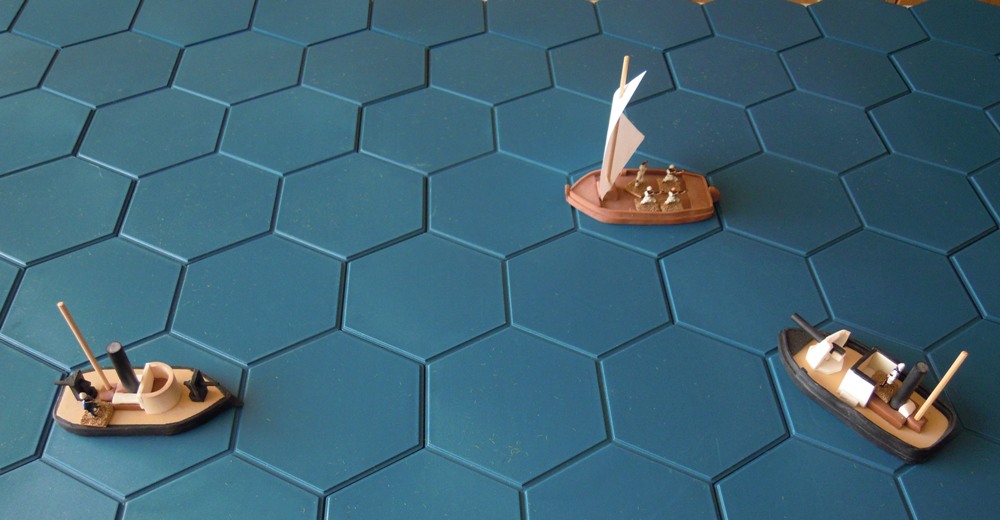
HMS Insolent in hot pursuit of the Marzibarian dhows.
The Marzibarian dhows. One of them has only half the number of crew that it needs, and it is already beginning to fall behind the others.
At first light on the morning following the attack on Raffia Island, the lookout aboard HMS Insolent spotted the dhows ahead of them.


As soon as it was possible, Lieutenant Commander Chamberlain brought as many of his crew that could be spared from the pursuit together, and explained what they were going to do. It was his intention to try to pick off the dhows one-by-one, starting with the rearmost. He called upon his engine crew – and especially his stokers – to do everything possible to ensure that the Insolent was able to achieve and maintain her designed top speed ... or to even better it!

Slowly but surely HMS Insolent shortened the distance between herself and the Marzibarian dhows.


Progress was slow, ...


... painfully slow at times, ...


... but eventually she came alongside the rearmost dhow, ...


... and for the first time in many years, sailors of the Royal Navy – armed solely with cutlasses and pistols – boarded an enemy ship at sea!


The fight was short and bloody, and after half of the dhow's crew were killed, the remainder surrendered.


When the dhow's hold was opened the sailors found more than thirty slaves in manacles ... and a stack of ivory!

Having left a small prize crew aboard the dhow, ...


... Lieutenant Commander Chamberlain continued the pursuit.


At this point the two dhows began to separate, and Lieutenant Commander Chamberlain decided to chase down the smaller of the two first.


HMS Insolent closed the gap between herself and the smaller dhow ...


... and signalled to it to stop by firing a shell across its bows.


When this failed, the British gunboat fired at the dhows mast ... which it hit!


HMS Insolent came alongside the stricken dhow ...


. and sent across an armed boarding party ...


... which quickly subdued the crew of the dhow. A search of the dhow revealed the presence of more slaves and ivory, and after leaving his Ship's Carpenter and a small prize crew aboard the dhow ...


... Lieutenant Commander Chamberlain went in pursuit of the third dhow.


As he got closer to the dhow HMS Insolent's lookout spied smoke on the horizon.


This indicated the presence of the Marzibarian gunboat Sultan Abdulla, which was sailing towards HMS Insolent and the dhow at maximum speed.


As the Sultan Abdulla approached, she began signalling to HMS Insolent. The signal enquired why the British gunboat appeared to be chasing a Marzibarian merchant ship.


Lieutenant Commander Chamberlain signalled back that he was in hot pursuit of the dhow, which he believed was carrying an illegal cargo.

Meanwhile, the distance between the two warships was shortening, and the Sultan Abdulla seemed to be trying the get between HMS Insolent and the dhow.


This reckless manoeuvre caused HMS Insolent to turn away in order to avoid a collision.


Lieutenant Commander Chamberlain was, however, able to get his gunboat astern of the dhow, but the presence of the Sultan Abdulla prevented him from getting alongside it.


At this point the Sultan Abdulla appeared to have given up sending a boarding party aboard the dhow, ...


... but then she cut across the bows of the British gunboat, ...


... forcing her to turn ...


... and giving the dhow the opportunity to escape.


By now Lieutenant Commander Chamberlain was becoming very frustrated by the actions of the Marzibarian gunboat, and signalled her captain to stop hampering his pursuit. The Marzibarian replied that he would do everything in his power to protect the Marzibarian merchant ship from 'the unwarranted attempts to seize and search the ship of another nation without due cause'. The Marzibarian did, however, offer to send a boarding party from his own ship aboard the dhow to ensure that there was no illegal cargo aboard it.

As neither slaves nor stolen ivory were 'illegal' in Marzibar, Lieutenant Commander Chamberlain regarded this 'offer' as nothing more than a delaying tactic, and the three ships continued to manoeuvre around each other. The result was inevitable ... and when the captain of the Sultan Abdulla 'misjudged' a turn, his ship collided with HMS Insolent.


Although his ships was not badly damaged (the hole below the waterline that was caused by the Marzibarian gunboat's ram was soon plugged, and the pumps were quite capable of dealing with the water that was seeping in), Lieutenant Commander Chamberlain realised that he had no alternative but to break off from the chase and return to port in order to repair his ship and to appraise Sir James Deville of recent events.

It gave Lieutenant Commander Chamberlain little pleasure to turn for home and to watch the Marzibarian dhow sail away, escorted by the Sultan Abdulla. One day he hoped to get his revenge on the Marzibarians who had cheated him of his prize ... and he hoped that that day would not be long coming.