Between attending Connections UK 2015 and taking part in the re-fight of Waterloo using 54mm-scale figures, Sue and I visited Knole House in Sevenoaks, Kent.

The building if the earliest parts of the present house was started by Thomas Bourchier, the then Archbishop of Canterbury, at some time between 1456 and 1486. When Bourchier died the house was left to the See of Canterbury, and it was owned by the See until 1538, when Henry VIII seized it from Archbishop Thomas Cranmer.
In 1566 ownership of the house passed to Thomas Sackville, and during the early years of the reign of James I he ordered that extensive renovations be made to the state rooms at Knole in the expectation that the King would pay the house a visit. The house remained in the ownership of the Sackville (and latterly the Sackville-West) family until just after World War II; it then passed into the ownership of the National Trust. (The Sackville-West family trust still owns most of the surrounding park, and the family continue to live in part of the house.)
When we visited the house was undergoing restoration, and we were somewhat limited as to what we could see.
The house is surrounded by parkland where a large number of deer roam free. It was therefore not very surprising to see a stag dozing in the shade near the house's main entrance.

The main gatehouse is very impressive, and as you pass through it, you can see a beautiful lawned quadrangle.

Before crossing the quadrangle, we turned right and went into the visitor centre.

Besides the ticket office, the centre contained a ceramic model of Knole House ...

... and a display about the house's history and – in particular – the people who had lived there.


We re-entered the quadrangle from the visitor centre ...

... and moved toward the gatehouse that gave access to an inner courtyard.


It was interesting to see that many of the buildings were adorned with finials that depicted a heraldic leopard holding a shield.

Once through the inner gatehouse ...

... we entered a paved courtyard.

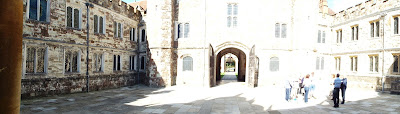
The inner gatehouse looked even more impressive when seen from the courtyard rather than from the quadrangle.

The building on the side of the courtyard furthest from the inner gatehouse had a colonnaded section that was surmounted by a balustraded balcony.


As we were unable to proceed any further, we retraced our steps back into the lawned quadrangle, where we were able to see the inner side of the outer gatehouse.

To the right of this gatehouse was the old estate office, which was full of interesting exhibits ... including an adding machine of the type that I used when I first went to work in the late 1960s!

Once we left the old estate office we walked back past the gatehouse entrance and the visitor centre to the Orangery.

This contained some interesting exhibits including a statue, ...

... a textile panel that told the history of Knole House, ...

... and a cast iron stove that used to be used to warm part of the house.

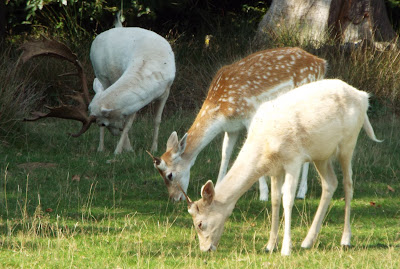
Once our visit to the main building was over, we took a short walk through the surrounding park, where we saw lots of deer at very close range.


We hope to return to Knole House at some time in the future so that once the restoration work has been completed, we can see more of the interior of the buildings.

The building if the earliest parts of the present house was started by Thomas Bourchier, the then Archbishop of Canterbury, at some time between 1456 and 1486. When Bourchier died the house was left to the See of Canterbury, and it was owned by the See until 1538, when Henry VIII seized it from Archbishop Thomas Cranmer.
In 1566 ownership of the house passed to Thomas Sackville, and during the early years of the reign of James I he ordered that extensive renovations be made to the state rooms at Knole in the expectation that the King would pay the house a visit. The house remained in the ownership of the Sackville (and latterly the Sackville-West) family until just after World War II; it then passed into the ownership of the National Trust. (The Sackville-West family trust still owns most of the surrounding park, and the family continue to live in part of the house.)
When we visited the house was undergoing restoration, and we were somewhat limited as to what we could see.
The house is surrounded by parkland where a large number of deer roam free. It was therefore not very surprising to see a stag dozing in the shade near the house's main entrance.

The main gatehouse is very impressive, and as you pass through it, you can see a beautiful lawned quadrangle.

Before crossing the quadrangle, we turned right and went into the visitor centre.

Besides the ticket office, the centre contained a ceramic model of Knole House ...

... and a display about the house's history and – in particular – the people who had lived there.


We re-entered the quadrangle from the visitor centre ...

... and moved toward the gatehouse that gave access to an inner courtyard.


It was interesting to see that many of the buildings were adorned with finials that depicted a heraldic leopard holding a shield.

Once through the inner gatehouse ...

... we entered a paved courtyard.


The inner gatehouse looked even more impressive when seen from the courtyard rather than from the quadrangle.

The building on the side of the courtyard furthest from the inner gatehouse had a colonnaded section that was surmounted by a balustraded balcony.


As we were unable to proceed any further, we retraced our steps back into the lawned quadrangle, where we were able to see the inner side of the outer gatehouse.

To the right of this gatehouse was the old estate office, which was full of interesting exhibits ... including an adding machine of the type that I used when I first went to work in the late 1960s!

Once we left the old estate office we walked back past the gatehouse entrance and the visitor centre to the Orangery.

This contained some interesting exhibits including a statue, ...

... a textile panel that told the history of Knole House, ...

... and a cast iron stove that used to be used to warm part of the house.

Once our visit to the main building was over, we took a short walk through the surrounding park, where we saw lots of deer at very close range.


We hope to return to Knole House at some time in the future so that once the restoration work has been completed, we can see more of the interior of the buildings.






.jpg)


