Pages

Wednesday, 4 November 2020

Nugget 330

I will be collecting the latest issue of THE NUGGET from the printer later this morning, and hope to post it out to members of Wargame Developments later today.

I have uploaded the PDF version to the Wargame Developments website, and it can be downloaded and read online using the password that was sent to all members when they resubscribed.

IMPORTANT: Please note that this is the third issue of THE NUGGET to be published for the 2020-2021 subscription year. If you have not yet re-subscribed, a reminder was sent to you. If you wish to re-subscribe using the PayPal option on the relevant page of the website, you can use the existing buttons as the subscription cost has not changed.

Tuesday, 3 November 2020

Went the day well?

I had to be at University Hospital Lewisham by 9.00am on Monday morning, so Sue and I booked a cab to pick us up from home at 8.00am. It was ten minutes late arriving due to the rush hour traffic ... and matters did no improve during our journey to the hospital. In fact, it took us an hour to travel under five and a half miles. Luckily, I was able to telephone the CT Department to tell them I was going to be late, and they were able to adjust the schedule to fit me in.

Having arrived at the CT Department, I was fitted with a cannula and given a litre of disclosing fluid to drink. This fluid lines the walls of the digestive system so that it is easier to see on the CT image, but it takes an hour to drink and leaves a metallic aftertaste in the mouth. Once the hour was up, I was taken to the room that houses the CT scanner. The actual process of scanning took less than ten minutes, and was rather like lying in bed on your back, with your hands above your head, whilst an underground train rumbles past.

After having the cannula removed (it had been used to feed a dye into my bloodstream during the scan), I then had to go to a separate department so that a blood sample could be taken. By this time it was just after 11.00am, and Sue and I decided to walk to the nearest cab rank to find a taxi to take us home. The traffic was much lighter than it had been during the rush hour, and we were home a little after 11.30am.

All-in-all, the day went quite well, and I should get the results - and know what treatment I will have to undertake - on Thursday or Friday.


The title I chose for this blog post comes from FOUR EPITAPHS, by John Maxwell Edmonds:

‘Went the day well?
We died, and never knew.
But, well or ill,
Freedom, we died for you.'

It was published in THE TIMES on 8th February 1918, and is sometimes confused with his later Kohima Epitaph:

‘When you go home, tell them of us,
That for your tomorrow, We gave our today.’

The title was also given to the excellent 1942 film about an English village that is seized by a group of German Fallschirmjagers in preparation for an invasion, and how the locals resist and eventually overcome the invaders.

It is a film that I never tire of watching (much to Sue's dismay!), even though I read the book and saw the similar film THE EAGLE HAS LANDED well before I saw WENT THE DAY WELL? on TV.

Sunday, 1 November 2020

A change of name

Over the past few days, I have been working quite solidly on the next book in the PORTABLE WARGAME series, and after giving it some serious thought, I have decided to change the name from THE PORTABLE SEVENTEENTH CENTURY WARGAME to THE PORTABLE PIKE & SHOT WARGAME. I think that this better describes the sort of wargames users will want to use the rules to fight ... and probably makes it slightly more appealing to the average wargamer.

To give regular blog readers some idea of what the book covers, here is an image of the current Contents page:

I hope to write the chapter about the Battle of Sedgemoor today so that I can send it off for proof reading by Wednesday.

Friday, 30 October 2020

The Portable Seventeenth Century Wargame book: A short progress report

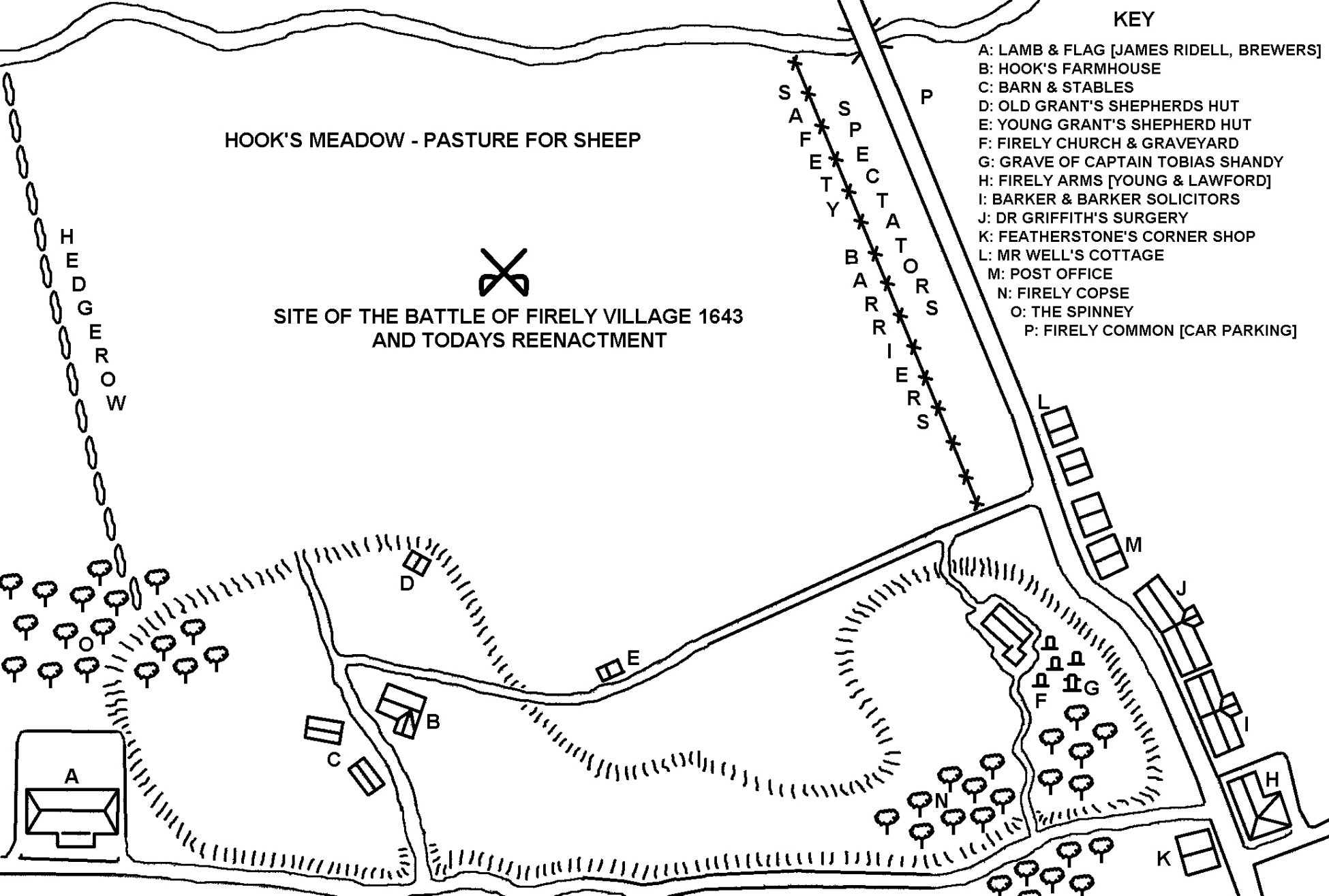
I have almost finished writing the first draft of the book's text, and I am now beginning to add some of the images. At present, I have just finished the first of several maps that Arthur Harman has provided to accompany one of the chapters he has written, and it looks like this:

Arthur supplied me with scans of his hand drawn maps, and I have been digitising them ... a process that takes time and quite a bit of concentration!

I am now about to start work on the second of Arthur's maps, which shows the initial positions of the various units as well as the course of the battle.

Thursday, 29 October 2020

Nugget 330

The editor of THE NUGGET sent the next issue (N330) to me whilst I was away, and I hope to take it to the printer tomorrow. With luck, I should be able to collect it by early next week, and post it out to members as soon afterwards as I can.

IMPORTANT: Please note that this will be the third issue of THE NUGGET to be published for the 2020-2021 subscription year. If you have not yet re-subscribed, a reminder was sent to you some time ago. If you wish to re-subscribe using the PayPal option on the relevant page of the website, you can use the existing buttons as the subscription cost has not changed.

Wednesday, 28 October 2020

I have been to ... Tiverton, Devon ... again!

When London was put into the Tier 2 COVID-19 alert level, Sue and I decided that if there was a chance that London might be moved up to Tier 3 before Christmas, we would go away for a long weekend whilst we could still travel. Unfortunately, as it is the week when many schools are taking their half-term holidays, the choice of places we could book at short notice was limited ... but Tiverton Castle did have some room. Furthermore, because we were returning so soon after our last visit, they offered us a discount on the cost.


Friday 23rd October: Tiverton

We set off by car at 11.00am ... and finally reached Tiverton at 4.45pm. The journey should have taken about four hours (including time for a comfort break), but a combination of roadworks, bad weather (i.e. torrential rain), and heavy traffic delayed our arrival. We were greeted by the owner’s wife, who gave us our keys and a very welcome coffee and walnut cake ... which we ate with a much-needed, refreshing cup of tea.

Suitably refreshed, we unpacked and settled in to our apartment, which forms part of the Castle’s wall. Sue and I decided to go out for dinner, and after a short walk into the centre of the town, we were able to eat in the Tiverton Steakhouse. We had eaten in this restaurant during our last visit to Tiverton, and enjoyed our meals there so much that it was a no-brainer to go there again.

Saturday 24th October: Exeter and Tiverton

Overnight, the weather took a turn for the worse, and by the time we had eaten breakfast, the rain was very heavy. We had planned to go to Killerton - a National Trust property between Tiverton and Exeter - after visiting the Marsh Barton area of Exeter, but as we were driving to Killerton from Exeter, the rain became torrential. Knowing that the distance between the car park and the main building was about a quarter of a mile, we knew that we would get soaked if we persisted with our planned visit ... so we returned to Tiverton to have lunch.

We bought some readymade rolls from a local bakery, and spent the early afternoon keeping warm and dry in our apartment. By 3.00pm, the rain has stopped, and Sue and I decided to go for a walk into Tiverton town centre. we had just reached the Pannier Market when it began to rain again. we did some shopping in several of the local shops before returning the the Castle.

During our walk back, we took a short detour up Castle Street to look at the local Masonic Centre.

Almost opposite is a plaque that explained that the alley leading from Castle Street to Tiverton Castle was known locally as Hippopotamus Court. This is a corruption of its original name - Hit and Miss Alley - and was the location of the tiltyard used by the. Castle’s garrison.

Tiverton Castle was one of ‘the ruins Cromwell knocked about a bit' during the English Civil War, and it was never repaired afterwards. Instead, it became a family home, and during the Georgian era a new house was built inside the grounds. Some parts of the original castle still exist, and these can be seen in the following photographs.

It was raining so hard at 7.00pm that we drove into the centre of Tiverton to have dinner for the second night running at the Tiverton Steakhouse.

For our main courses, Sue had Dover Sole and I ate Chicken Chasseur, and we followed that with Carrot Cake and Apple Pie.

We returned home after dinner, and spent the rest of the evening reading, resting, and watching TV.

Sunday 25th October: Exmouth and Exeter

Having gained an extra hour due to the clocks going back at the end of British Summer Time, Sue and I hoped that the change would be marked by a general improvement in the weather ... and it was! We awoke to find the sun shining, and decided that we would visit Exmouth.

Sue and I set off after breakfast, and reached Exmouth at 11.20am. There was plenty of space in the town centre car park, and we spent the next hour wandering around.

We then drove to the seafront ... which was surprisingly crowded. There seemed to be more people on the beach than there had been during our last visit, and we discussed the possibility of staying in Exmouth for lunch.

Sue and I had a short walk along the Esplanade, ...

... from where we could see three cruise liners at anchor on the other side of the estuary.

During our walk, the sky began to darken quite rapidly, and it soon became apparent that it was going to rain. Rather than stay in Exmouth and get wet, Sue and I decided to go to central Exeter. The drive took about forty-five minutes, and we had no difficulty parking in the Princesshay Car Park.

We stayed in central Exeter for nearly three hours, and besides doing some serious retail therapy, we ate an excellent lunch in the local branch of the Zizzi chain of Italian restaurants. It is situated in Gandy Street, just off the High Street.

We also had the opportunity to take a look at Exeter Cathedral, which is currently undergoing some restoration work.

On our drive back to Tiverton, it began to get dark, and the rain we had avoided in Exmouth caught up with us. By the time we reached Tiverton Castle, the rain was torrential, and we had to dash from the car to our front door to ensure that we were not soaked. We then spent the rest of the afternoon reading and resting.

Because we had eaten a big lunch, Sue and I only had a snack for our evening meal. This meant that we did not have to go out to eat ... which was probably just as well, as the weather had remained wet and windy.

Monday 26th October: Tiverton and Wellington

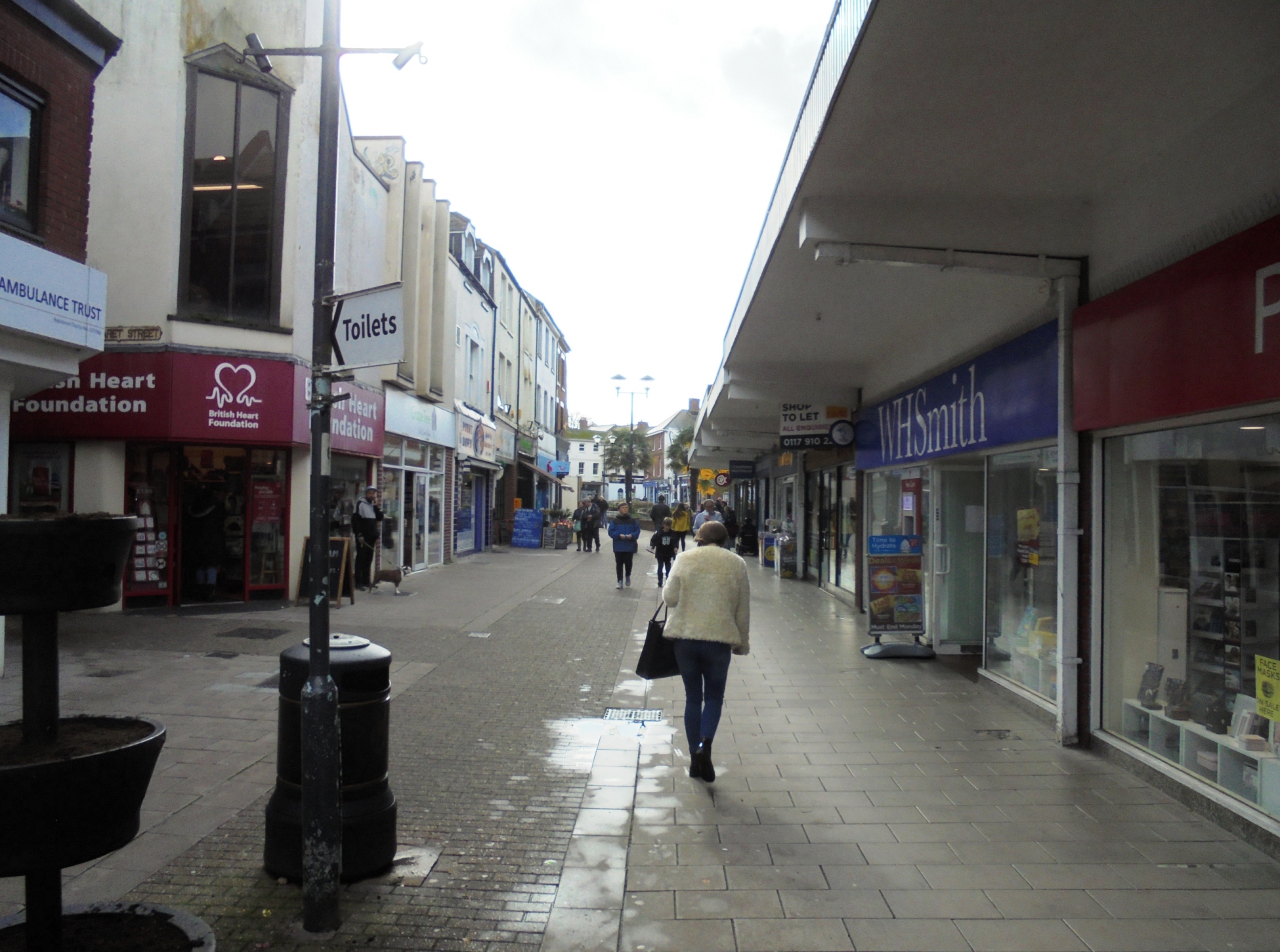
It was sunny when we awoke, but it looked as if it had been raining. After breakfast, Sue and I paid a visit to the Pannier Market in Tiverton.

Monday is the day of the week when half of the market is turned over to the sale of second-hand and antique articles, and we had an interesting time looking at what was on sale. I considered buying a copy of WITH THE FLAG TO PRETORIA, but it was not in very good condition and I decided that it was overpriced.

It began to rain just after we left the Market, and we sheltered from the rain in several of the local shops. Once it had stopped, we explored parts of the town we had not seen before. It was whilst we were doing this that the hospital telephoned me with the results of my recent colonoscopy. I took the call whilst sitting in a small garden just off the town’s main shopping street, where there was a small memorial that had been erected by the Burma Star Association.

The news rather took the wind out of my sails, and we returned home to Tiverton Castle for a drink and a chat about what to do.

In the end, we decided that rather than sit in our apartment thinking about the results, it would be better to go out somewhere. After a quick look at a map of Devon and. Somerset, we chose to go to Wellington. We  drove there across country using mainly B-class roads ... which proved ‘interesting’! (Some of the roads were only just wide enough for one vehicle. Luckily, we did not meet any other vehicles coming in the other direction.)

Wellington was relatively deserted, and many of the businesses were closed.

Sue and I made our way to Wellington Park, where there was a rather unusual war memorial to the dead of the two World Wars.

After looking for somewhere to eat lunch, we ended up in a local pub called - appropriately - The Iron Duke.

We struggled a bit with the ‘order your food and drink using the app’, but we persisted ... and ended up with exactly what we wanted! The food was better than we expected, and we were struck by the excellent COVID-secure environment.

The sun was shining as we drove home, and after our earlier cross-country journey, we used the M5 and A361 to get back to Tiverton. We arrive back at the Castle just before 4.15pm, just as it was beginning to get dark. We stayed there reading and resting until it was time to go out for dinner. For our last night in Tiverton, we returned to the Branzino Italian Restaurant.

Sue and I both ate pizza, and then walked back to the Castle to do some packing before watching TV until it was time to go to bed.

Tuesday 27th October: Going home

We had packed our car by 10.00am, and after a short diversion to fill up with petrol at a local filling station, we set off for home. It rained almost all the way home, and this affected the time it took us to get back. (A four-hour journey took slightly more than five hours.) We managed to take a short comfort break at Weyhill Services on the A303, but the main delays were due to restricted visibility because of the heavy rain, roadworks in the Amesbury/Stonehenge area, and to heavy traffic between Junctions 3 and 2 on the M25 approach to the Dartford Crossing.

Tuesday, 27 October 2020

Another short health update

Back on 15th October, I mentioned that I'd had a colonoscopy and was awaiting the results. They came through yesterday.

Two of the polyps were harmless, but the third contained cancer cells. I now have to undergo a CT scan to find out if the cancer is anywhere else in my body, after which the team dealing with my case will decide on what treatment I will need. I expect to have the CT scan within a fortnight, and will keep my regular blog readers aware of any developments.


I strongly recommend anyone who has what the literature coyly describes as ‘traces of blood in your poo' to undertake the screening test and to have a colonoscopy if one is offered. The earlier the cancer is caught, the greater the chances of a complete recovery.


Since writing this blog post, I have received a letter containing the date and time of my CT scan. I will be having it on Monday 2nd November, and should have the results and an outline of any treatment programme within a week afterwards.

Monday, 26 October 2020

The Royal Edward and the UB-14

Following on from my recent blog post about the Maritime Museum in Barcelona, I have found some more information about the fate of one of the ships whose model is on display (the Royal Edward) ... and the submarine that sank her!


The RMS Cairo was built in 1907 by the Fairfield Shipbuilding and Engineering Company of Govan, Scotland, for the Egyptian Mail Steamship Company. They sold her to Canadian Northern Steamship Company in 1910, when she was renamed RMS Royal Edward.

The Royal Edward was requisitioned for military service when the First World War broke out, and after a period as an internment ship moored off Southend-on-Sea, she was used as a troop transport. On 28th July 1915, Royal Edward embarked 1,367 officers and men at Avonmouth to take them to the eastern Mediterranean to take part in the Gallipoli campaign.

She was torpedoed by the German submarine UB-14 was off the island of Kandeloussa at approximately 10.00am on 13th August, and she sank in less than six minutes. It is estimated that 950 lives were lost when she sank.


The UB-14 was a German Type UB I submarine. It was built by the AG Weser shipyard in Bremen, and launched and commissioned in March 1915. She was ‘transferred’ to the Austo-Hungarian Navy as the U-26 (i.e. she was crewed by German sailors but listed as a ship of the Austro-Hungarian Navy because Italy was not at war with Germany at the time) and transported in sections by rail to Pola on the Adriatic, where she was reassembled.

Her first commander was Oberleutnant zur See Heino von Heimburg (who later served as a Vice Admiral and People's Court judge during the Second World War) and she became the most successful German submarine serving in the Mediterranean and Black Sea. During her career she:

  • Torpedoed and sank the Italian armoured cruiser Amalfi on 7th July 1915

  • Torpedoed and sank the British troop transport Royal Edward on 28th July 1915
  • Torpedoed and seriously damaged the British troop Southland on 2nd September 1915
  • Sank the Russian coaster Katja on 7th October 1915
  • Sank the Russian transport ship Apscheron on 8th October 1915
  • Torpedoed and sank the British submarine HMS E-20 on 6th November 1915

  • Sank the Russian sailing ship Karasunda on 5th June 1917

After the end of the war, the UB-14 was disarmed at Sevastopol, and scuttled in the Black Sea early in 1919.

Sunday, 25 October 2020

The Maritime Museum in Barcelona

I actually meant to write this blog post after I returned from our last cruise in February(!). For some reason, I never finished it ... and a couple of days ago I found the draft in a file, along with a selection of photographs that I was going to use. Rather than let it languish on my computer's hard drive, I decided to complete it


Models and paintings of warships

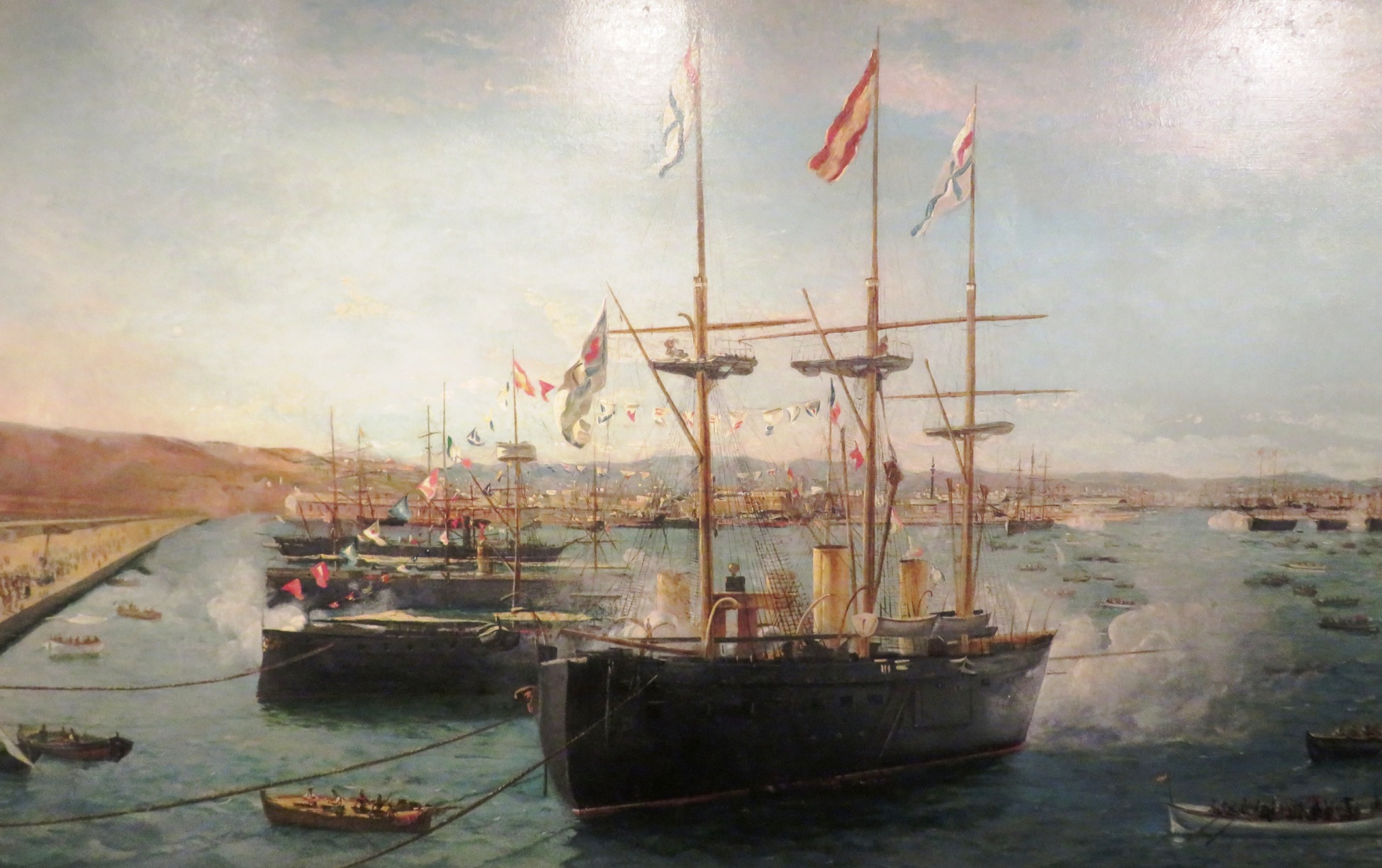
The museum's collection includes a large painting of the Spanish fleet during a royal review.

It was painted at a time when the major fleets of the world were introducing steam-powered ironclads into service, and several of them can be seen in the following details from the painting.

Amongst the model warships on display there were an 80-gun warship (probably the guide model for the Havana-built San Carlos, San Luis, and San Fernando), ...

... a 1930s C-class submersible, ...

...the 1930s British-designed, heavy cruiser Canarias, ...

... and the American-designed Knox-class frigate Cataluna.


Models of merchant ships

The museum also has a large number of models of merchant ships, many of which were operated by Spanish companies. The models include the City of Paris, ...

... the Cairo (later known as Royal Edward), ...

... the Reina Victoria Eugenia, ...

... the Ciudad de Sevilla, ...

... the Romeu, ...

... the Michelangelo, ...

... Villa de Madrid, ...

... and the Infanta Isabel de Borbon.

Thursday, 22 October 2020

My next short-term goals

Having managed to achieve the first short-term goals that I set myself, I’ve decided to set myself another couple, and these are:

  • Organise some more of the figures and equipment in my Eastern Front/Great Patriotic War collection into ‘formations in boxes’
  • Complete the text of THE PORTABLE SEVENTEENTH CENTURY WARGAME book

I haven’t set a timescale to achieve these aims, but I’d like to see if I can achieve them in about three weeks.