Pages

Tuesday, 24 July 2018

Spanish Civil War: Day-by-Day: 24th July – 18th November 1938

THE BATTLE OF THE EBRO

To relieve pressure on the Madrid defences and to divert Nationalist forces from their offensive towards Valencia, the Republic ordered General Juan Modesto to launch an offensive across the River Ebro. The attack, which was made by the newly formed Republican Army of the Ebro, forced the Nationalists, who were led by General Juan Yague, to retreat. In its initial phase the offensive was very successful, and on some parts of the front the attackers managed to advance up to 25 miles. The attack then began to lose impetus and the Republican forces began to dig in to await the Nationalist counter-attack. Superior use of air power and relentless attacks on the ground gradually forced the Republicans to retreat. This culminated, on 30th October, in a massive Nationalist attack and by 18th November the Republicans had been forced back across the River Ebro.

Spain at the end of July 1938. The red areas are under Republican control whilst the blue areas are under Nationalist control.

Monday, 23 July 2018

A week away

It seemed like it had been a long time since Sue and I had been on a cruise (it isn't; it just felt like it!), so we decided to take a week-long one aboard the only ship in P&O's fleet that we had not been on ... MV Britannia.

MV Britannia. (Original image © Brian Burrell)
Britannia is big ... much bigger than any previous cruise ship we had been on. Her characteristics are as follows:
  • Tonnage: 143,730 gross tons
  • Dimensions:
    • Length: 1,083' (330m)
    • Beam: 144' (44m)
    • Height: 232' (70.67m))
    • Draft: 28' (8.3m)
  • Decks: 15 passenger decks
  • Installed power:
  • Propulsion: 2 x Wärtsilä 12V46F & 2 x Wärtsilä 14V46F diesel engines powering 2 x VEM Sachsenwerk GMBH electric motors with a total shaft power 36,000kW.
  • Speed: 21.9 knots
  • Passenger capacity: 3,647
  • Crew: 1,398 officers and crew
One of the reasons we had avoided cruises on Britannia was her size, but in the end we decided to give her a try. We chose to go on a cruise that only lasted a week and that was just before the school holidays started in England.

(She is described as being 'family friendly', and after careers in education we did not want to spend our holiday on a ship that could easily have several hundred children and their parents aboard. This might sound curmudgeonly, but once parents realise that you have been a teacher, all they want to do is to talk about how good/bad their child's education is. That's not our idea of a holiday!)

The cruise took us to:
  • St Peter Port, Guernsey (Day 2)
  • La Coruña, Galicia, Spain (Day 4)
  • Santander, Asturias, Spain (Day 5)
  • La Rochelle, France (Day 6)

I will be writing a more detailed blog about our cruise in the very near future ... but first we have to unpack!

Sunday, 22 July 2018

Badly damaged ... but still useful: Hibiki and Amatskaze

Hibiki was one of the twenty-four Fubuki-class destroyers built for the Imperial Japanese Navy in the mid 1930s.


She had a very active career up until August 1944, when she was torpedoed by the submarine USS Hake whilst escorting a convoy from Takao to Manila. The damage was extensive, and her bow was blown off as far back as her first turret. She was given a temporary bow ...


... and taken back to Yokosuka where a new bow was fitted to her. Hibiki then returned to service and was still afloat when the war ended. After a period during which she acted as a disarmed repatriation vessel, she was handed over to the Soviet Navy. She was subsequently re-named twice (first she was re-named Verniy and later Dekabrist), re-armed, and eventually ended up as a barracks ship. It is thought that she was expended as a target at some time during the 1970s

Amatsukaze was one of the nineteen Kagero-class destroyers built for the Imperial Japanese Navy during the late 1930s.


Like the Hibiki, the Amatsukaze had an active career until she was torpedoed in January 1944 whilst on convoy duty in the South China Sea. She was hit by a torpedo fired by the US submarine USS Redfin, as a result of which the forward section of her hull as far back as her aft boiler room was blown off. The aft section of the ship remained afloat and was towed to Saigon for temporary repairs before going to Singapore for a more extensive reconstruction.


The reconstruction the Amatsukaze underwent was drastic, and involved the fitting of a V-shaped bow that resulted in the ship being much shorter than it had been. A new bridge was added where the former forward torpedo tubes had originally been sited, and her anti-aircraft armament was enhanced.


She was re-classified as an escort, and it was whilst performing that duty that she was attacked and sunk by US aircraft on 6th April 1945.

Saturday, 21 July 2018

Badly damaged ... but still useful: Konstruktor and Marat

Konstruktor was built in Finland (Helsingfors) for the Imperial Russian Navy and was a member of the General Kondratenko-class of destroyers. She was originally named the Sibirskiy Strelok.


In Soviet Navy service she was re-named Konstruktor and used as training/test ship. When the German-led Axis forces invaded Russia, she was rearmed and used as a patrol boat. As a result of bomb damage her bows were blown off and she sank. Her hull was raised, and a new much shorter bow section was fitted to her.


She returned to service as a gunboat and remained in service until the end of the war.

Marat was originally built in St Petersburg as the battleship Petropavlovsk for the Imperial Russian Navy and was one of four sister ships of the Gangut-class dreadnoughts.


After the Russian Revolution, the ship was re-named Marat and she became one of the heavy units of the Soviet Navy's Baltic Fleet. She was reconstructed from 1928 to 1931, ...


... and took part in the Winter War against Finland. Her anti-aircraft armament was enhanced, and at the time of the German-led Axis invasion of Russia she was operating in support of the Soviet Army along the Baltic Sea coast. In July 1941 she was hit by two large bombs whilst in harbour, one of which was dropped by the famous Luftwaffe 'Ace' Oberleutnant Hans-Ulrich Rudel of III./StG 2. These bombs detonated her forward magazine, destroying most of the forward part of the ship.


She was subsequently re-floated and moved so that she could act as a floating battery in support of the defenders of Leningrad. She was re-named Petropavlovsk in May 1943, and after the war there were plans to re-build her using parts from her sister ship Poltava/Frunze. This came to nothing, and she was scrapped in the 1950s.

Friday, 20 July 2018

Badly damaged ... but still useful: HMS San Giorgio

The San Giorgio was one of two San Giorgio-class Italian armoured cruiser that was built before the First World War.


She was modernised at La Spezia between the Wars for use as a training ship ...


... and was in Tobruk harbour when Allied troops captured the port. The ship's crew used demolition charges to sink her, and she came to rest on the harbour bottom with a large part of her hull above water.


She was commissioned into the Royal Navy as HMS San Giorgio and subsequently used as an immobile repair ship.

Thursday, 19 July 2018

Badly damaged ... but still useful: HMS Iron Duke and HMS York

HMS Iron Duke was the lead ship of the Iron Duke-class of super-dreadnoughts and had served as Admiral Jellicoe's flagship at the Battle of Jutland. Under the terms of the Washington Naval Treaty she was partially disarmed and used as a training ship.


When the Second World War broke out, the Iron Duke was moved to Scarpa Flow to act as a base/depot ship and anti-aircraft vessel. She was badly damaged by German bombers in October 1939 and would have sunk if she hadn't been run aground. She was repaired so that she could continue to act as a static harbour ship, but she remained beached for the remainder of her service.


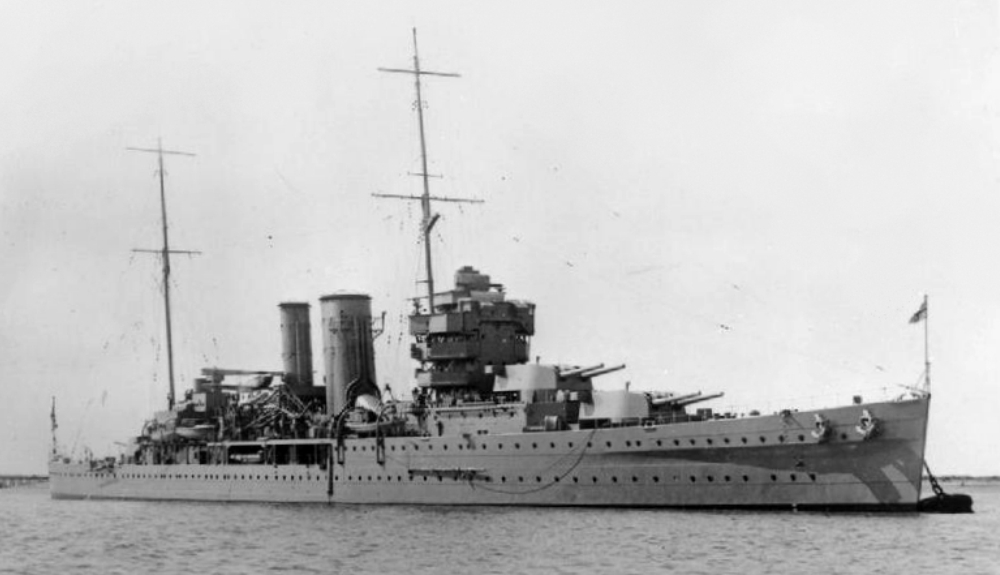
HMS York was a heavy cruiser (and half-sister of HMS Exeter) ...


... which was sunk in Suda Bay, Crete by Italian explosive motor boats operated by the elite Decima Flottiglia MAS. Like HMS Iron Duke, she was beached before the ship sank, ...


... and from the end of March 1941 until the evacuation of Crete in May of that year, her anti-aircraft guns were used to provide air defence for the Suda Bay area. Her armament was destroyed just before the final troops were evacuated from the island.

Wednesday, 18 July 2018

Badly damaged ... but still useful: HMS Zubian and HMS Eskimo

HMS Zubian was built from the undamaged bow section of HMS Zulu ...


... and the stern section of HMS Nubian.


Both the ships were members of the Tribal-class of destroyers (1905) and had been damaged in action in October and November 1916 respectively in the English Channel. The undamaged parts were taken to HM Dockyard, Chatham, where they were joined to create the new warship … even though there was a 3.5-inch difference in the width of the two parts!


HMS Eskimo was a member of the Tribal-class destroyers (1938) and was damaged during the Second Battle of Narvik in April 1940. She was hit by a torpedo fired by the German destroyer Z2 Georg Thiele, which blew her bows off.


Despite this near catastrophic damage, Eskimo was temporarily repaired by the fleet repair ship HMS Vindictive and then sent to her original builders (Vickers Armstrong in Newcastle) to be re-built. She re-entered service in 1942, and served in the Atlantic, Mediterranean, and the Far East.

Tuesday, 17 July 2018

Badly damaged ... but still useful

Warships are expensive to build and when they are damaged as a result of military action, navies are reluctant to scrap them. If possible, heavily damaged ships are repaired so that they can continue to perform useful service. Examples of this are:
  • HMS Zubian (Royal Navy)
  • HMS Eskimo (Royal Navy)
  • HMS Iron Duke (Royal Navy)
  • HMS York (Royal Navy)
  • HMS San Giorgio (Royal Italian Navy, then Royal Navy)
  • Konstruktor (Imperial Russian Navy, then Soviet Navy)
  • Marat (Imperial Russian Navy, then Soviet Navy)
  • Hibiki (Imperial Japanese Navy)
  • Amatsukaze (Imperial Japanese Navy)
All of the above were badly damaged (and in some cases actually sunk) but their hulls were repaired or re-used, and in some cases, they were re-commissioned as active warships. Over the next few days I hope to look at each of the above in more detail.

HMS Eskimo after she had been hit by a torpedo fired by the German destroyer Z2 Georg Thiele during the Second Battle of Narvik in April 1940. Almost all of her bow was blown off.

Sunday, 15 July 2018

Pushing some Napoleonic figures around on the tabletop

I had a spare hour yesterday, and spent it pushing some of the figures from Napoleonic collection around on the tabletop. I was experimenting with the use of two-base units, and was rather impressed by the way that they looked.

Infantry

Left to right: Infantry deployed into Line, Column, and Square.
Cavalry

Left to right: Cavalry deployed into Line and Column.
Artillery

Left to right: Artillery unlimbered and ready to fire and  limbered and ready to move. (N.B. The cannons have yet to be fixed to bases.)
This is all part of the process of developing my PORTABLE NAPOLEONIC WARGAME. As yet I haven't begun to do more that try a few ideas out, but things seem to be coming together.

Saturday, 14 July 2018

My next writing projects

I have been thinking about my next two writing projects. The first is a book about the Masters of the Hertfordshire Masters' Lodge No.4090 who served during the First World War. The Lodge was formed in 1920, and many of the members who became Worshipful Masters of the Lodge had distinguished war records that have yet to be recorded. It is my intention to complete the book in time for the Lodge's November meeting, which will be very close to the centenary of the Armistice that brought an end to the fighting.


Unless I have a major change of mind in the interim, the second book will be my PORTABLE NAPOLEONIC WARGAME book. I have begun jotting down a few ideas and have been looking at Paddy Griffith's NAPOLEONIC WARGAMING FOR FUN for inspiration with regard to what the book should cover.


At present I want the book to cover:
  • A simple divisional-level set of wargame rules where one base = one infantry battalion/cavalry regiment/artillery battery and that are a Napoleonic version of my original PORTABLE WARGAME RULES
  • A more complex set of divisional/corps-level rules where each unit has two rather than one base of figures, and where each infantry and cavalry unit represent a brigade/regiment and each artillery unit represents several batteries
  • A more abstract set of corps/army-level rules that might be adaptable for use in a kriegsspiel.
It is my intention that each of the above will share what is termed a common ‘game engine’ (i.e. the games mechanisms will be very similar in each game) and will used the same figures.

Paddy Griffith's NAPOLEONIC WARGAMING FOR FUN ...


... is currently published and sold by the 'History of Wargaming' Project (ISBN 978 1 4452 0299 0).