Pages

Friday, 15 October 2010

Memoir of Battle at Sea (MOB@S): Move then fire or fire then move?

After I wrote my earlier blog entry about my draft version of MEMOIR OF BATTLE AT SEA, I did some thinking about the game sequence. In the version I wrote earlier today, ships moved and then fired ... but one of the things that I liked about Joseph Morschauser's 'Frontier' wargames rules was the fact that artillery fired before units moved.

As a result, I have redrafted the rules so that ships fire and then move, and this is the version that I will hopefully play-test sometime this weekend.

MEMOIR OF BATTLE AT SEA

At the beginning of each battle both sides throw a D6 die. The side with the highest score moves first each turn.

During each turn both sides fire and then move their ships. Gunfire is deemed to be simultaneous, and a ship that has been hit and sunk may fire its guns that turn – as it sinks – if a suitable target is in range.

Ship Data
Firing Dice
The six faces of the D6 firing dice are marked as follows:
  • 1 x Major hit (worth two points)
  • 2 x Minor hit (worth one point)
  • 3 x Miss
Firing
If the target ship is not ahead or astern of the firing ship (i.e. it is in a hex that is not wholly in a hex that is within a sixty degree arc either side of the hex ahead or astern of the firing ship), the firing ship may ‘fire’ with full effect. The number of dice thrown is reduced by one for every hex the target ship is distant from the firing ship.
For example, a modern pre-dreadnought firing at a target ship that is abeam of it ‘fires’ by throwing eight dice. The number of dice thrown depends upon the range, and is counted down as follows: 8-7-6-5-4-3-2-1. Therefore if a target is at point-blank range (i.e. one hex) she 'fires' (or throws) eight dice, but if it is five hexes away, the pre-dreadnought ‘fires’ four dice.
If the target ship is ahead or astern of the firing ship (i.e. it is in a hex that is wholly in a hex that is within a sixty degree arc either side of the hex ahead or astern of the firing ship), the firing ship may ‘fire’ with half effect (i.e. it only throws half the number of dice it may normally throw). The number of dice thrown is reduced by one for every two hexes the target ship is distant from the firing ship.
For example, a modern pre-dreadnought firing at a target ship that is ahead of it ‘fires’ by throwing four dice. The number of dice thrown depends upon the range, and is counted down as follows: 4-4-3-3-2-2-1-1. Therefore if a target is at point-blank range (i.e. one hex) she 'fires' (or throws) four dice, but if it is five hexes away, the pre-dreadnought ‘fires’ two dice.
Sinking
All hits are cumulative, and when a ship's point’s value is reached, it sinks.

Movement
Movement is measured in hexes. Ships may turn sixty degrees after moving forward one hex, the turn 'costing' one hex of movement.
For example, a destroyer has a movement rate of five hexes. It can move forward one hex, turn sixty degrees (= one hex of movement), move forward another one hex, turn sixty degrees again (= one more hex of movement), and move forward a third hex.

Memoir of Battle at Sea (MOB@S)

Over lunch today I managed to put some ideas for my version of MEMOIR OF BATTLE AT SEA (MOB@S for short) down on paper. They are as follows:

MEMOIR OF BATTLE AT SEA

At the beginning of each battle both sides throw a D6 die. The side with the highest score moves first each turn.

During each turn both sides move all their ships and then both sides fire. Gunfire is deemed to be simultaneous, and a ship that has been hit and sunk may fire its guns that turn as it sinks if a suitable target is in range.

Movement is measured in hexes. Ships may turn sixty degrees after moving forward one hex, the turn 'costing' one hex of movement.
For example, a destroyer has a movement rate of five hexes. It can move forward one hex, turn sixty degrees (= one hex of movement), move forward another one hex, turn sixty degrees again (= one more hex of movement), and move forward a third hex.
The six faces of the firing dice are marked as follows:
  • 1 x Major hit (worth two points)
  • 2 x Minor hit (worth one point)
  • 3 x Miss
If the target ship is not ahead or astern of the firing ship (i.e. it is in a hex that is not wholly in a hex that is within a sixty degree arc either side of the hex ahead or astern of the firing ship), the firing ship may ‘fire’ with full effect. The number of dice thrown is reduced by one for every hex the target ship is distant from the firing ship.
For example, a modern pre-dreadnought firing at a target ship that is abeam of it ‘fires’ by throwing eight dice. The number of dice thrown depends upon the range, and is counted down as follows: 8-7-6-5-4-3-2-1. Therefore if a target is at point-blank range (i.e. one hex) she 'fires' (or throws) eight dice, but if it is five hexes away, the pre-dreadnought ‘fires’ four dice.
If the target ship is ahead or astern of the firing ship (i.e. it is in a hex that is wholly in a hex that is within a sixty degree arc either side of the hex ahead or astern of the firing ship), the firing ship may ‘fire’ with half effect (i.e. it only throws half the number of dice it may normally throw). The number of dice thrown is reduced by one for every two hexes the target ship is distant from the firing ship.
For example, a modern pre-dreadnought firing at a target ship that is ahead of it ‘fires’ by throwing four dice. The number of dice thrown depends upon the range, and is counted down as follows: 4-4-3-3-2-2-1-1. Therefore if a target is at point-blank range (i.e. one hex) she 'fires' (or throws) four dice, but if it is five hexes away, the pre-dreadnought ‘fires’ two dice.
All hits are cumulative, and when a ship's point’s value is reached, it sinks.

Thursday, 14 October 2010

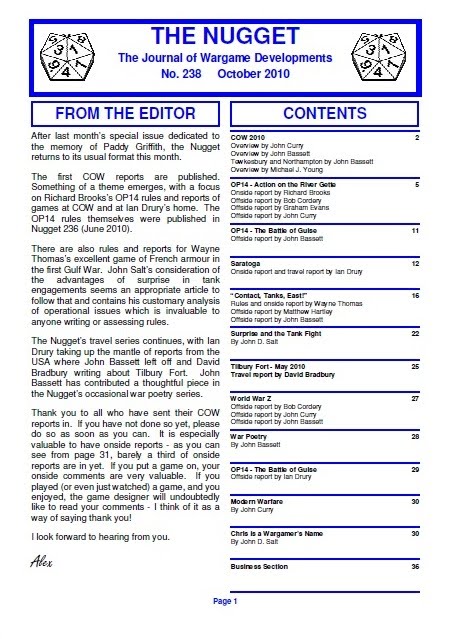
Nugget 238

I have collected the latest issue of THE NUGGET from the printers, and hope to post it either tomorrow or Saturday morning. It should be with full members of Wargame Developments by early next week.


I have also uploaded the PDF versions of THE NUGGET and THE NUGGET COLOUR SUPPLEMENT to the Wargame Developments website as well, and these will be available for full members and e-members of Wargame Developments to download and read as soon as they receive the new password. This will be posted out to full and e-members at the same time as THE NUGGET.

Running to stand still ... but gradually getting somewhere!

The last few days seem to have been very long ones. Besides doing our normal teaching, I and the rest of the staff have had to be at work after hours so that the school can remain open for Open Evening. These are for potential students and their families to look around the building and to ask questions about what is taught.

As a result I have not got home much before 8.30pm, having left for work at 7.30am ... and I live fairly close to where I work. Other staff live much further away than I do, and it is little wonder that everyone is now feeling very tired. We are looking forward to the half-term holiday in less than two-weeks time. It cannot come soon enough.

It seems like an age since I did any serious thinking about wargaming ... but the reality is that it is probably just two days. In that time Ogrefencer has sent me a draft copy of his version of MEMOIR OF BATTLE AT SEA naval wargames rules. Now that I have had time to have a proper look at them, they look very interesting indeed, and although he has approached the solution from a slightly different direction than I have done, I can see that our respective versions of the rules are likely to cross-fertilise each other.

He hopes to mount a play-test at some time over the weekend, and if I get a chance I hope to follow suit.

Tuesday, 12 October 2010

Nugget 238

The latest issue of THE NUGGET (N238) was sent to me by the editor at the weekend, and I took it to the printers yesterday. I hope to be able to post it out later this week. I will also be sending out the password needed to open the PDF versions of THE NUGGET to full and e-members of Wargame Developments at the same time.

I will make the PDF versions of THE NUGGET available for full and e-members to download from the Wargame Developments website as soon as I can after the password has been sent out.

Real Life and Wargaming

On Sunday I wrote a report about the wargame I and a group of friends had played. The main thrust of the scenario concerned the armed rescue of someone who had been kidnapped. At the time I wrote the blog entry I was unaware of the death of British aid worker Linda Norgrove. She had been killed during an attempt to rescue her from the people who were holding her after she had been kidnapped.

When I was made aware of what had happened to Ms Norgrove, my first thoughts were those of sympathy for her family. She had been undertaking aid work of immense value to the people of the Dewagal valley in the Kunar province of Afghanistan when she was kidnapped in September, and her seizure seems to have served no useful purpose except in the minds of the people who had taken her.

My second thoughts concerned my blog entry. Should I remove it because the scenario and outcome had similarities to events that had so recently taken place in Afghanistan? Or should I leave it in situ?

After giving it some considerable thought, I decided that I would take the latter course. My reasoning was as follows:
  • When the game was set up, none of the participants were aware of events in Afghanistan. Had we been, we may have chosen to fight a different scenario.
  • There was no intent upon our part to be disrespectful to the memory of Ms Norgrove. In fact, as I stated earlier, I wrote my blog entry before being aware of what had happened.
  • The game had been played. We could not 'un-play' it nor could we 'un-enjoy' our day of wargaming. By removing the blog entry so as to make it appear that the game never happened would be hypocritical.
Unlike any other hobbies or pastimes, wargaming is about one of the darker aspects of human existence ... war. Wargamers ... that is me and you ... 'play' at war. To some people that makes us appear very odd, if not sinister.

Over the years wargamers have tried to rationalise what they do, but when it comes down to it, we do it for a variety of reasons. Some wargame because of a deep interest in military history, some because they want to understand more about strategy and tactics, some because they like to paint model figures and vehicles, some because it allows them to escape for the humdrum events of normal life, and some because they are gamers, and this is the sort of game they enjoy. Every wargamer I have met has had a different reason for taking up and enjoying the hobby.

The death of Linda Norgrove and the coincidental staging of the "Les Affreux" wargame remind us that wargames are about real life ... and death. It is something that we need to be reminded of occasionally, if only to give us a sense of proportion.

I hope that I write on behalf of us all within the wargaming community when I pass on our deepest sympathy to the family of Linda Norgrove.

Her death diminishes us all.

Sunday, 10 October 2010

"Les Affreux"

Today I have been to North Africa ... well, the wargame I played was set there, so I suppose that is where I have been in my imagination!

Over the past few years, a group of us has tried to have a wargame every month or so. Work and other things have conspired to make this difficult sometimes, but today was one of the occasions when everything seemed to come together, and we managed to stage a wargame ... and what an interesting one it was!

The game was set during the late 1960s, when mercenaries were both a dirty word and a (deniable) instrument of some countries' international policies. The scenario concerned the attempt by a group of mainly French mercenaries (almost all ex-Foreign Legion Paratroops) to release a kidnapped and imprisoned African leader. The leader had been taken by his kidnappers to a 'friendly' North African country, where he was 'housed' in a well-protected barrack block in a small town some twenty miles from the coast.

I was one of the French ex-Foreign Legion Paratroops, and it was a pleasure to meet so many of my old comrades in as bar in Marseilles, especially my old boss Colonel D*****d. Over a glass or three of 'pinard', we reminisced about our time in Indo-China, Algeria, and the Congo, and when the Colonel announced that there was a 'job' in the offing, we all jumped at the chance to serve together again, especially as it involved the release of our old political paymaster.

After scouring Europe and the Near East for weapons and equipment (well, Lisbon, Split, and Beirut), we had the men and equipment necessary for the task ahead. But before the mission could be mounted, we needed up-to-date information about the target, and the leader of the British mercenaries (a Greek Cypriot) volunteered for the task.

His report indicated that the town had an airstrip which was used by the country's Air Force, and that at least four MIG-17s were based there. The airstrip was also protected by two 57mm anti-aircraft guns. He saw at least two platoons of troops guarding the barracks where the African leader was 'housed', but saw no other defenders. It was on this intelligence that we based our plan of attack.

The target, looking north west from the south east corner of the town. The barracks block is the brown building with the two watchtowers, gatehouse, and barbed wire.
Another view of the town.
The airstrip, with the MIG-17s parked in dispersal areas along the edge of the runway.
A view of the airstrip taken from the window of a light aircraft.
Having assembled in Corsica, our party sailed to the North African coast in a fishing vessel hired from a group of smugglers. During the early evening we went ashore unseen and embarked in a lorry and van that were also hired from the smugglers. We then drove the twenty miles to the target, arriving just after dusk. One party was left to set up an ambush position on the edge of town, supported by the group's mortar, whilst the rest of the French mercenaries, assisted by a group of Belgians, moved towards the barracks. The British mercenaries went separately along the edge of the airstrip to put the 57mm anti-aircraft guns out of action.

My task was to assist in the main assault on the barrack block by guarding the perimeter whilst the assault group went in, and then to assist in the exfiltration of the rescued African leader.

My team of men. All expert fighters and men I could rely on ... which was probably just as well in view of how things turned out!
Everything went according to plan until the main assault group reached the barbed wire around the barracks ... and then all hell let lose!

The assault team managed to get through the wire, and blew a hole in the wall of the barracks. They then threw in stun grenades, which they followed up with a barrage of automatic fire. In response, the defenders fought back with an unexpected level of ferocity, and several of the mercenaries were wounded.

The assault on the barracks.
My own group had pressed on to cover the southern flank of the assault ... and ran into murderous fire from the airstrip's control tower. Two of my men were lightly wounded, but we eventually managed to bypass the control tower and press on towards the 57mm anti-aircraft gun at the southern end of the runway. This had now become our objective as the British mercenary contingent had its hands full on the other side of the runway.

We managed to get close to the 57mm anti-aircraft gun in a 'liberated' car, but its capture resulted in three of my group suffering more serious wounds, and we were pinned down by fire from a nearby building.

Both 57mm anti-aircraft guns are now under the control of the mercenaries.
Using the captured 57mm anti-aircraft gun we managed to winkle out the enemy troops in the nearby building and the control tower, but whilst this was going on, things had taken a turn for the worse at the north end of the town.

Unknown to us, the assault on the barracks had not gone well, and the leader of the Belgian mercenaries managed to kill the African leader during the firefight in the barracks. In addition, reinforcements, that included light armoured vehicles, had arrived and had been ambushed as they tried to enter the town. The fighting was very intense, and the enemy suffered large numbers of casualties and lost several vehicles. In the end, however, numbers began to prevail, and the ambush party and the mortar team were forced southwards towards the remnants of the assault group.

At this point a light aircraft that had been hired to exfiltrate the African leader arrived, and his body and those of the mercenaries wounded in the fighting in the north were loaded aboard. There was a very unpleasant moment when the leader of the Belgian mercenaries was 'escorted' from the plane and forced to remain behind to continue the fight.

The light aircraft has taxied to a halt and the dead and wounded have been loaded aboard.
My troops were too far away to give any assistance to our colleagues fighting at the northern end of the runway.
During the fighting in the northern part of the town, the leader of the Belgian mercenaries was killed ... which saved me having to undertake the task later.

The enemy press forward warily, as they know that the mercenaries will fight to the last round and the last man ... unless, of course, they can get away!
Bang on time, the C47 that was supposed to exfiltrate us landed on the airstrip and taxied up to the north end, where the remnants of the assault group, the ambush team, and the mortar crews boarded unmolested by the enemy troops. My group attempted to reach the plane before it took off, but loading our wounded onto the truck took longer than expected, and it became apparent that we were not going to make it. We therefore drove south, and after a considerable journey managed to get away from our pursuers. The British mercenaries were in a similar position, and they went westwards in their truck and managed to make it back to the coast, where they sailed back to Corsica in the smuggler's fishing boat.

Was the mission a success? We did not manage to exfiltrate the African leader alive ... but we had his body, and it would serve as a rallying point for his people in the future. We also dealt a stinging blow on the enemy, and killed and wounded over one hundred of his troops for minimal losses. And finally, the traitorous Belgian was dead ... and his death was no loss to anyone except the CIA!

All-in-all it was a rattling good game, and everyone enjoyed themselves tremendously. I look forward to further games of this ilk ... now where did I put my beret, flack jacket, and FN rifle?

Memoir of Battle at Sea: Firing ahead and astern

After I had written yesterday's blog entry, it struck me that I had not made allowance in the firing rules for the restrictions placed on a warship's ability to fire ahead and astern.

I have therefore come up with the following amendment to the firing rules:

If the target ship is ahead or astern of the firing ship (i.e. it is in a hex that is wholly in a hex that is within a sixty degree arc either side of the hex ahead or astern of the firing ship), the firing ship may ‘fire’ with half effect (i.e. it only throws half the number of dice it may normally throw). The number of dice thrown is reduced by one for every two hexes the target ship is distant from the firing ship. For example, a modern pre-dreadnought firing at a target ship that is ahead of it ‘fires’ by throwing four dice. The number of dice thrown depends upon the range, and is counted down as follows: 4-4-3-3-2-2-1-1. Therefore if a target is at point-blank range (i.e. one hex) she 'fires' (or throws) four dice, but if it is five hexes away, the pre-dreadnought ‘fires’ two dice.

I hope that this makes the revised mechanism clear.

Saturday, 9 October 2010

Memoir of Battle ... at sea

I have recently been exchanging emails with Ogrefencer about the possibility of using some of the mechanisms from BATTLE CRY and MEMOIR '44 in a naval wargame. After giving it some thought, I have decided to put my ideas down on paper.

The main mechanism I have 'borrowed' from BATTLE CRY/MEMOIR '44 is the combat system. Each ship type's weapons are allocated a range, which is also the maximum number of dice that ship type can 'fire' (or throw). For example, a modern pre-dreadnought's guns can fire eight hexes, and at point-blank range (i.e. one hex) she 'fires' (or throws) eight dice. For each hex the 'target' ship is further away from the 'firing' ship, the number of dice thrown is reduced by one.

The six faces of the dice are marked as follows:
  • 1 x Major hit (worth two points)
  • 2 x Minor hit (worth one point)
  • 3 x Miss
All hits are cumulative, and when a ship's points value is reached, it sinks.

Movement is measured in hexes. Ships may turn sixty degrees after moving forward one hex, the turn 'costing' one hex of movement. For example, a destroyer has a movement rate of five hexes. It can move forward one hex, turn sixty degrees (= one hex of movement), move forward another one hex, turn sixty degrees again (= one more hex of movement), and move forward a third hex.

These rules are very much a work in progress, and I expect that they will undergo several changes as they develop.

P.S. The working title for the rules is MEMOIR OF BATTLE AT SEA (which is shortened to MOBAS ... or should that be MOB@C?)

Friday, 8 October 2010

Working title

When I get to a certain stage in the design and development of a set of wargames rules, I like to have a working title in mind.

After some thought, the working title I have come up with for my modified version of BATTLE CRY is MEMOIR OF BATTLE (MOB). The title was chosen to reflect that fact that the rules are derived from both BATTLE CRY and MEMOIR '44, and that they are intended to be used to fight the battles that arise during an as-yet-to-be-decided-upon campaign.