Pages

Saturday, 17 March 2012

What next?

Having finished both my 'cartoon' battleships and the German-style torpedo boat, I am pondering on what to do next ... and I think that I have the answer.

I started down the road that led to the building of these three model ships because I thought that a model battleship, built in the style of the 'Monopoly' playing piece, would be ideal to use on the tabletop alongside my 15mm-scale figures. Building these three ships has given me both the skills and the confidence to return to that original objective, albeit that the model ships I intend to produce are going to be slightly less generic than the 'Monopoly'-inspired battleship model I have already built.


I have already begun to thumb through my (reprint) copy of JANE'S ALL THE WORLD'S FIGHTING SHIPS (1898) for some inspiration ...


... and found that there is plenty there to interest me.

Turning ideas into reality

I sat down to turn the hull of the wooden RMS Titanic kit I bought in Thursday into a World War I German-style torpedo boat at about 11.00am ... and by 4.00pm I had finished building my model!

Most of the time was spent waiting for the glue to dry on the various components, painting my recently completed 'cartoon' battleship, going shopping with my wife, having lunch, and watching a couple of TV programmes. The actual time it took to make the parts was probably less than an hour, with another fifteen or so minutes spent on the final assembly process. The results look like this:


The model still needs to have its surface sealed with a couple of coats of PVA before it can be painted ... but it does show that it does not take very long to turn a shop-bought, ready-cut hull into a model warship that will past muster on the tabletop.

Looking for ideas

I am about to begin work on turning the pine hull from my recently bought wooden kit of RMS Titanic into some sort of small warship that can operate alongside my 'cartoon' battleships. Before I started I decided to spend some time looking at a variety of different possible real warships that I could base my prototype on ... and came upon the following photograph of a German World War I torpedo boat.


Many of these ships survived the war and continued to serve in the much-reduced German Navy, where they were often modified to perform a variety of minor but important duties (e.g. training, convoy escort). The basic outline of the ship is so simple that it should not be too difficult to build something that resembles her in a fairly short period of time.

Battleships by post

The postal delivery in my area of London has been somewhat erratic of late, and it was therefore something of a surprise when the doorbell went at 7.30am ... and the postman was there with a parcel for me!

I bought three models of 'Gneisenau' from an eBay retailer on Wednesday evening ... and they were delivered this morning, which I think is excellent service from both the seller and the Post Office.

The question that is no doubt forming in your mind is ... why three 'Gneisenau's?


The answer is quite simple:
  • I can build one model straight from the box as 'Gneisenau
  • I can modify one model so that it represents the 'Scharnhorst'
  • I can build one model as 'Gneisenau' but rearmed with 15"/38cm guns (this project was cancelled in 1943 whilst work was underway)
In the latter case the spare gun turrets will probably be used to arm some scratch-built 'pocket battleships'.

More models to add to my growing pile of as-yet-to-be-built 1:1200th-scale model ships!

Friday, 16 March 2012

A busy day ... but I still had time for a bit of retail therapy!

This morning my wife and I went over to see my father in his care home. Unfortunately he was not having a good day, and although he recognised us, it took him some time to remember our names ... and that was only after considerable prompting.

The problem with his dementia is that it is not a gradual decline; it seems to stabilise for a while and then take a significant nose-dive, usually as a result of a chest or urinary infection. Sometimes there is a degree of 'recovery' after the infection has been dealt with, but each time his level of recent memory has been reduced. The prognosis is that this will continue.

We both felt rather 'down' after our visit, and my wife decided that a spot of lunch, followed by some retail therapy, might be in order to lift our spirits. She was right. Before having a very nice lunch of fish and chips in a local fish restaurant we spent some time wandering around the local shopping centre ... and for once I actually bought some things that I had been hoping to buy but which I expected would be out of stock.

The first thing that I bought was a Revell 1:1200th-scale model of the USS Yorktown.


This has been added to the growing pile of 1:1200th-scale model ships that I hope to build in the near future.

The other thing that I bought was a small modeller's hand drill.


This will hopefully enable me to drill holes in basswood a bit quicker that I can at the moment using my pin vices ... and with a bit of luck it will get some use over the next few days.

Thursday, 15 March 2012

Possibilities?

I paid a visit to the local branch of Hobbycraft today to buy some more basswood and paint ... and also came away with something that may have possibilities. It is a wooden kit of the RMS Titanic.


The hull of the model is made of pine and is approximately 7.5"/19cm long and 1"/2.5cm wide. Whilst it is not perfect – and it is certainly in need of some sanding – the hull could possibly be used as the basis of a small wooden warship that I can use alongside my 'cartoon' battleships. I may well make this my next project, and if it is successful it might pave the way for me to speed up the process of building a 'fleet' of ships that I can use on the tabletop ... or floor!

Wednesday, 14 March 2012

The Great Pacific War

Today's post brought a new book to add to my collection ... THE GREAT PACIFIC WAR by Hector C Bywater. This edition is a reprint (Original published 1925; this edition published 1991 by St Martin's Press [ISBN 0 312 06364 4]) of Bywater's imaginary history of a war fought across the Pacific Ocean by Japan and the United States, but unlike most imaginary history this was not a fanciful volume of fiction; it was based upon a very detailed knowledge of the navies of both nations and an understanding of their strategic and tactical philosophies.


I have wanted a copy of this book ever since I read William H Honan's biography of Bywater (BYWATER: THE MAN WHO INVENTED THE PACIFIC WAR) when it was published in 1990 by Macdonald (ISBN 0 356 19135 4). I was so intrigued by the notion that someone had already identified in 1925 the basic strategy the Japanese would adopt in the 1940s that I wanted to read his account of what he thought might happen. I was also intrigued by the man himself.

Hector C Bywater was born in London in 1884. His family moved to the United States when he was 17, and by the age of 19 he was working as a part-time writer of navy-related news articles for the 'New York Herald' newspaper. The newspaper then sent him back to Europe to act as one of their overseas correspondents. It was at about this time that he began to spy for the British Secret Service. He maintained his cover story that he was an American journalist so effectively that he was able to remain in Germany until he returned to the United States in 1915. On his return to the US he helped to investigate suspicious activity in New York's docks and to avert a German bombing campaign in New York.

After the Great War Bywater became a full-time journalist specialising in writing articles about the World’s navies. His articles covered such topics as the Washington Treaty negotiations – which he attended – and the growing might of the Japanese Navy. In 1921 he wrote his first book about the possibility of a clash between Japan and the United States entitled book SEA-POWER IN THE PACIFIC: A STUDY OF THE AMERICAN-JAPANESE NAVAL PROBLEM. He followed this in 1925 with his book THE GREAT PACIFIC WAR.

For a time Bywater lived near Keston Ponds near Beckenham, Kent, and it is recorded that he actually fought wargames on the ponds using model warships that fired corks at each other. His biographer actually states in his book that these wargames were part of the way in which Bywater developed his ideas about how the forthcoming Great Pacific War was going to be fought.

Hector Bywater died in August 1940 of as a result of complications arising from acute alcoholism, although some conspiracy theorists insist that he was actually poisoned by agents working for the Japanese.

Horses ... lots of 'em!

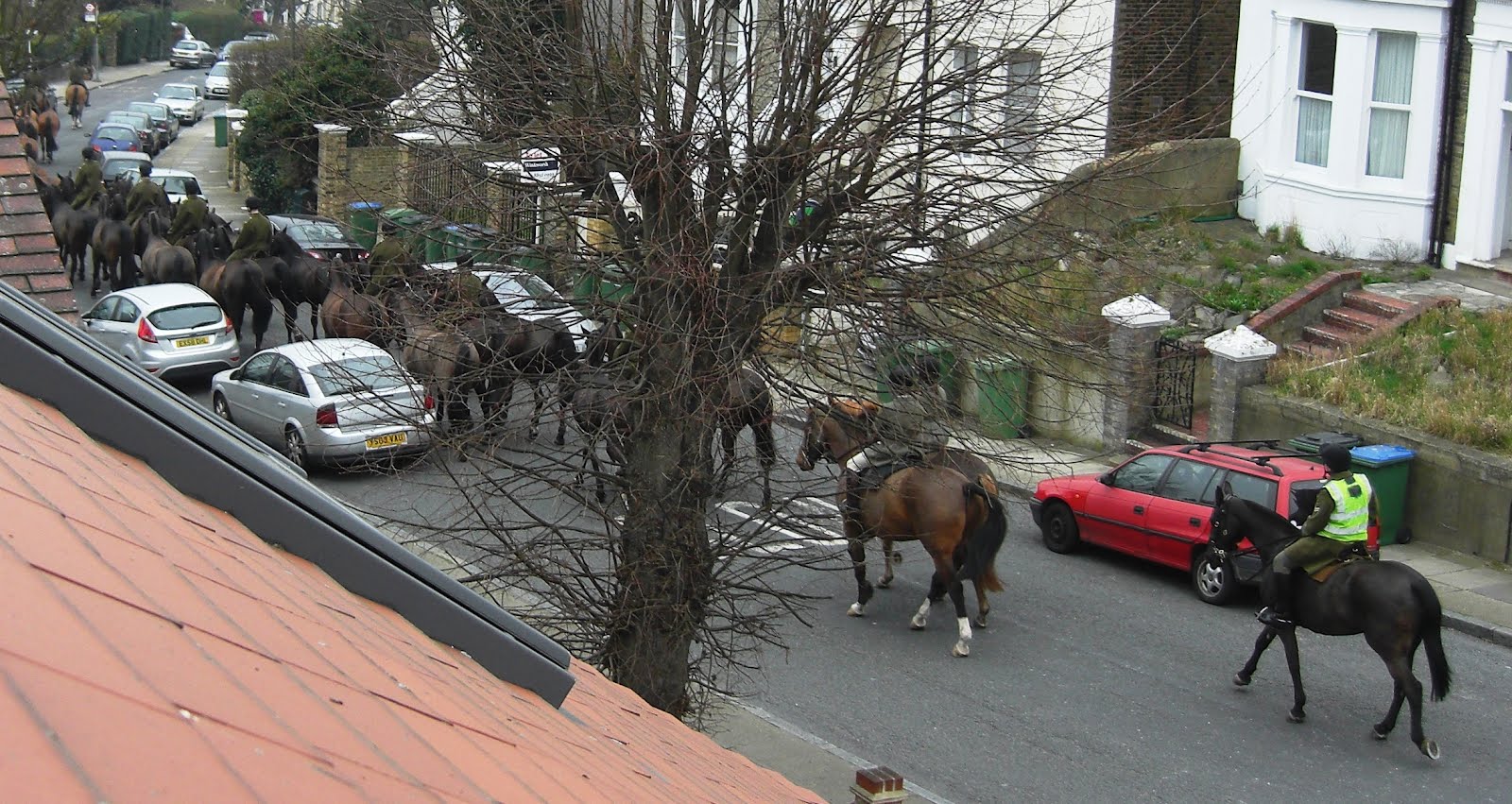
At the beginning of the year The King's Troop, Royal Horse Artillery moved from their former base in St John's Wood to Woolwich. Since then I have seen them exercising their horses in and around Woolwich, Blackheath, Greenwich, and Shooters Hill, and once or twice they have actually brought them along the road where I live. Today was once such day ... and for once I had my cameras to hand and was able to take the following photographs from my office window (it is in the loft conversion of my house ... hence the inclusion of red roofing tiles in the photographs).

The middle of the column. Note that the riders who act as drivers each have three horses in hand.
The rear of the column. The front of the column can just be seen in the top left-hand part of the photograph.
It is a magnificent sight to see such a large number of well-groomed and beautiful animals ... and long may they remain a regular sight around where I live.

Finished ... all bar the painting

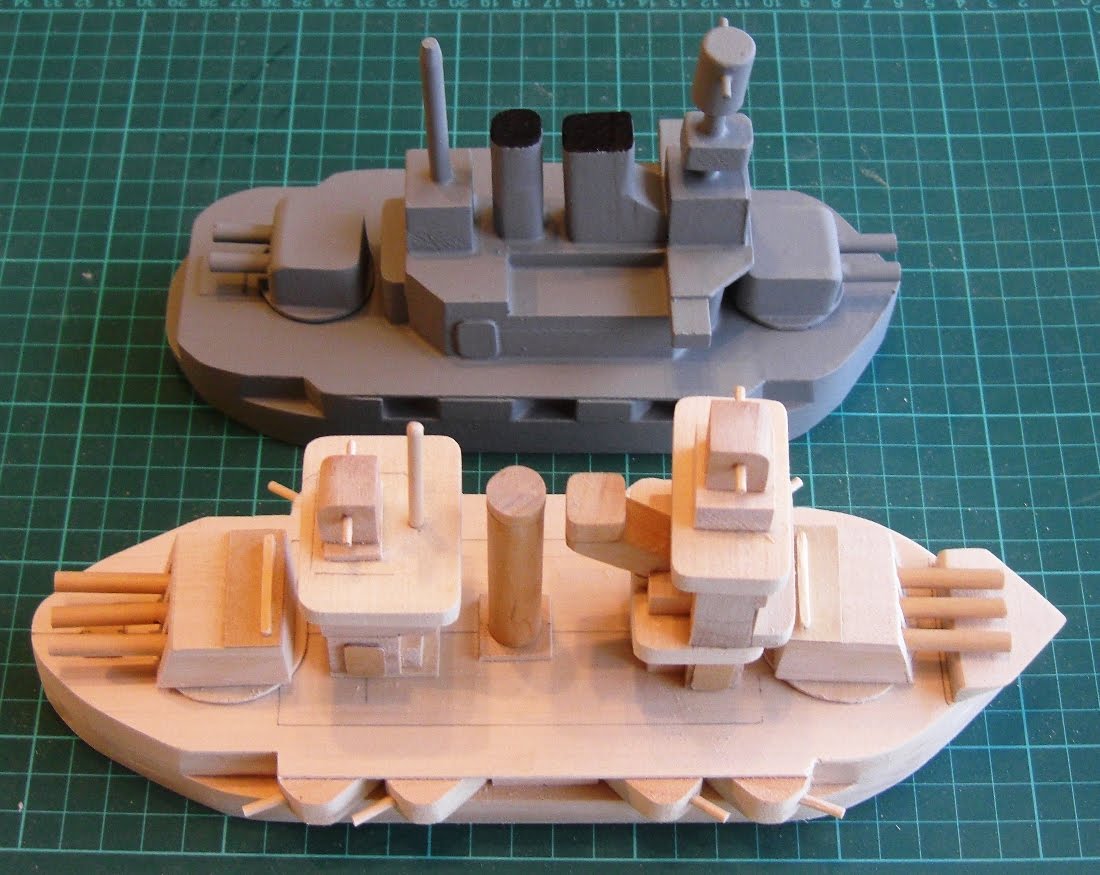
After my wife went off to work this morning I decided that the time had come to put the finishing touches to my latest 'cartoon' model battleship. I finished assembling the main part of the model, and finished it off by adding some hatches, rangefinders atop the main turrets, and fixing the gun barrels of the secondary into their casemates. All I have to do now is to paint two coats of PVA over the model to seal the wood, and then I can begin painting it.


To give some idea how big this model is I have placed it alongside my existing 'cartoon' model of the German pre-dreadnought, Schleswig-Holstein.

Tuesday, 13 March 2012

I go driving in my car ...

I should have almost finished assembling the superstructure of my latest model battleship this morning ... but I have only just got back from driving my wife to Croydon. She is appearing as a witness at an industrial tribunal and had to be there by 10.00am. It is just over 12.5 miles from our house to the location of the offices of the Employment Tribunal Service, and to make sure that we arrived in plenty of time we set off at 8.30am.

We got there at 9.50am!

The drive back actually took longer, as one of the roads that I had used to get to Croydon was closed when I tried to drive back along it, and the diversion that had been put in place seemed to take me miles out of my way ... and into several minor traffic jams.

I have to go back in a couple of hours to pick my wife up when the hearing ends. Hopefully she will not need to go back again tomorrow ...

(For all those of you who are wondering why I chose to drive rather than expecting my wife to travel by public transport, the answer is very simple. Despite the delays and hold-ups it was still quicker than the journey would have taken by public transport, which would have involved two buses and three separate railway lines to get there ... and the same to get back. Transport for London predicted that it would take a minimum of two hours ... assuming that none of the buses or trains were late.)