Pages

Saturday, 7 May 2016

On sale in the National Archives bookshop

Recently Sue and I paid one of our periodic visits to the National Archives, Kew, to do some genealogical research. (We are still charting the career of William Richardson, one of her forebears, who started as a Gunner in the Royal Artillery in the last eighteenth century and – after surviving service for many years as a member of the garrison of Jamaica – eventually reached the rank of Sergeant Major.)

Whilst we were there we paid a visit to the onsite bookshop, where I bought two books that were in the sale. They were HMS HERMES: 1923 & 1959 ...


... and THE COLOSSUS-CLASS AIRCRAFT CARRIERS: 1944-1972.


Both books were written by Neil McCart and published by Fan Publications in 2001 and 2002 respectively.

HMS HERMES: 1923 & 1959 (ISBN 1 901225 05 4) begins by telling the story of the first aircraft carrier to be named Hermes from her building in the aftermath of the Great War until her sinking by Japanese aircraft in the Indian Ocean in April 1942. It then charts the origins and service of the second aircraft carrier of that name through her numerous commissions, her rebuilding and re-tasking from her role as a conventional aircraft carrier into that of a commando carrier and then again into a VSTOL carrier, and her eventual sale to the Indian Navy, with whom she still serves as INS Viraat ... albeit until her replacement by a newer aircraft carrier.

THE COLOSSUS-CLASS AIRCRAFT CARRIERS: 1944-1972 (ISBN 1 901225 06 2) relates the history of eight of the ten ships of the class. (It does not cover HMS Pioneer or HMS Perseus, neither of which was ever commissioned as an aircraft carrier.) At some stage in their careers all of them were commissioned into the Royal Navy, and several of them were loaned, transferred, or sold to other countries, where they performed sterling service in navies that otherwise might not have been able to operate aircraft carriers:
  • Colossus: Became the French Navy's FNS Arromanches in 1946. She continued in service until 1974, and was scrapped in France in 1978.
  • Glory: Scrapped in Scotland in 1961.
  • Ocean: Scrapped in Scotland in 1962.
  • Venerable: Sold to the Royal Netherlands Navy in 1948, where she was renamed HNLMS Karel Doorman. In 1969 she was sold to Argentia, where she was renamed ARA Veinticinco de Mayo. She was scrapped in India in 1999.
  • Vengeance: Loaned to the Royal Australian Navy in 1952 as HMAS Vengeance. She was returned to the UK in 1955 and then sold to the Brazilian Navy in 1960, where she was renamed Minas Gerais. She was withdrawn from service in 2001 and scrapped in India in 2004.
  • Pioneer: Completed as a maintenance carrier. Scrapped in Scotland in 1954.
  • Warrior: Loaned to the Royal Canadian Navy in 1946 as HMCS Warrior. Returned to the UK in 1948, and sold to Argentina in 1958, where she became ARA Independencia. Scrapped in Argentina in 1971.
  • Theseus: Scrapped in Scotland in 1962.
  • Triumph: Rebuilt and reclassified as a repair ship in 1965. Scrapped in Spain in 1981.
  • Perseus: Completed as a maintenance carrier. Scrapped in Scotland in 1958.
Not a bad collective service record when one considers that their expected operational life when they were designed was three years!

Friday, 6 May 2016

Airfix Battles: The first play-test

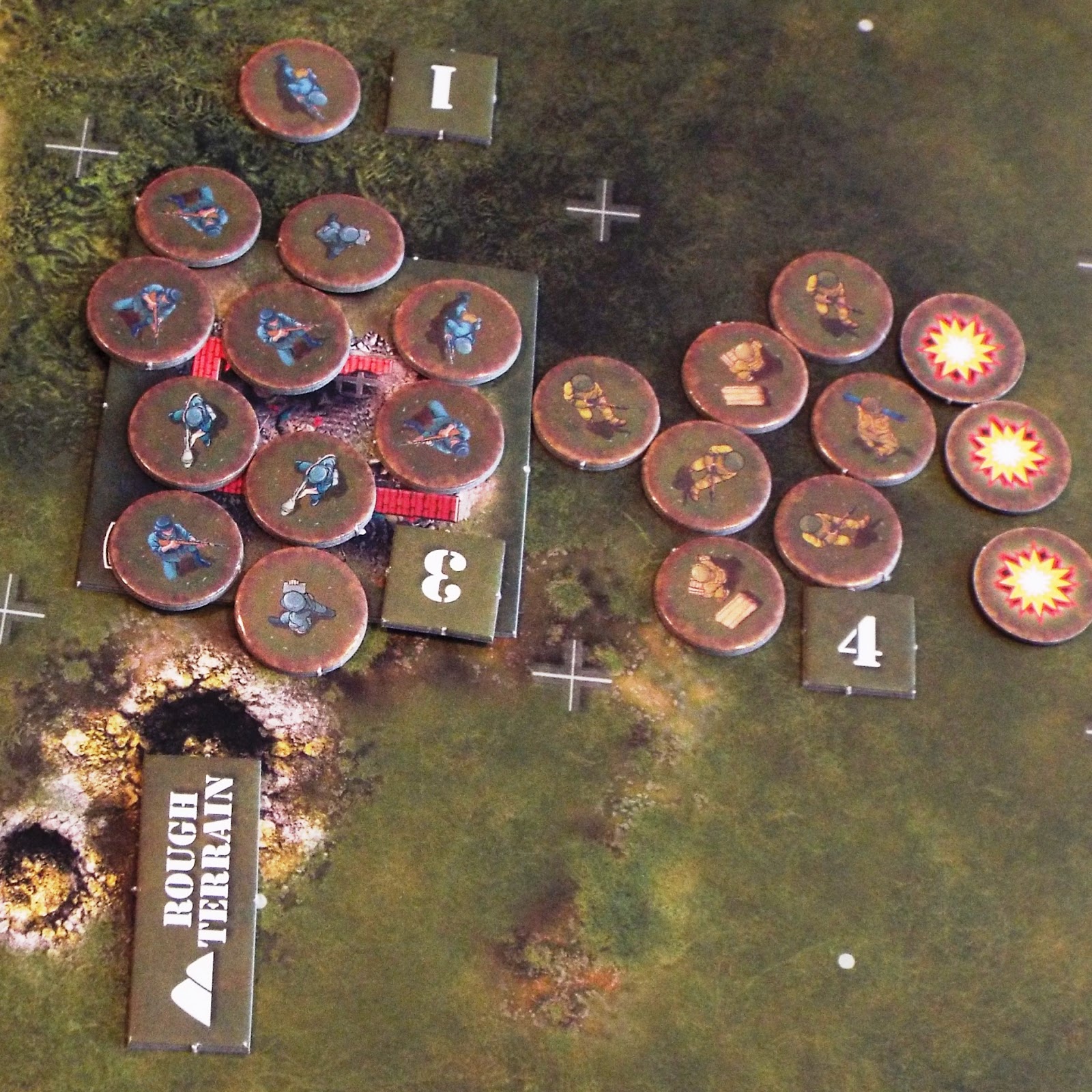
I had a couple of hours to spare so I thought that I would mount my first play-test of AIRFIX BATTLES. I chose to set up the first scenario (or 'mission') in the book.


Both sides comprised two squads of Infantry, some Veterans, and a Captain.


In order to get a better feel for how the game works, I used the solo play option for both sides, using D6 scores to determine which side moved first each turn. (After Turn 2 (see below) I also removed any exclusively Vehicle-related Command Cards from the pack that I used as I thought that including them might slow the game down.) I'm not sure if this was what the designers originally intended, but it enabled me to conduct the play-test as an interested observer, not as a participant.

Starting Positions
Each side deployed in their respective Deployment Zones.


Turn 1
Both sides drew a '2 Units may Fire then Move with +1' Command Card, with the Germans moving first.


The Americans then moved.


Turn 2
The Germans drew a '1 Unit may Move with +2 and then Fire once' Command Card and the Americans drew a '2 Vehicle Units may Move once each, and then Fire once each' Command Card.

As the Germans were the only side with a card that could be used, they chose to move their Veterans and to fire at one of the American Units ...


... with quite devastating results. (They caused 3 casualties and the American Unit had to take a Morale Check, which it failed. As a result it was now Pinned.)


Turn 3
The Americans drew a '1 Infantry Unit may Move 3 times its normal move' Command Card and the Germans drew a '1 Infantry Unit may Fire once then Move +2' Command Card.

The unpinned American Infantry Unit charged forward and assaulted the German Infantry Unit occupying a farm.


They were met by defensive fire, which depleted their numbers by 3.


Their assault went in, with the result that the German also lost 3 men.


The Germans then counter-assaulted, and inflicted another 2 casualties on the Americans.


Both sides then undertook a Morale Check ... with the result that the German Infantry Unit became Pinned but the Americans were not!

The German Veterans now fired at the already pinned American Infantry Unit ...


... and inflicted 3 more casualties on it.


The Veterans then withdrew to support their own pinned Infantry Unit.


The pinned American Unit took a further Morale Check ... which it failed. As a result, the Unit withdrew towards its side's Deployment Zone.

Turn 4
With things seemingly not going very well for the Americans, which side went first this turn was very important. The Germans threw the better D6 die score and went first

The Germans drew a '1 Unit may Fire with +1 on each Die Roll when rolling to hit' Command Card and the Americans drew a '1 Infantry Unit with Rifles may Move then Fire using the Rifles. Re-roll once for each miss when firing at a target within 2 squares' Command Card.

As the Germans had no Units that qualified to use their Command Card (the only Unit that might have been able to use it was Pinned), the Americans were able to use theirs. The American Infantry Unit that had previously assaulted the German Infantry Unit in the farm chose not to move and fired at them ...


... and inflicted a further 3 casualties.


The German Infantry Unit then failed its Morale Check and fell back, leaving the farm unoccupied.


Turn 5
The situation on the tabletop had now reached a stage where both sides were roughly equal. They had both had an Infantry Unit fall back, and both still had intact Veterans and Officers. The Americans had suffered a few more casualties than the Germans, but not sufficient to restrict their ability to achieve their objective.

The Germans drew a '1 Vehicle Unit may Move once, and then 1 Infantry Unit may Move once then Fire once' Command Card and the Americans drew a 'Fire with 1 Infantry Unit. Then 1 different Infantry Unit may Fire and then Move' Command Card.

As the Germans had no Vehicle Units, they moved their Veteran Unit so that it could fire at the remaining American Infantry Unit.


The effect was devastating, and the American Unit's sole survivor began to retreat towards his side's Deployment Zone.


At this point the Germans had achieved their objective and thus won the battle.

Comments
  1. During the set-up stage I did have a few problems trying to work out which figures were which as the images on the counters are quite small. I really wish that I had bought a box each of Airfix's WW2 German and WW2 US troops before mounting the play-test as I would have had no problems identifying which figures were armed with which weapons. (In fact, it doesn't really matter what is depicted on each counter as this is not important as far as resolving combat is concerned ... but for aesthetic reasons I think I prefer to be able to identify the weapons each figure is armed with.)
  2. I really like the Assault Rules! The fact that the defenders can lay down defensive fire before the Assault takes place at least gives them a chance to stopping it in its tracks. In addition, the ability of defending Units to counter-assault makes the outcome for both sides uncertain until the whole process is finished.
  3. Infantry casualty rates seem to be quite high ... but I suppose that they might have been lower in this play-test if I had used the available cover somewhat better and not mounted an assault on such a heavily garrisoned farm.
  4. It was fun to play, even though my method of playing solo might have left something to be desired. The play-test did enable me to use most of the main game mechanisms, which worked extremely well and were quite simple once they had been mastered.

This was my first play-test of the AIRFIX BATTLES rules, and I hope to mount further battles in the near future so that I can see how well they work when Armoured Vehicle and Artillery Units are involved as well.

Thursday, 5 May 2016

Ships of the Italian Navy seen in La Spezia

La Spezia is one the Italian Navy's main naval bases. The First Naval Group Command (Comando del Primo Gruppo Navale (COMGRUPNAV 1)) is based there, as is the Comando delle Forze di Contromisure Mine (MARICODRAG), Italy's Mine Countermeasures Command.

(Comando del Primo Gruppo Navale currently comprises the following ships:
  • Caio Duilio (Orizzonte-class Air-defence Destroyer)
  • Carlo Bergamini (Bergamini-class General-purpose Frigate)
  • Virginio Fasan (Bergamini-class Anti-submarine Frigate)
  • Carlo Margottini (Bergamini-class Anti-submarine Frigate)
  • Maestrale (Maestrale-class Anti-submarine Frigate)
  • Grecale (Maestrale-class Anti-submarine Frigate)
  • Libeccio (Maestrale-class Anti-submarine Frigate)
  • Scirocco (Maestrale-class Anti-submarine Frigate)
  • Bersagliere (Lupo-class Light Patrol Frigate)
  • Vesuvio (Stromboli-class Replenishment Tanker)
  • Elettra (Intelligence Gathering Ship)
Comando delle Forze di Contromisure Mine comprises two squadrons:
  • COMSQUADRAG 53, which includes the Gaeta-class Minehunters Numana, Rimini, Termoli, and Viareggio, and the Lerici-class Minehunters Vieste and Sapri
  • COMSQUADRAG 54, which includes the Gaeta-class Minehunters Alghero, Chioggia, Crotone, and Gaeta, and the Lerici-class Minehunters Lerici and Milazzo)
Most of these ships were not present (or not visible) when we visited La Spezia, but the following ships were:

An Audace-class Guided Missile Destroyer, which was withdrawn from service in 2006.


Bergamini-class Frigates: Carlo Margottini (F592) (on the left) and Carlo Bergamini (F590) (on the right).


A Maestrale-class Anti-submarine Frigate.


A Soldati-class Frigate: Artigliere (F582), which has now been withdrawn from service.


Magnaghi (A 5303) Hydrographic Survey Vessel.


A Stromboli-class Replenishment Tanker: Vesuvio (A5329).


Although not part of the Italian Navy, the Guardia di Finanza (Finance Guard) is a Military Police force that is responsible for dealing with financial crime, smuggling, and countering the drugs trade. They maintain a fleet of armed patrol boats that are stationed at various bases around Italy's coastline.

Wednesday, 4 May 2016

Zones of Control: Perspectives on Wargaming

I ordered my copy of ZONES OF CONTROL: PERSPECTIVES ON WARGAMING when its forthcoming publication was announced last year. Recently I had heard that its publication was imminent ... but the announcement did not include an actual publication date. It was therefore a pleasant surprise when my copy was delivered yesterday afternoon.


The book has been edited by Pat Harrigan and Matthew G. Kirschenbaum and published by MIT Press (ISBN 978 0 262 03399 2). It has 806 pages and is intended to provide 'a diverse set of perspectives on wargaming's past, present, and future.' It is divided into nine sections, each of which starts with what the editors term 'an anchoring chapter by an established authority.' These are then followed by 'a variety of shorter pieces both analytical and anecdotal'.

The contents are as follows:
  • Editors’ Introduction by Pat Harrigan and Matthew G. Kirschenbaum
  • Series Forword
  • Foreword: The Paper Time Machine Goes Electric by James F. Dunnigan
PART I: PAPER WARS
  • A Game Out of All Proportions: How a Hobby Miniaturized War by Jon Peterson
  • The History of Wargaming Project by John Curry
  • The Fundamental Gap between Tabletop Simulation Games and the “Truth” by Tetsuya Nakamura
  • Fleet Admiral: Tracing One Element in the Evolution of a Game Design by Jack Greene
  • The Wild Blue Yonder: Representing Air Warfare in Games by Lee Brimmicombe-Wood
  • Historical Aesthetics in Mapmaking by Mark Mahaffey
  • The “I” in Team: War and Combat in Tabletop Role-Playing Games by A. Scott Glancy
PART II: WAR ENGINES
  • War Engines: Wargames as Systems from the Tabletop to the Computer by Henry Lowood
  • The Engine of Wargaming by Matthew B. Caffrey Jr.
  • Design for Effect: The “Common Language” of Advanced Squad Leader by J. R. Tracy
  • Combat Commander: Time to Throw Your Plan Away by John A. Foley
  • Empire of the Sun: The Next Evolution of the Card-Driven Game Engine by Mark Herman
  • The Paths of Glory Lead but to the Gaming Table by Ted S. Raicer
  • New Kind of History: The Culture of Wargame Scenario Design Communities by Troy Goodfellow
PART III: OPERATIONS
  • Operations Research, Systems Analysis, and Wargaming: Riding the Cycle of Research by Peter P. Perla
  • The Application of Statistical and Forensics Validation to Simulation Modeling in Wargames by Brien J. Miller
  • Goal-Driven Design and Napoleon’s Triumph by Rachel Simmons
  • Harpoon: An Original Serious Game by Don R. Gilman
  • The Development and Application of the Real-Time Air Power Wargame Simulation Modern Air Power by John Tiller and Catherine Cavagnaro
  • Red vs. Blue by Thomas C. Schelling
  • Hypergaming by Russell Vane
PART IV: THE BLEEDING EDGE
  • Wargaming Futures: Naturalizing the New American Way of War by Luke Caldwell and Tim Lenoir
  • Creating Persian Incursion by Larry Bond
  • Modeling the Second Battle of Fallujah by Laurent Closier
  • Playing with Toy Soldiers: Authenticity and Metagaming in World War I Video Games by Andrew Wackerfuss
  • America’s Army by Marcus Schulzke
  • We the Soldiers: Player Complicity and Ethical Gameplay in Call of Duty: Modern Warfare by Miguel Sicart
  • Upending Militarized Masculinity in Spec Ops: The Line by Soraya Murray
PART V: SYSTEMS AND SITUATIONS
  • Wargames as Writing Systems by Sharon Ghamari-Tabrizi
  • Playing Defense: Gender, Just War, and Game Design by Elizabeth Losh
  • Debord’s Nostalgic Algorithm by Alexander R. Galloway
  • The Ludic Science Club Crosses the Berezina by Richard Barbrook
  • War Games by David Levinthal
  • Troubling the Magic Circle: Miniature War in Iraq by Brian Conley
PART VI: THE WAR ROOM
  • Wargames as an Academic Instrument by Philip Sabin
  • Lessons from the Hexagon: Wargames and the Military Historian by Robert M. Citino
  • Simulation Literacy: The Case for Wargames in the History Classroom by Rob MacDougall and Lisa Faden
  • The Amateur Designer: For Fun and Profit by Charles Vasey
  • Struggling with Deep Play: Utilizing Twilight Struggle for Historical Inquiry by Jeremy Antley
  • Model-Driven Military Wargame Design and Evaluation by Alexander H. Levis and Robert J. Elder
PART VII: IRREGULARITIES
  • Gaming the Nonkinetic by Rex Brynen
  • Inhabited Models and Irregular Warfare Games: An Approach to Educational and Analytical Gaming at the US Department of Defense by Elizabeth M. Bartels
  • Chess, Go, and Vietnam: Gaming Modern Insurgency by Brian Train and Volko Ruhnke
  • Irregular Warfare: The Kobayashi Maru of the Wargaming World by Yuna Huh Wong
  • A Mighty Fortress is Our God: When Military Action Meets Religious Strife by Ed Beach
  • Cultural Wargaming: Understanding Cross-Cultural Communications Using Wargames by Jim Wallman
PART VIII: OTHER THEATERS
  • Wargaming (as) Literature by Esther MacCallum-Stewart
  • Tristram Shandy: Toby and Trim’s Wargames and the Bowling Green by Bill McDonald
  • Third Reich and The Third Reich by John Prados
  • How Star Fleet Battles Happened by Stephen V. Cole
  • Total Global Domination: Games Workshop and Warhammer 40,000 by Ian Sturrock and James Wallis
  • When the Drums Begin to Roll by Larry Brom
  • War Re-created: Twentieth-Century War Reenactors and the Private Event by Jenny Thompson
PART IX: FIGHT THE FUTURE
  • War, Mathematics, and Simulation: Drones and (Losing) Control of Battlespace by Patrick Crogan
  • How to Sell Wargames to the Non-Wargamer by Michael Peck
  • Wargaming the Cyber Frontier by Joseph Miranda
  • The Unfulfilled Promise of Digital Wargames by Greg Costikyan
  • Civilian Casualties: Shifting Perspective in This War of Mine by Kacper Kwiatkowski
  • Practicing a New Wargame by Mary Flanagan
  • Acknowledgements and Permissions
  • References
  • Index
This is a massive tome, and it is not a book that one is able to read overnight. Neither is it a book that is one could describe as 'not put downable' ... in fact to someone who has become used to reading most books on a Kindle, it feels like it weights a ton! That said, I think that it has something for everyone who likes to think about wargames and wargaming, and from what I have read so far, I believe that it is going to become a book to which people will refer for many years to come.

Tuesday, 3 May 2016

Ships of the Spanish Navy seen in Cartagena

The Spanish Navy has three main naval bases, one of which is Cartagena. Cartagena appears to be the main support base for the patrol vessels and smaller warships (e.g. minehunters) used by the Spanish Navy, and during our recent visit to that port we saw quite a few Spanish warships of these types in and around the harbour.

Patrol Vessel: Chilreu-class
Only one of the Chilreu-class patrol vessels (the Alborán (P62)) was in Cartagena during our visit.


Patrol Vessel: Meteoro-class
Whilst we were leaving Cartagena, Ventura passed a Meteoro-class patrol ship,


Patrol Vessel: Descubierta-class
The Descubierta-class are former corvettes, which have now been re-rated as patrol vessels. There were three of the class in harbour at the time of our visit, including the Infanta Elena (P76), ...


... the Cazadora (P78), ...


... and the Diana (M11).


This last ship is not a patrol vessel, having been disarmed and converted for use as mine counter-measures support ship. It has been rumoured that she may be rearmed and sold to Angola.

Patrol Vessel: Toralla-class
The name-ship of the class (Toralla (P81)) was entering Cartagena just as Ventura was mooring.


Minehunters: Segura-class
There were three ships of the Segura-class minehunters moored alongside in the naval base, including the Segura (M31) ...


... and the Turia (M34).


The design of these vessels is based upon that of the Royal Navy's Sandown-class minehunters.

Sealift Transports
The Spanish Navy has three sealift transports, and two of them were in Cartagena on the day of our visit. They were the Ro-Ro ships Martín Posadillo (A04) ...


... and El Camino Español (A05).


Other vessels
Like all other navies, the Spanish Navy has a plethora of small craft that it uses for minor roles, and a number of them were moored inside the naval base.


Although not a naval vessel as such, Cartagena is also one of the bases used by the Salvamento Marítimo. It is responsible for maritime traffic control, safety and rescue operations, and the protection of the maritime environment within Spanish waters. Amongst the vessels that it operates are a number of large rescue/salvage tugs, including the Clara Campoamor.


This vessel and its sistership – the Don Inda – are the largest of the rescue/salvage tugs operated by the Salvamento Marítimo, and one of them is stationed on Spain's Mediterranean coast and the other on her Atlantic coast.

Monday, 2 May 2016

Model Merchant Marine

I have finally managed to paint the twelve merchant ships I made to go alongside my toy-like pre-dreadnought model warships.


I stuck to a very basic paint scheme of black hulls, white upperworks, brown hatch covers, and coloured funnels. This serves to distinguish them as merchant ships and to give each one a slightly different look.

Sunday, 1 May 2016

1864: The DVD

During a recent visit to a branch of ASDA in Dartford, Kent, I found a copy of the film version of the Danish TV series that was shown in June 2015 on BBC TV.


The film is 121 minutes long, and is in Danish with English subtitles. I have yet to watch it, so I'm not sure what the film version of the eight-part series is like ... but as it only cost me £3.00, I am quite willing to be mildly disappointed! (I suspect that I won't be!)