Pages

Friday, 10 August 2018

It's in The Works

I am an habitue of 'The Works', a chain of discount book, craft, and toy shops, and visit any branch that I come across. Sue and I recently visited the Retail Outlet Centre in the Chatham Maritime area, and as there is a branch of 'The Works' there, I paid it a visit.

Coincidentally I recently had an email from Derek Clark about some model ships he had bought to modify and use with my GRIDDED NAVAL WARGAME rules. Amongst the models he bought was one for a small stern wheel paddle steamer ...


... and during my visit to 'The Works' I found a very similar (if not exactly the same!) model on sale for £1.50 ... and bought two.

The front and back of the box look like this ...


... and the instructions and components look like this:


I probably won't build the models straight from the box but will use the components to build vessels of my own design.

Thursday, 9 August 2018

My latest book sales figures

Just as I finish writing the text of my latest book, my current book sales figures were sent to me by Lulu.com.


There are no major changes since last month, with sales of most of my wargame books continuing to go up slowly but surely. I hope that one or two of my more recent books will be reviewed in a wargame magazine sometime soon, and that this will encourage a few more sales.

Wednesday, 8 August 2018

Addendum to 'A different way of measuring weapon ranges in Gridded Naval Wargames'

As an addition to a comment to a recent blog entry, Philip Dutré sent me the following note and diagram:
Dear Bob,

I've included a quick diagram below, showing a straight line on an offset grid. You can see that the distance between 2 squares is 6, but the straight line passes through 7 squares.

This happens in some particular situations, but I guess that in practice during the game, it doesn't matter.

Phil

I must admit that I had not considered this possibility, but I think that it is worth sharing as it is a very useful addition to the discussion.

An idea that just will not go away

I really like the somewhat abstract way in which my fellow blogger Thistlebarrow has approached organising his Napoleonic armies. Since retiring to Spain he has been using his numerous armies to re-fight whole campaigns, something that I would love to emulate ... but with campaigns set during the Second World War.

He recently used a photograph of his Napoleonic Austrian Army to illustrated his method of organising a tabletop army ...


... and since seeing it I have been thinking (and not for the first time) about whether a similar approach might fit my requirements.

Thistlebarrow's armies are organised as follows:
  • An Army Commander
  • 1st Corps
    • Corps Commander
    • Artillery (one base of artillery)
    • Four Brigades (each of four bases of infantry)
    • Cavalry (two bases of cavalry)
  • 2nd Corps
    • Corps Commander
    • Artillery (one base of artillery)
    • Four Brigades (each of four bases of infantry)
    • Cavalry (two bases of cavalry)
  • 3rd Corps
    • Corps Commander
    • Artillery (one base of artillery)
    • Four Brigades (each of four bases of infantry)
    • Cavalry (two bases of cavalry)
  • 4th Corps
    • Corps Commander
    • Artillery (one base of artillery)
    • Four Brigades (each of four bases of infantry)
    • Cavalry (two bases of cavalry)
Each army therefore contains:
  • Five commanders (and their staff)
  • Four units of artillery
  • Sixteen units of infantry
  • Four units of cavalry
Not counting commanders and their staff, an army therefore has 128 infantry figures, 32 cavalry figures, 16 gunners and 4 guns.

This is something that I want to do some more thinking about ... and this might involve getting some figures out of storage and putting them on the tabletop.

Please note that the photograph featured above is © Thistlebarrow.

Tuesday, 7 August 2018

A different way of measuring weapon ranges in Gridded Naval Wargames

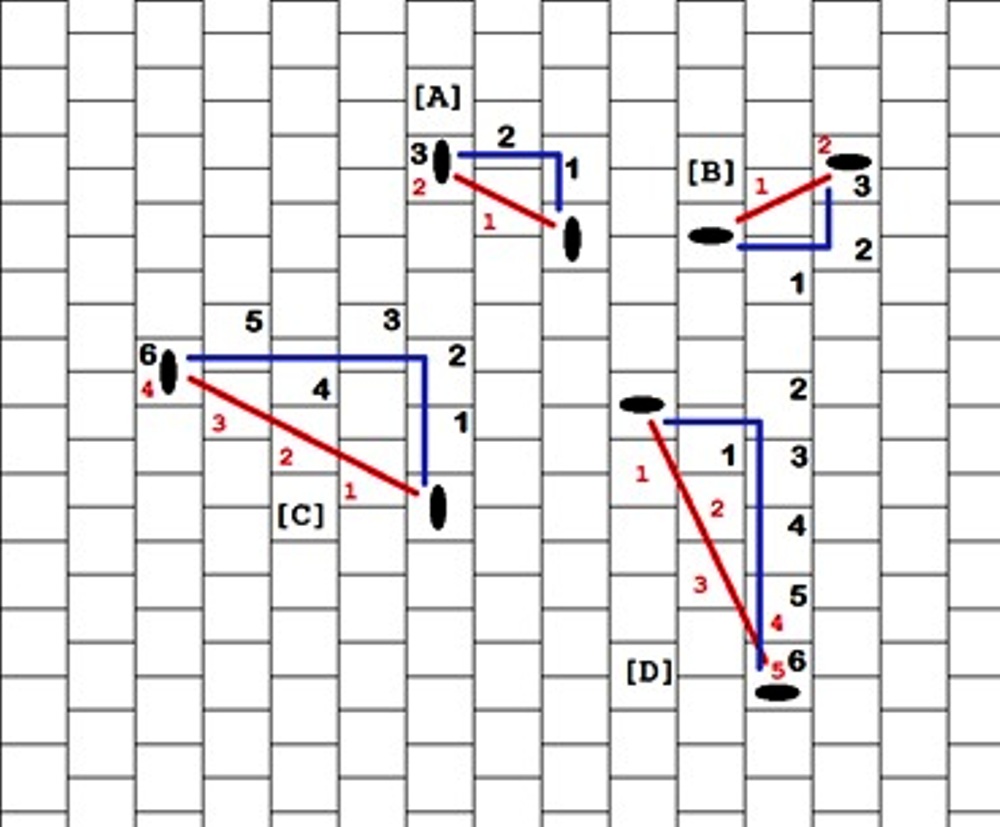
Last Saturday I received a very interesting email from Eric Sprague which was accompanied by an explanation of how he thought that movement and weapon ranges should be measured on a grid of offset squares. I thought that what he proposed was well thought out and with his permission I have reproduced it below.
Movement and Range on an Offset Square Grid

To calculate movement and range on an off-set square grid should be no different than a hex grid. I have recreated the diagrams from your book. (Figures B and D are just rotated 90 degrees.) I have added a blue line to show how you proposed calculating these. The numbers in red are how I would have calculated the same distance.
The same in hexes. These are the same as the off-set squares above to show the similarities.
Notice how I numbered in black exactly as you had above. In Figures A, B and C, in both off-set squares and hexes, the red line follows from one square or hex to the next without going astray. In Figure D the red line does not follow a distinct path but is more closely approximated by the red numbers.
This makes a lot of sense, and I can see why he proposes these changes. In consequence, I thoroughly recommend anyone who wants to to use Eric's method in preference to that laid down in my book. From personal preference I will continue to use hexed and normal squared grids and avoid offset ones whenever I can ... but if I do use them at some time in the future, I will be using Eric's method of measuring weapon ranges.

Monday, 6 August 2018

Getting my head down and doing some serious work

Over the past few days I have been working hard writing my book about the members of the Hertfordshire Masters' Lodge (No.4090) who served in the military in the period up to 1920. Thanks to the depth of research that had already been done before I started, the writing has taken less time than I expected, and the draft text is now complete. It now remains to be proof read and any corrects made, and once that stage is completed, I can begin the process of transferring the text to Lulu.com and producing the first printed proof copies.

I want to be able to publish the book in time for the centenary of the end of the Great War, and with luck that should not be too difficult a goal to achieve. Interestingly, the original research that was been done included military service (and Civil Defence work) up to 1945. I think that a second volume covering the period 1920 to 1945 would make sense, especially if I can publish it to coincide with the eightieth anniversary of the outbreak of the Second World War.

Sunday, 5 August 2018

The Matrix Games Handbook

My complimentary copy of THE MATRIX GAMES HANDBOOK: PROFESSIONAL APPLICATIONS FROM EDUCATION TO ANALYSIS AND WARGAMING arrived in the post yesterday, and it was very interesting to look through the complete book. I’d seen the section that I contributed to, but other than seeing the list of contents, I had little idea what the rest of the book contained.


The book is split into five sections, with each section containing a number of chapters.
  • Acknowledgements
  • Foreword: The Potentially Utility of the Matrix Game Approach to Military Training, Education and Analysis by John Curry
  • Biographies of Contributors
  • Introduction
  • Section 1: The History of Matrix Games
    • The Early Days of Matrix Games in the UK by Bob Cordery
    • The American History of Matrix Games by Chris Engle
    • The Rise of Professional Matrix Games by Tim Price
  • Section 2: Practical Advice
    • Running Matrix Games by Tim Price
    • Checklist by Tim Price
    • Sample Game: Baltic Challenge: NATO and Russian posturing in the Baltic Sea
    • The Australian Perspective by Todd Mason
  • Section 3: The Theory of Matrix Games
    • Walking in the Dark: An Allegory of Knowledge by Chris Engle
    • The Intellectual Underpinnings of Matrix Games by Chris Engle
    • Verbal Algorithms and the Human Machine by Chris Engle
    • Emerging Themes from the Matrix Game Based Narrative Methodology by John Curry
  • Section 4: Matrix Games and Education
    • Gaming Multi-Agency Responses by Helen Mitchard
    • Using Matrix Games in the Classroom by Dorian Love
    • Effective Learning at the Swedish Defence University by Johan Elg
    • Language Training by Neal Durando
    • Reflections on Military Language Training by Jose Anibal Ortiz Manrique
  • Section 5: The Professional Application of Matrix Games
    • Gaming the Wars of the Future by Chris Engle
    • Operations Research Tools by Ben Taylor
    • Building Boyd Snowmobiles: Matrix Games as a Creative Catalyst for Developing Innovative Technology by Paul Vebber
    • ISIS Crisis: Using a Matrix Game to Explore Contemporary Conflict by Rex Brynen
  • Further Reading
  • Appendix 1: Simple Counter Sheets for Matrix Games
This is NOT a book about how to design or play Matrix Games. It is a book that explains how Matrix Games have evolved and how they can be used. It does examine their limitations but also points out how their potential is still being discovered and developed.

THE MATRIX GAMES HANDBOOK: PROFESSIONAL APPLICATIONS FROM EDUCATION TO ANALYSIS AND WARGAMING was edited by John Curry, Chris Engle and Peter Perla and published by the History of Wargaming Project (ISBN 978 0 244 99213 2). It costs £14.95 (plus postage and packing).

Saturday, 4 August 2018

Making progress with my latest book ... and on a very appropriate day as well!

I began work on writing my latest book last Tuesday ... and already I have completed about a third of the entries.

The book is about the members of the Hertfordshire Masters' Lodge (No.4090) who served in the military in the period up to 1920, and as I have been reading the notes and then writing each individual entry I have been struck by the variety of experiences that they underwent.


The entries so far cover the following:
  • A silversmith who was born in 1851, and who became a stalwart member of one of the earliest Volunteer Rifle Corps. He was too old to serve during the Great War.
  • A doctor who was born in 1860 and who was a pre-war volunteer. He served with a Territorial battalion as medical officer until the end of the Great War.
  • A second doctor who was born in 1862 and who joined the Royal Navy as a surgeon. Although he had retired in 1907, he re-enlisted in 1914 and worked as a naval doctor at HMS Excellent (the Royal Navy's School of Gunnery) until he was invalided out in late 1916.
  • A teacher who was born in 1864 and who set up and ran one of the earliest school Cadet Corps in the UK. He continued to help train prospective officers until the end of the Great War.
  • A naval officer who was born in 1872, served with the Naval Brigade at the Siege of Ladysmith during the Second Boer War and commanded one of the earliest battle cruisers at the Battles of Heligoland and Dogger Bank. He then served as Jellicoe's 'Captain of the Fleet' at the Battle of Jutland before taking up a post at the Admiralty as one of the junior Sea Lords. He later commanded a Battle Cruiser Squadron and the Australian Fleet.
  • A musical instrument maker who was born in 1878 and volunteered to join the British Army in 1915. He was commissioned as a Lieutenant in a Pioneer Battalion and served in France until he was invalided out in 1917 when his health broke down.
  • A civil engineer who was born in 1880 and who joined the Royal Engineers as an officer in 1916. He was Mentioned in Despatches in 1917 and was made a Chevalier of the Legion d’Honneur for his services.
  • A nurseryman who was born in 1883, and who was a senior NCO in a Territorial unit when war broke out in 1914. He served during the fighting in Belgium and France, and was made an officer in the Army Service Corps when the army was expanded by Lord Kitchener. He took part in the fighting to stem the German Offensive in 1918 and was Mentioned in Despatches.
  • A dentist who was born in 1884, and who was not called up until the last weeks of the war. He then served for just over a year in the newly-formed Royal Air Force.
  • A minister of religion who was born in 1885 and who served as an Army Chaplain for two years on the Western Front.
  • An advertising executive who was born in 1887 and who served as an officer with the Royal Naval Volunteer Reserve from 1915 onwards. He became an expert in anti-submarine warfare and during the Second World War he helped trained the crews of the Royal Navy's rapidly expanded anti-submarine force.
  • An accountant who was born in 1888 and who volunteered to join the Royal Navy Reserve in 1914. He became a Paymaster, and after service during the Dardanelles Campaign he devised a special movement system for ship sailing across the Irish Sea that reduced the number of accidental collisions and ships sunk by U-Boats. After the war he was awarded an OBE for his work.
  • A bank manager who was born in 1891 and who was already serving as an officer in a Territorial unit when was was declared. He and his unit formed part of the Tyne Garrison until 1918, when he went to France just before the German Offensive of 1918. He remained in the British Army after the war had ended and took part in the Afghan War before being demobilised in 1921.
I still have quite a few more entries to write, and I'm sure that they will tell stories of equally interesting and diverse military service.

It is rather appropriate that I have written this blog entry today as it is the 104th anniversary of Britain's declaration of war on German.

Thursday, 2 August 2018

Eye test results mean a few changes may be required

Yesterday I went for an eye test. I wasn't due to have one until next year, but over recent months I'd noticed a gradual deterioration in my eyesight, particularly when looking at something like my computer screen. The results were not earth-shattering but will require me to make a few changes.

First and foremost, my distance vision has deteriorated and I will need new prescription lenses. In order to reduce the number of times I will need to change my glasses to use my computer, I have opted for varifocal lenses that will have enhanced peripheral vision. I have also opted for a second pair of glasses for medium to close distances, and these will replace my existing reading glasses.

The optometrist also spotted a couple of problems that will need to be addressed. Firstly, I am showing the early stages of developing cataracts in both eyes, and I have been advised to have light-reactive lenses fitted as this will reduce the amount of light entering my eyes on bright days. This should slow the development of the cataracts, as will taking multi-vitamins each day. The second problem relates to my eyelids, which are slightly swollen, causing the tear ducts to become blocked. As a result, my eyes are drier than they should be, and I am now having to use eye drops to reduce the swelling, unblock the tear ducts, and lubricate my eyes.

If my eyesight is going to gradually get worse over the next few years, I need to think about how it might affect my wargaming. The most obvious thing is that trying to paint smaller-sized figures is going to become more difficult, and a move to larger figures in the near future might make sense. As my regular blog readers will already know, I've already collected quite a substantial number of per-painted Del Prado 25/28mm-scale Napoleonic figures, and painting this size of figure in future should not present me with too many problems. As to my plans for staging a re-fight of Operation Barbarossa ... well painting the vehicles should not present me with any problems and I know that I can produce passably painted 20mm-scale figures. The latter might not win any prizes, but as they won't be entered into any painting competitions, that isn't a problem.

Wednesday, 1 August 2018

Russian maps

I was recently offered something a little out of the ordinary ... four identical sets of four Russian maps (one of each map in 1:100,000, 1:50,000, 1:25,000, and 1:10,000) used to teach map-reading skills. My immediate thought was 'they will be useful' and I gratefully accepted the offer. The maps arrive today, and they look like this:


As the maps cover a variety of different terrain, I can see them being very useful when I want to 'generate' some terrain for battles between Axis and Soviet forces during the Second World War.

So, it's a big vote of thanks to Bill Roberts for thinking of me when he was disposing of these maps. I will certainly find a use for them ... and I suspect that other might do so as well!