Pages

Sunday, 11 October 2020

Battle report: The battle for the Vilno-Pskov Road

This climactic battle saw three German divisions (1st and 2nd Infantry Divisions and 1st Panzer Division) attacking a Russian force that comprised 1st Rifle Division and the remnants of 2nd Rifle Division and 1st Tank Corps. The latter two formations had received some replacements, none of which were of high quality, and some of the Russians units occupied hastily constructed field fortifications.

In light of the failure of the Russian troops to hold back the German invaders, the Russian leader had issued a 'Not one step back!' (Ни шагу назад!/Ni shagu nazad!) order, which meant that no Russian unit could retreat, whatever the circumstances.

The attackers

  • 1st Infantry Division:
    • General von Tarlenheim (Average; 6 SPs)
    • 1st Divisional HQ (Average; 2 SPs)
    • 1st Infantry Regiment (Average; 3 SPs)
    • 2nd Infantry Regiment (Average; 3 SPs)
    • 3rd Infantry Regiment (Average; 4 SPs)
    • 1st Artillery Regiment (Average; 2 SPs + 2 SPs)
    • 1st Anti-tank Battalion (Average; 2 SPs + 2SPs)
    • Total strength: 26 SPs (equivalent to 13,000 men)
    • Exhaustion Point: 9 SPs
  • 2nd Infantry Division:
    • General Sapt (Average; 6 SPs)
    • 2nd Divisional HQ (Average; 2 SPs)
    • 4th Infantry Regiment (Average; 4 SPs)
    • 5th Infantry Regiment (Average; 4 SPs)
    • 6th Infantry Regiment (Average; 4 SPs)
    • 2nd Artillery Regiment (Average; 2 SPs + 2 SPs)
    • 2nd Anti-tank Battalion (Average; 2 SPs + 2 SPs)
    • Total strength: 28 SPs (equivalent to 14,000 men)
    • Exhaustion Point: 10 SPs
  • 1st Panzer Division:
    • General Hentzau (Above average; 6 SPs)
    • 4th Divisional HQ (Average; 2 SPs)
    • 1st Armoured Car Battalion (Average; 2 SPs)
    • 1st Panzer Regiment (Average; 3 SPs)
    • 2nd Panzer Regiment (Average; 3 SPs)
    • 7th Motorised Infantry Regiment (Average; 4 SPs + 3 SPs)
    • 4th Artillery Regiment (Average; 2 SPs)
    • 4th Panzerjager Battalion (Average; 2 SPs)
    • Total strength: 27 SPs (equivalent to 13,500 men)
    • Exhaustion Point: 9 SPs
The German total strength = 81 SPs (equivalent to 40,500 men).

The defenders

  • 1st Rifle Division:
    • DivCom Renko (Average; 6 SPs) [In overall charge of the Russian troops]
    • 1st Divisional Reconnaissance Unit (Average; 1 SP)
    • 1st Rifle Regiment (Average; 4 SPs)
    • 2nd Rifle Regiment (Average; 4 SPs)
    • 3rd Rifle Regiment (Average; 4 SPs)
    • 1st Artillery Regiment (Average; 2 SPs + 2 SPs)
    • 1st Anti-tank Battalion (Average; 2 SPs + 2 SPs)
    • Total strength: 27 SPs (equivalent to 13,500 men)
    • Exhaustion Point: 9 SPs
  • 2nd Rifle Division:
    • 4th Rifle Regiment (Poor; 4 SPs)
    • 5th Rifle Regiment (Average; 4 SPs)
    • 6th Rifle Regiment (Poor; 4 SPs)
    • 2nd Artillery Regiment (Poor; 2 SPs + 2 SP)
    • 2nd Anti-tank Battalion (Average; 2 SPs + 2 SPs)
    • Total strength: 20 SPs (equivalent to 10,000 men)
    • Exhaustion Point: 7 SPs
  • 1st Tank Corps:
    • 1st Armoured Car Regiment (Average; 2 SPs)
    • 1st Tank Brigade (Average: 3 SPs)
    • 2nd Tank Brigade (Poor; 3 SPs)
    • Total strength: 8 SPs (equivalent to 4,000 men)
    • Exhaustion Point: 3 SPs
The Russian total strength = 55 SPs (equivalent to 27,500 men). [Any unit that has been reconstituted or received 50% or more replacement personnel have been downgraded.]

The battlefield

A map of the battlefield.
A photograph of the battlefield.

The disposition of the opposing forces

The Russian defenders were located as shown on the following map:

A map of the battlefield showing the locations of the Russian defenders.
A photograph of the battlefield showing the locations of the Russian defenders.

Note: Because of the sheer size of this battle in comparison with the earlier two, I have not produced a detailed blow-by-blow account. Instead, I have fought each turn and then summarised the events in a short description and in the the captions for each image.

Turn 1: The attack by the 1st Infantry Division begins

It had been decided that 1st Infantry Division should begin the process of destroying the remaining Russian forces on the Vilno-Pskov Road. As a result, they mounted their attack from the north-western (top left-hand) corner of the battlefield.

The leading elements of 1st Infantry Division advance onto the battlefield.
The Russian 1st and 2nd Tank Brigades immediately move forward to counter-attack, but inflict no casualties on the German attackers.
A photograph of the battlefield showing the situation at the end of Turn 1.

Turn 2: The 1st Infantry Division blunts the Russian counter-attack and the 2nd Infantry Division begins their attack

The 1st Infantry Division immediately engaged the oncoming Russian 1st and 2nd Tank Brigades.

The counter-attack by the Russian 1st and 2nd Tank Brigades meets with some success, but the 1st Tank Brigade suffers two-thirds casualties in the process. The German 1st Anti-tank Battalion is caught in the flank by the 2nd Tank Brigade, and is reduced to 50% effectiveness.

Whilst the 1st Infantry Division's attack began to develop, the 2nd Infantry Division mounted their attack from the eastern side of the battlefield.

The 4th and 5th Infantry Regiments engage the foremost Russian units (1st Divisional Reconnaissance Unit and 1st Anti-tank Battalion) in close combat.
Despite being in a complex of field defences, the 1st Divisional Reconnaissance Unit is overrun by 5th Infantry Regiment, which immediately engages the 1st Anti-tank Battalion in the flank. The latter has already been mauled by the 4th Infantry Regiment, and is wiped out by the German attack.
A photograph of the battlefield showing the situation at the end of Turn 2.

Turn 3: The 1st Infantry Division attack is stalled whilst the fighting in the south intensifies

The Russian counter-attack continued, and although the Russian 1st and 2nd Tank Brigades were effectively destroyed, the 1st Infantry Division suffered significant casualties.

The Russian 1st and 2nd Tank Brigades are destroyed in the fighting with the 1st Infantry Division, but in the process, they overrun and destroy the 1st Anti-tank Battalion and inflict casualties on  1st Infantry Regiment. For the moment, this effectively stalls the continued advance of the 1st Infantry Division.
The 1st Armoured Car Regiment takes up a position astride the bridge over the river.
The 2nd Infantry Division continued its attack, but began to find that the Russian defences were much stronger than anticipated. Casualties began to mount on both sides, and by this stage in the battle, the Germans had already suffered more casualties than they had in their previous battles.
The 4th and 5th Infantry Regiments begin their attacks on the main Russian defences ... and find them far more difficult to overcome than they expected. The 2nd Artillery Regiment arrives, and it is hoped that they will soon be able to give much-need fire support to the attacking infantry, but it is doubtful that the Russian artillery (the 1st Artillery Regiment) on the nearby hill is not going to engage the Germans with counter-battery fire.
A photograph of the battlefield showing the situation at the end of Turn 3.

By this point in the fighting, the Russians had lost 13 SPs (equivalent to 6,500 men) and the German had lost 8 SPs (equivalent to 4,000 men).

Turn 4: The fighting turns into a slogging match

Realising that a swift victory was not possible, the Germans began to consolidate their position, and adopted slower and more deliberate tactics.

Using the remnants of  the 1st and 2nd Infantry Regiments to guard their left flank from any possible Russian attack, the 1st Infantry Division begin to bombard the nearest Russian defences. At the same time, the 3rd Infantry Regiment moves forward on the Division's right flank.
Having suffered casualties trying to assault the Russian defences with a head-on attack, the 2nd Infantry Division pulls back its leading infantry regiments and the 2nd Artillery Regiment begins to bombard the 1st Artillery Regiment atop the nearby hill. The exchange of artillery fire reduces the 1st Artillery Regiment to 50% effectiveness, whilst the 2nd Artillery Regiment suffers no casualties whatsoever.
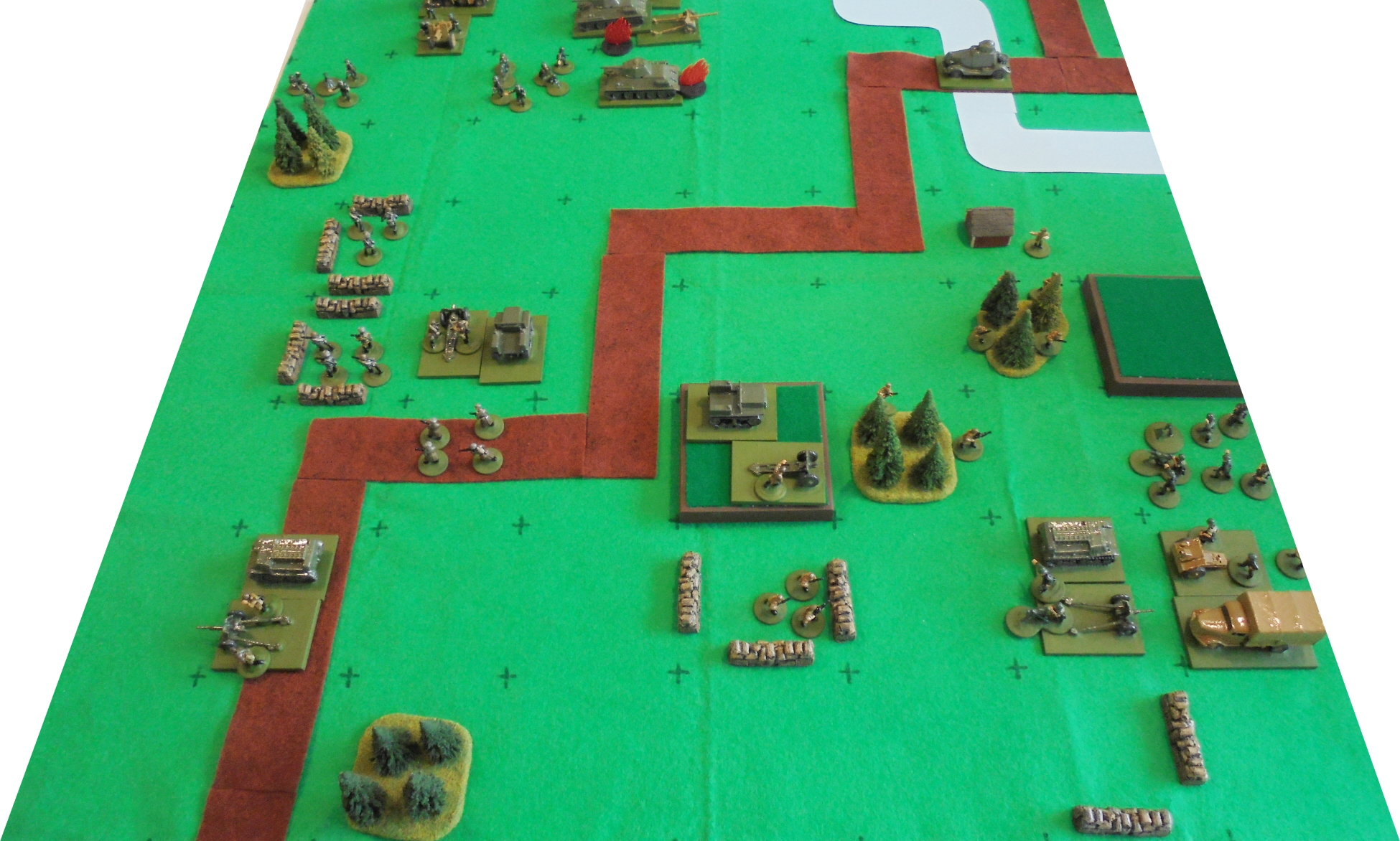
A photograph of the battlefield showing the situation at the end of Turn 4.

Turn 5: The slogging match continues

Whilst the German and Russian artillery seek to gain ascendancy over their opponents, the 3rd Infantry Regiment continues to insinuate its way forward.

In the northern part of the battlefield, the 1st Artillery Regiment and 2nd Artillery Regiment engage in counter-battery fire to little effect ....
... whereas at the southern end, the 2nd Artillery Regiment manages to eliminate the 1st Artillery Regiment.
Under cover of the artillery exchange, the 3rd Infantry Regiment uses the woods to mask their move forward.
A photograph of the battlefield showing the situation at the end of Turn 5.

Turn 6: The slow process of wearing down the defenders continues

The artillery duel in the north continues, and in the south the Germans gradually begin to whittle away at the Russian defences.

The duel between the 1st Artillery Regiment and the 2nd Artillery Regiment sees both side suffer casualties.
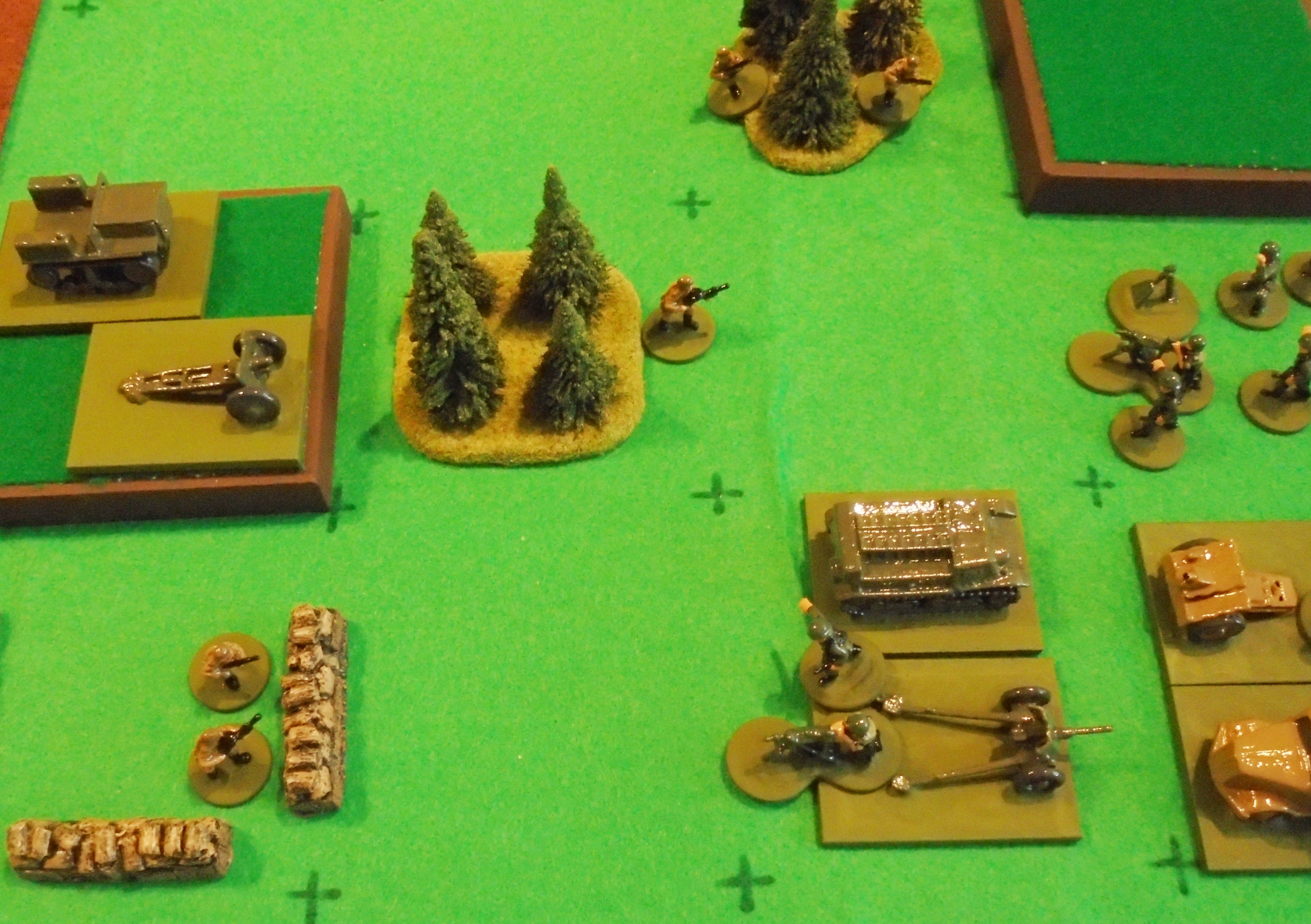
The strength of the defenders is gradually eroded by the superior firepower of the German infantry and their artillery support.
A photograph of the battlefield showing the situation at the end of Turn 6.

By this point in the fighting, the Russians had lost 22 SPs (equivalent to 11,000 men) and passed their Exhaustion Point, and the German had lost 12 SPs (equivalent to 6,000 men).

Turn 7: The beginning of the end

In the north, 1st Artillery Regiment fires at the 2nd Artillery Regiment, to no effect.

In the south, the 2nd Artillery Regiment's fire destroyed the last remnant of the 2nd Rifle Regiment in the nearby woods.

The Russian defences in the south are about to collapse after the destruction of the 2nd Rifle Regiment.

DivCom Renko is aware that the Germans are close to breaking through his defences in the south, and resolves to move his troops back to the bridge. He orders the 2nd Rifle Division to leave its current positions and 'realign' in the direction of the bridge over the river.

The 2nd Rifle Division begins its retreat towards the bridge.

Seeing the enemy withdrawing, the Germans mount major attacks in the northern and southern sectors of the battlefield.

The 1st, 2nd, and 3rd Infantry Regiments engage the retreating/'realigning' Russian 2nd Rifle Division, and destroy the 4th Rifle Regiment and the 2nd Artillery Regiment in the process. During the firefight with the 4th Rifle Regiment, DivCom Renko is killed.
Whilst the remaining soldiers of the 4th Infantry Regiment and 3rd Rifle Regiment  fight for possession of a section of the Russian defences, the 5th and 6th Infantry Regiments attack the 1st Rifle Regiment that is defending the woods.
At this point, the leading tanks of 1st Panzer Division appear from the west, precipitating a Russian surrender.
The arrival of the tank of 1st and 2nd Panzer Regiments in the rear of the retreating 2nd Rifle Division, coupled with the death of DivCom Renko, causes all the remaining Russian units to surrender.
A photograph of the battlefield showing the situation at the end of Turn 7.

The final tally

The Germans had completed the destruction of the Russian forces opposing them, and the road to Pskov was now open for them to advance ... but the cost of the victory had been high. Overall, the Germans had lost 14 SPs (equivalent to 7,000 men and approximately a quarter of all the German troops involved in the fighting), and only one of its infantry regiments was still at full strength. An anti-tank battalion would need to be replaced, and an artillery regiment was down to half its original strength. Both the 1st and 2nd Infantry Divisions would need time to recover, and although the 1st Panzer Division was at full strength, the infantry was needed to hold and defend any gains that had been achieved. They also had a large number of prisoners to process as well as stocks of captured equipment to deal with.

The Russian had lost two rifle division and a tank corps (equivalent to 21,000 men) ... but these could be replaced in a matter of weeks. The replacements would probably no be as well trained or equipped as the lost formations. but as the 'Boss' once aid, 'quantity has a quality all of its own'.

Saturday, 10 October 2020

The Quarantined Wargamer

In the past I have dabbled a bit with YouTube, but unlike some other people, I have never really used its full potential.

One person that I know who has is Lee Hadley (AKA Big Lee), who besides writing a very interesting blog, has produced a series of YouTube programmes about wargaming entitled THE QUARANTINED WARGAMER. They generally last approximately fifteen to twenty minutes, and have covered a diversity of topics.

I watch them regularly, and I have never been disappointed ... and I suspect that most of my regular blog readers would not be disappointed as well. I thoroughly recommend them.

Friday, 9 October 2020

Eastern Front/Great Patriotic War mini-campaign: The final battle map

Using the terrain generator system contained in my THE PORTABLE COLONIAL WARGAME book, I created a map for my forthcoming battle, and it looks like this:

The Russians will be deployed in field defences up to three grid squares from the road that runs from the top right-hand corner of the map towards the bottom left-hand corner. The 1st Rifle Division will occupy positions between the road and the bottom right-hand corner of the map, the 2nd Rifle Division will be in the area between the road and the left-hand side of the map, and the 1st Tank Corps will be deployed protecting the bridge across the river.

The German 1st Infantry Division will attack from the north (i.e. the upper edge of the map), the 2nd Infantry Division will attack from the east (i.e. the right-hand edge of the map), and the 1st Panzer Division will move in from the west (i.e. the left-hand edge of the map).

Thursday, 8 October 2020

Eastern Front/Great Patriotic War mini-campaign: A brief recap

Before fighting the third battle of my mini-campaign, I wanted to produce a brief recap of the effect of the fighting to date. I also wanted to try out an SP equivalence idea that Archduke Piccolo has used in his recent Blacklands War Campaign. He chose to equate 1 SP to 1,000 men, but I felt that for my mini-campaign, 1 SP = 500 men was more appropriate.


At the start of the campaign, the two sides fielded the following forces:

GERMANY

  • 1st Infantry Division:
    • General von Tarlenheim (Average; 6 SPs)
    • 1st Divisional HQ (Average; 2 SPs)
    • 1st Infantry Regiment (Average; 4 SPs)
    • 2nd Infantry Regiment (Average; 4 SPs)
    • 3rd Infantry Regiment (Average; 4 SPs)
    • 1st Artillery Regiment (Average; 2 SPs + 2 SPs)
    • 1st Anti-tank Battalion (Average; 2 SPs + 2 SPs)
    • Total strength: 28 SPs (Equivalent to 14,000 men)
    • Exhaustion Point: 10 SPs
  • 2nd Infantry Division:
    • General Sapt (Average; 6 SPs)
    • 2nd Divisional HQ (Average; 2 SPs)
    • 4th Infantry Regiment (Average; 4 SPs)
    • 5th Infantry Regiment (Average; 4 SPs)
    • 6th Infantry Regiment (Average; 4 SPs)
    • 2nd Artillery Regiment (Average; 2 SPs + 2 SPs)
    • 2nd Anti-tank Battalion (Average; 2 SPs + 2 SPs)
    • Total strength: 28 SPs (Equivalent to 14,000 men)
    • Exhaustion Point: 10 SPs
  • 1st Panzer Division:
    • General Hentzau (Above average; 6 SPs)
    • 4th Divisional HQ (Average; 2 SPs)
    • 1st Armoured Car Battalion (Average; 2 SPs)
    • 1st Panzer Regiment (Average; 3 SPs)
    • 2nd Panzer Regiment (Average; 3 SPs)
    • 7th Motorised Infantry Regiment (Average; 4 SPs + 3 SPs)
    • 4th Artillery Regiment (Average; 2 SPs)
    • 4th Panzerjager Battalion (Average; 2 SPs)
    • Total strength: 27 SPs (Equivalent to 13,500 men)
    • Exhaustion Point: 9 SPs
The German total strength = 83 SPs (Equivalent to 41,500 men).

RUSSIA

  • 1st Rifle Division:
    • DivCom Renko (Average; 6 SPs)
    • 1st Divisional Reconnaissance Unit (Average; 1 SP)
    • 1st Rifle Regiment (Average; 4 SPs)
    • 2nd Rifle Regiment (Average; 4 SPs)
    • 3rd Rifle Regiment (Average; 4 SPs)
    • 1st Artillery Regiment (Average; 2 SPs + 2 SPs)
    • 1st Anti-tank Battalion (Average; 2 SPs + 2 SPs)
    • Total strength: 27 SPs (Equivalent to 13,500 men)
    • Exhaustion Point: 9 SPs
  • 2nd Rifle Division:
    • DivCom Pribluda (Below average; 6 SPs)
    • 2nd Divisional Reconnaissance Unit (Average; 1 SP)
    • 4th Rifle Regiment (Average; 4 SPs)
    • 5th Rifle Regiment (Average; 4 SPs)
    • 6th Rifle Regiment (Average; 4 SPs)
    • 2nd Artillery Regiment (Average; 2 SPs + 2 SPs)
    • 2nd Anti-tank Battalion (Average; 2 SPs + 2 SPs)
    • Total strength: 27 SPs (Equivalent to 13,500 men)
    • Exhaustion Point: 9 SPs
  • 1st Tank Corps:
    • DivCom Borodin (Below average; 6 SPs)
    • 1st Armoured Car Regiment (Average; 2 SPs)
    • 1st Tank Brigade (Average; 3 SPs)
    • 2nd Tank Brigade (Average; 3 SPs)
    • 3rd Tank Brigade (Average; 3 SPs)
    • 10th Motor Rifle Regiment (Average; 4 SPs + 2 SPs)
    • Total strength: 23 SPs (Equivalent to 11,500 men)
    • Exhaustion Point: 8 SPs
The Russian total strength = 77 SPs (Equivalent to 38,500 men).

As a result of the fighting during the first two battles of the campaign, the relative strengths of both sides are as follows:

GERMANY

  • 1st Infantry Division:
    • General von Tarlenheim (Average; 6 SPs)
    • 1st Divisional HQ (Average; 2 SPs)
    • 1st Infantry Regiment (Average; 3 SPs)
    • 2nd Infantry Regiment (Average; 3 SPs)
    • 3rd Infantry Regiment (Average; 4 SPs)
    • 1st Artillery Regiment (Average; 2 SPs + 2 SPs)
    • 1st Anti-tank Battalion (Average; 2 SPs + 2SPs)
    • Total strength: 26 SPs (Equivalent to 13,000 men)
    • Exhaustion Point: 9 SPs
  • 2nd Infantry Division:
    • General Sapt (Average; 6 SPs)
    • 2nd Divisional HQ (Average; 2 SPs)
    • 4th Infantry Regiment (Average; 4 SPs)
    • 5th Infantry Regiment (Average; 4 SPs)
    • 6th Infantry Regiment (Average; 4 SPs)
    • 2nd Artillery Regiment (Average; 2 SPs + 2 SPs)
    • 2nd Anti-tank Battalion (Average; 2 SPs + 2 SPs)
    • Total strength: 28 SPs (Equivalent to 14,000 men)
    • Exhaustion Point: 10 SPs
  • 1st Panzer Division:
    • General Hentzau (Above average; 6 SPs)
    • 4th Divisional HQ (Average; 2 SPs)
    • 1st Armoured Car Battalion (Average; 2 SPs)
    • 1st Panzer Regiment (Average; 3 SPs)
    • 2nd Panzer Regiment (Average; 2 SPs)
    • 7th Motorised Infantry Regiment (Average; 4 SPs + 3 SPs)
    • 4th Artillery Regiment (Average; 2 SPs)
    • 4th Panzerjager Battalion (Average; 2 SPs)
    • Total strength: 26 SPs (Equivalent to 13,000 men)
    • Exhaustion Point: 9 SPs
The German total strength = 80 SPs (Equivalent to 40,000 men). German losses amount to 3 SPs (1,500 men), of which 1 SP (500 men) will be replaced before the next battle.

RUSSIA

  • 1st Rifle Division:
    • DivCom Renko (Average; 6 SPs)
    • 1st Divisional Reconnaissance Unit (Average; 1 SP)
    • 1st Rifle Regiment (Average; 4 SPs)
    • 2nd Rifle Regiment (Average; 4 SPs)
    • 3rd Rifle Regiment (Average; 4 SPs)
    • 1st Artillery Regiment (Average; 2 SPs + 2 SPs)
    • 1st Anti-tank Battalion (Average; 2 SPs + 2 SPs)
    • Total strength: 27 SPs (Equivalent to 13,500 men)
    • Exhaustion Point: 9 SPs
  • 2nd Rifle Division:
    • 5th Rifle Regiment (Average; 1 SPs)
    • 6th Rifle Regiment (Average; 3 SPs)
    • 2nd Artillery Regiment (Average; 2 SPs + 1 SP)
    • 2nd Anti-tank Battalion (Average; 2 SPs + 2 SPs)
    • Total strength: 11 SPs (Equivalent to 5,500 men)
    • Exhaustion Point: 4 SPs
  • 1st Tank Corps:
    • 1st Armoured Car Regiment (Average; 2 SPs)
    • 1st Tank Brigade (Average; 3 SPs)
    • Total strength: 5 SPs (Equivalent to 2,500 men)
    • Exhaustion Point: 2 SPs
The Russian total strength = 43 SPs (Equivalent to 21,500 men). Russian losses amount to 34 SPs (17,000 men), of which 12 SPs (6,000 men) will be replaced before the next battle.

Wednesday, 7 October 2020

One short-term aim achieved!

I finally got my act together, and finished painting the Russian gunners that have been sitting on my work table for some time.

They will provide crews for eight artillery pieces, and will enable me to form at least two more Russian ‘formations in boxes’ for my Eastern Front/Great Patriotic War project.

(The figures were manufactured by Irregular Miniatures, and are 20mm-scale gun crews from their Really Useful Guns range.)


That is the first of my short-term aims achieved! Now onto the next!

Monday, 5 October 2020

Setting some short-term aims

Yesterday’s blog post generated quite a few comments, and they have helped me to set myself the following short-term aims:

  • Finish painting the Russian gun crews that have been sitting half finished on my work table. They can then be used to help form a couple more ‘formations in a box’.
  • Finish play-testing my Operation Barbarossa mini-campaign. I have one large battle to fight ... and this should enable me to complete this project.
  • Add the place names to the new, colour version of the Madasahatta map.

These are my current short-term aims. I hope that whilst I am working to achieve them, I will be able to formulate some more long-term ones.

Sunday, 4 October 2020

Selection and maintenance of the aim

Selection and maintenance of the aim is regarded as being the most important of the ten principles of war ... and has been foremost in my mind for some time.

Regular blog readers will probably have realised that for the last few months I have not been concentrating on a specific project, but tending to dabble a bit in several. It is difficult to explain why, but for some reason I have not been able to maintain my interest in anything for very long ... hence lots of bits and pieces getting done, but nothing actually being finished.

Earlier in the year I went through a period of ennui, but this is something different. It is more a case of just not being able to settle to anything because I cannot seem to select my ‘aim’, and therefore I have nothing to ‘maintain’.

I need to set myself an aim ... and over the next few days I hope to select one.

Saturday, 3 October 2020

Another Haynes Manual: StuG III

Ever since I bought my first Airfix model of the StuG III, it has been one of my favourite armoured fighting vehicles ... and when I discovered that Haynes had produced on of their manuals about it, I had to buy a copy.

STUG III: STURMGESCHUTZ III AUSFUHRUNG A TO G (SDKFZ 142) has nine chapters and a bibliography:

  • Introduction
  • From concept to eve of combat
  • Short-barrelled StuG III Ausf A-E (Sdkfz 142)
  • Long-barrelled StuG III Ausf F-G (Sdkfz 142/1)
  • Anatomy of the StuG III Ausf A-E
  • Anatomy of the StuG III Ausf F, F/8 and Ausf G
  • StuG III walk-around
  • StuG III in combat 1940-43
  • StuG III in combat 1944-45
  • Bibliography
As with the other volumes in this series, this book contains numerous photographs and line drawings, and has match to offer the serious modeller and anyone with an interest in the technical aspects of armoured vehicle development.

STUG III: STURMGESCHUTZ III AUSFUHRUNG A TO G (SDKFZ 142) was written by Mark Healey and published in 2019 by Haynes Publishing (ISBN 978 1 78521 213 0).

Friday, 2 October 2020

The first Masonic meeting in over six months that I was planning to attend ... has been cancelled

The last time I attended a Masonic meeting was on 26th February. It was the meeting of the Kudu Chapter No.8662 of the Holy Royal Arch, and I gave them a talk about Sir Charles Warren. We ate a meal together afterwards ... and on 17th March, United Grand Lodge of England suspended all Masonic activity until 17th July.

There are very few Masonic meetings during the summer months, and my first scheduled meeting should have been the Hertfordshire Provincial Grand Lodge meeting on 23rd September ... but initially this was restricted to just thirty attendees and subsequently to six(!) ... and so I was not able to attend. My second meeting should have been at Freemason’s Hall, Great Queen Street, London on 24th September ... but as I am now seventy and getting there involved travelling on public transport, I had to give my apologies.

(People in my age group have been advised not to travel by public transport if it is at all possible to avoid potential contact with someone who might be infected with COVID-19.)

Today I was going to drive to Radlett, Hertfordshire, to attend a meeting of the Veritatem Sequere Lodge No.9615 ... and despite the fact that my round trip is over one hundred miles, it would have been worth it to be able to attend a meeting and feel part of the fraternity once again. This is not to say that we haven’t kept in contact by telephone, Zoom, and WhatsApp, but to actually meet other Masons in a Temple (even if there are only going to be six of us in attendance) and to conduct the ritual of opening and closing the Lodge is something that I have been looking forward to doing for months. Unfortunately, some of those who were going to attend are now unable to, and as we need five to be quorate, the meeting will have to be abandoned.

It looks as if I am going to have to wait until at least December before I will be able to attend a Lodge meeting ... and I suspect that I will not actually do so until well into 2021.

Thursday, 1 October 2020

Yet another three months on ...

I think that a lot of us expected that by now, the impact of COVID-19 might just have begun to abate. Back on 1st July I wrote 'things are just beginning to ease, although there seems to be growing evidence that we may have a second wave of the pandemic on the horizon'. Well, they did ease for a bit, but now parts of the country are going back to a state of almost full lockdown, and where I live in London has seen the number of confirmed cases double in the last ten days, and is on the so-called 'watch list' for further restrictions. In addition, the Prime Minister has announced that it may take at least another six months before life will begin to return to normal ... whatever that means.

So, what have I achieved during the last three months, and what plans do I have for the next three ... or even six?

Looking back, I can see that I have actually done quite a lot as well as failed to do some of the things that I planned to do. Amongst the latter is finishing THE PORTABLE SEVENTEENTH CENTURY WARGAME book. I have the text pretty well completed, but the hiatus surrounding the changes Lulu.com introduced continues to rumble on, and I do not yet feel confident about publishing a new book with them until they have sorted out the ongoing issues with my current books.

On the positive side:

  • I have helped to stage the first VCOW (Virtual Conference of Wargamers), and I am taking part in the planning for another one that we hope to stage in February.
  • I have drawn a campaign map for my planned Eastern Front/Great Patriotic War campaign, drafted a set of appropriate campaign rules that I am currently play-testing, and I am also play-testing a World War Two version of my PORTABLE WARGAME rules.
  • I have taken part in some online wargames with Gary Sheffield.
  • Sue and I have managed to have two 'away days' to Rochester and Sandwich as well as a short break in Tiverton.
  • I have managed to print and distribute the two issues of THE NUGGET that were delayed by the lockdown as well as the two most recent issues.
  • I have begun the process of redrawing a colour version of Eric Knowles's Madasahatta map.
  • I have finished reading all George Simenon's Maigret books, and have begun reading my way through the Bernie Gunther books by Patrick Kerr.

At first glance, I don't seem to have achieved as much during the last three months as I did between April and June, but the good weather was a welcome distraction, and helped me to avoid some of the impact of the ongoing pandemic on my mental health. Being outside in the warm, fresh air did much to raise our spirits, especially as we were able to leave home to go somewhere other than to the shops.

What does the next three months hold for us? Who knows? I suspect that it will be more of the same, with more restrictions being put into place by Christmas. Luckily, I have plenty to do, and as long as I do not have a visit from the dreaded 'Black Dog', I hope to carry on much as before.


Nine months ago, I wished my regular blog readers and fellow bloggers a safe and healthy 2020 ... and I have repeated that message six months ago and again, three months after that. Today I would like to reiterate those best wishes again.

STAY SAFE AND STAY WELL!