Pages

Wednesday, 14 January 2009

Basking in the tropical heat of South East London ...

Well the engineer came - slightly later than arranged but not by much - and the gas-powered central heating boiler is working. In fact it is working overtime.

To make up for the lack of heating for the last five days I have turned the controls right up and the house is warming up nicely. In a moment I am off to have a long, hot shower, followed by a spell of painting, and then a nice meal.

Life is getting better ...

Tuesday, 13 January 2009

... and then the central heating boiler broke down

Not a lot to report since my last blog entry due to the fact that the gas-fired central heating boiler broke down last Friday night/Saturday morning, since when most of the rooms in the house - including my wargames room - have been very cold and almost unusable. I tried to do some more work on my terrain boards but my hands were too cold to paint so I gave up. We do have some electric fires, but they are in the main living rooms.

The engineer came today to fix the boiler (three hours later than the time set for the appointment but at least he did turn up) but although he has identified the fault he did not have the parts that he needed to fix it. He should be back tomorrow morning ... or Thursday afternoon if the parts are not immediately available.

Let's hope it is not too cold for the next few days ...

Thursday, 8 January 2009

Table Top Battles - Third set of terrain boards - slight change of colour

The MDF has proved more difficult to paint that I had first expected. It soaked up the acrylic emulsion paint like a sponge, especially along the edges. However I persisted ... and this morning I thought that I had finished.

Before marking the grid onto the terrain boards I decided to see how some based figures looked against the green colour I had chosen to paint the boards with. This proved to be a very wise move on my part. They looked awful. The green was just too drab, and made the figures look drab.

So what to do?

A quick look around my store of model paint revealed that I had several pots of Games Workshop/Citadel 'Goblin Green'. I have used this colour on figure bases over recent years, and thought that I could use the colour on my terrain boards. So I painted one of them in 'Goblin Green' ... and it looked just fine. I have now painted all of the boards with this colour paint, and although they will need another coat to make sure the original colour does not show through at all, I am now on track to get my final set of terrain boards finished within the next seven days ... I hope!

Sunday, 4 January 2009

Table Top Battles - Third set of terrain boards started

I have now begun work on the third set of terrain boards for use with the TABLE TOP BATTLES wargames rules. These will be for land battles in temperate climate, and will be painted in green acrylic emulsion paint (again from Homebase), marked with 5cm x 5cm squares with a permanent OHP marker pen and gloss varnished to protect the playing surface. They will then be given a coat of matt varnish to deaden the gloss.

Unlike the first two sets of terrain boards these will be made from 15mm thick MDF cut into 30cm x 30cm squares. This is because I was unable to obtain any more corner sections of unpainted Jigwar terrain boards. Because thin MDF tends to warp when painted I have decided to use 15mm thick MDF in the hope that they will remain flat after painting. Time will show if I have made the correct decision.

Saturday, 3 January 2009

Table Top Battles - Play-test - Land Battles (for mid-20th century warfare on hexes) - Improved images

The images that I originally used to illustrate the play-test were rather too brown when seen onscreen. I have therefore replaced them slightly enhanced versions of the original images.

Friday, 2 January 2009

Table Top Battles - Play-test - Land Battles (for mid-20th century warfare on hexes) - Some thoughts

After I had written up the most recent play-test blog entry I began to think about the scenario, the unit ratings, the results of some of the combat that took place, and the rules. My thoughts are as follows:

  1. The scenario seemed to be quite reasonable although the balance between the two sides gave the Russian attackers a distinct advantage (i.e. a 2:1 superiority in artillery, a 3:1 superiority in infantry, and a 3:1 superiority in points values).
  2. I probably rated the Russian infantry units as being better than they should have been - they should probably have been rated as 'Conscript' (and thus had a points value of 2) and not as 'Regular'. I looked back over the notes of the dice scores and this would have made a difference to the outcomes of several crucial events. It would also have reduced the overall Russian superiority in points values to close to 7:3.
  3. It was too easy for attackers to drive defenders out of defensive positions without having to resort to Hand-to-Hand combat. The Russians did this twice during the play-test and I felt that this was unrealistic.
  4. The side that gains the initiative at the beginning of a turn can sometimes exploit their advantage to an extent that does not always seem to be very historically 'accurate'. I had not noticed this in previous play-tests, and it may be a phenomena that only seems to have an undue influence in mid-20th century battles. I can easily avoid this problem by using the playing card unit activation system used in RED FLAGS AND IRON CROSSES rather than the D12-based system used in the TABLE TOP BATTLES wargames rules.

Thursday, 1 January 2009

Table Top Battles - Play-test - Land Battles (for mid-20th century warfare on hexes)

This play-test was played solo so that I could try out the various adaptations I have made to the TABLE TOP BATTLES wargames rules so that they can be used for mid-20th century warfare with Hexon II hexes. I chose a World War II Eastern Front setting as I already had suitably based figures and vehicles.

Scenario

Elements of a Luftwaffe Feld Divisione had been given the task of defending a small town and road junction that lay between a range of small hills. The junction was important because it served as a major supply route for the German units in the area. The 3 infantry units of the Luftwaffe Feld Divisione were rated as ‘Conscript’ and had a points value of 2, as did the German anti-tank and mountain artillery units. The General commanding the Luftwaffe troops was rated as ‘Average’ and also had a points value of 2.

A Russian offensive had broken through the German front-line, and the objective for part of the advancing Russian forces was the town and road junction. The troops allocated for the task included 9 infantry units (all rated as ‘Regular’ and with a points value of 3), 2 field artillery units and 2 anti-tank artillery units (each with a points value of 2) and an ‘Average’ General (also with a points value of 2). The Russians also had 2 tank units equipped with T34 medium tanks (with a points value of 3) and each carried a ‘Regular’ infantry unit (with a points value of 3). These were to be used to exploit the capture of the town and road junction.

Turn 1

The Russians had the initiative during this turn.

The Russians advanced towards the main German positions. The advance is led by a line of 6 infantry units supported by the field artillery units in the centre and with the flanks guarded by the anti-tank artillery units.

The Germans did not move any of their units.

The leading Russian infantry units on the right opened fire on the nearest German unit. This forced the German unit to withdraw, where it then came under fire from the 2 Russian field artillery units. Their fire was very effective and forced the German unit to withdraw even further away from the main German line of defence.

The German mountain artillery concentrated its fire on the leading Russian infantry unit on the left and destroyed it.

Turn 2

The Germans had the initiative during this turn.

Before the Russians could occupy the empty front-line defences, the German infantry unit occupying the centre of the German defences moved into them. They were – in turn – replaced by the German infantry unit that had been forced to withdraw.

The Russians continued their advance on the German positions and brought forward a further 3 infantry units to support the attack.

Every German unit able to fire engaged the Russian unit closest to them. This proved to be very effective; two Russian infantry units were forced to withdraw and a Russian field artillery unit was destroyed by gunfire from its German opposite number.

The Russian replied with fire from every unit within range of the German unit occupying the foremost German defensive position. This concentration of fire was – for the most part – ineffective but it did manage to force the German unit to withdraw onto the hill behind its original position.

Turn 3

The Russians had the initiative during this turn.

Seizing the opportunity to close with the Germans, all the Russian troops advanced as far forward as was possible.

In response the Germans did not move and prepared to fight to the death.

The Russians again concentrated their fire on the German front-line units, but this time it was far more effective. The German infantry unit that had withdrawn onto the top of the hill behind its previous position was destroyed by artillery fire from the Russian field artillery unit. A second German unit – the one occupying the centre of the German defences – was forced to withdraw to the rearmost outskirts of the town.

In reply the Germans were unable to inflict any serious casualties on the Russians, who were now poised to enter the town.

Turn 4

The Russians had the initiative during this turn.

The inexorable Russian advance continued.

All the Germans could do was to move the infantry unit that had previously withdrawn forward into a wood to the right of the town.
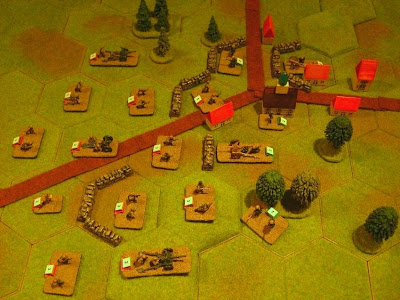
The Russians engaged every German unit within range, with devastating results. The German infantry on the left was wiped out and the German anti-tank artillery unit was destroyed by Russian field artillery fire.

In response the German infantry unit in the wood engaged the Russian infantry unit that was occupying the nearby hill whilst the German mountain artillery unit fired over open sights at the advancing Russians. Unfortunately luck was not with the Germans, whose fire had no effect.
Turn 5

The Germans had the initiative during this turn.

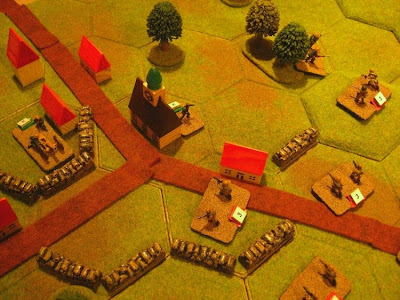
Realising that they were about to be overwhelmed, the German General withdrew his last remaining infantry unit from the wood and into the town in the hope that this would delay the inevitable Russian victory.

The Russian General’s response was predictable – he ordered a full-out advance with the intention of closing on the enemy and destroying them.

The Germans were now fighting for their lives and engaged any Russian units that were within range. The German mountain artillery unit and the infantry unit inflicted no casualties on the Russians but the German General – at the head of his staff and personal bodyguard – repulsed one of the Russian infantry units.

The Russian response was swift and terrible, and no German units survived the combined gunfire of the Russian units that were within range.

Postscript

Once the town and road junction were captured the tank units and their associated infantry units advanced along the road to exploit the breach in the German defences.

Conclusions

The adaptations to the rules seemed to work quite. The play-test took just over two hours including time to do the write-up, and indicated that with a few further adaptations and modifications – possibly to give elite troops an even greater effect and poor quality troops a lesser effect in firefights and Hand-to-Hand combat – it is quite easy use the TABLE TOP BATTLES wargames rules to refight mid-20th century battles on Hexon II hexes.

Wednesday, 31 December 2008

Table Top Battles - Some further thoughts on adapting the rules for mid-20th century warfare

I had hoped that at some time today I would be able to play-test my adaptation of the TABLE TOP BATTLES wargames rules for warfare in the mid-20th century. However the virus I have now had for over a week and the need to prepare for this evening’s festivities have not made that possible. It has, however, given me time to think about what Stand Points Values to give each stand and the weapon ranges I will use.

I intend to allocate Stand Points Values as follows:
  • 1 point: Poor General and Militia Infantry
  • 2 points: Average General, Light Armoured Fighting Vehicles, Conscript Infantry, and Artillery
  • 3 points: Exceptional General, Medium Armoured Fighting Vehicles, Cavalry, and Regular Infantry
  • 4 points: Heavy Armoured Fighting Vehicles and Elite Infantry
I intend to use the following weapon ranges:
  • Infantry Weapons: 2 hexes
  • Armoured Fighting Vehicle Weapons and Anti-tank Artillery: 4 hexes
  • Artillery: 6 hexes
With any luck I should be able to try these ideas out in a play-test tomorrow.

- o 0 o -
After adding this entry to my blog I realised that it was actually the 50th entry I have made since I started ... and I managed to add it on the last day of 2008!

Tuesday, 30 December 2008

Hexon II - Just how much do I own?

As will be obvious from my previous blog entries, I like to use a gridded tabletop in my wargames. I was sold on the idea when I bought my first box of Hexon II some years ago, and since then I have bought more as and when I could afford it (or I could persuade my wife to buy it for me for Christmas and/or my birthday).

Because I am beginning to recover from the virus I have had over Christmas I thought that it would be a good time to sit down and take stock of what Hexon II terrain I own. It also gave me the opportunity to sort it into the IKEA storage boxes I bought some time ago to store it in. I expected that the whole exercise would take me an hour or so … and now – some four hours later – I have a complete list of every bit of Hexon II terrain that I own and it is safely stored in its own fully labelled storage boxes.

What surprised me was the sheer amount that I own. Besides enough basic terrain tiles to cover an area 15’ x 4’ (a box will cover 3’ x 4’ and I have a box each of the Green, Green/Brown, Desert, Desert Transitional, and Blue terrain tiles) I have 19 mountains and rocky outcrops, 28 hills and escarpments, and several feet of streams, rivers, and roads. I also have a trench system and a variety of fortifications.

This stocktaking exercise has convinced me that I must concentrate on developing the TABLE TOP BATTLES wargames rules so that I can use them with my Hexon II terrain.

Sunday, 28 December 2008

Christmas is over ... but the virus remains!

As usual I spent this Christmas at the 'Le Strange Arms Hotel', Old Hunstanton, Norfolk. It is a wonderful hotel with a lot of character, an excellent staff, and more food available than you could ever eat!

Unfortunately my wife and I also succumbed to the virus that is currently laying so many people low in the UK, and this is lingering on now that we have returned home. One effect of this virus is a total lack of physical and mental energy. I just cannot concentrate on anything. This is a great pity as my wife bought me the latest publication by FOUNDRY PUBLICATIONS and I was looking forward to reading it.

The book is ARMIES OF THE 19th CENTURY: THE AMERICAS 1: THE PARAGUAYAN WAR by Terry Hooker. It contains background information about the war, a detailed history of the war, and extensive information about the armies and uniforms of the protagonists. I am sure that it will give me lots of ideas for new wargame armies to collect and battles to fight.