After a bit of a hiatus, THE SECOND PORTABLE WARGAME COMPENDIUM is now available in Kindle format.

Amazon has yet to link this edition to the hardback and softback editions but it can be found here
After a bit of a hiatus, THE SECOND PORTABLE WARGAME COMPENDIUM is now available in Kindle format.
Amazon has yet to link this edition to the hardback and softback editions but it can be found here
It’s just over a week since I decided to do some work on my Eastern Front/Great Patriotic War collection, but since then I’ve made little progress … and the arrival of a copy of Gabriele Esposito’s ARMIES OF THE ITALIAN RISORGIMENTO has rather knocked me off course.
Reading the book gave me loads of ideas for possible imagi-nations set in the period from 1815 to 1850. Furthermore, it gives me a way to use some of the surplus figures from my Napoleonic collection that would otherwise sit in storage boxes. These might require some renovation, varnishing, and rebasing … but that shouldn’t take me too long, and then the fighting can begin!
So, what should I do? I suspect that I’m likely to work on both these projects in parallel for a while, which I know is bit of a cop out on my part … but who cares except me?
The sort of thing that I’m envisaging with regard to any 1815 to 1850 imagi-nations armies I might create would be somewhat akin to my Cordeguayan Civil War of 1820 armies. These fought several battles back in 2011 during the early stages of the development of the PORTABLE WARGAME.

The Presidential Army (led by President-for-Life and General José Santa Maria).

The Constitutionalist Army (led by General Roberto Branco).
Wednesday was another day that didn’t quite go according to plan.
It started whilst I was having my morning shower in the bathroom on the top floor of our house. I was just finishing when Sue called up, ‘Do you know that there is water dripping through the ceiling?’ Resisting the temptation to reply in a sarcastic fashion that of course I did (In truth, I had no idea that there was a problem), I dried myself off as best I could and went down to the first floor … and found that water was indeed dripping through a small crack in the ceiling. It was immediately obvious that there was a problem with the outflow pipe from the shower, and as soon as I was dressed, I phoned our insurers and arranged for them to send a plumber round to fix it on Friday.
As we had planned to do our weekly food shop on Friday, it was obvious that we had to change our plans and do it today. This meant that we had to move what we had planned to do on Thursday to Wednesday … and so after eating a late breakfast at a cafe in nearby Welling and dropping off some electrical goods at the local branch of Emmaus, we went to Lesnes Abbey.
Rather like The Point that Sue and I visited a few weeks ago, Lesnes Abbey is one of those little-known gems that one can find in London. It occupies a position on high ground overlooking the River Thames to the east of London in the London Borough of Bexley. The land was given to Bishop Odo* after the Norman Conquest, and the abbey was founded in 1178 by Richard de Luci, the Chief Justiciar of England. This was probably an act of penance for his role in the conflict between Henry II and Thomas Becket, the Archbishop of Canterbury, which resulted in the latter's murder in 1170 by four of knights. De Luci resigned from his position in 1179 and retired to the abbey. He died there three months later, and he was buried in the abbey’s Chapterhouse.
The abbey was one of the first to be closed when Henry VIII authorised the dissolution of the monasteries. Despite owning quite a large amount of land, it never been a rich establishment, and after its closure in 1525 almost all of its buildings were demolished by 1534. The land then passed through the hands of several owners until 1633, when it was bequeathed to Christ’s Hospital. The site was bought by the London County Council in 1930 and opened as a public park a year later, and it is now owned and run by the London Borough of Bexley.
The location of Lesnes Abbey and its layout

A map of the park in which Lesnes Abbey is located. Click on the map to enlarge it.

An artist's impression of what the exterior of the abbey would have looked like. Click on the image to enlarge it.

An artist's impression of what the interior of the abbey church would have looked like. Click on the image to enlarge it.

A floor plan of the abbey. Click on the image to enlarge it.
The ruins of the abbey


The abbey site also boasts a lookout point from which you can look out over London, ...


... a mulberry tree (which is very similar to the one at Charlton House!), ...

... and a carved statue of a monk.

Sue and I had a great time at Lesnes Abbey, and we will no doubt return there again in the future.
* Bishop Odo was William the Conqueror’s half-brother and was probably the second most powerful person in England after the Conquest.
A copy of ARMIES OF THE ITALIAN RISORGIMENTO (which was written by by Gabriele Esposito) was sent to me by Arthur Harman, who well knows my interest in the less well-known wars of the nineteenth century. Having read through it, I realised that it was a mine of information for both serious military historians and wargamers, and in the latter case, particularly for those whose interests lie in the direction of small campaigns and/or imagi-nations.

There are quite a few very obscure military units mentioned in the text and/or illustrated using some of the numerous contemporary, coloured plates in the book. For example, where else would I have been able to read anything about the Volontari Ecclesiastica Siciliana (Sicilian Ecclesiastical Volunteers)? These were a group of Sicilian clerics and priests who fought with Garibaldi's troops and who wore an all-black uniform that combined elements of clerical and military dress, topped off with a black Phrygian or Liberty Cap that was adorned by a large rosette in the colours of the Italian flag!
The book's contents include:
I have already had several hours of enjoyable reading from this book, and I suspect that this book will be the source of several ideas for future projects.
ARMIES OF THE ITALIAN RISORGIMENTO was written by by Gabriele Esposito and published in 2022 by MMP Books (ISBN 978 83 66549 95 1).
I had plans for the past weekend, but in the end, they pretty well came to nought.
It started on Saturday morning. I had planned to spend Saturday sorting out which bits of my Eastern Front/Great Patriotic War collection needed to be worked on first, but over breakfast my wife told me that she wanted us to go the the local branch of Lidl to buy a double air fryer that was on special offer. In the end our ‘quick’ shopping trip turned into something altogether different, and we ended up leaving Lidl with a trolley full of stuff … including the double air fryer.
By the time we had unpacked everything that we had bought and installed the new air fryer in place of our old one, it was time for lunch. After lunch I spent an hour and a half labelling the envelopes that THE NUGGET will be posted out in, fixing second class stamps to those going to UK addresses, and then putting copies of the latest issue on the magazine into them. By then it was time to do some gardening I had promised to do, and it wasn’t until the late afternoon that I began sorting out my Eastern Front/Great Patriotic War collection.
I’d been working on this for about an hour when the doorbell went, and a courier delivered a book about the armies of the Risorgimento that had been sent to me by Arthur Harman. As a result I spent the rest of the afternoon reading the book (which I will review in due course) and did not return to my planned task.
On Sunday morning I attended an online meeting of the Wargame Developments committee, where the details of the forthcoming COW2023 (Conference of Wargamers) were finalised. As soon as my part had ended, I made my apologies and took Sue to Severndroog Castle, where a producer's market was due to take place. We parked our car on Shooters Hill and walked through Oxleas and Castle Woods to the Castle ... only to find that the market appeared to have been cancelled. This rather threw our plans for the day into some disarray as we had expected to buy lunch from one of the market stalls. As a result, we drove to Welling and bought lunch there.
By the time we had eaten, done some shopping, and returned home, it was already after 1.00pm. I still needed to complete some of the gardening tasks I had promised to do over the weekend, and these took me just over thirty minutes, by which time I was in need of a refreshing drink and a sit down. (I'm not as young as I used to be, and working in the garden on a warm day rather takes it out of me!)
The 'short' break for refreshment and a rest turned into a doze, and by the time I woke up, the early afternoon had slipped by and I decided that I really ought to do some of my planned sorting out. However, when I got up to my toy/wargame room on the top floor of our house, it was very hot, and even with the windows open and the fan going I only managed to stick at it for about thirty minutes, by which time I was in need of another drink.
Whilst I had been upstairs, Sue had been finishing off the online check-in for our next cruise, and before I could return downstairs, she called me on our internal phoneline and asked me to log on and print off our boarding passes and luggage labels. This took longer than expected because the printer need to have a new colour ink cartridge installed. I eventually completed this 'simple' task and made my way downstairs ... by which time it was almost time for afternoon tea. For once, afternoon tea did not comprise tea and cakes: instead, Sue and I each had a large bowl of fruit salad. It was very refreshing and a lot healthier.
All the time I had been gardening and sorting out the inkjet printer, I kept thinking about the contents of the book Arthur Harman had sent me. The uniforms were from that period when the Napoleonic shako-and-tailcoat style had gradually evolved into the kepi or helmet and jacket style of the late ninetieth and early twentieth century. Not quite the same as those of the Belle Époque, but not all that different ... and I kept thinking about the RISK figures that I had bought to photograph for THE SECOND PORTABLE WARGAME COMPENDIUM.

The replacement RISK figures that I bought from the United States. They are approximately 15mm scale and are made of hard plastic.
Mark Cordone had used these figures to create some very nice armies and it struck me that I could copy his example ...

Mark Cordone's Waterloo French Army. © Mark Cordone.

Mark Cordone's Waterloo Anglo-Dutch/Allied Army. © Mark Cordone.

Mark Cordone's Waterloo Prussian Army. © Mark Cordone.
The end result of all of this is that I have yet to make very much progress in sorting out my Eastern Front/Great Patriotic War collection and I am in danger of being diverted towards working on a new project. In other words, I'm experiencing a typical wargamer's dilemma!
Yet again our printer – Macaulay Scott Printing Company of Welling, Kent – has done an excellent job of printing, collating, folding, and stapling the latest issue of THE NUGGET, and as a result I was able to collect it from them yesterday. I hope to be able to post it out to members by Monday. In the meantime, members can read this issue online.

IMPORTANT: Please note that this is the ninth and last issue of THE NUGGET to be published for the 2022-2023 subscription year. If you have not yet re-subscribed, a reminder was sent to you some time ago. If you wish to re-subscribe, please follow the instructions on the relevant page of the website.

Before adding more renovated, varnished, and rebased figures and vehicles to my Eastern Front/Great Patriotic War collection, I decide to survey what I had already got ... and this is what I currently have organised in formations:
German
Hungarian
Russian
They are all currently configured to be used with the modern version (i.e. the World War II version) of the PORTABLE WARGAME rules as published in DEVELOPING THE PORTABLE WARGAME, but in the light of recent development they may be reorganised somewhat.
For sometime I’ve been working on and off on my Belle Époque project, but since work on the Second PW Compendium is almost over, I feel the need to have a change of project to keep my wargaming interest fresh.
Back during the COVID pandemic lockdown I did a lot of work on my Eastern Front/Great Patriotic War project, and I’ve decided to return to it for a time.

Some of the German vehicles that I renovated, varnished, and rebased during the COVID pandemic.
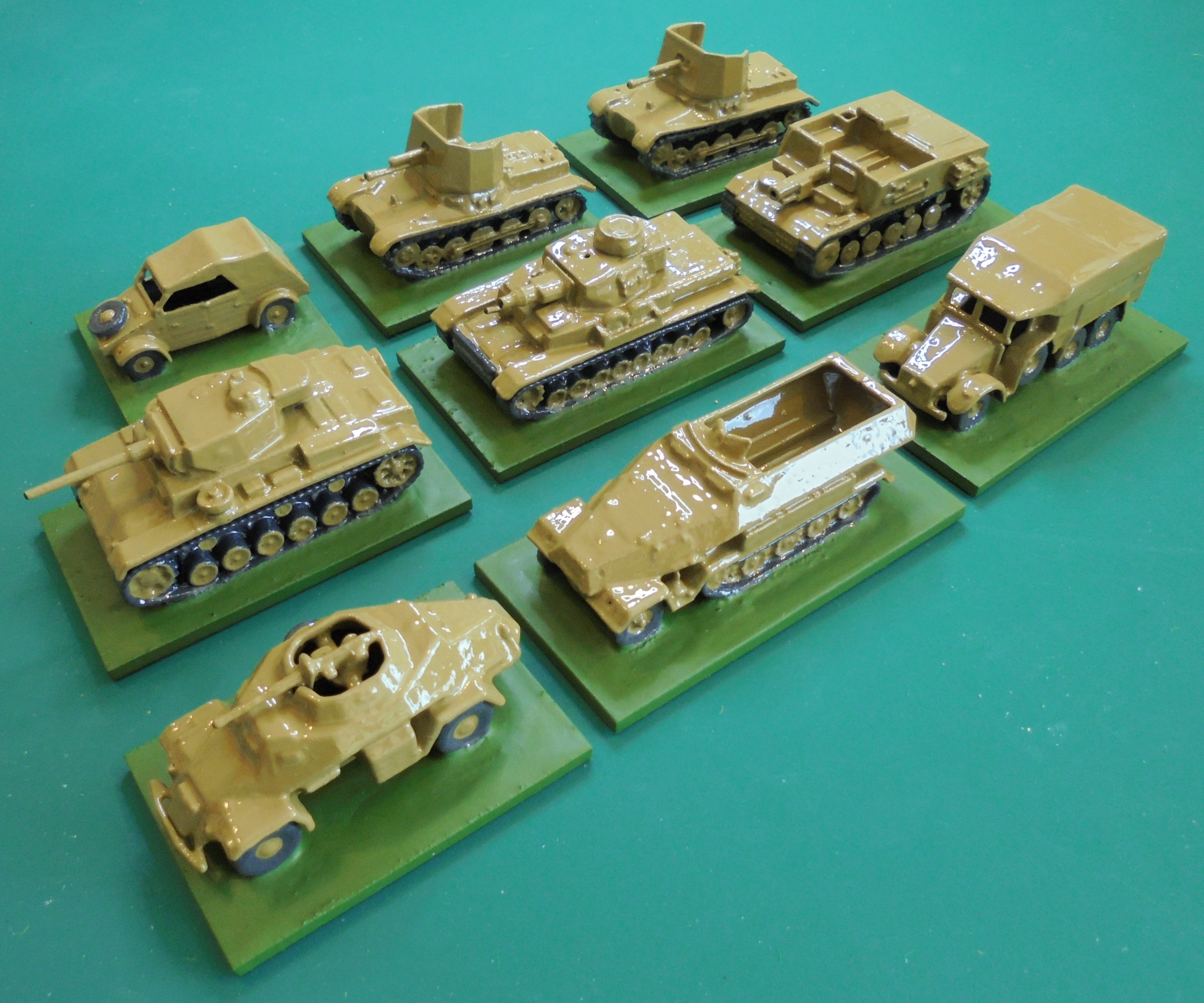
Some more of the German vehicles that I renovated, varnished, and rebased during the COVID pandemic.
I might even manage to fight a few battles with the figures I’ve already renovated, varnished, and rebased as well as add some more of the collection ... so watch this space for developments!
Over the Bank Holiday weekend, the editor of THE NUGGET sent me the latest issue of the journal and I sent it to the printer yesterday. I hope that it will be ready to be posted out to members by Friday so that they will be able to read it after next weekend.

IMPORTANT: Please note that this is the ninth and last issue of THE NUGGET to be published for the 2022-2023 subscription year. If you have not yet re-subscribed, a reminder was sent to you some time ago. If you wish to re-subscribe, please follow the instructions on the relevant page of the website.
An Amazon delivery driver brought me this year's issue of WARSHIP on Thursday, and over the weekend I spent several very enjoyable hours reading it.

I have been buying this publication since 1977, when it started life as a quarterly softback magazine. It became a hardback annual in 1989, and the original softback issues were then re-bound and sold in hardback format, with four quartlerly issues in each volume. They form the backbone of my naval history and warship design collection and currently occupy well over a metre of my bookshelves.
This issue was edited by John Jordan, and contains the following article:
There is a lot of interesting stuff in this year's annual but one particular article stands out as being of more interest to me than the others ... The German Flak Ships Part 1: The German and ex-Norwegian hulls. I have written several blog posts about this topic as well as mentioning them in a guest blog post on THE DAWLISH CHRONICLES website.
This is a book that I know that I will return to many, many times in the future for both information and inspiration.
WARSHIP 2023 was edited by John Jordan and published in 2023 by Osprey Publishing (ISBN 978 1 4728 5713 2).


